
Quick Answer
sterile vs living root zone home hydroponics is a philosophy choice: run an inert, frequently sanitized system, or cultivate a microbe-friendly bioponic approach with compatible inputs. Problems start when growers mix bleach-level hygiene habits with organic teas—or expect “beneficials” to rescue a warm, dirty tank.
Compare paths with cleaning/sterilizing, organic/bioponic, beneficial bacteria, biofilm, and peroxide uses/risks.
Key takeaways for sterile vs living root zone home hydroponics
- Sterile vs living root zone hydroponics only works when habits match the chosen lane.
- Sanitized inert systems favor mineral nutrients, light-proof reservoirs, and reset discipline.
- Living/bioponic lanes need oxygen, cooler temps, and patience—not random sterilants.
- UF/IFAS and extension sanitation habits still apply to food crops in either lane.
- Original rule: pick a lane for the whole loop—do not bleach on Monday and compost-tea on Tuesday.
- Sterile vs living root zone hydroponics fails when biofilm is ignored in “sterile” tanks.
- Beneficial products are not a substitute for cool roots and clean intakes.
- Write your lane on the reservoir lid so helpers do not “help” with the wrong cleaner.
Related HydroponicEra guides

Why the Philosophy Matters

sterile vs living root zone home hydroponics is about compatible routines. A sterile-leaning home system emphasizes between-crop sanitation, mineral feeds, and rapid response to slime. A living-leaning system accepts managed biology, often with organic or hybrid inputs, and avoids broad sterilants that wipe the community you are trying to keep.
Neither lane is morally superior. Mismatched habits are what kill roots. Extension food-safety and greenhouse hygiene materials remind growers that edible crops still need clean handling regardless of philosophy.
Lane Comparison

| Lane | Fits | Conflicts |
|---|---|---|
| Sterile / inert | Beginners using complete mineral lines | Heavy organic additives, “never clean” culture |
| Living / bioponic | Growers willing to manage biology + smell triage | Routine harsh sterilant dumps mid-cycle |
| Hybrid (advanced) | Clear SOPs for when biology is reset | Improvisation without notes |
| No lane declared | Chaos | Everything |
Step-by-Step Choose-and-Commit
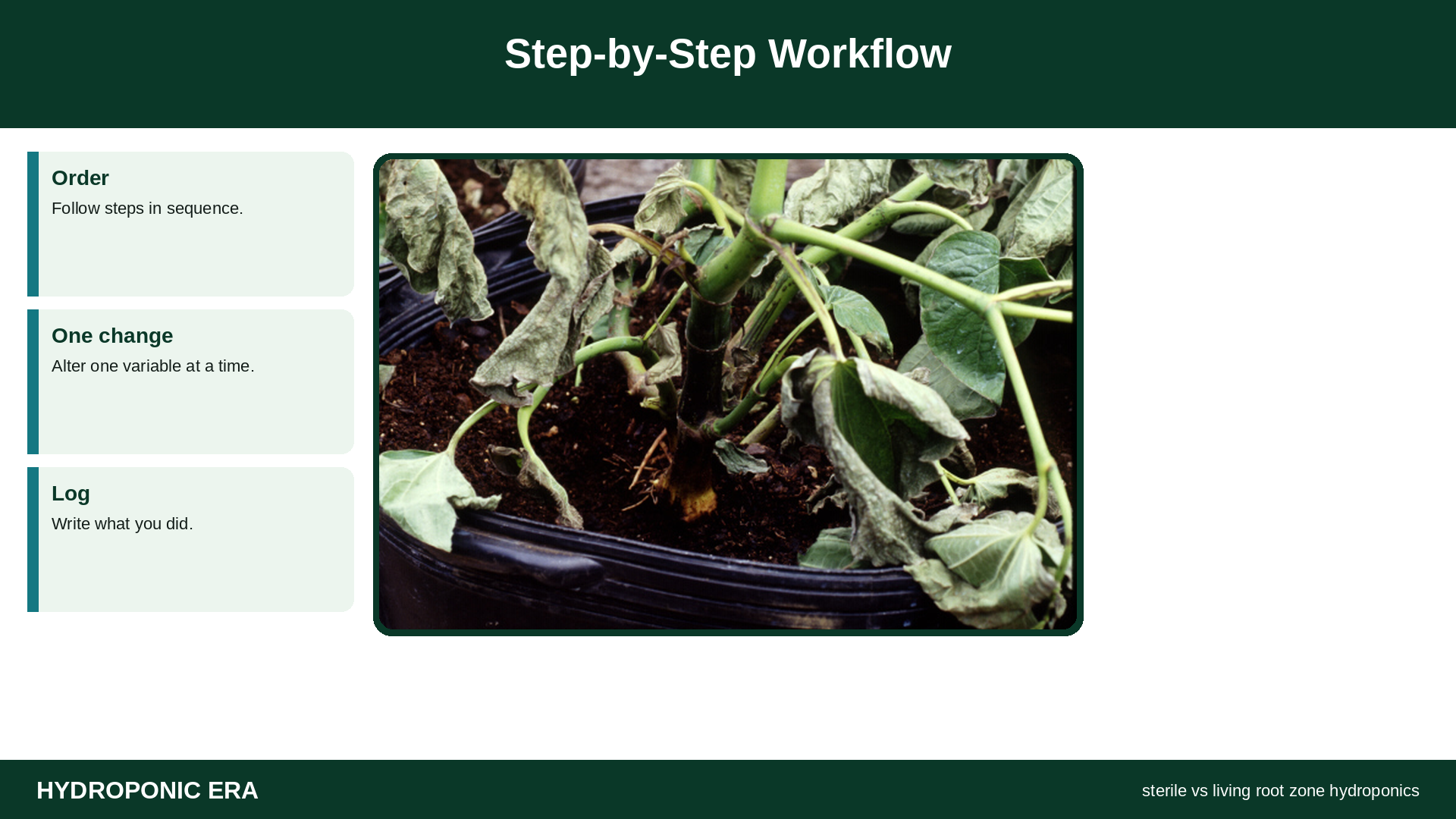
- Write your goal: simplest mineral DWC vs organic curiosity vs hybrid.
- Inventory cleaners and additives already on the shelf—retire conflicts.
- If sterile-leaning: set a clean/reset calendar (cleaning).
- If living-leaning: prioritize DO, temperature, and smell checks (DO, foam/smell).
- Label the reservoir with the lane and allowed inputs.
- Train anyone who helps: which bottle is never dumped “just in case.”
- Scout biofilm under lids weekly in both lanes.
- After a disease event, decide reset intensity that matches your lane.
- Do not market your greens as something your process is not.
- Keep food-handling hygiene either way (food safety).
Variables
| Variable | Effect | Link |
|---|---|---|
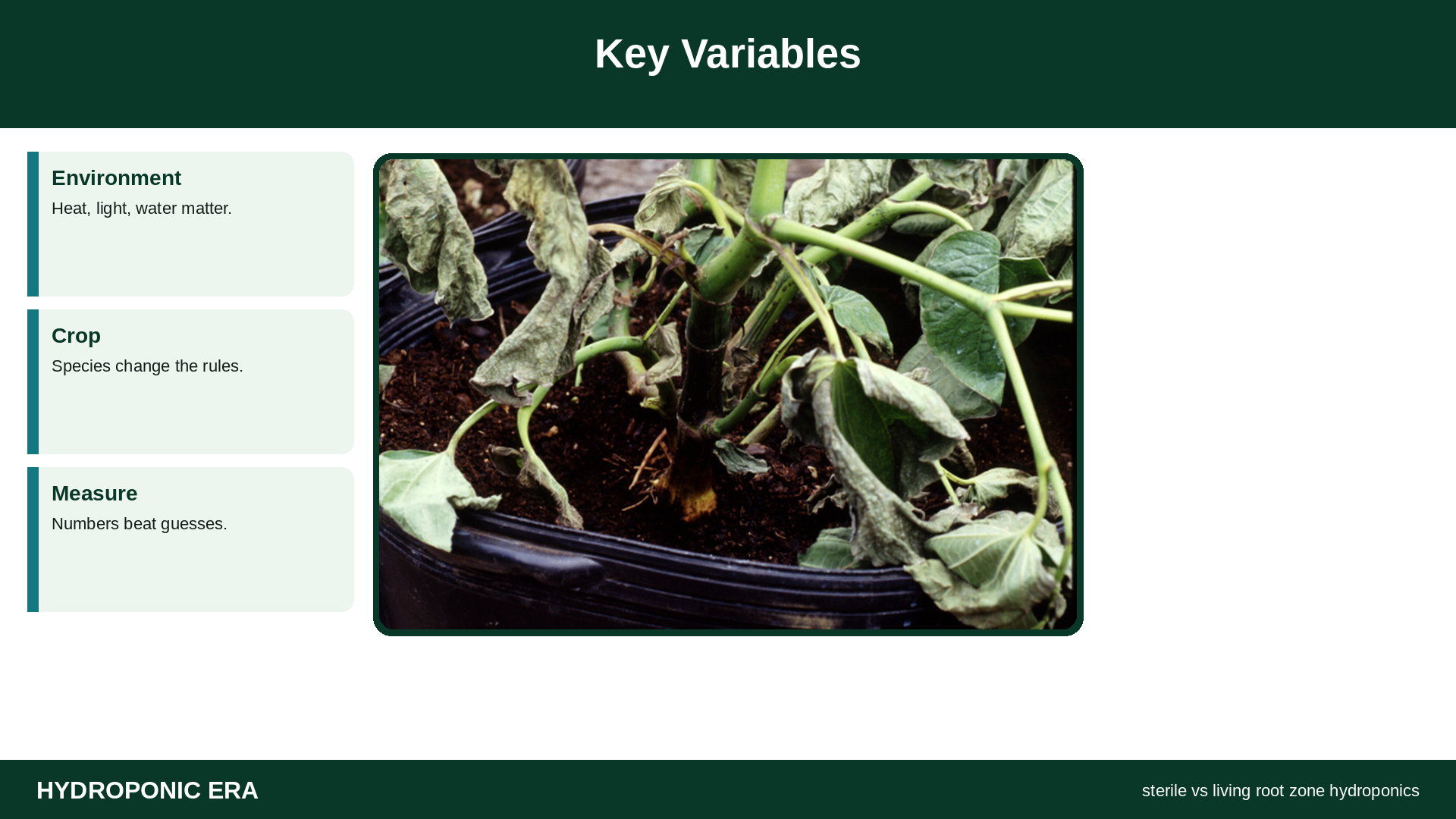
| Reservoir temperature | Warm favors unwanted biology | res temp |
| Light leaks | Algae complicates both lanes | algae |
| Input type | Organics change oxygen demand | organics |
| Crop risk tolerance | High-value canopy → stricter hygiene | food safety |
Common mistakes with sterile vs living root zone home hydroponics
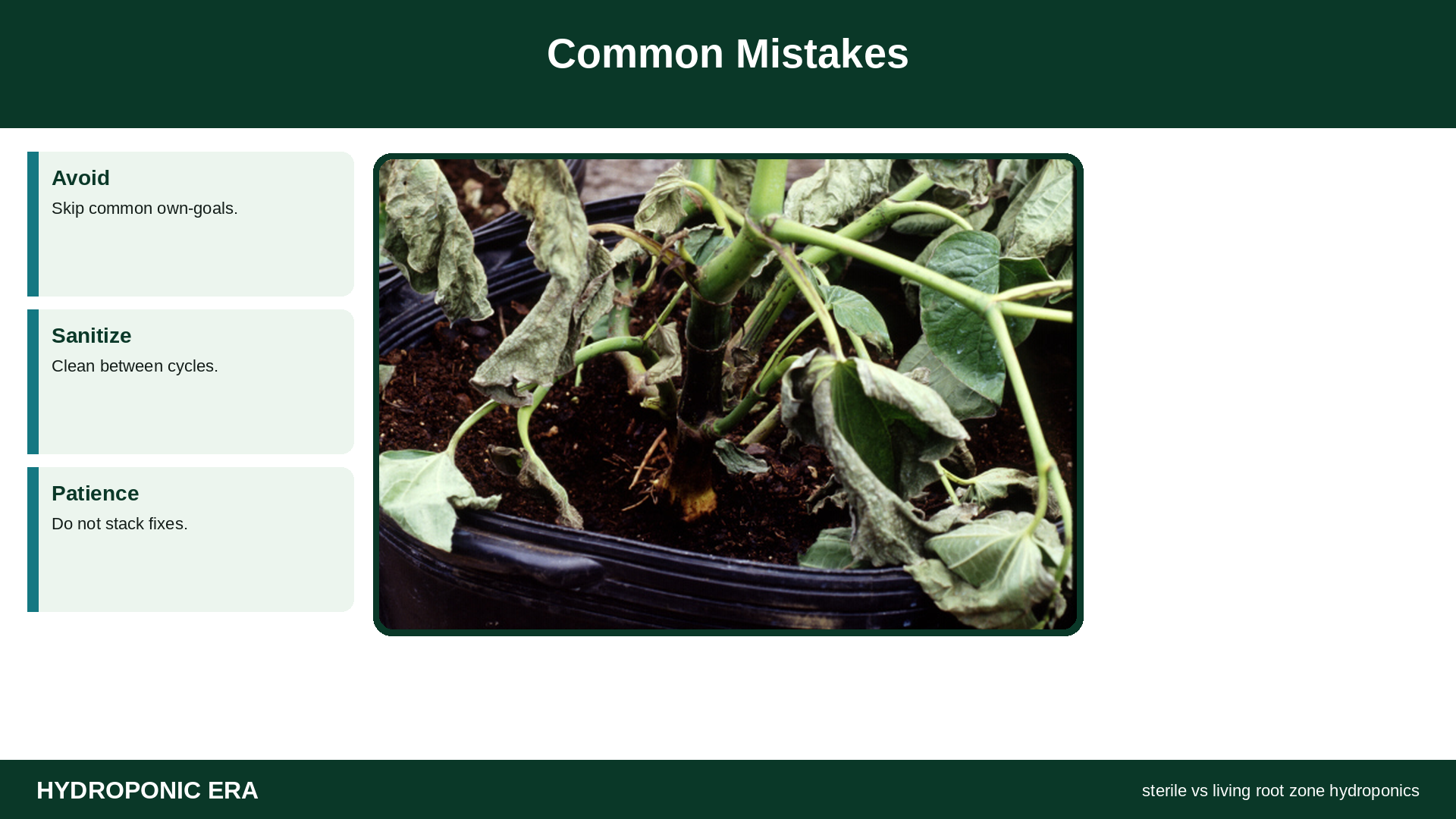
- Bleach + beneficial tea in the same week
- Calling a slimy tank “living soil energy”
- Never cleaning because “sterile means I used RO once”
- Using peroxide daily until roots look cooked
- Mixing lanes across shared tools without rinse
- Ignoring lid films because the water “looks clear”
Troubleshooting
| Signal | Lane hint |
|---|---|
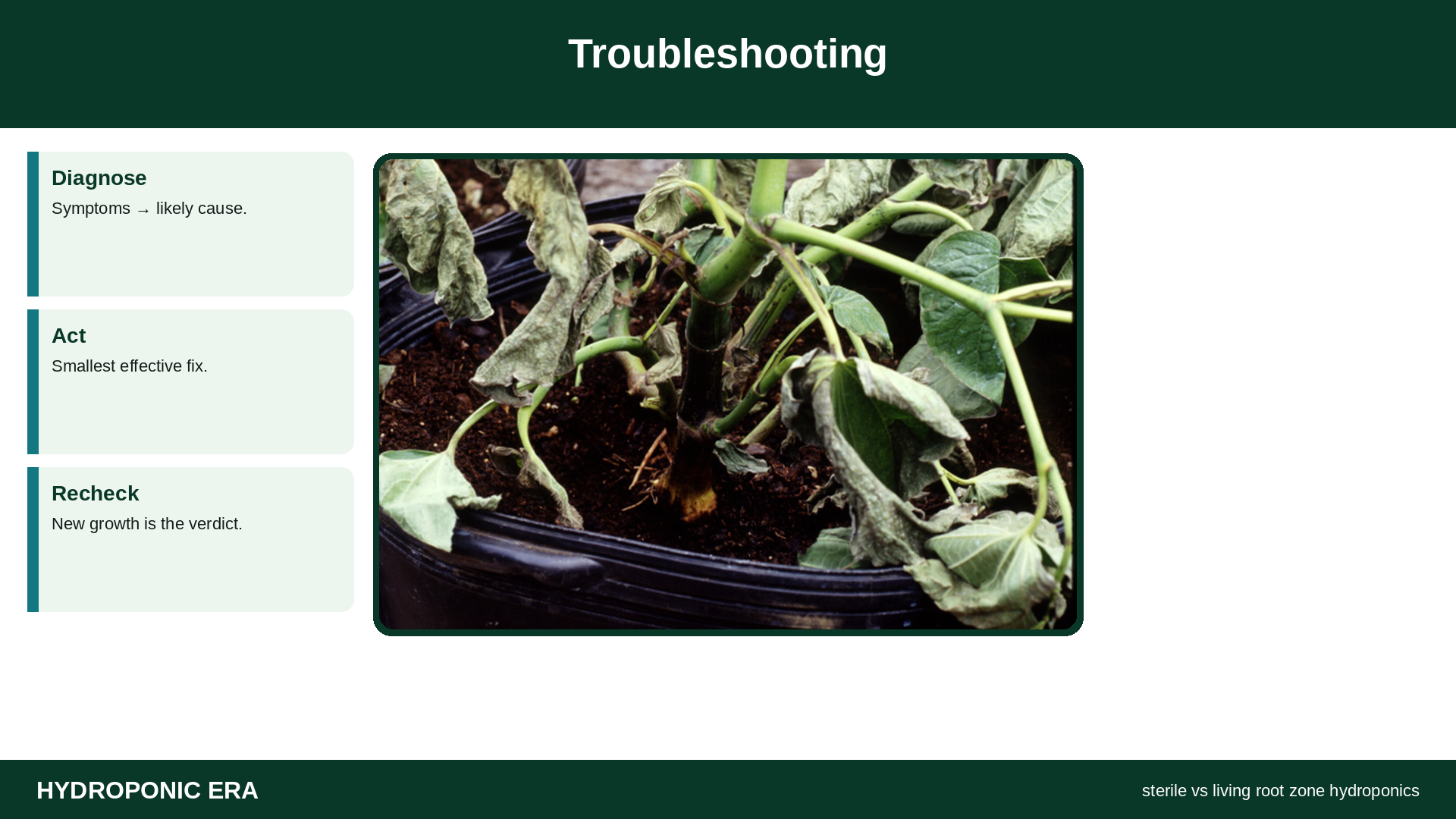
| Sour smell + brown roots | Reset; see brown roots, pythium |
| Cloud after organic add | cloudy, oxygen, temp |
| Repeated collapses after “sterile” claims | Hygiene theater—scrub biofilms |
| Stable mineral system, no slime | Stay the course; do not add chaos inputs |
Original Framework: Lane Label

Lid sticker: LANE: STERILE or LANE: LIVING + allowed cleaners/inputs list. If you cannot label it, you do not have a philosophy—you have improvisation.
Closing practice for sterile vs living root zone hydroponics: compatibility beats ideology.
What to Check Before You Commit to a Root-Zone Lane
- Lane written on lid?
- Conflicting bottles removed?
- DO/temp plan matches lane?
- Biofilm scout scheduled?
- Food handling SOP ready?
- Shared tools rinsed between systems?
Picking a Lane and Staying There
Sterile vs living root zone hydroponics drama usually comes from mixing philosophies mid-cycle: enzymes one day, harsh oxidizers the next, compost tea after a bleach clean. Choose a lane. Mineral sterile-leaning systems emphasize cleanliness, cool reservoirs, and disciplined water changes. Living/bioponic-leaning systems need oxygen, gentle handling, and patience with cloudiness that is biological rather than precipitated salts.
If you switch lanes, reset: clean, refill, and restart biology or sterility on purpose. See beneficials, peroxide risks, cleaning, and organics.
Diagnostics That Respect the Lane
Smell, root color, and filters tell truth. Sour anaerobic smells are emergencies in either lane. White healthy roots with mild earthy scent can be normal in living systems; the same film in a “sterile” DWC may mean you already left the lane. Log products you add—mystery stacks make sterile vs living root zone hydroponics impossible to debug.
Sterile vs Living Root Zone Hydroponics: Product Audit Habit
Once a month, list every bottle that touched the reservoir. If the list includes bleach-level cleansers, aggressive oxidizers, and living inoculants in the same crop cycle, you do not have a lane—you have a conflict. Pick sanitation products that match the philosophy, and schedule full resets when switching.
Living lanes still need oxygen and cool roots; sterile lanes still need complete nutrition. Neither excuses ignoring pythium, dissolved oxygen, or slimy anaerobic corners. Write the lane on the lid so helpers do not “help” with the wrong bottle.
FAQs about sterile vs living root zone home hydroponics

Which lane is best for beginners?
Most beginners succeed faster on mineral + clean resets.
Can I switch lanes mid-grow?
Prefer waiting for a full reset between crops.
Are beneficials mandatory?
No—many clean mineral systems run well without them.
Are organics “more natural” automatically safer?
Not automatically—manage oxygen, smell, and food hygiene.
Is peroxide sterile-lane friendly?
It is a tool with risks; see the peroxide guide—do not drown roots.
What about aquaponics?
Different system class; do not copy-paste bleach habits into fish loops.
Extended Home-Grower Walkthrough
Use this extended walkthrough as a second pass after the Quick Answer. Walk the system with a notebook: write the date, crop, EC, pH, reservoir temperature, and one observation about roots or leaves. Change only one control at a time when a problem appears. If last week’s fix did not show in new growth, revert and try the next smallest lever. Keep university and extension principles in mind—oxygen, sanitation, and measured nutrition beat product stacking.
Photograph the canopy and the reservoir surface weekly. Dated photos settle arguments about algae, tip burn, or stretch faster than memory. When a helper waters for you, leave a one-page card with do-not-touch items and the exact top-off rule. Store calibration sachets next to the meters so “I will calibrate later” stops being the default. Review timers after any power event. Confirm air stones still roar. Confirm drains still drain.
At the end of the week, score the cycle 1–5 for ease and plant quality. Low scores should trigger a sanitation or climate review before you buy new hardware. Link neighboring HydroponicEra guides when the symptom matches a cluster page. Prefer labeled procedures over improvisation under stress. Healthy boring routines are the real upgrade path for home hydroponics.
Keep sterile vs living root zone home hydroponics on your ops card so helpers follow one standard.
Keep sterile vs living root zone home hydroponics on your ops card so helpers follow one standard.
Keep sterile vs living root zone home hydroponics on your ops card so helpers follow one standard.
Keep sterile vs living root zone home hydroponics on your ops card so helpers follow one standard.
Keep sterile vs living root zone home hydroponics on your ops card so helpers follow one standard.
Keep sterile vs living root zone home hydroponics on your ops card so helpers follow one standard.
Review sterile vs living root zone home hydroponics whenever you change crop, climate, or water source.
Review sterile vs living root zone home hydroponics whenever you change crop, climate, or water source.
Review sterile vs living root zone home hydroponics whenever you change crop, climate, or water source.
Review sterile vs living root zone home hydroponics whenever you change crop, climate, or water source.
Review sterile vs living root zone home hydroponics whenever you change crop, climate, or water source.
Review sterile vs living root zone home hydroponics whenever you change crop, climate, or water source.
Sources
- University of Florida IFAS — HS1421: Growing Herbs in Small Hydroponic Systems
- University of Florida IFAS — HS184: Building a Floating Hydroponic Garden
- Oklahoma State University Extension — Hydroponics
- University of Kentucky Greenhouse Horticulture — Root disease management in hydroponic systems (PDF)
- Ohio State University Extension — HYG-1132 Food safety / produce handling
- Penn State Extension — Hydroponics Systems and Principles of Plant Nutrition
1 thought on “Sterile vs Living Root-Zone Philosophy for Home Growers”