
The best hydroponic nutrients are complete, water-soluble formulas made for soilless growing, meaning they supply calcium, magnesium and chelated micronutrients, not just N-P-K. For most US home growers, General Hydroponics Flora Series is the most flexible pick, Masterblend 4-18-38 with calcium nitrate and Epsom salt is the budget pick, and the FoxFarm hydro trio suits growers who want a brand schedule.
| Grower type | Our pick | Why |
|---|---|---|
| All-around home grower | General Hydroponics Flora Series | Three parts you can adjust from seedling to fruit |
| Budget leafy greens or tomatoes | Masterblend 4-18-38 + calcium nitrate + Epsom salt | Low cost per gallon, simple dry salts |
| Wants a brand week-by-week schedule | FoxFarm Grow Big Hydro, Big Bloom, Tiger Bloom | Detailed feeding schedule with EC targets |
| Countertop kit owner | The kit maker’s own nutrient, or a complete hydro formula at reduced strength | Small reservoirs need gentle, measured doses |
| Organic-minded grower | OMRI-listed hydro products, with care | Possible, but harder to keep stable |
| Advanced or DIY grower | Custom salt recipe | Full control over every element |
| Anyone tempted by garden fertilizer | Skip it as a main nutrient | Often missing calcium and magnesium |
How we chose the best hydroponic nutrients: we compared labels, official feed charts and Penn State Extension guidance on nutrient programs. We did not run side-by-side yield trials, so treat these as informed starting points, not lab rankings.
What Makes the Best Hydroponic Nutrients?
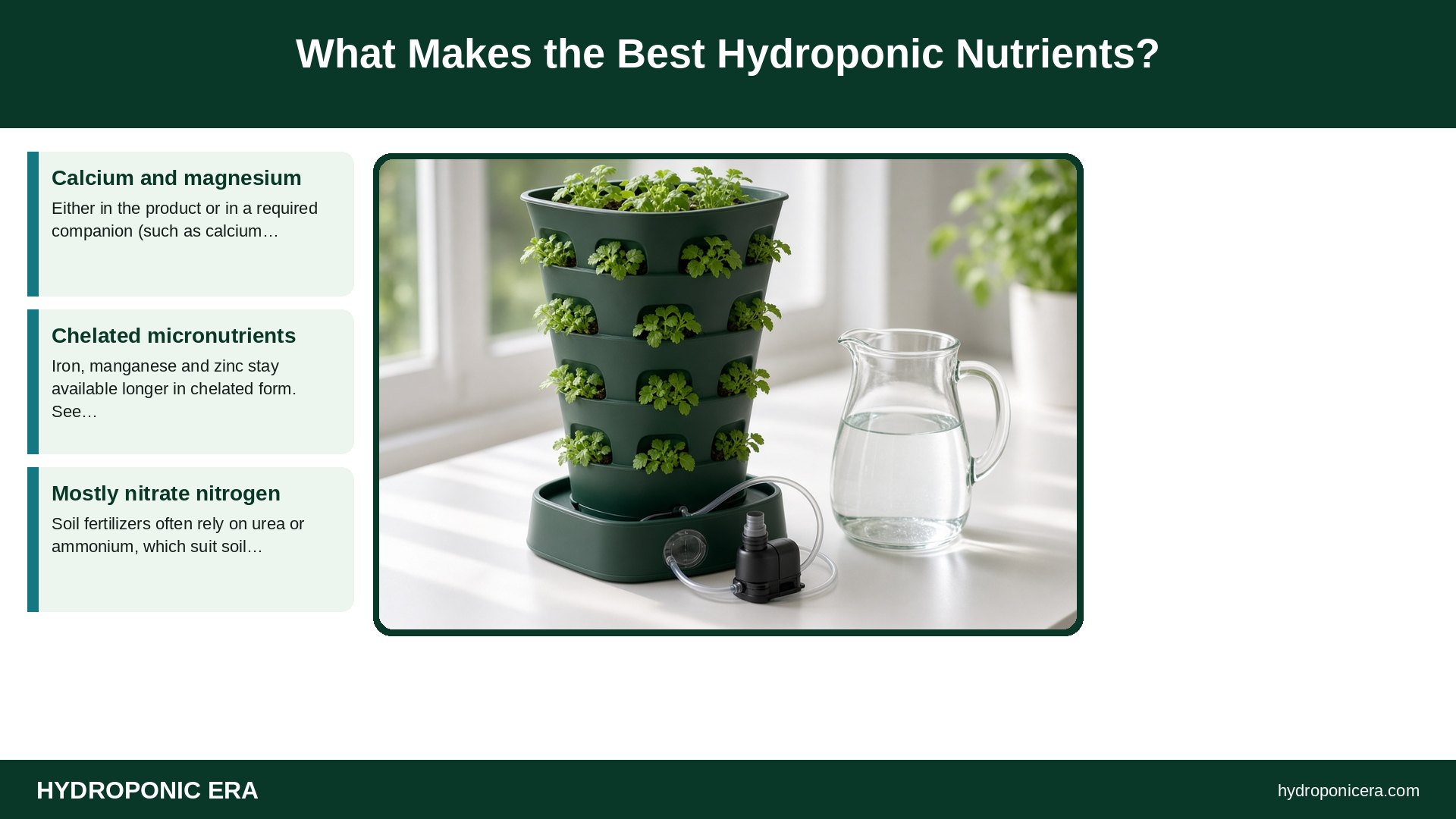
In hydroponics the nutrient solution is the plant’s only food source. Penn State Extension describes three ways to build one: buy a fertilizer program (a base fertilizer plus specific add-ons), use a single complete fertilizer, or mix your own recipe from individual salts. It also warns that a complete fertilizer used alone may not provide proper balance, and that magnesium and calcium may not be included.
So, when you shop for the best hydroponic nutrients, look for:
- Calcium and magnesium. Either in the product or in a required companion (such as calcium nitrate and Epsom salt).
- Chelated micronutrients. Iron, manganese and zinc stay available longer in chelated form. See chelated vs non-chelated micros.
- Mostly nitrate nitrogen. Soil fertilizers often rely on urea or ammonium, which suit soil microbes better than a reservoir.
- A clear feed chart. Doses in milliliters or grams per gallon, ideally with EC targets.
- Full solubility. Powders should dissolve without sludge.
Which Are the Best Hydroponic Nutrients for Each Grower?
1. General Hydroponics Flora Series: best all-around
FloraMicro, FloraGro and FloraBloom are mixed in different ratios as plants move from seedling to bloom. The official chart lists doses in milliliters per gallon for each stage. It costs more per gallon than dry salts, but it’s forgiving and widely sold at US hydroponic stores. Read our Flora Series feeding chart guide.
2. Masterblend 4-18-38 kit: best budget pick
Masterblend’s directions combine its 4-18-38 base with calcium nitrate and magnesium sulfate (Epsom salt). Penn State Extension uses a nearly identical 4-18-38 program as its example of a hydroponic fertilizer program. Dry salts are cheap per gallon and store well. Read our Masterblend 4-18-38 recipe.
3. FoxFarm hydro trio: best brand schedule
Grow Big Hydroponic (3-2-6) is labeled for vegetative growth in hydroponic systems at 2 teaspoons (10 mL) per gallon with each reservoir change, and FoxFarm says to switch to Tiger Bloom (2-8-4) and Big Bloom when flowering starts, usually around week 5. See our FoxFarm hydroponic feeding schedule.
4. Kit-brand nutrients: best for countertop gardens
Small kits have tiny reservoirs, so dosing matters more than the brand name; even the best hydroponic nutrients can burn plants at the wrong strength. The maker’s own nutrient is the simplest choice. A complete hydro formula at reduced strength can work if you measure EC.
5. Organic options: possible, with trade-offs
Organic inputs can clog pumps, feed biofilm and swing pH. FoxFarm’s Big Bloom, for example, is OMRI Listed, but it isn’t a complete stand-alone solution. Read organic and bioponic nutrients before you switch.
6. Custom salt recipes: best for advanced growers
Mixing individual salts gives total control and the lowest cost, but it needs a scale and careful math. Penn State Extension notes that in concentrated stock tanks, calcium should go in a different tank than phosphates and sulfates.
7. Garden-store fertilizer: not one of the best hydroponic nutrients
All-purpose soil fertilizers are designed around soil. Many lack calcium and magnesium and lean on urea. See Miracle Gro hydroponics for the full verdict.
How Do You Choose One-Part, Two-Part or Three-Part?
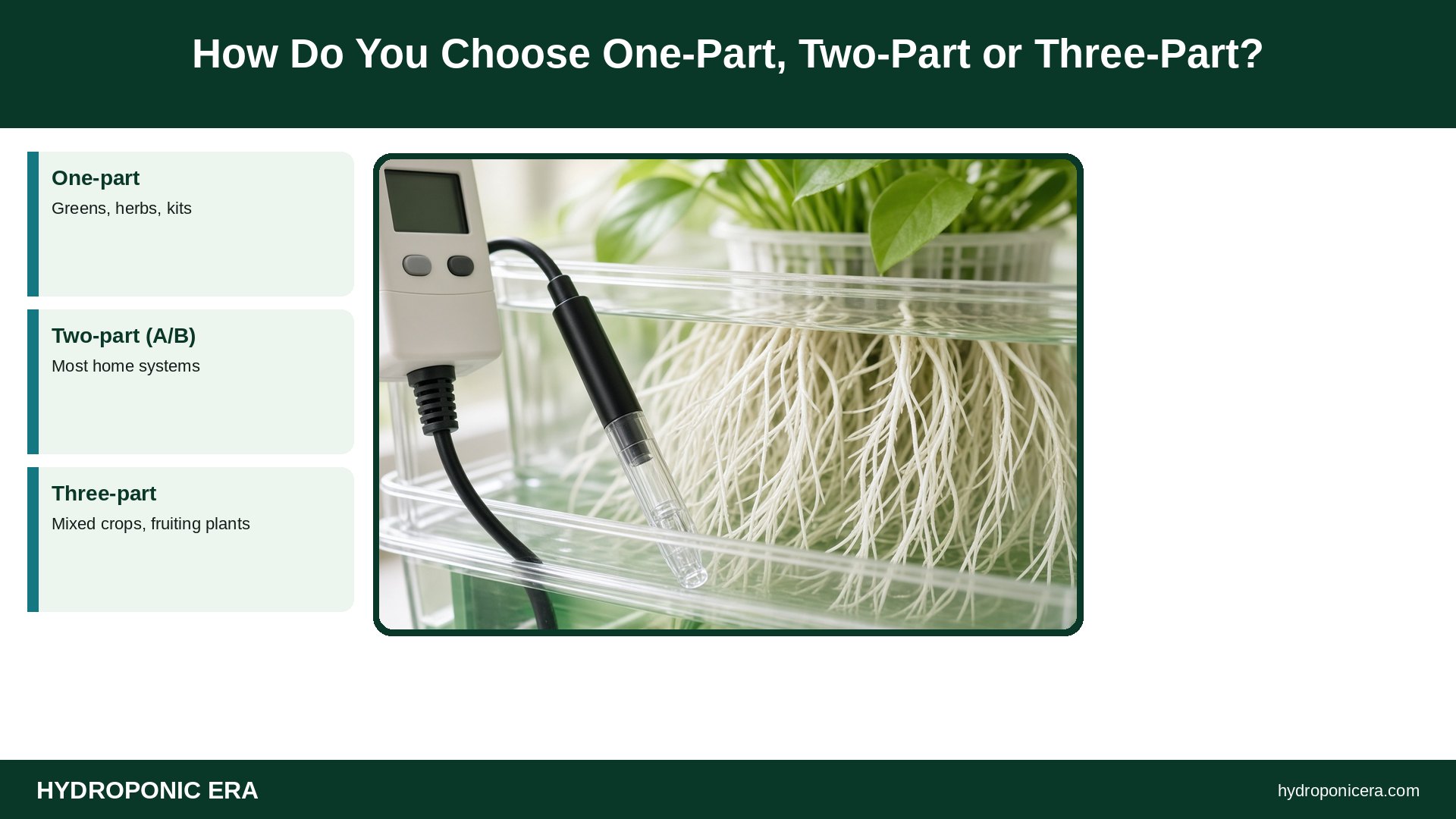
| Type | Pros | Cons | Best for |
|---|---|---|---|
| One-part | Simplest to mix | Less control by stage | Greens, herbs, kits |
| Two-part (A/B) | Keeps calcium apart from sulfates and phosphates in concentrate | Two bottles to measure | Most home systems |
| Three-part | Adjust ratios from seedling to bloom | More math and more bottles | Mixed crops, fruiting plants |
Our one-part vs two-part vs three-part nutrients guide covers this in depth.
How Do You Use the Best Hydroponic Nutrients Correctly?

- Test your water first. Know the starting EC and hardness. See starting EC baseline.
- Fill the reservoir with water before adding anything.
- Add parts one at a time and stir between each. Never mix concentrates together. See nutrient mixing order.
- Start at half to three-quarter strength for seedlings and young greens.
- Check EC and pH. Most crops do well around pH 5.5 to 6.5. FoxFarm’s hydroponic labels, for example, call for pH 5.8 to 6.3. See how to control pH.
- Top off with water, then change the solution regularly. See how often to change hydroponic water.
What Mistakes Waste Even the Best Hydroponic Nutrients?

| Mistake | Result | Fix |
|---|---|---|
| Mixing concentrates together | Cloudy solution, locked-out calcium | Add each part to water separately |
| Following the bottle, ignoring EC | Burned or hungry plants | Feed to an EC target for your crop |
| Skipping calcium nitrate in a 4-18-38 program | Tip burn, blossom end rot | Always use all three components |
| Brand hopping mid-crop | Hard-to-diagnose problems | Change between crops, not during |
| Adding every bottle on the shelf | Salt buildup, wasted money | Start with the base nutrients only |
FAQs About the Best Hydroponic Nutrients
What are the best hydroponic nutrients for beginners?
A complete liquid like General Hydroponics Flora Series, or the nutrient made for your kit. Both come with clear charts.
Which of the best hydroponic nutrients costs the least?
Dry salt programs like Masterblend 4-18-38 with calcium nitrate and Epsom salt usually cost the least per gallon.
Are the best hydroponic nutrients different for lettuce and tomatoes?
The base can be the same, but fruiting crops need more potassium and higher EC in bloom. See leafy vs fruiting recipes.
Do I need Cal-Mag?
Only if your base nutrient or water is low in calcium and magnesium, or you use RO water. See calcium and magnesium deficiency.
How long does mixed nutrient solution last?
Most home growers change it every one to three weeks. See stale nutrient solution.
Related HydroponicEra Guides
Sources
- Penn State Extension — Hydroponics Systems: Nutrient Solution Programs and Recipes
- General Hydroponics — FloraSeries
- Masterblend — Masterblend International
- FoxFarm — Grow Big Hydroponic Liquid Plant Food
- FoxFarm — Feeding Schedules