
You can use bleach in hydroponics, but mainly as a cleaner and disinfectant between crops, not as a routine nutrient additive. Plain, unscented household bleach (sodium hypochlorite) kills algae, bacteria, and fungi on reservoirs, tubing, net pots, and trays when you clean with a diluted solution and rinse thoroughly. Adding bleach to a live reservoir is riskier: chlorine can damage roots, kills beneficial microbes, breaks down quickly, and there is no well-established university dose for home systems. Never mix bleach with acids (including pH down) or ammonia.
Key takeaway: Chlorine is an excellent between-crop cleaner. For a running system, safer options include hydrogen peroxide at careful doses, UV sterilizers, cooler water, and better light-proofing.
| Question | Short answer |
|---|---|
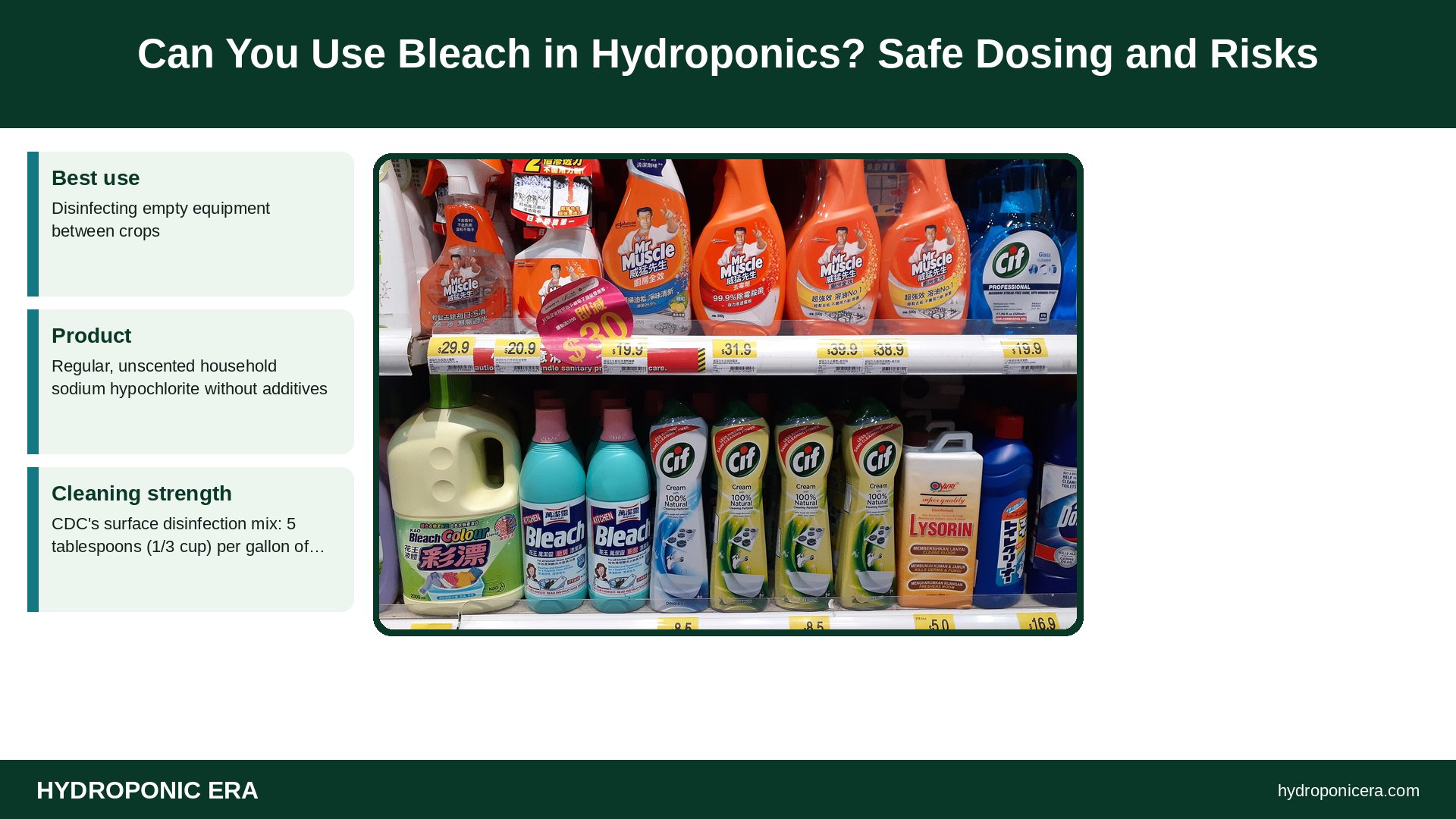
| Best use | Disinfecting empty equipment between crops |
| Product | Regular, unscented household sodium hypochlorite without additives |
| Cleaning strength | CDC’s surface disinfection mix: 5 tablespoons (1/3 cup) per gallon of water |
| Rinse | Thoroughly with clean water, then air-dry |
| In live reservoirs? | Not recommended as routine; no validated home dose |
| Never mix with | Acids (pH down), ammonia, or other cleaners |
What Bleach Does
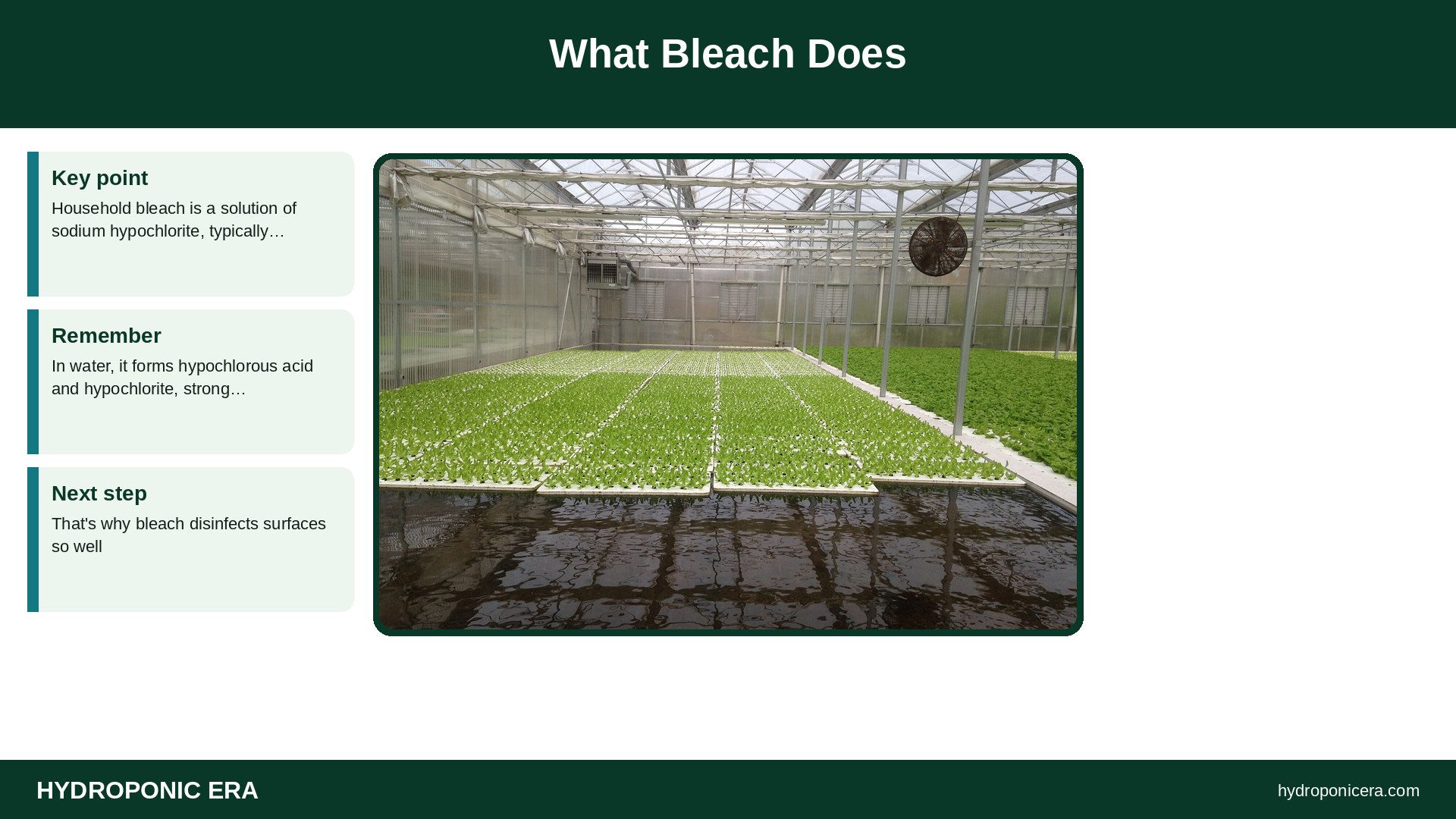
Household bleach is a solution of sodium hypochlorite, typically labeled around 5–9% for regular US products. In water, it forms hypochlorous acid and hypochlorite, strong oxidizers that destroy microbial cells. That’s why bleach disinfects surfaces so well. The same oxidizing power also damages living root tissue, and it doesn’t distinguish between harmful and helpful microbes.
Use the regular, unscented kind only. Scented, “splash-less,” or gel versions contain thickeners, fragrances, or surfactants you don’t want in a growing system.
How to Clean a Hydroponic System With Bleach
- Empty and scrub. Drain the reservoir, remove plants and roots, and scrub away biofilm, algae, and mineral crust with soap and water. Disinfectants work poorly on dirty surfaces.
- Mix the solution. The CDC’s guidance for disinfecting surfaces is 5 tablespoons (1/3 cup) of regular bleach per gallon of room-temperature water, or 4 teaspoons per quart. Mix in a ventilated area, wearing gloves and eye protection.
- Apply and wait. Wipe or soak parts so surfaces stay wet for the contact time on the product label or CDC guidance.
- Circulate if needed. For pumps and tubing, run the solution through the system briefly.
- Rinse well. Flush everything several times with clean water until no chlorine smell remains.
- Air-dry. Let parts dry fully before reassembling.
Our full guide to cleaning and sterilizing a hydroponic system covers each component, and the end-of-grow teardown protocol lays out the sequence.
Safety: Never Mix Bleach With Acids or Ammonia
Mixing bleach with acids releases chlorine gas, and mixing it with ammonia releases chloramine gases; both are dangerous to breathe. In hydroponics, the common acids are pH down products (phosphoric, nitric, or sulfuric acid). Never add bleach to a reservoir right after pH down, and never use both in the same cleaning bucket. Rinse thoroughly between products and work with good ventilation.
- Wear gloves and eye protection.
- Store chlorine products and acids separately, away from children and pets.
- Label any bucket used for cleaning so it isn’t reused for nutrients by mistake.
Is Bleach Safe in a Live Reservoir?
Some growers add small amounts of chlorine to running reservoirs to fight root rot or algae. The evidence for home use is limited, and there’s no standard dose recommended by US extension services for hobby systems. The risks are real:
- Root damage. Chlorine can burn fine root hairs, especially in warm water.
- Short-lived effect. Hypochlorite reacts with organic matter and breaks down, so the effect fades quickly.
- Kills beneficial microbes. If you use beneficial bacteria, chlorine wipes them out.
- Reaction with nutrients. Oxidizers can react with chelated micronutrients.
Commercial operations sometimes use controlled chlorination with monitoring equipment. That’s very different from pouring a household jug into a tote. For home growers, prevention and safer tools work better.
Safer Alternatives in a Running System
| Problem | Better first steps |
|---|---|
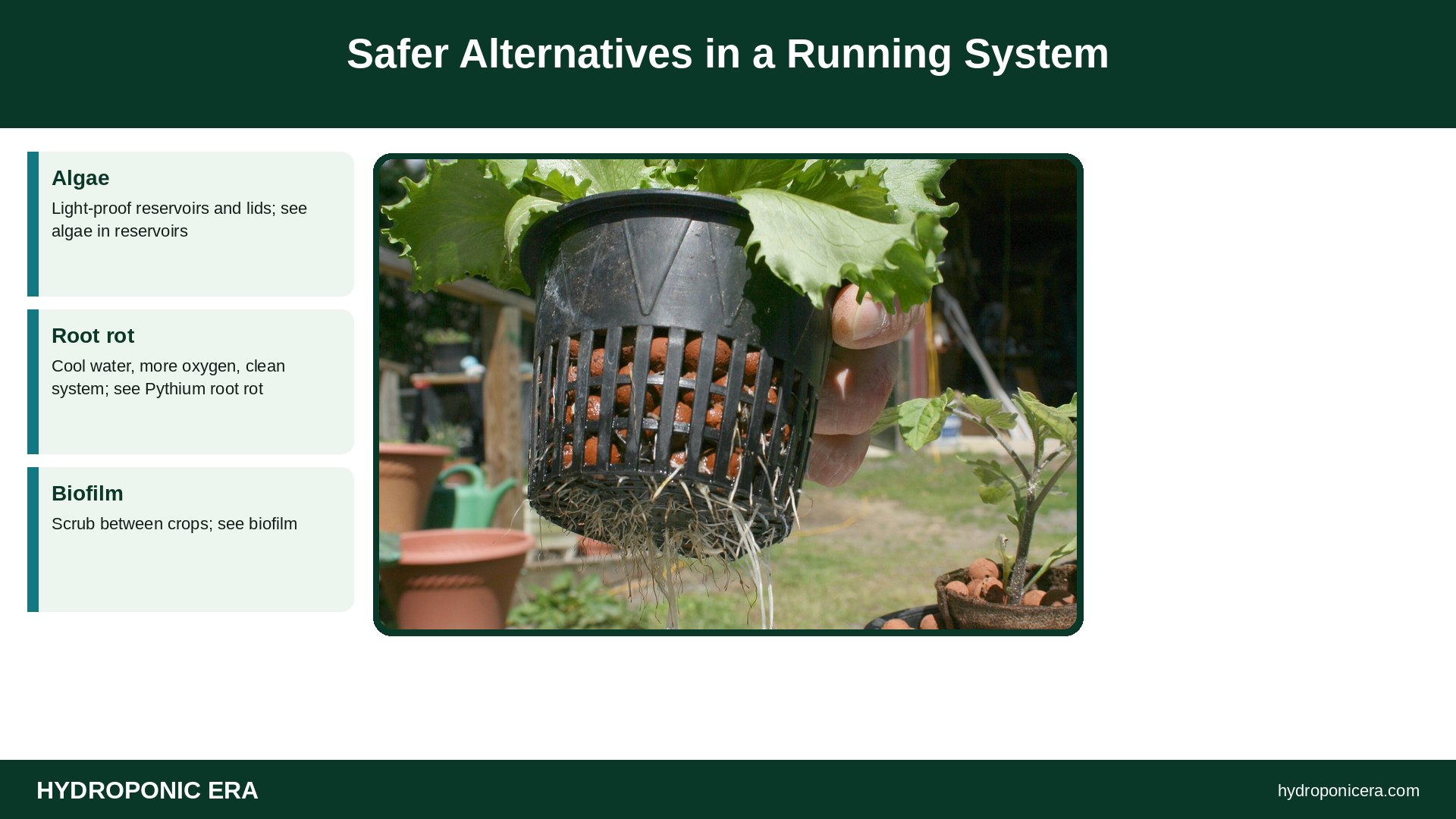
| Algae | Light-proof reservoirs and lids; see algae in reservoirs |
| Root rot | Cool water, more oxygen, clean system; see Pythium root rot |
| Biofilm | Scrub between crops; see biofilm |
| Microbes in solution | UV sterilizers or careful hydrogen peroxide |
Bleach vs Hydrogen Peroxide
Both are oxidizers. Hydrogen peroxide breaks down into water and oxygen, which some growers prefer in live systems, but it also damages roots at high doses and its effect is brief. Bleach leaves chlorine compounds and is better reserved for cleaning empty equipment. Neither fixes underlying problems like warm water or light leaks.
Chlorine in Tap Water
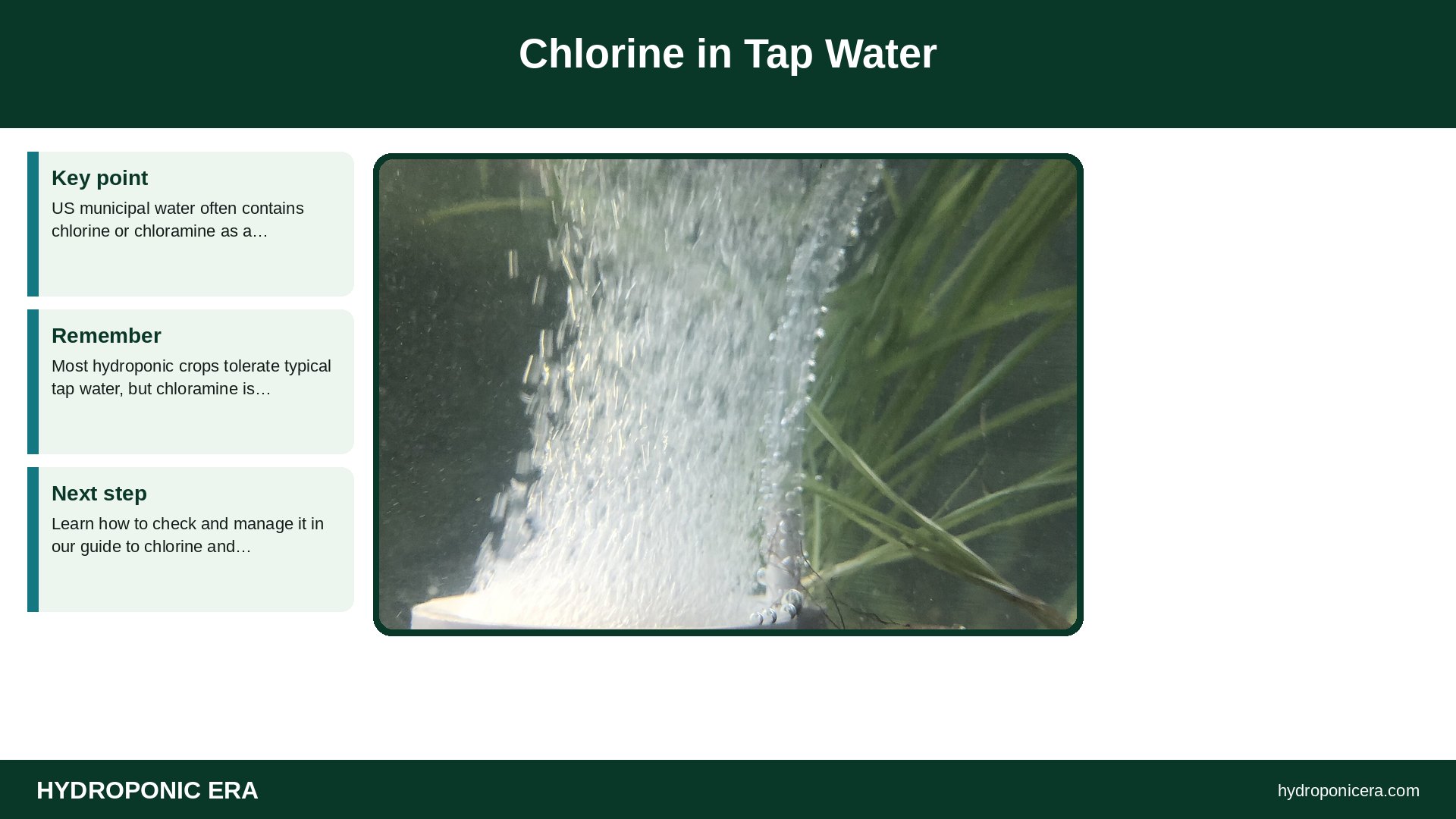
US municipal water often contains chlorine or chloramine as a disinfectant at low levels. Most hydroponic crops tolerate typical tap water, but chloramine is more persistent than chlorine. Learn how to check and manage it in our guide to chlorine and chloramine in tap water.
Cleaning Specific Parts
- Net pots and trays: soak after scrubbing, then rinse.
- Air stones: heavily fouled stones are cheap to replace; cleaning rarely restores them fully.
- Pumps: disassemble impeller housings and scrub; run the disinfecting solution through, then plenty of clean water.
- Tubing: flush, then rinse repeatedly. Replace tubing with stubborn biofilm.
- Rockwool and media: don’t bleach and reuse rockwool for food crops; see rockwool reuse and disposal.
When to Disinfect
Disinfect between every crop, after any disease outbreak such as root rot, and before using second-hand equipment. Our cleaning calendar helps make it routine. Regular cleaning with bleach at the right time reduces the need for any additive in the reservoir later.
Disposal
Dilute used cleaning solution with plenty of water and pour it down a household drain, not onto plants, lawns, or storm drains. Never dispose of it into a septic system in large volumes without checking local guidance. See nutrient solution disposal.
A Simple Between-Crop Cleaning Routine
Most home growers only need a full disinfecting clean between crops or after a disease problem. Drain the system, pull out roots and media, scrub away film with warm soapy water, rinse, then soak or wipe with the diluted solution for the contact time on the product label. Rinse several times with clean water and let everything air-dry before refilling. Keep a log of the date so you know when the next deep clean is due. Our weekly and monthly cleaning calendar shows how this fits with routine reservoir changes.
FAQs: Bleach in Hydroponics
How much bleach do I use to clean a hydroponic system?
The CDC’s surface disinfection mix is 5 tablespoons (1/3 cup) of regular unscented bleach per gallon of water. Scrub first, apply, then rinse thoroughly.
Can I add bleach to my reservoir to stop root rot?
It’s not recommended as a routine fix. It can damage roots, and there’s no validated home dose. Improve oxygen and water temperature first.
Is it safe to mix bleach and pH down?
No. Acids and chlorine products can release toxic chlorine gas. Never combine them.
Do I need to rinse after cleaning with bleach?
Yes. Rinse several times with clean water until no chlorine smell remains, then air-dry.
Can I use scented bleach?
No. Use a plain, unscented product without thickeners or fragrance.
Sources
- CDC — Cleaning and Disinfecting with Bleach
- Penn State Extension — Hydroponics Systems: Nutrient Solution Programs and Recipes
- Photo credits (Wikimedia Commons, edited with titles): HK STT 石塘咀 Shek Tong Tsui 山道 Hill Road Japan Home Centre goods CIF Kao Bleach August 2021 SS2 by Him Him Leonmans (CC BY-SA 4.0); Deep water culture by ArcadiYay (CC BY-SA 4.0); Water droplets on a late cotoneaster (Cotoneaster coriaceus) leaf, Jardim da Fundação Calouste Gulbenkian, Lisbon, Portugal julesvernex2 by Jules Verne Times Two (CC BY-SA 4.0); 2009-03-30 Lettuce roots by Ildar Sagdejev (Specious) (CC BY-SA 4.0); Air Stone Disk aquarium Germany 2024 by Nimmerwelk (CC BY-SA 4.0)