
Distilled water helps in hydroponics when your tap or well water is very hard, high in sodium, chloride, or boron, or otherwise unsuitable, because distilled water starts with almost no dissolved minerals. That blank slate lets you control exactly what nutrients plants receive. It isn’t required for most growers, and it costs more than tap water. If you use distilled water, choose a complete nutrient that includes calcium and magnesium, or add a Cal-Mag supplement, because pure water supplies none.
Key takeaway: Test your tap water first. If its EC and hardness are moderate, use it. Switch to distilled water or RO water only when your source water causes real problems.
| Question | Short answer |
|---|---|
| Starting EC | Very close to zero |
| When it helps | Very hard, salty, or contaminated source water; small systems |
| Downsides | Cost, plastic jugs, no calcium or magnesium |
| Need Cal-Mag? | Often yes, unless your nutrient already includes enough |
| Alternatives | Reverse osmosis, rainwater, blending with tap water |
What Distilled Water Is
Distillation boils water and condenses the steam, leaving most dissolved minerals and many contaminants behind. The result has very low electrical conductivity because there are few ions to carry current. The USGS explains that conductivity rises with dissolved salts, which is why EC meters are useful for checking water quality. See our EC and TDS guide.
When Distilled Water Helps
- Very hard water. High calcium and magnesium plus bicarbonates push pH up and leave little room for nutrients. See hard water and RO.
- Salty water. Water softened with salt-based softeners or naturally high in sodium can build up in recirculating systems. See sodium buildup.
- Problem well water. Some wells contain iron, boron, or other issues. See well water decision tree.
- Small systems. A countertop garden uses only a gallon or two, so buying distilled water is affordable.
- Sensitive plants. Carnivorous plants, some orchids, and certain houseplants prefer very low-mineral water.
- Experiments. Science projects that need a clean baseline.
When You Don’t Need It
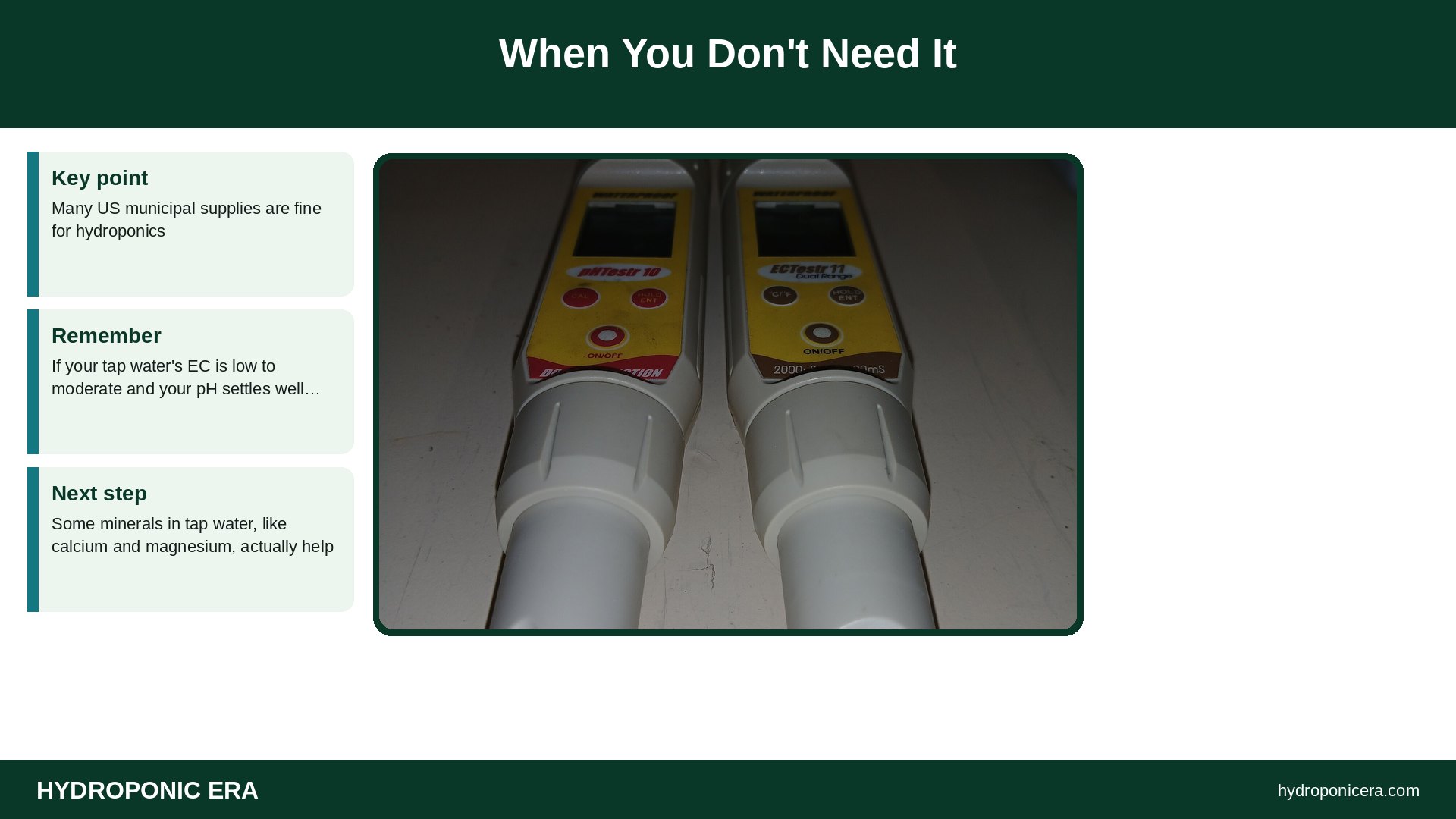
Many US municipal supplies are fine for hydroponics. If your tap water’s EC is low to moderate and your pH settles well after adding nutrients, distilled water adds cost without benefit. Some minerals in tap water, like calcium and magnesium, actually help. Measure the EC of your tap water before deciding; our guide to starting EC baseline shows how.
Calcium and Magnesium: The Main Catch
Distilled water contains no calcium or magnesium. Some hydroponic nutrients are designed for soft or RO water and include plenty; others assume your water supplies some. If you switch to distilled water and see deficiencies such as tip burn or interveinal yellowing, add a Cal-Mag product or choose a complete nutrient. See calcium and magnesium deficiency.
pH Behavior With Distilled Water
Pure water has almost no buffering capacity, so pH can swing easily. Once nutrients are added, the solution gains some buffering, but it may still drift more than tap water mixes. Adjust pH after mixing nutrients, use small doses of pH up or down, and check more often at first. See controlling pH and alkalinity management.
Distilled vs RO vs Rainwater
| Water | Minerals | Cost | Notes |
|---|---|---|---|
| Distilled | Very low | High per gallon (bought) or energy-intensive (home distiller) | Convenient for small systems |
| Reverse osmosis | Very low | Low per gallon after setup | Wastes some water; filters need replacing |
| Rainwater | Low | Free | Quality varies with roof and storage; check local rules |
| Tap water | Varies | Lowest | Fine for many US growers; test first |
Blending Distilled Water With Tap Water
You don’t have to go all or nothing. Mixing distilled or RO water with tap water lowers hardness and EC while keeping some calcium and magnesium. For example, a 50/50 blend cuts the mineral load roughly in half. Measure the EC of the blend before adding nutrients and adjust the ratio until you reach a comfortable starting point.
Cost Considerations
Buying distilled water by the gallon is practical for countertop gardens and houseplants. For larger reservoirs, the cost and plastic waste add up quickly, and an RO system usually becomes cheaper over time. Home distillers use electricity to boil water, which may cost more than RO in many areas. Track water costs with our cost tracking framework.
Using Distilled Water in an AeroGarden or Countertop Unit
Many countertop gardens work fine with tap water, but if you notice white crust on the bowl or lid, hard water may be to blame. Switching to distilled water reduces scaling. Use the manufacturer’s nutrient as directed, since many countertop formulas include calcium. See AeroGarden troubleshooting.
Distilled Water Mixing Steps
- Fill the reservoir with distilled water.
- Add Cal-Mag first if your nutrient requires it, then base nutrients, following the label order. See mixing order.
- Stir and measure EC.
- Adjust pH to your crop’s target, usually 5.5–6.5.
- Check pH again after an hour, since low-buffer solutions can drift.
Signs You Should Switch Water Sources
A few clues suggest your tap water is causing problems and a purer source could help: white crust on pumps and net pots, a starting EC so high that you can’t reach your target without overdosing, pH that climbs quickly every day because of high alkalinity, or repeated tip burn and lockout symptoms despite a correct recipe. Ask your water utility for its annual water quality report, which lists hardness and alkalinity, or test with an inexpensive EC meter. If the starting EC is low and pH holds steady, plain tap water is usually fine and purchased water just adds cost and plastic jugs.
For larger setups, a reverse osmosis unit is often cheaper per gallon than buying jugs. See sizing an RO system.
FAQs: Distilled Water for Hydroponics
Is distilled water better for hydroponics?
Only when your tap water is problematic. Otherwise, tap water is cheaper and works well.
Do I need Cal-Mag with distilled water?
Often yes, unless your nutrient already supplies enough calcium and magnesium. Check the label.
Why does pH swing with distilled water?
Pure water has little buffering. Adding nutrients helps, but expect more drift at first.
Is distilled water the same as RO water?
Both have very low minerals. They’re made differently but behave similarly in hydroponics.
Can I use bottled spring water?
You can, but mineral content varies by brand. Measure its EC before using it.
Sources
- USGS — Conductivity (Electrical Conductance) and Water
- Penn State Extension — Hydroponics Systems: Nutrient Solution Programs and Recipes
- Photo credits (Wikimedia Commons, edited with titles): US Navy 050107-N-0057P-246 Aviation Electronics Technician 2nd Class Jason D. Schapp of Oakridge, Ore., and members of the Indonesian Army unload jugs of water that were purified in distilling plant aboard USS Abraham Lincoln ( by U.S. Navy photo by Photographer’s Mate 2nd Class Seth C. Peterson (Public domain); Water droplets on a late cotoneaster (Cotoneaster coriaceus) leaf, Jardim da Fundação Calouste Gulbenkian, Lisbon, Portugal julesvernex2 by Jules Verne Times Two (CC BY-SA 4.0); PH- und Leitfähigkeitsmessgeräte by Rotkaeppchen68 (CC0); Hydroponic lettuce @ Plaine des Cafres 03 by Rémih (CC BY-SA 4.0); Epsomite by WTucker (talk) (CC BY-SA 3.0)