
An aquaponics biofilter is the component that houses the nitrifying bacteria that convert toxic ammonia and nitrite from fish waste into nitrate for plants. Media bed systems don’t need a separate one, because FAO’s aquaponics manual says the grow beds themselves are excellent biofilters. NFT and raft (DWC) systems do need one. FAO’s sizing rule is based on daily feed: about 1 liter of volcanic gravel or 0.5 liter of Bioballs per gram of fish feed per day, with the biofilter container at least one-sixth of the fish tank volume. Bigger is safer: FAO says an oversized biofilter can’t harm the system and has saved many from collapse.
Key takeaway: Size the biofilter by feed, choose high-surface-area media, aerate it, and keep it shaded.
| Media (FAO) | Specific surface area | Volume needed per gram of daily feed |
|---|---|---|
| Volcanic gravel/tuff | About 300 m²/m³ | 1 liter |
| Bioballs | About 600 m²/m³ (500–700) | 0.5 liter |
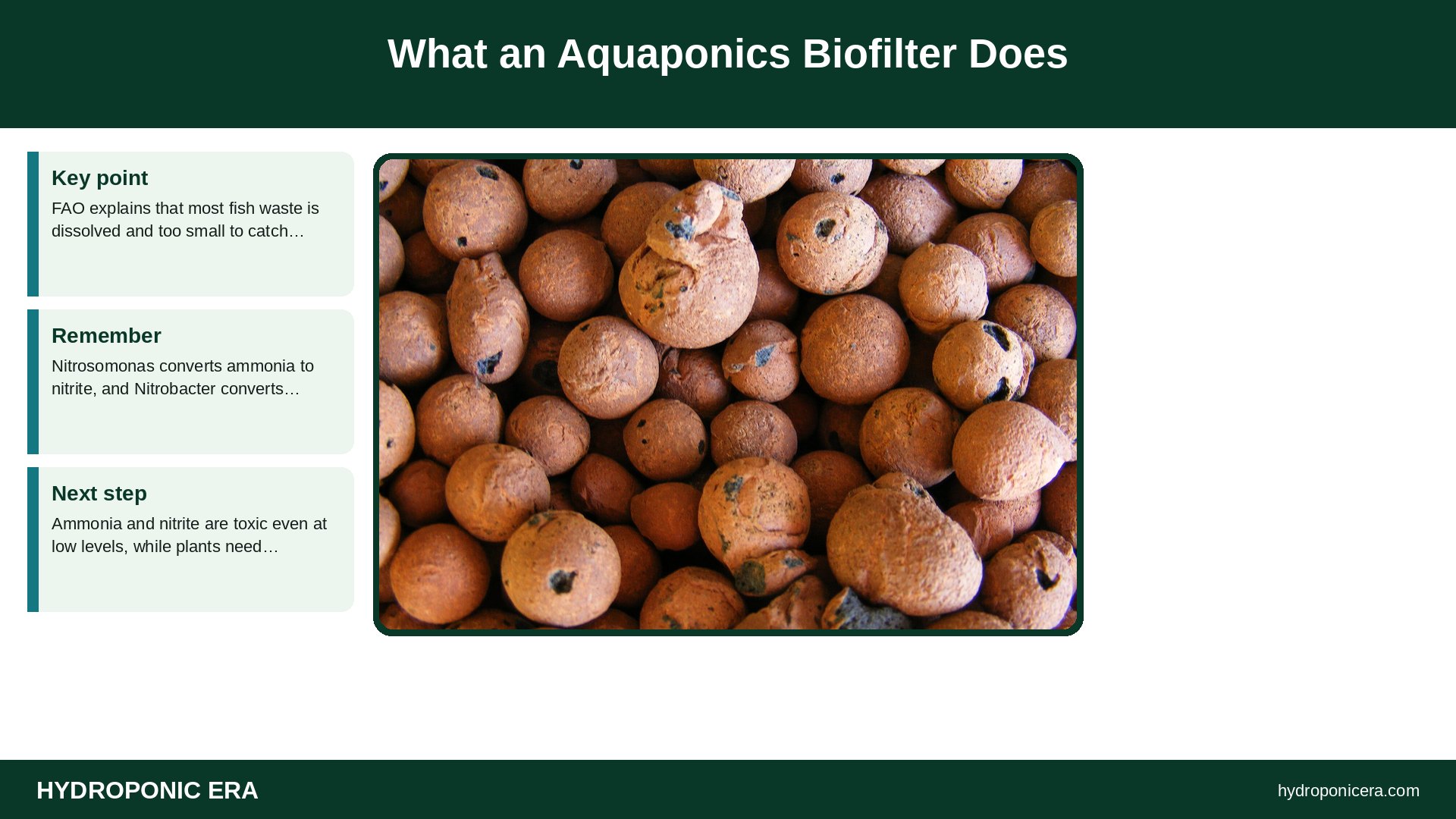
| Expanded clay (LECA) | About 250–300 m²/m³ | About 1 liter |
What an Aquaponics Biofilter Does
FAO explains that most fish waste is dissolved and too small to catch with a mechanical filter, so bacteria do the work. Nitrosomonas converts ammonia to nitrite, and Nitrobacter converts nitrite to nitrate. Ammonia and nitrite are toxic even at low levels, while plants need the nitrate. FAO also notes that water movement inside a biofilter breaks down very fine solids that pass the clarifier. See nitrifying bacteria.
Do You Need a Separate Biofilter?
- Media beds: no. FAO says the beds are perfect biofilters.
- NFT and DWC: yes. There’s too little surface area otherwise.
- Large UVI-style raft systems: FAO notes some rely on canal surfaces and plant roots instead.
See aquaponics raft system and NFT vs DWC.
How to Size an Aquaponics Biofilter
Biofiltration depends on the amount of feed entering the system each day. Example: you feed 100 g (about 3.5 oz) per day.
- Volcanic gravel: 100 × 1 L = 100 liters (about 26 gallons) of media.
- Bioballs: 100 × 0.5 L = 50 liters (about 13 gallons) of media.
FAO says to treat these as minimums and to oversize the biofilter if cold water could slow bacteria. The container should be at least one-sixth of the fish tank volume. See aquaponics fish food for feeding rates.
Choosing Biofilter Media
FAO says good media has a high surface-area-to-volume ratio, is inert, and is easy to rinse. Bioballs have nearly double the surface area of volcanic gravel. Other options FAO lists include plastic bottle caps, nylon shower poufs, netting, PVC shavings, and nylon scrub pads. With lower-surface media, fill the container as full as possible and make it larger. See clay pebbles.
Keep Your Aquaponics Biofilter Healthy
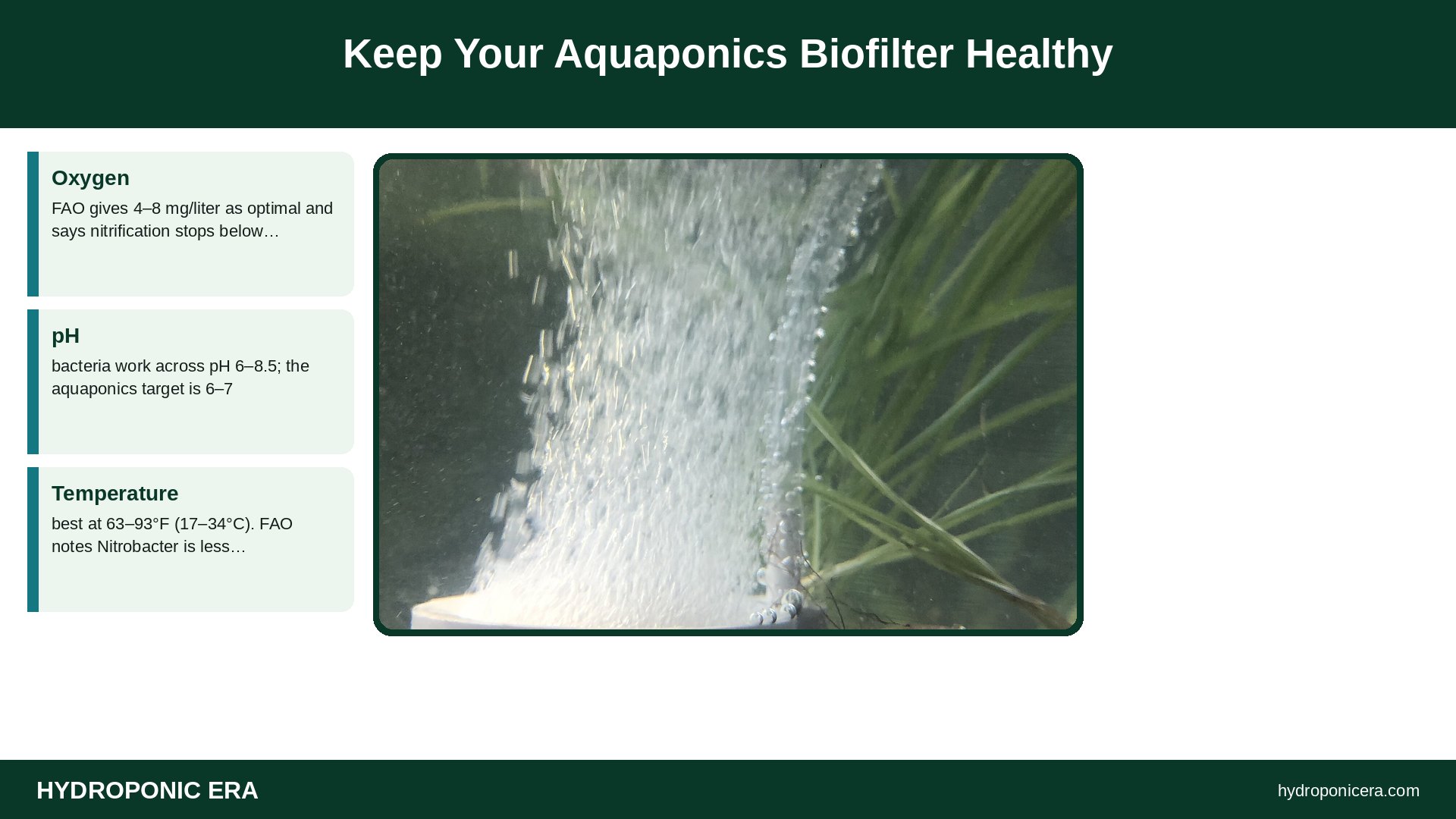
- Oxygen: FAO gives 4–8 mg/liter as optimal and says nitrification stops below 2 mg/liter. Dedicate an air stone to the biofilter.
- pH: bacteria work across pH 6–8.5; the aquaponics target is 6–7.
- Temperature: best at 63–93°F (17–34°C). FAO notes Nitrobacter is less cold-tolerant, so watch nitrite in winter.
- Shade: FAO says bacteria are sensitive to sunlight until colonies establish, so shade external biofilters.
DIY Aquaponics Biofilter Design
A simple DIY design from FAO’s layout: water flows from the fish tank to a mechanical separator, then into a container filled with media and an air stone, then to the grow units. Steps:
- Pick a food-safe container at least one-sixth of the fish tank volume.
- Fill with Bioballs or other high-surface media.
- Add an air stone at the bottom.
- Bring water in at the bottom and out the top, or the reverse, so it passes through all the media.
- Optionally add a bucket of nylon netting to catch fine solids, as FAO suggests.
- Cover it to block light.
Cleaning the Biofilter
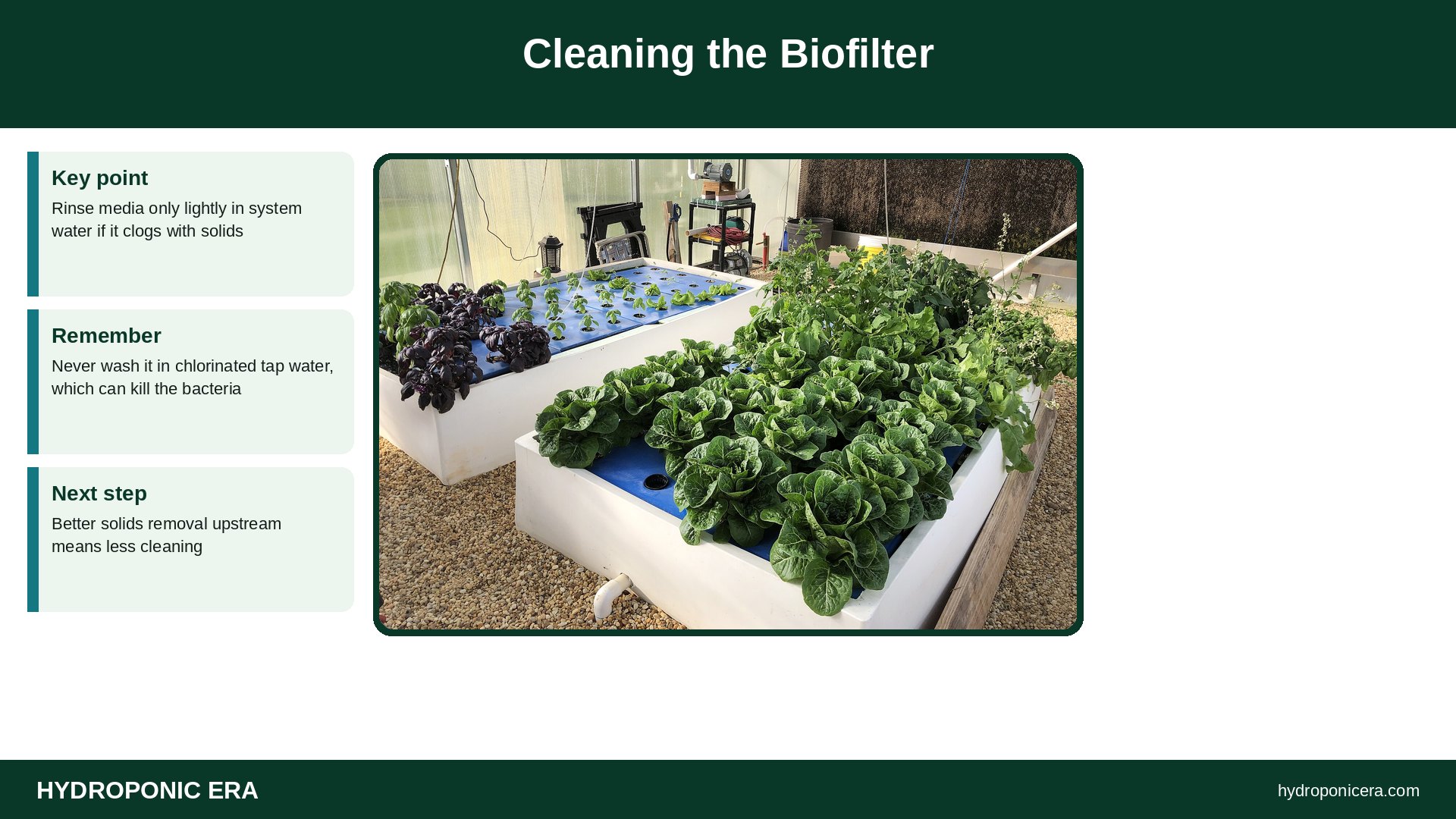
Rinse media only lightly in system water if it clogs with solids. Never wash it in chlorinated tap water, which can kill the bacteria. Better solids removal upstream means less cleaning. See aquaponics cycling.
Aquaponics Biofilter Price
A DIY biofilter can be cheap: a food-grade barrel or tote, an air stone, and media. Commercial biofilters cost more but save time. Bioballs cost more than gravel but need half the volume.
Aquaponics Biofilter Startup
A new aquaponics biofilter has no bacteria yet. FAO notes cycling usually takes 3–5 weeks. You can speed colonization by adding a small amount of media or filter material from an established, disease-free system. Keep pH, temperature, and oxygen in range during startup. See aquaponics cycling.
Aquaponics Biofilter Troubleshooting
- Ammonia rising: biofilter too small, low oxygen, or low temperature. Add media and aeration.
- Nitrite rising in winter: FAO notes Nitrobacter is less cold-tolerant; reduce feed and keep water warmer.
- Clogged media: improve solids removal upstream.
- Bad smell: anaerobic zones; increase aeration and clean.
Aquaponics Biofilter for Cold Climates
FAO says biofilters should be oversized if low temperatures could affect bacterial activity, and extra media may be needed as a buffer in winter. If water drops below 63°F (17°C), add more media or plan to cut feed. See aquaponics winter.
Aquaponics Biofilter Placement
FAO places the biofilter after the mechanical separator and before the grow units, so it receives water that’s already had large solids removed. Keep it shaded, accessible for inspection, and level with the rest of the loop so water flows by gravity where possible.
Sizing the Aquaponics Biofilter: FAO Worked Example
FAO gives a worked example with volcanic tuff, which has a specific surface area of about 300 m²/m³. To process 200 g (about 7 oz) of fish feed per day, FAO calculates roughly 44.3 liters (about 11.7 gallons) of tuff, meaning 1 liter of tuff handles the ammonia from about 4.5 g of feed. FAO notes Bioballs have almost double the surface area to volume of volcanic gravel, so they need less volume. FAO’s advice is to oversize the biofilter when you build it; a secondary biofilter can be added later if needed.
FAQs: Aquaponics Biofilter
What does an aquaponics biofilter do?
It houses bacteria that convert ammonia and nitrite to nitrate.
How big should my biofilter be?
FAO says 1 L of gravel or 0.5 L of Bioballs per gram of daily feed, as a minimum.
Do media beds need a biofilter?
No. The beds act as the biofilter.
What is the best biofilter media?
High surface area, inert, easy to rinse media like Bioballs.
Does a biofilter need aeration?
Yes. Nitrification stops below 2 mg/liter of oxygen.
Sources
- FAO — Small-scale aquaponic food production
- Photo credits (Wikimedia Commons, edited with titles): South Sister lava flows, USGS by C. Dan Miller, USGS/Cascades Volcano Observatory (Public domain); Hydroton by Lucis (CC BY-SA 3.0); Solanum lycopersicum in aquaponics at the NC Greenhouse Nursery by Gogerr (CC BY-SA 4.0); Air Stone Disk aquarium Germany 2024 by Nimmerwelk (CC BY-SA 4.0); Deepwater Aquaponics Floating Rafts Growing Lettuce, Basil and Arugula by Alabama Extension (CC0)