
How do you remove pond muck? Remove pond muck by scooping or vacuuming the soft sludge from the bottom, netting out leaves before they sink, trimming dying plants, and keeping water oxygenated. A lab study at Grand Valley State University found muck-digesting bacteria pellets did not reduce sediment organic matter, so physical removal and prevention work better than products.
Key takeaway: Pond muck is decaying leaves, plant debris, fish waste and silt on the bottom. Take it out by hand, net or pond vacuum, keep about half the surface free of plants, net leaves in fall, and aerate. Save a little silt when you clean, as the RHS advises, and do major clean-outs in early autumn.
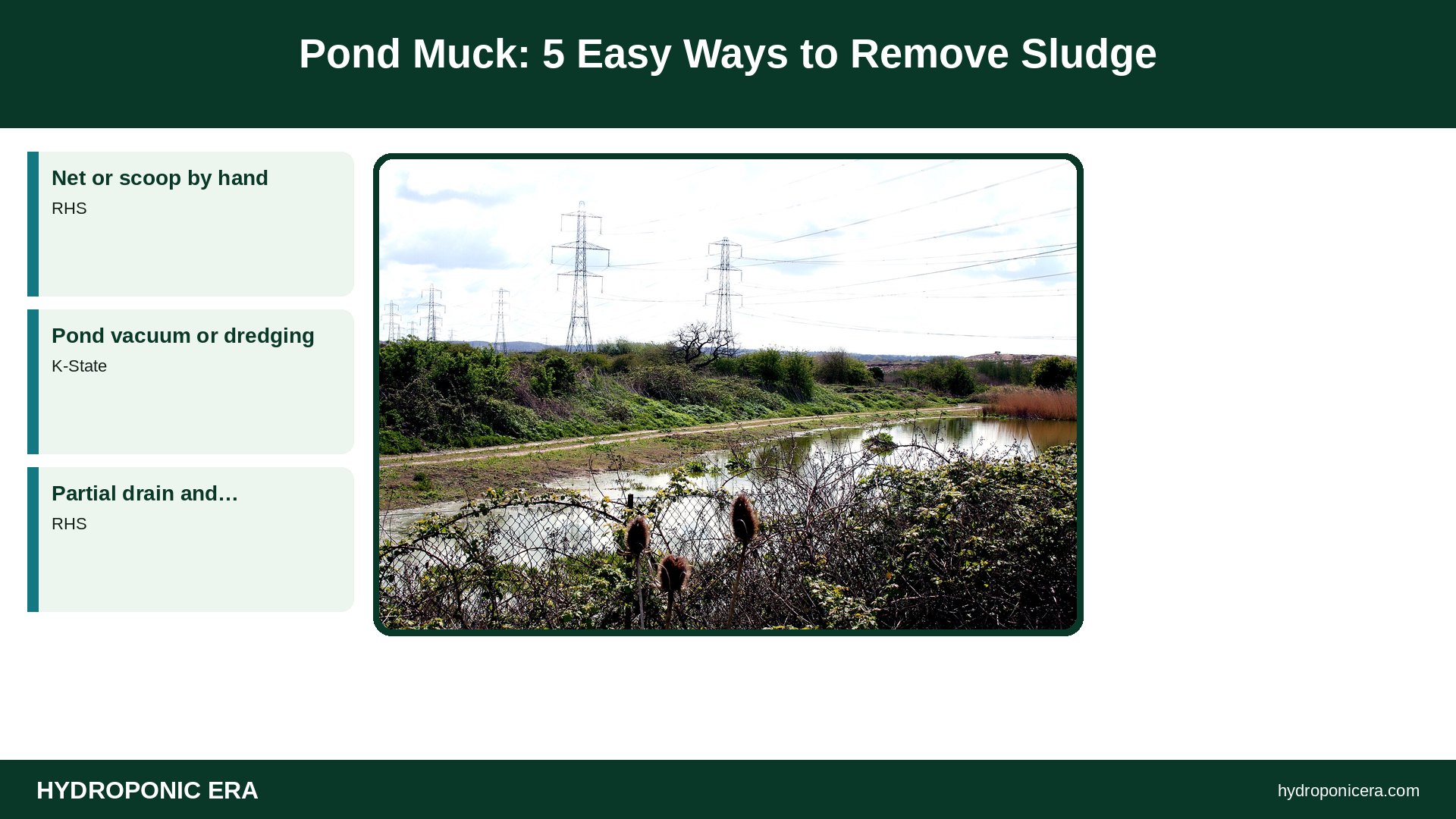
| Method | Works for | Source |
|---|---|---|
| Net or scoop by hand | Small ponds, leaves and soft sludge | RHS |
| Pond vacuum or dredging | Bottom sludge in lined ponds | K-State |
| Partial drain and clean-out | Badly silted ponds, early autumn | RHS |
| Leaf netting in fall | Preventing new muck | K-State, Virginia Extension |
| Bacteria pellets | Not shown to cut organic sediment in lab tests | Grand Valley State University |
What Is Pond Muck?
Pond muck is the soft, dark layer of organic matter that settles on a pond bottom. It builds from fallen leaves, dead plant parts, uneaten food and fish waste mixed with silt. The RHS advises removing dead and fading leaves so they do not decompose in the water, because decay is what turns debris into muck.
The USDA NRCS definition quoted by Grand Valley State University describes muck soils as sapric organic soils, decomposed until the plant material is unidentifiable and saturated for long periods. In a garden pond, that means sludge you can no longer tell apart from leaves.
Penn State Extension notes that bacteria feeding on dead and decaying vegetation use up oxygen, which can stress fish, especially under ice.
How Do You Remove Pond Muck by Hand?
Remove pond muck by hand with a fine net, scoop or pond vacuum, working in small sections so you do not cloud the whole pond. Kansas State University lists dredging, or cleaning the pond bottom, as a routine task, and recommends a net with a long handle for lifting debris. Spread the work over several sessions.
- Net floating leaves and debris first.
- Scoop or vacuum soft sludge from the deepest point, where it collects.
- Leave removed material at the pond edge overnight so creatures can crawl back, as the RHS suggests.
- Compost the muck or spread it on garden borders.
- Top up with rainwater or dechlorinated water.
Do Muck-Digesting Bacteria Products Work?
The evidence is weak. Grand Valley State University’s Annis Water Resources Institute tested Mukk Buster pellets on sediment from three Michigan lakes for 8 weeks and found no statistically significant difference in organic matter with or without pellets. The researchers concluded the pellets were not an effective treatment and noted raised chloride levels from the pellets themselves.
The report adds that muck-reducing products have not been validated in peer-reviewed literature, and that an earlier non-peer-reviewed Florida trial combining microbes with aeration showed little or limited muck removal.
The study was done in lab tubes and bins, not ponds, so the authors recommended field testing. Until stronger evidence exists, treat bacteria products as unproven and focus on removal and prevention.
When Should You Do a Full Pond Clean-Out?
Do a full clean-out only when a pond is badly silted or overgrown, and do it in early autumn. The RHS says ponds rarely need a total clear-out, which can disrupt the ecosystem for years. Traditional advice of every five years for small ponds and ten for large ones is a guide, not a rule.
- Set up a shaded holding tank with pond water for fish and deep-water plants.
- Pump the water down, removing fish as they become visible.
- Lift plants gradually and keep marginals moist.
- Scoop out silt but keep a little to return, per the RHS.
- Scrub the liner with fresh water; Kansas State warns never to power-wash it.
- Refill, replant and return fish.
How Do You Prevent Pond Muck?
Prevent pond muck by stopping debris from reaching the bottom. Kansas State and Virginia Extension both recommend leaf netting in fall, and the RHS advises cutting back vigorous plants to keep about half the surface clear and removing tatty leaves and fading flowers before they rot. Avoid overfeeding fish, since uneaten food adds to the sludge.
- Netting: stretch it over the pond before leaf fall.
- Plant care: trim marginals and thin oxygenators such as anacharis.
- Filtration: a bog filter or biofilter traps fine solids.
Does Aeration Help With Pond Muck?
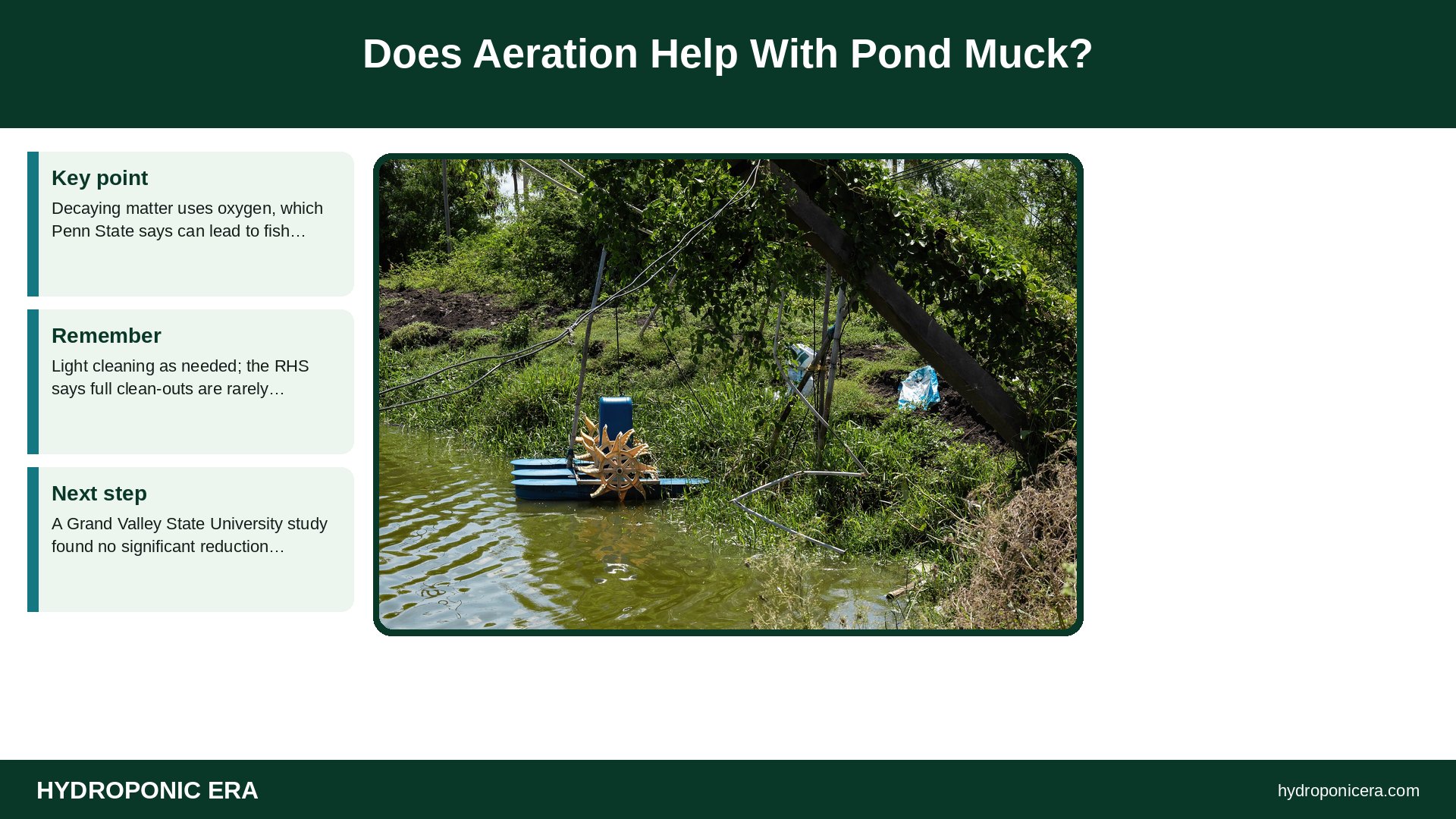
Aeration helps the pond cope with muck rather than removing it. The RHS recommends keeping water well oxygenated with a bubble fountain or pump, especially in hot weather and with fish, and Penn State explains that decomposing vegetation draws oxygen down. Good oxygen supports fish and beneficial microbes while you physically remove the sludge.
See our aquaponics air pump guide for choosing an aerator.
Is pond muck bad for fish?
Decaying matter uses oxygen, which Penn State says can lead to fish stress and winterkill.
How often should I clean pond muck?
Light cleaning as needed; the RHS says full clean-outs are rarely needed.
Do pond sludge bacteria really work?
A Grand Valley State University study found no significant reduction in sediment organic matter from muck pellets.
Can I use pond muck in the garden?
Yes. The RHS suggests adding removed silt to borders.
Should I remove all the muck?
No. The RHS advises returning a little silt to help re-establish tiny organisms.
Sources
- Royal Horticultural Society. Pond care: maintenance tips.
- Grand Valley State University, Annis Water Resources Institute. Assessment of the Effectiveness of Muck-Digesting Bacterial Pellets.
- Kansas State University. MF2913 Water Gardening: Maintenance.
- Penn State Extension. Winterkill in Ponds.
- Photo credits (Wikimedia Commons, edited with titles): Sutton (northern fringe), Abandoned sludge pond – geograph.org.uk – 2910670 by Dr Neil Clifton (CC BY-SA 2.0); Pond-edge plants at Achamore Garden – geograph.org.uk – 5446824 by M J Richardson (CC BY-SA 2.0); Pond covered with green algae – geograph.org.uk – 2371127 by Stephen Rogerson (CC BY-SA 2.0); Aeration systems in an Aqua pond near Eluru by iMahesh (CC BY-SA 4.0)
1 thought on “Pond Muck: 5 Easy Ways to Remove Sludge”