
Is activated charcoal good for plants? Activated charcoal for plants is mainly useful in closed terrariums and water filters, not as fertilizer. Penn State Extension mixes charcoal into terrarium soil to absorb chemicals and odors, and Purdue Extension notes activated carbon adsorbs chlorine and organic compounds. It does not feed plants or fix drainage.
Key takeaway: Activated charcoal for plants earns its place in closed terrariums. Use a thin layer or a small mix-in of activated charcoal in closed terrariums. Skip it in ordinary pots. Gravel or charcoal layers do not improve pot drainage, and biochar, not activated charcoal, is the product studied as a soil amendment.
| Use | Does it help? | Source |
|---|---|---|
| Closed terrarium | Yes, absorbs odors and chemicals | Penn State, UVM |
| Water filter | Yes, adsorbs chlorine and organics | Purdue |
| Drainage layer in pots | No, creates a perched water table | WSU |
| Fertilizer | No nutrients to speak of | General |
| Soil amendment | Biochar is the studied option | UMaine |
What Is Activated Charcoal for Plants?
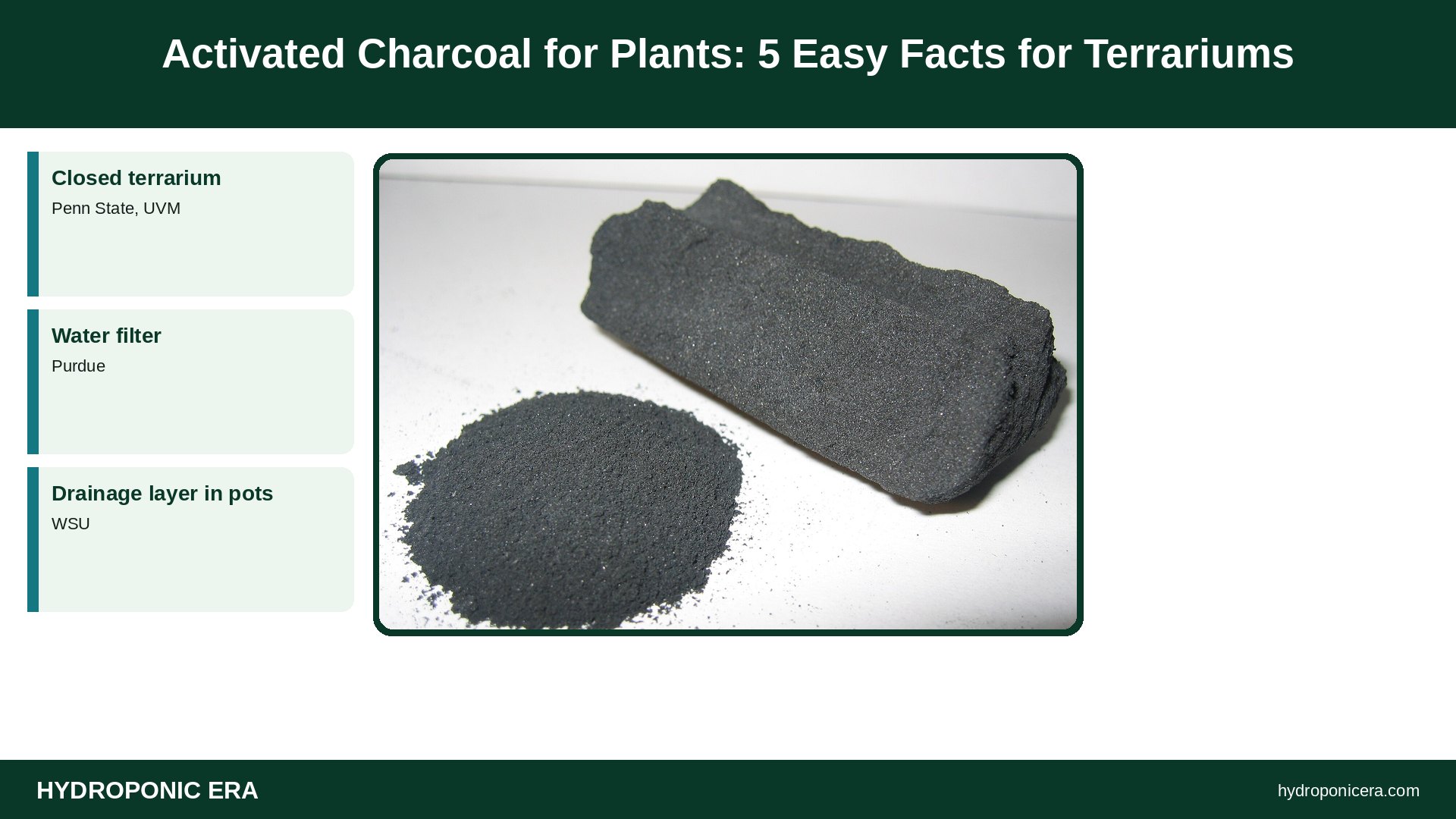
Activated charcoal is carbon processed to be extremely porous. Purdue Extension explains that one ounce of activated carbon has an estimated 30,000 square yards (about 25,000 square meters) of surface area, and that contaminants stick to that surface in a process called adsorption. That is why activated charcoal for plants is sold mostly for terrariums.
Purdue adds that activated carbon removes chlorine and many organic compounds, and is moderately effective on some heavy metals. Once its surface is full, it stops working, which is why filters need replacement.
How Do You Use Activated Charcoal for Plants in a Terrarium?
Add activated charcoal for plants as a thin layer or mix a little into the soil. University of Vermont Extension layers 1 to 2 inches (2.5 to 5 cm) of coarse gravel, a thin layer of activated charcoal, then 2 to 3 inches (5 to 7.5 cm) of light potting soil. It says the charcoal helps prevent odors and bacterial growth.
- Choose a clean glass container with a lid for closed designs.
- Add a base layer of gravel if you like the look.
- Spread a thin layer of activated charcoal, or mix it into the soil.
- Add 2 to 3 in (5 to 7.5 cm) of light, perlite-rich potting mix.
- Plant, mist lightly and close the lid.
Penn State Extension mixes the charcoal into the potting soil instead of layering it, noting it absorbs chemicals and odors. Either approach is common.
Does Activated Charcoal for Plants Improve Drainage?
No. Activated charcoal for plants does not fix drainage. Washington State University Extension calls drainage layers a myth that refuses to die: soil scientists showed nearly 100 years ago that water does not move easily from fine-textured layers into coarse ones. A layer of charcoal, gravel or shards at the bottom of a pot holds water in the soil above.
Penn State Extension agrees that a rock layer is no longer thought to improve drainage; in an open terrarium or dish garden it is a design choice. For better drainage, use a pot with holes and a coarse, airy mix.
| Approach | Effect on drainage | Better option |
|---|---|---|
| Charcoal or gravel layer | Perched water; wetter roots | Uniform mix |
| Pot with drainage holes | Excess water exits | Always choose this |
| Perlite or pumice in mix | More air space | Mix through the soil |
See our guides to pumice and pea gravel as growing media.
What Is the Difference Between Activated Charcoal and Biochar?
They are related but used differently. University of Maine Extension explains that biochar and charcoal are both made by heating organic material without oxygen, but biochar is made from varied plant waste at higher temperatures. Biochar is used as a soil amendment for its porosity, pH-raising effect and cation exchange capacity.
| Product | Made for | Garden use |
|---|---|---|
| Activated charcoal | Adsorbing chemicals and odors | Terrariums, filters |
| Biochar | Soil improvement | Poor soils, mixed with compost |
| Grill charcoal | Fuel | Avoid; may contain additives |
UMaine adds that if your garden soil is already fertile, biochar may offer little benefit. Do not use barbecue briquettes in place of either product, and do not expect activated charcoal for plants to act like biochar in garden beds.
Can You Use Activated Charcoal for Plants in Water or Hydroponics?
Activated charcoal for plants in water works mostly as a filter. Purdue Extension notes activated carbon removes chlorine, so carbon filters are a common way to treat tap water before use. Inside a hydroponic reservoir, carbon can also adsorb organic compounds, but it saturates and needs replacing. It is not a substitute for monitoring pH and EC.
For tap water issues, read our guide to chlorine and chloramine in tap water. For reservoir odors, see foam and smell triage.
Does Activated Charcoal for Plants Stop Root Rot?
There is no reliable evidence that activated charcoal for plants cures root rot. Charcoal can reduce odors in a closed container, but rot comes from wet, airless roots and pathogens. Fix the cause by improving drainage, reducing watering and removing damaged roots. Water-grown plants need clean containers and fresh water.
- Odor control: charcoal helps in sealed terrariums.
- Root rot: fix watering and drainage instead.
- Orchids: use bark mixes; see water culture orchids.
- Semi-hydro: inert media like LECA suits water-loving setups.
How Much Activated Charcoal for Plants Should You Use?
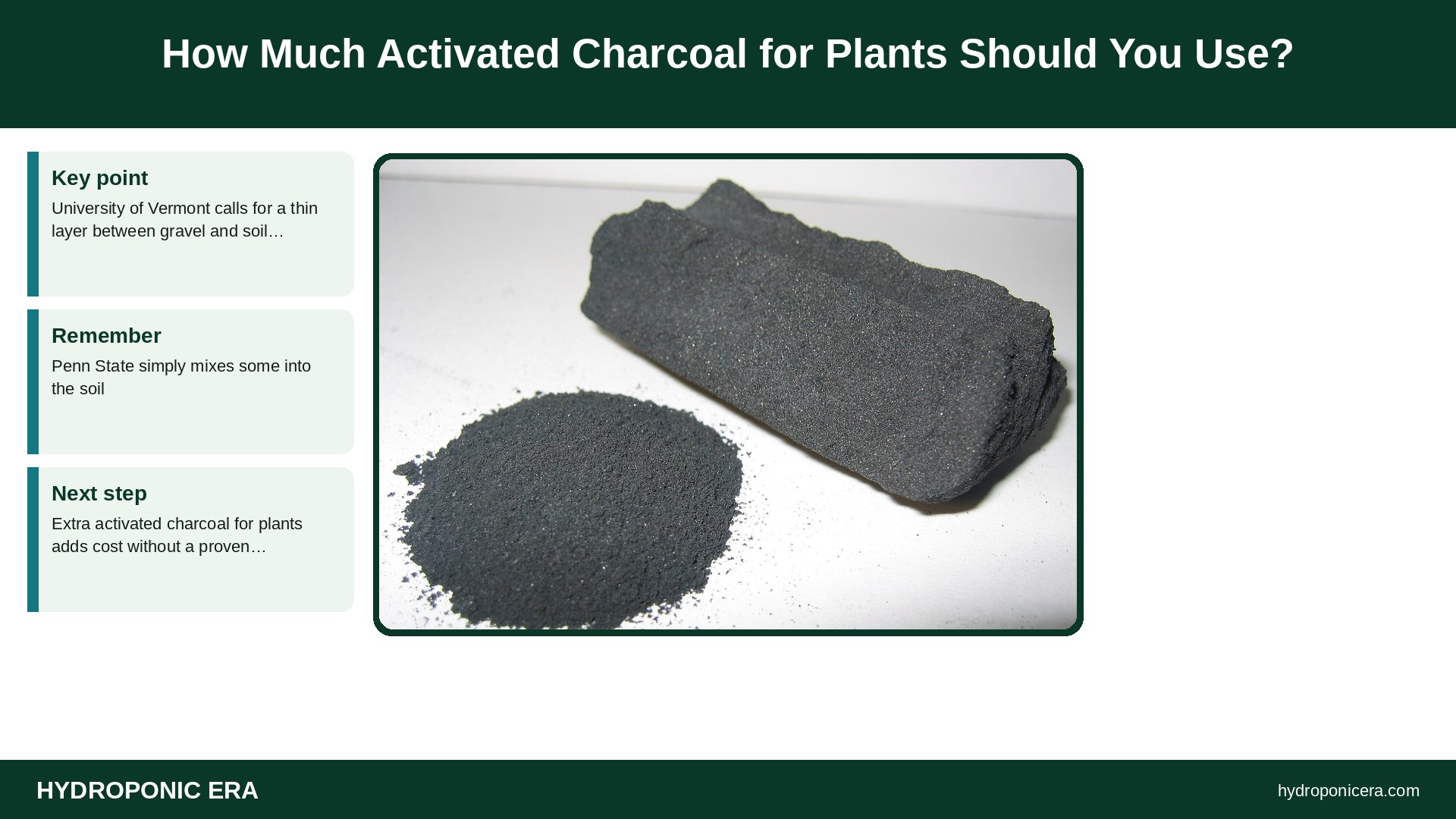
A little goes a long way. University of Vermont calls for a thin layer between gravel and soil in a terrarium. Penn State simply mixes some into the soil. Extra activated charcoal for plants adds cost without a proven benefit, and ordinary potted plants do not need it.
FAQ About Activated Charcoal for Plants
Is horticultural charcoal the same as activated charcoal?
Both are charcoal; activated charcoal is processed for far more surface area.
Can I use activated charcoal capsules?
Unflavored capsules are activated carbon, but bulk terrarium charcoal is cheaper.
Does activated charcoal raise soil pH?
UMaine notes biochar can raise pH; amounts in terrariums are small.
Do succulents need activated charcoal?
No. They need a fast-draining mix and a pot with holes.
Sources
- Penn State Extension. Creating a Closed Terrarium.
- University of Vermont Extension. Creating a Garden in a Terrarium.
- Purdue Extension. WQ-13 Home Water Treatment Using Activated Carbon.
- Washington State University Extension (Chalker-Scott). The Myth of Drainage Material in Container Plantings (PDF).
- University of Maine Cooperative Extension. What’s the difference between charcoal and biochar?.
- Photo credits (Wikimedia Commons, edited with titles): Activated Carbon by Ravedave (talk) (CC BY 2.5); Goerlitz Wilhelmsplatz Terrarium by Oberlausitzerin64 (CC BY-SA 4.0); RIBogorSeerose by Ziegler175 (CC BY-SA 4.0)