
Most indoor systems need aquaponics grow lights, and a modern full-spectrum LED is the best choice for nearly all of them. Light the grow beds, not the fish: aim for a daily light integral (DLI) of about 12–17 mol/m²/day for lettuce and leafy greens, which works out to roughly 210–295 µmol/m²/s of PPFD for 16 hours a day. Fruiting crops like tomatoes need more. Keep the fish tank covered and shaded, because light on the water grows algae. Choose a fixture with a rated efficacy of about 2.5 µmol/J or better, mount it securely above splash height, and plug everything into a GFCI outlet.
Key takeaway: In aquaponics the fish don’t need grow lights. Spend your lighting budget on the plants, and keep light off the water.
| Factor | Target | Source |
|---|---|---|
| Lettuce DLI | 17 mol/m²/day with strong airflow; about 12 without | Cornell CEA |
| PPFD for 17 DLI over 16 h | About 295 µmol/m²/s | Calculated |
| Fixture efficacy | 2.5 µmol/J or higher | Kusuma, Pattison and Bugbee (2020); DLC |
| LED lifespan | 100,000+ hours (manufacturer ratings) | Kentucky State University |
| Fish tank | Covered and shaded; no direct light on water | FAO |
| Electrical | GFCI protection, cords off the floor | FAO |

Why Indoor Aquaponics Needs Grow Lights
A sunny window gives far less usable light than it seems, especially in winter. Leafy greens grown under low light stretch, stay small and take longer to harvest. Kentucky State University’s aquaponics handbook notes that advances in grow lights, especially LEDs, have made indoor growing more cost-effective by improving energy efficiency and plant yields.
Aquaponics adds one twist: you have fish and nitrifying bacteria in the same loop. The FAO notes that sunlight on fish tanks and biofilters causes algae, and that UV light can harm nitrifying bacteria while they first colonize a new system. So aquaponics grow lights should shine on the plant canopy only.
How Much Light Do Aquaponic Plants Need?
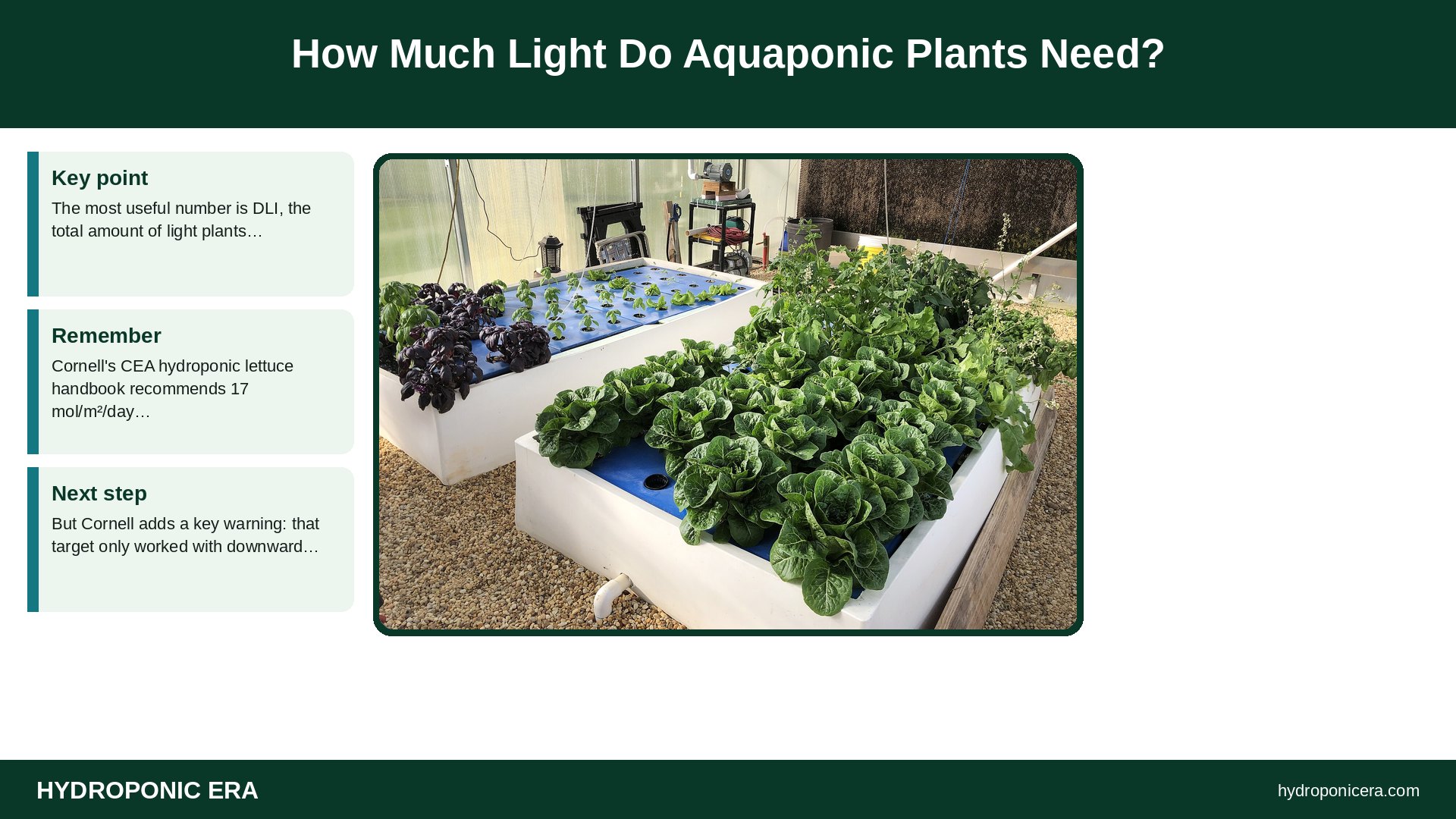
The most useful number is DLI, the total amount of light plants receive in a day. Cornell’s CEA hydroponic lettuce handbook recommends 17 mol/m²/day for its Boston Bibb lettuce system. But Cornell adds a key warning: that target only worked with downward airflow from overhead fans. Without it, they couldn’t go above about 12 mol/m²/day before tipburn appeared, because rapid growth outpaced calcium delivery to the young leaves.
To turn DLI into a fixture target, use this formula: PPFD = DLI ÷ (hours × 0.0036). For 17 mol over a 16-hour day, that’s about 295 µmol/m²/s at the plant tops. For 12 mol, it’s about 210 µmol/m²/s. Herbs fall in a similar range, while fruiting crops such as tomatoes and peppers need noticeably more light. See PPFD and DLI in hydroponics and grow lights for hydroponic lettuce.
Best Types of Aquaponics Grow Lights
- Full-spectrum LED: the best all-around option. Kentucky State University reports LED lifespans of 100,000+ hours, and its trials found LEDs produced more leafy green biomass than fluorescent, metal halide or induction lights. White light also makes it easier to spot pests and nutrient problems. See full spectrum grow lights.
- Fluorescent (T5): Kentucky State says fluorescents are mainly used for seedlings and vegetative growth. Fine for small herb beds, but less efficient. See T5 vs LED grow lights.
- HPS and metal halide: powerful, but they run hot and use more energy. Heat over a fish tank can push water temperature up. See LED vs HPS grow lights.
How to Choose LED Aquaponics Grow Lights
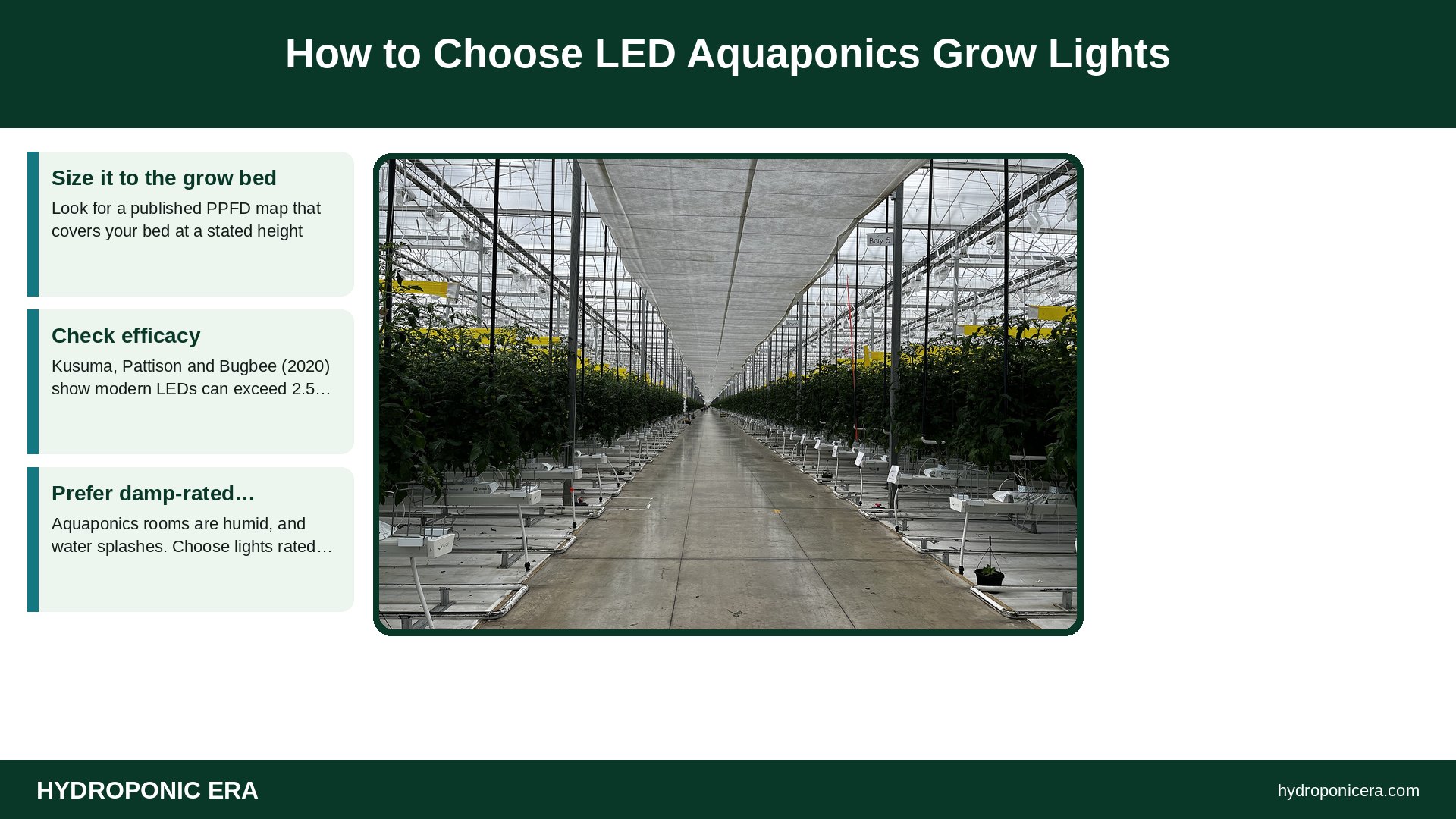
- Size it to the grow bed. Look for a published PPFD map that covers your bed at a stated height.
- Check efficacy. Kusuma, Pattison and Bugbee (2020) show modern LEDs can exceed 2.5 µmol/J, and the DesignLights Consortium uses efficacy thresholds for its horticultural product list. Higher efficacy means lower power bills.
- Prefer damp-rated fixtures. Aquaponics rooms are humid, and water splashes. Choose lights rated for damp or wet locations when possible.
- Get adjustable height or dimming so you can match light to seedlings, greens and fruiting plants.
- Ignore “watt equivalent” claims. Compare actual watts drawn, PPFD and µmol/J.
Aquaponics Grow Lights: Hanging Height and Schedule
Hanging height depends on the fixture, so follow its PPFD chart rather than a fixed rule. Start high and lower the light until you reach your PPFD target, then watch the plants. Pale, bleached leaves near the center mean the light is too strong or too close. Long, stretched stems mean too little light. A phone meter app can give a rough check. See light distance by growth stage and measuring PPFD with a phone.
For leafy greens, 14–16 hours of light a day on a timer is a common schedule. Keep the schedule steady, since sudden changes stress plants. See hydroponic light schedules.
Keeping Light Off the Fish Tank
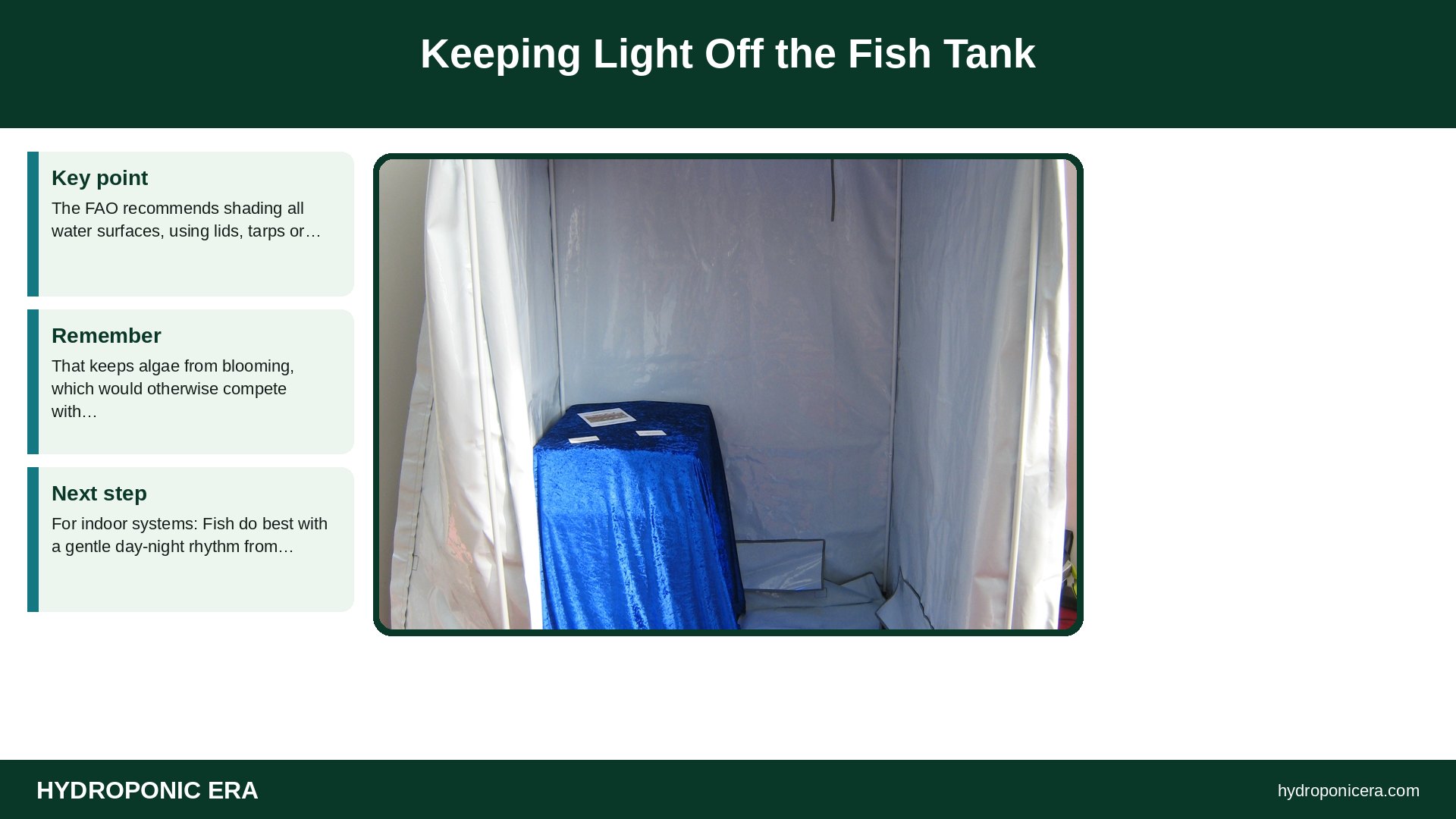
The FAO recommends shading all water surfaces, using lids, tarps or shade cloth so no water touches direct light. That keeps algae from blooming, which would otherwise compete with plants for nutrients, swing pH and oxygen, and clog pumps. For indoor systems:
- Use an opaque tank, or wrap a clear one.
- Cover the tank with a lid that has a feeding hatch.
- Aim lights at the beds and add reflective side panels if needed.
- Cover any exposed water in rafts or channels.
Fish do best with a gentle day-night rhythm from room light. A small aquarium light on a timer is plenty if you want to watch them. See aquaponics algae control.
Electrical Safety Near Water
The FAO advises shielding outlets from water and using a residual-current device, which is a GFCI in the U.S. Mount lights on chains or a sturdy frame so they can’t fall into the water, keep power strips off the floor, and add drip loops to all cords. Unplug lights before servicing the tank.
Common Mistakes With Aquaponics Grow Lights

- Lighting the tank: grows algae, not food.
- Too little light: slow, leggy greens.
- High light without airflow: Cornell found tipburn on lettuce above about 12 mol/m²/day without vertical airflow.
- Hot lamps over small tanks: raise water temperature and stress fish. See aquaponics water temperature.
- Buying by watt claims: check PPFD and efficacy instead.
Related reading: aquaponics lettuce and aquaponics herbs.
FAQs
Do aquaponics fish need grow lights?
No. Fish only need gentle room light; grow lights are for plants.
What DLI does aquaponic lettuce need?
About 12–17 mol/m²/day; the higher end needs good airflow.
Are LED grow lights best for aquaponics?
Yes for most systems: they’re efficient, long-lasting and run cooler than HPS.
How many hours should aquaponics grow lights run?
About 14–16 hours a day for leafy greens.
Can I use a regular LED bulb?
Only for a tiny herb bed; dedicated fixtures deliver far more usable light.
Why is my fish tank green under grow lights?
Light is reaching the water; cover and shade the tank.
Sources
- Cornell University CEA — Hydroponic Lettuce Handbook
- Kentucky State University — Aquaponics Handbook
- Kusuma, Pattison and Bugbee (2020), Horticulture Research — From physics to fixtures to food: current and potential LED efficacy
- DesignLights Consortium — Horticultural Technical Requirements V4.0
- FAO Fisheries and Aquaculture Technical Paper 589 — Small-scale aquaponic food production: Integrated fish and plant farming
- Photo credits (Wikimedia Commons, edited with titles): Terramera scientists working in a climate-controlled growth chamber located in Vancouver, BC. The space uses LED lighting, which supports plant growth. (50188965171) by Simon Fraser University – Communications & Marketing (CC BY 2.0); Deepwater Aquaponics Floating Rafts Growing Lettuce, Basil and Arugula by Alabama Extension (CC0); U.S. Department of Agriculture (USDA) Rural Development (RD) Ohio business program staff visited Mucci Farms, a 75-acre greenhouse production farm in Huron, Ohio on September 25, 2024 – 2 by USDAgov (Public domain); Led digital visuals-leds in grow box PNr°0082 by D-Kuru (CC BY-SA 3.0 at); Deepwater Aquaponics Floating Rafts Growing Lettuce, Basil and Arugula by Alabama Extension (CC0)