
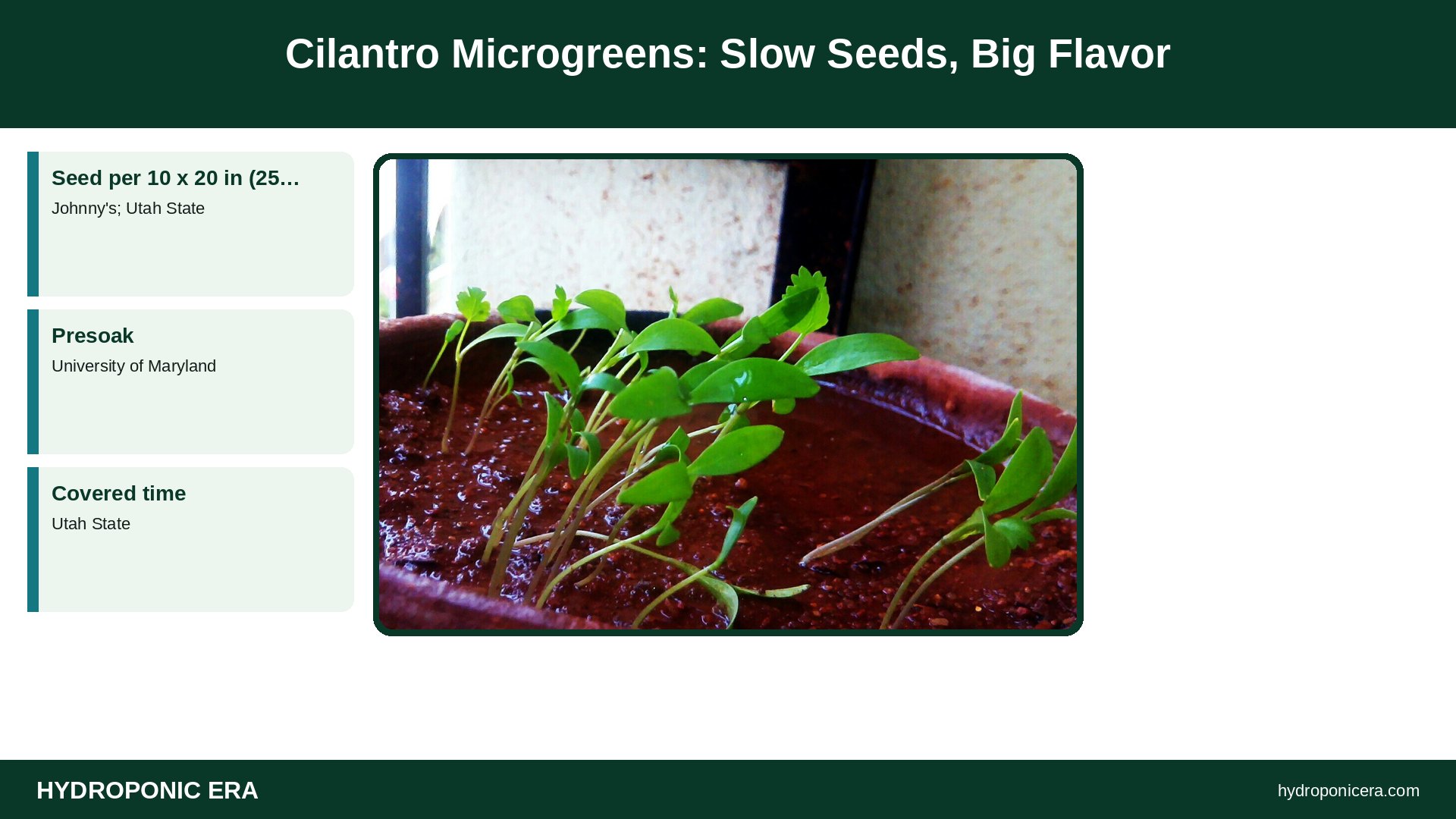
Cilantro microgreens are slow but worth it: expect about 16–28 days from sowing to harvest, with a long germination of up to 1–2 weeks. Sow about 26–28 grams of seed per 10 x 20 inch (25 x 51 cm) tray, ideally split or “monogerm” seed, which Johnny’s says germinates faster and sheds its seed coat more readily. Soaking whole seed for 6–12 hours can speed germination. Cilantro microgreens taste like mature cilantro and were the top source of carotenoids among 25 microgreens tested by USDA researchers.
Key takeaway: Patience is the main skill. Use split seed, keep the tray evenly moist and dark until most seeds sprout, and don’t give up on day 5.
| Cilantro microgreens at a glance | Value | Source |
|---|---|---|
| Seed per 10 x 20 in (25 x 51 cm) tray | 26–28 g | Johnny’s; Utah State |
| Presoak | Optional, 6–12 hours | University of Maryland |
| Covered time | 7–14 days | Utah State |
| Days to harvest | 20 days (Johnny’s); 21–28 days (Utah State) | Johnny’s; Utah State |
| Yield per tray | About 6 oz (170 g) (Johnny’s); 0.1 lb (46.8 g) (Penn State, unlit greenhouse) | Johnny’s; Penn State |
| Seed cost per tray | About $0.28 | Utah State |
Why Cilantro Microgreens Are Different
What we call a cilantro “seed” is actually a small, round fruit (coriander) that usually holds two seeds inside a hard shell. That shell slows water uptake and makes germination slow and uneven. Johnny’s sells monogerm (split) cilantro seed for microgreens because it germinates faster and sheds the seed coat more readily than whole seed. Maryland Extension lists cilantro among the seeds whose germination speeds up after soaking 6–12 hours, along with pea, sunflower, beet and buckwheat.
How to Grow Cilantro Microgreens
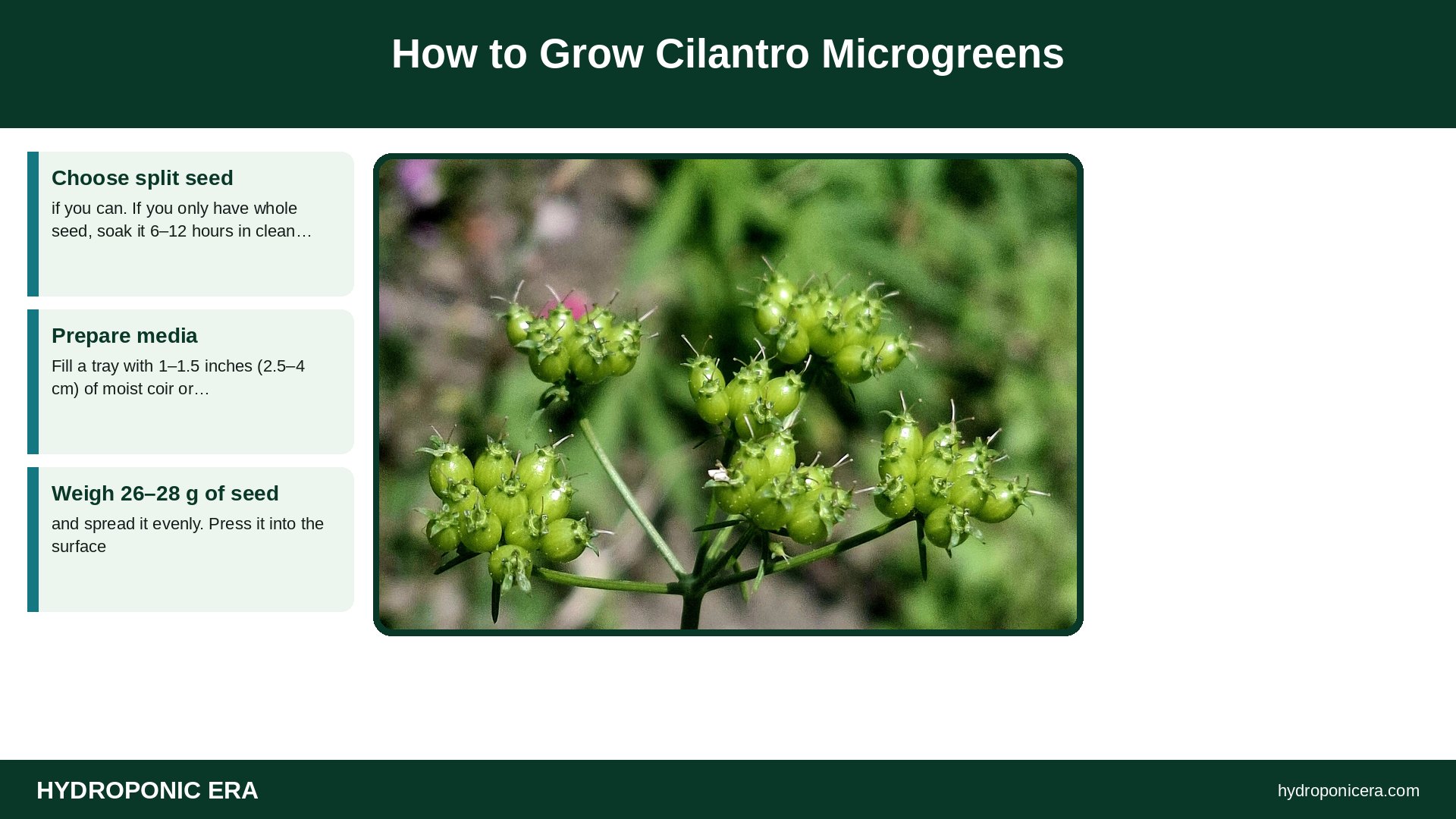
- Choose split seed if you can. If you only have whole seed, soak it 6–12 hours in clean water and drain well.
- Prepare media. Fill a tray with 1–1.5 inches (2.5–4 cm) of moist coir or seed-starting mix. Coir or soil holds moisture longer than a thin mat, which helps during the long germination.
- Weigh 26–28 g of seed and spread it evenly. Press it into the surface.
- Cover and weight. Utah State keeps cilantro covered 7–14 days; press with a light weight for the first half of that time.
- Keep evenly moist. Mist when the surface looks dry. Letting it dry out stops germination.
- Uncover once most seeds have sprouted and give 16–18 hours of light.
- Bottom water to keep the slender leaves dry.
- Harvest at about 20–28 days, when the narrow seed leaves are open and the first lacy true leaf appears.
Temperature for Cilantro Microgreens
Penn State gives 60–75°F (16–24°C) for germinating microgreens and 60–70°F (16–21°C) air. Johnny’s comparison chart suggests germinating microgreens at about 75°F (24°C) and then growing on at about 60°F (16°C). Cilantro is a cool-season herb, so it does best in the cooler range once up. Utah State’s indoor schedule runs 74°F (23°C) for germination and 72°F (22°C) under lights, falling to 68°F (20°C) at night.
Light
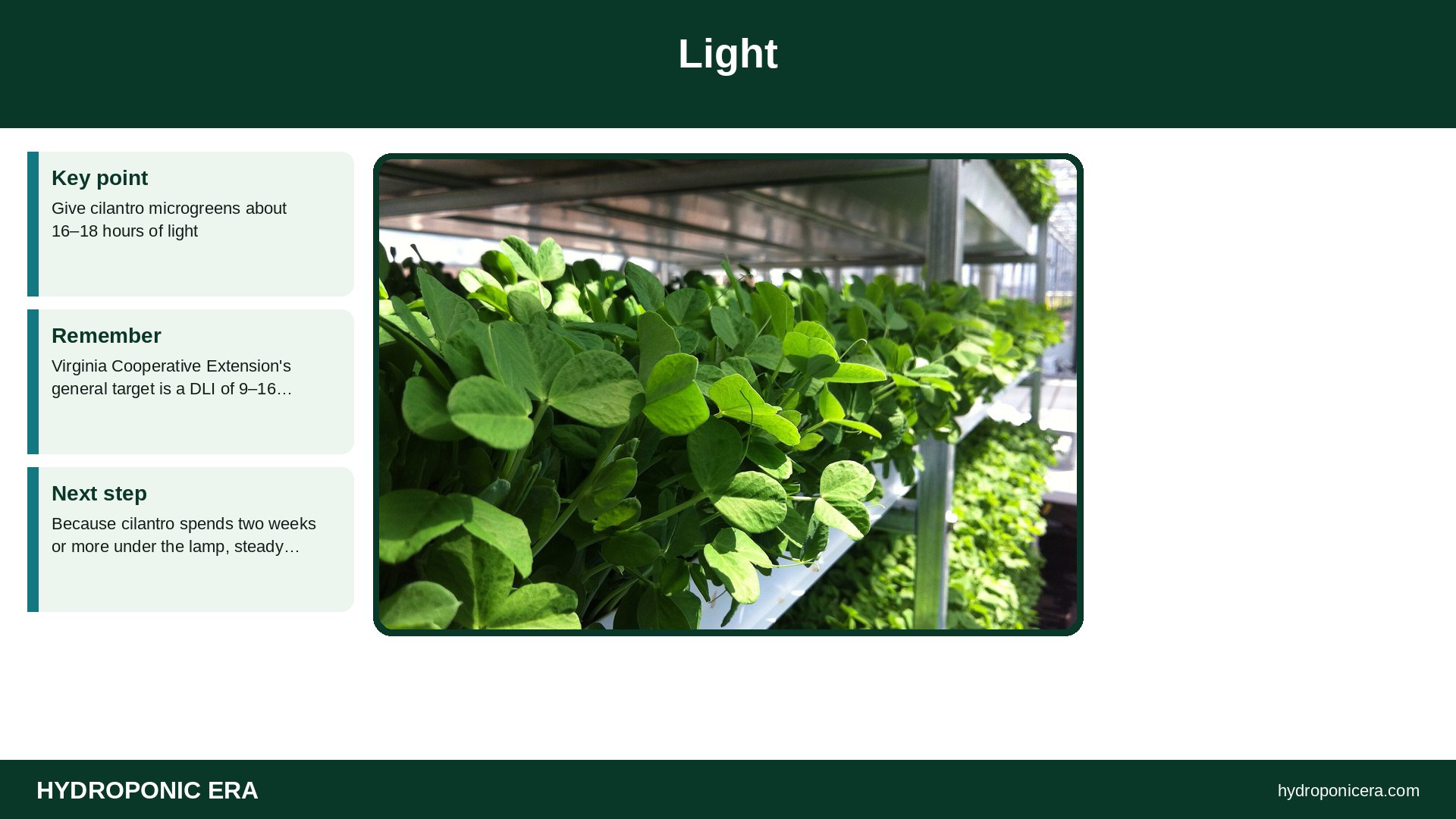
Give cilantro microgreens about 16–18 hours of light. Virginia Cooperative Extension’s general target is a DLI of 9–16 mol/m²/day, which you can reach at about 150–250 µmol/m²/s over 16–18 hours. Because cilantro spends two weeks or more under the lamp, steady light matters more than with fast crops. See microgreens light requirements.
Yield: Lower Than Most
Cilantro microgreens yield less than brassicas. In Penn State’s greenhouse trials without supplemental light, cilantro averaged 0.1 lb (46.8 g) per tray, the lowest of 18 crops, compared with 0.44 lb (201 g) for Red Rain mustard. Johnny’s trial, harvested at first true leaf, recorded about 6 oz (170 g) per tray from 26 g of seed and noted 1 oz (28 g) of seed sows about one flat. Their flavor and nutrients are why growers and chefs still choose them. See microgreen seed density.
Nutrition
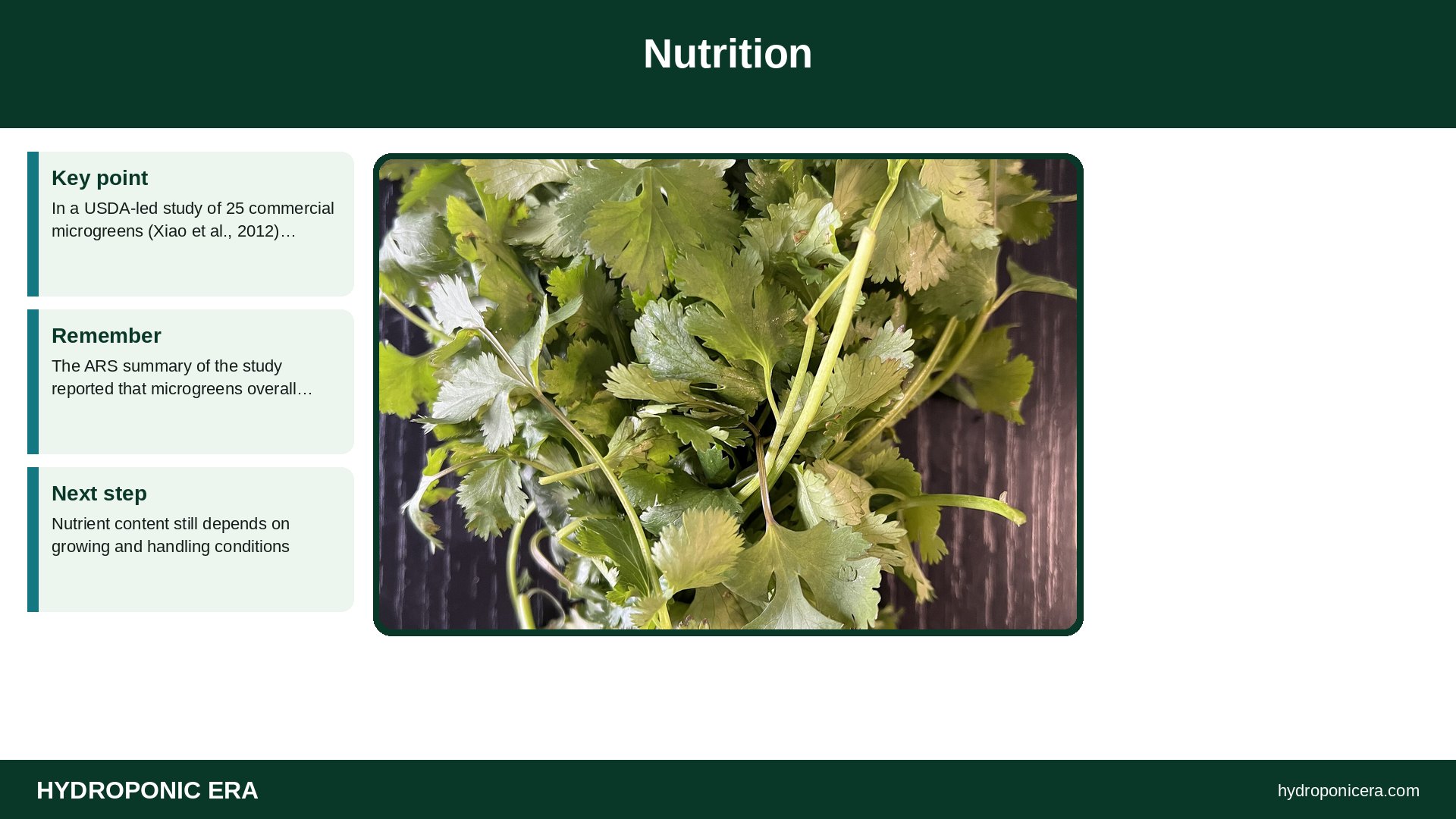
In a USDA-led study of 25 commercial microgreens (Xiao et al., 2012), cilantro had the highest concentrations of carotenoids, the pigments that include beta-carotene, a vitamin A precursor, and lutein. The ARS summary of the study reported that microgreens overall contained about five times greater levels of vitamins and carotenoids than mature plants. Nutrient content still depends on growing and handling conditions.
Common Problems With Cilantro Microgreens
| Problem | Likely cause | Fix |
|---|---|---|
| Nothing after a week | Normal for whole seed | Keep moist and dark; wait up to 14 days |
| Uneven stand | Whole seed germinates unevenly | Use split seed or soak first |
| Hulls stuck on leaves | Seed coat not shed | Mist; use monogerm seed |
| Mold during long blackout | Too wet, no airflow | Vent covers daily; don’t overwater |
| Leggy, pale seedlings | Covered too long after sprouting | Uncover as soon as most are up |
See microgreens mold.
Harvesting and Storage
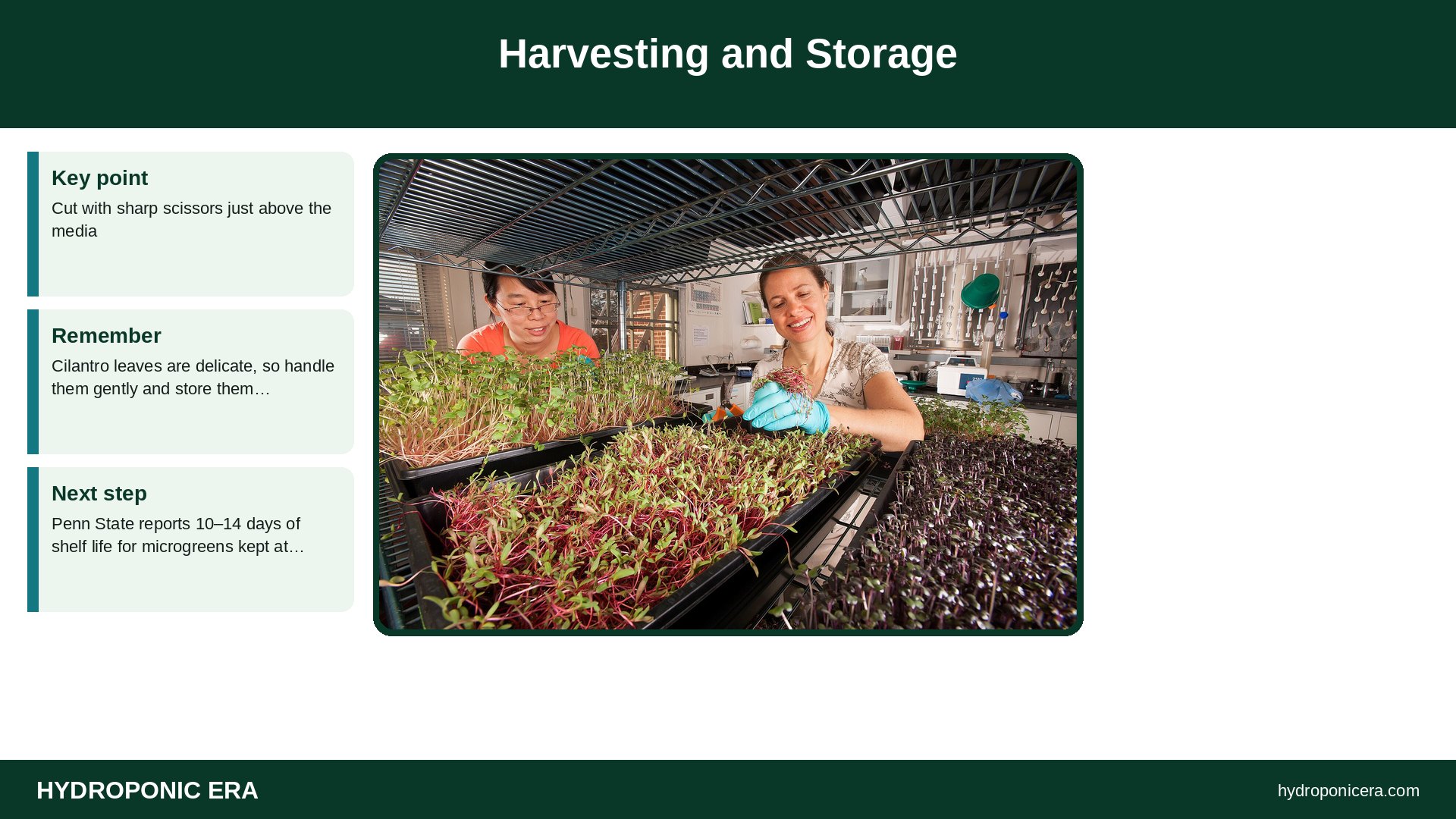
Cut with sharp scissors just above the media. Cilantro leaves are delicate, so handle them gently and store them unwashed in a sealed container in the fridge. Penn State reports 10–14 days of shelf life for microgreens kept at 41°F (5°C) in the dark, but delicate herbs usually fade sooner, so use cilantro microgreens within a few days. See how to harvest microgreens and how long microgreens last.
How to Use Cilantro Microgreens
Use them anywhere you’d use cilantro leaves: tacos, salsa, curries, pho, rice bowls and salads. Add them at the end of cooking or raw, since heat dulls their flavor. Their small size makes them an easy garnish, and a small tray goes a long way. If you love the flavor but want faster results, grow a tray of cilantro microgreens alongside quick crops like radish so you always have something to harvest. See best microgreens to grow.
Planning Around Cilantro’s Slow Timeline
Cilantro is the slowest crop most home growers try. In Johnny’s 2017 trial it averaged about 20 days to harvest from 26 g of seed and yielded about 6 oz (170 g) per tray. By comparison, Hong Vit radish in the same trial gave about 11.5 oz (326 g) in 9.5 days. So cilantro microgreens take roughly twice as long for about half the weight.
That doesn’t make them a bad crop, it just changes the plan. If you want a tray every week, you’ll need about three trays in rotation, each sown 7 days apart. Start your first tray about 3 weeks before you need it, and keep a separate tray for fast crops so the slow cilantro doesn’t hold up your shelf.
FAQs
How long do cilantro microgreens take?
About 20–28 days, including up to 2 weeks to germinate.
Should I soak cilantro seeds?
Soaking whole seed for 6–12 hours can speed germination.
What is split cilantro seed?
Seed with the husk split so it germinates faster and sheds more easily.
How much cilantro seed per tray?
About 26–28 g per 10 x 20 inch (25 x 51 cm) tray.
Why aren’t my cilantro seeds sprouting?
Give them time, keep them moist and warm, and use fresh seed.
Are cilantro microgreens nutritious?
Yes; they ranked highest for carotenoids in a USDA study of 25 microgreens.
Sources
- Johnny’s Selected Seeds — Microgreens Comparison Chart
- Johnny’s Selected Seeds — Micro Greens Yield Trial 2017
- Utah State University Extension — Grow Your Own Microgreens
- University of Maryland Extension — Growing Microgreens and Baby Greens Indoors
- Penn State Extension — Growing Microgreens
- Xiao et al. (2012), Journal of Agricultural and Food Chemistry — Vitamin and Carotenoid Concentrations of Edible Microgreens
- USDA ARS — Specialty Greens Pack a Nutritional Punch
- Virginia Cooperative Extension — Introduction to Microgreen Production
- Photo credits (Wikimedia Commons, edited with titles): Coriander plant by Bharathnallan (CC BY-SA 4.0); Coriander Green Seeds (Coriandrum sativum) in Shimla by Sapna Sony (CC BY-SA 4.0); Lufa Farms Microgreens in Trays by Lufa Farms (CC BY-SA 2.0); Liat Portal for Foodie Disorder – Cilantro from San Francisco Farmers Market by HaJunkiyada (CC BY-SA 4.0); Liping Kou observes microgreens by Peggy Greb (Public domain)