
Mustard microgreens are among the fastest and most productive microgreens: sow about 8–15 grams of seed per 10 x 20 inch (25 x 51 cm) tray with no soaking, keep it covered 1–2 days, and harvest in about 10–14 days. They taste spicy, like a mild wasabi or horseradish, and come in green, red and frilly types. In Penn State’s trials, Red Rain mustard gave the highest yield of 18 microgreens tested, about 0.44 lb (201 g) per tray.
Key takeaway: Mustard seed is tiny, so sow light. A little seed covers a whole tray, and a bit more light than average brings out the best red color.
| Mustard microgreens at a glance | Value | Source |
|---|---|---|
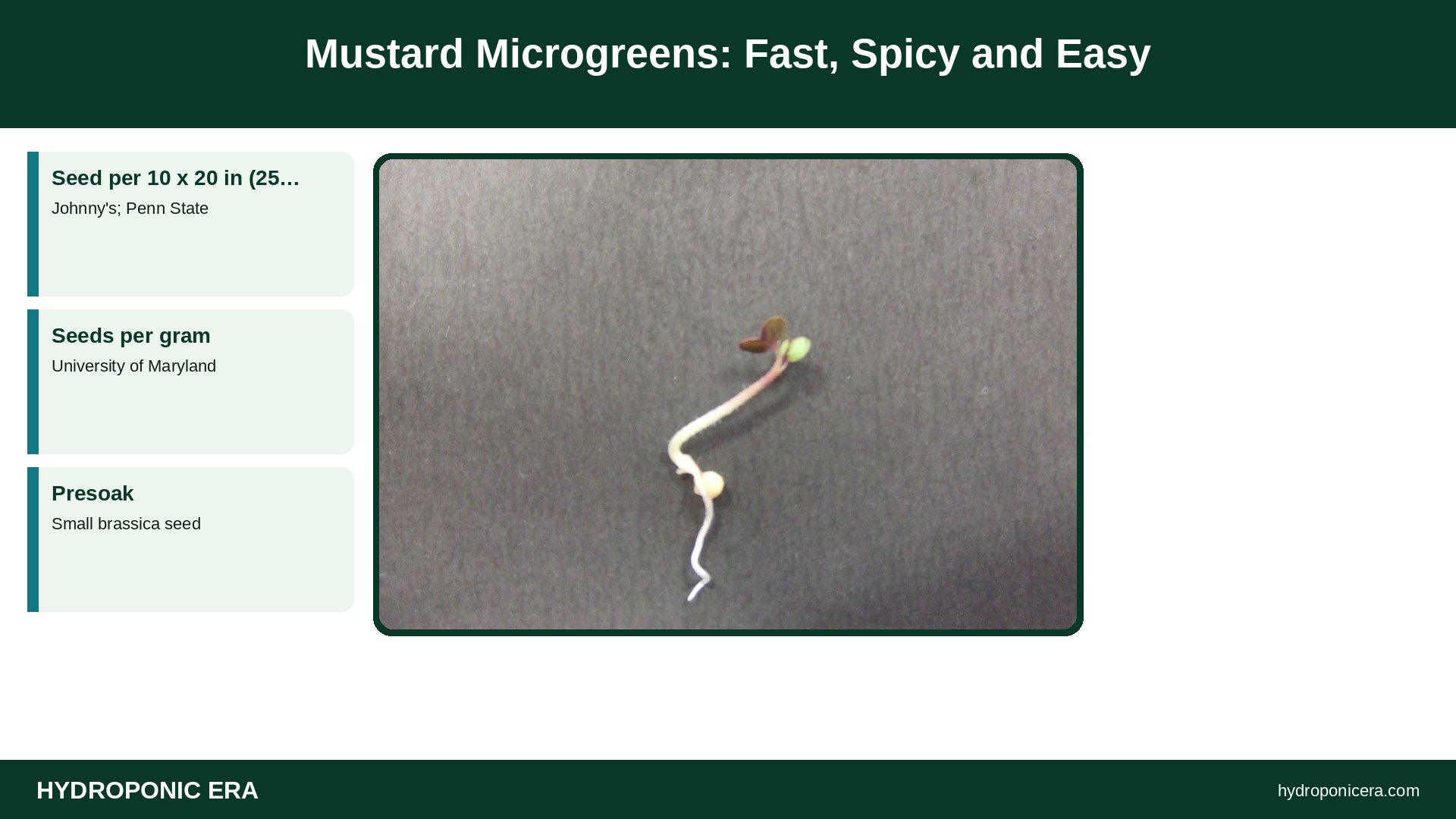
| Seed per 10 x 20 in (25 x 51 cm) tray | 8 g (Garnet Giant); 10–15 g typical | Johnny’s; Penn State |
| Seeds per gram | About 530 | University of Maryland |
| Presoak | No | Small brassica seed |
| Days to harvest | About 12.5 days (Garnet Giant); fast group 10–15 days | Johnny’s |
| Light target | DLI 12 mol/m²/day or more | Virginia Tech (Allred and Mattson 2024) |
| Yield per tray | About 9.5 oz (269 g) (Johnny’s); 0.44 lb (201 g) Red Rain (Penn State) | Johnny’s; Penn State |
Best Varieties for Mustard Microgreens
Johnny’s comparison chart lists many mustards for microgreens, all in its fast-growing group of 10–15 days:
- Garnet Giant: bright green and red leaves; spicy.
- Red Giant: green leaves with red veins; spicy.
- Ruby Streaks: deeply serrated green and maroon leaves; spicy.
- Scarlet Frills: lobed green-red leaves; very spicy.
- Wasabina: heavily frilled green leaves; spicy.
- Miz America and Red Katana: dark red leaves; milder mustard flavor.
Penn State’s trials used Red Rain, which out-yielded every other crop it tested. Mixing a red and a green mustard in separate trays gives you color contrast for salads.
How to Grow Mustard Microgreens
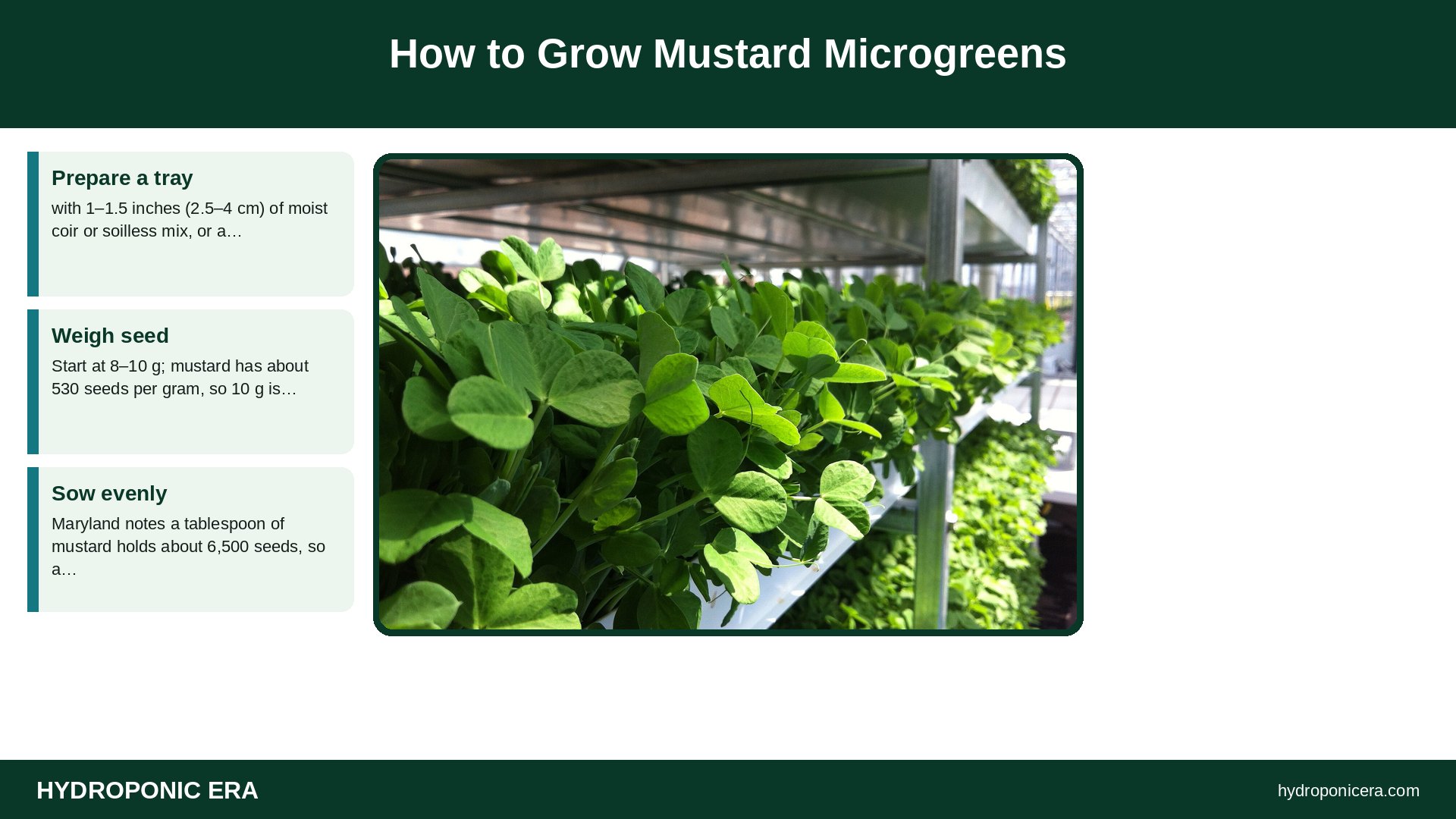
- Prepare a tray with 1–1.5 inches (2.5–4 cm) of moist coir or soilless mix, or a soaked hemp mat.
- Weigh seed. Start at 8–10 g; mustard has about 530 seeds per gram, so 10 g is roughly 5,300 seeds.
- Sow evenly. Maryland notes a tablespoon of mustard holds about 6,500 seeds, so a tablespoon is plenty for a flat.
- Mist and cover with another tray and a light weight.
- Keep warm. Cabbage-family seeds germinate in about 36 hours at 72°F (22°C), says Maryland.
- Uncover after 1–2 days and move under light.
- Bottom water once seedlings are up.
- Harvest at 10–14 days, when leaves are open and colored.
Light for Mustard Microgreens
Virginia Tech’s guide cites research suggesting mizuna and mustard microgreens may benefit from a DLI of 12 mol/m²/day or higher, more than arugula’s 9. That’s about 200 µmol/m²/s for about 17 hours, or 185 µmol/m²/s for 18 hours. Red mustards in particular color up more under brighter light. In dim light they stay greener and stretch. See microgreens light requirements and PPFD and DLI explained.
Why Mustard Microgreens Are So Productive
| Crop (Penn State, 10–15 g seed, 2-week cycle) | Yield per tray |
|---|---|
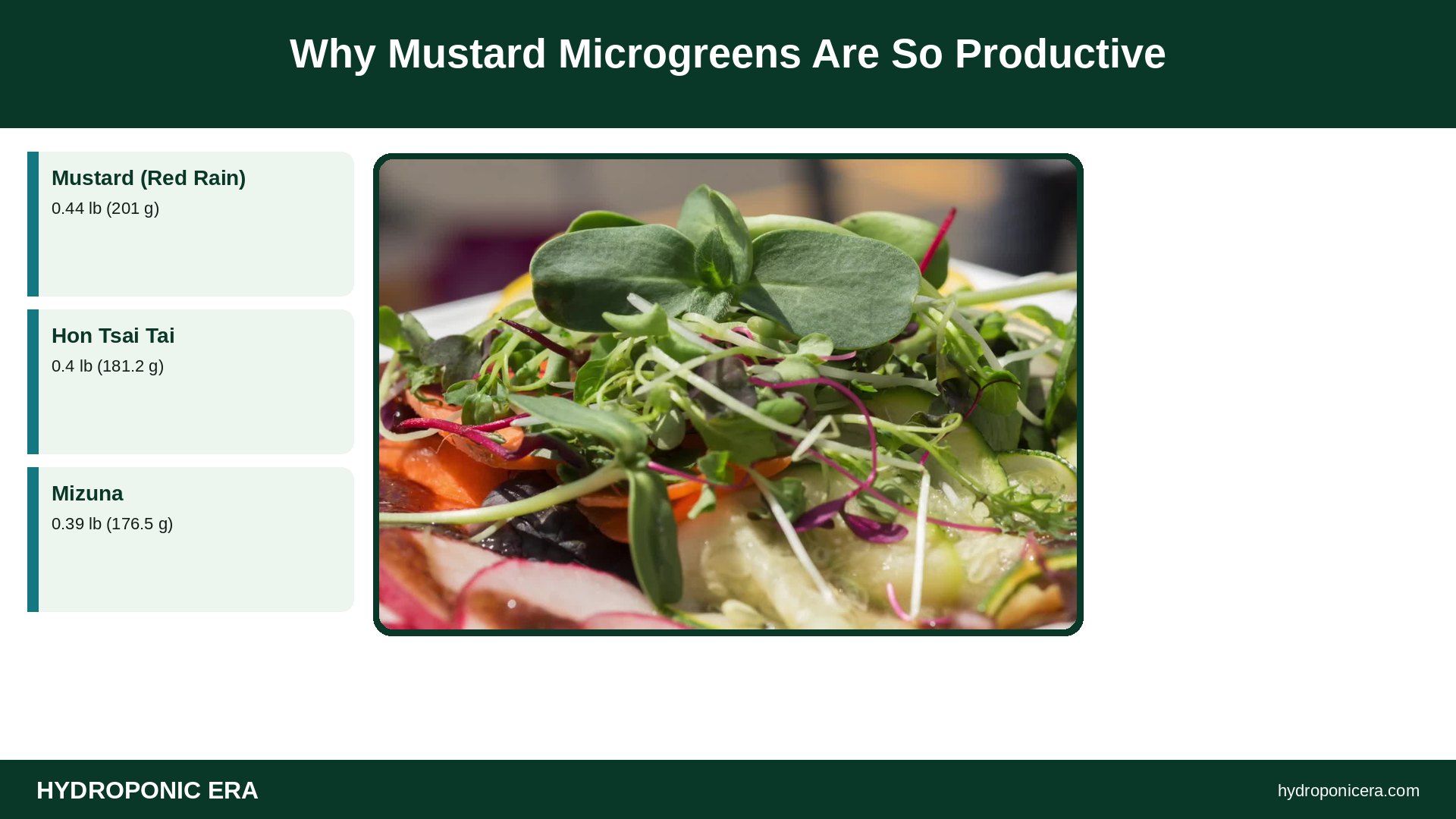
| Mustard (Red Rain) | 0.44 lb (201 g) |
| Hon Tsai Tai | 0.4 lb (181.2 g) |
| Mizuna | 0.39 lb (176.5 g) |
| Kale (Russian) | 0.34 lb (154.6 g) |
| Arugula | 0.33 lb (147.6 g) |
| Cilantro | 0.1 lb (46.8 g) |
Small seeds mean many plants per gram, and mustard seedlings grow quickly with large leaves. Johnny’s trial got about 9.5 oz (269 g) of Garnet Giant per tray from just 8 g of seed, and noted 1 oz (28 g) of seed sows about 3.5 flats, making mustard one of the cheapest crops per tray. See microgreen seed density.
Flavor and Heat
Mustard microgreens get their bite from the same compounds that make mustard and horseradish hot. Heat varies by variety, from mild Miz America to very spicy Scarlet Frills. Harvest earlier for a gentler flavor. The heat fades with cooking, so add them at the end. Mustard pairs well with sandwiches, sushi, steak, eggs and potato salad.
Common Problems
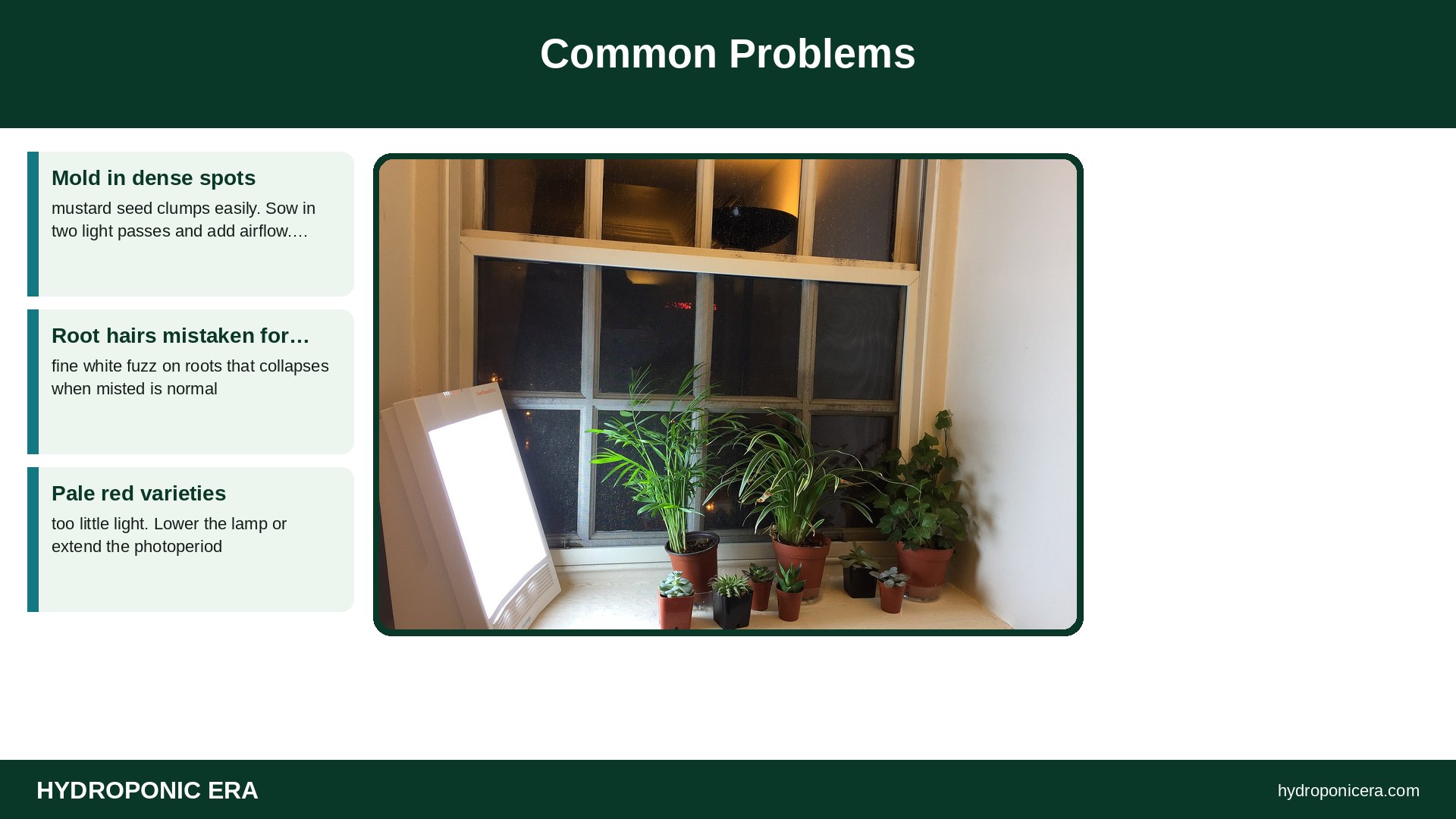
- Mold in dense spots: mustard seed clumps easily. Sow in two light passes and add airflow. See microgreens mold.
- Root hairs mistaken for mold: fine white fuzz on roots that collapses when misted is normal.
- Pale red varieties: too little light. Lower the lamp or extend the photoperiod.
- Leaning seedlings: light from one side. Rotate the tray daily if using a window.
- Damping-off: crowded, wet trays. Bottom water and sow lighter. See damping-off.
Harvesting and Storage
Cut mustard microgreens just above the media with clean scissors once the leaves are open and colored. Store unwashed in a sealed container in the fridge, and wash just before eating. Penn State reports microgreens kept at 41°F (5°C) in the dark can last 10–14 days. See how to harvest microgreens and how long microgreens last.
Mustard Microgreens in Hydroponic Systems
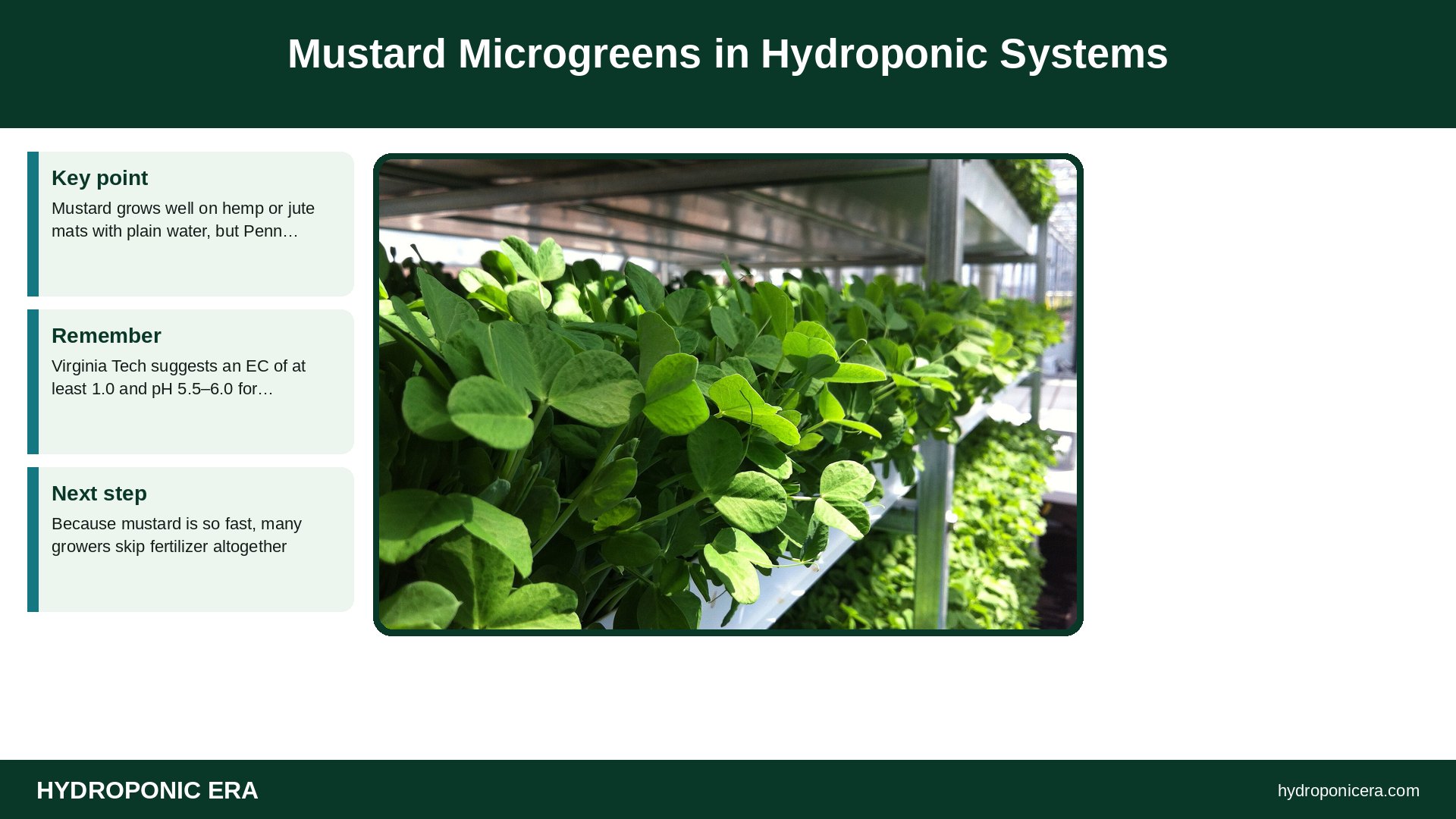
Mustard grows well on hemp or jute mats with plain water, but Penn State notes that a dilute feed of 50–100 ppm nitrogen can help. Virginia Tech suggests an EC of at least 1.0 and pH 5.5–6.0 for hydroponic microgreens. Because mustard is so fast, many growers skip fertilizer altogether. See microgreen grow mats.
For a quick, spicy and high-yielding crop, mustard microgreens are hard to beat. Try one red and one green variety and see which flavor you prefer. See best microgreens to grow.
Buying Seed and Staying Safe
Buy mustard seed sold for microgreens or sprouting. Penn State advises against pesticide-treated seed, since the seed coat can stay on the seedling and be eaten. Bulk seed lowers your cost per tray a lot: Maryland Extension notes seed sold in 1/32 ounce (about 1 g) packets can cost 30 times more per seed than quarter-pound (113 g) bags. Store leftover seed in a cool, dry, dark place in a sealed container so it keeps its germination rate. Wash your trays between crops, use clean water, and wash the greens before eating. These simple habits matter more than any special equipment when growing a raw crop like mustard microgreens.
Mixing Mustard With Milder Microgreens
Mustard finishes on almost the same timeline as other brassicas. In Johnny’s 2017 trial, Garnet Giant mustard took about 12.5 days, broccoli 12.5 days and Red Russian kale 13.5 days, so they can share a tray and be cut together. Johnny’s also sells a Spicy Micro Mix that averaged about 13.5 days and 10 oz (283 g) per tray. If straight mustard is too hot for your family, try a blend of mustard with a mild brassica like broccoli or kale to soften the bite.
FAQs
How long do mustard microgreens take?
About 10–14 days.
Do mustard seeds need soaking?
No; sow them dry.
How much mustard seed per tray?
About 8–15 g per 10 x 20 inch (25 x 51 cm) tray.
Are mustard microgreens spicy?
Yes, from mild to very spicy depending on variety.
Why are my red mustard microgreens green?
They need more light to develop red color.
Which mustard yields best?
Red Rain topped Penn State’s yield trials.
Sources
- Penn State Extension — Growing Microgreens
- Johnny’s Selected Seeds — Microgreens Comparison Chart
- Johnny’s Selected Seeds — Micro Greens Yield Trial 2017
- University of Maryland Extension — Growing Microgreens and Baby Greens Indoors
- Virginia Cooperative Extension — Introduction to Microgreen Production
- Photo credits (Wikimedia Commons, edited with titles): Mustard seedling by Tess Watson from Edinburgh, Scotland, UK (CC BY 2.0); Lufa Farms Microgreens in Trays by Lufa Farms (CC BY-SA 2.0); 20160617-AMS-LSC-9000 (61-sec.) (27334710733) by U.S. Department of Agriculture (Public domain); Potted plants succulents under grow light Nov 2016 by Asdfjrjjj (CC BY-SA 4.0); Lufa Farms Microgreens in Trays by Lufa Farms (CC BY-SA 2.0)