
Why is my rosemary dying indoors? Rosemary dying indoors is most often caused by watering problems: soggy soil rots roots, while a bone-dry pot causes drought. NC State Extension calls overwatering the common cause of decline. Other causes are weak winter light, warm dry rooms, spider mites, powdery mildew and repotting stress after digging from the garden.
Key takeaway: Rosemary is a Mediterranean shrub that hates wet roots and dim light, so winter indoors is hard on it. Extension experts from New Hampshire, Nebraska and North Carolina agree on the fixes: a very bright window, a cool room around 45 to 55°F (7 to 13°C), and careful watering. Here is how to diagnose rosemary dying indoors.
| Symptom | Likely Cause | Source |
|---|---|---|
| Brown, soft roots; sudden collapse | Overwatering, root rot | NC State; Nebraska |
| Dry, brittle needles | Pot dried out completely | UNH Extension |
| Curling leaves | Moisture stress | UNH Extension |
| Thin, spindly stems | Too little light | UNH Extension |
| White powder on leaves | Powdery mildew, poor airflow | NC State |
| Fine webbing, speckling | Spider mites | NC State; UNH |
| Decline right after potting up | Repotting stress | UNH Extension |

Why Is My Indoor Rosemary Dying?
The short answer: water, light and temperature are out of balance. UNH Extension says keeping rosemary alive through winter is a real challenge, and that watering is the single most difficult part. Plants dry out quickly and suffer drought, but they also rot if kept too moist. That narrow window explains most rosemary dying indoors.
- Overwatering: NC State says overwatering is the common cause of decline or death.
- Underwatering: a pot that dries out fully can kill the plant fast (UNH).
- Low light: thin, stretched stems signal too little light (UNH).
- Warm rooms: warm air speeds drying and stress; cooler rooms help (UNH).
- Pests and disease: spider mites, aphids, mealybugs, whiteflies and powdery mildew (NC State).
- Transplant stress: UNH notes plants dug from the garden often fail after repotting.
If you are growing it without soil, see how to grow rosemary hydroponically.

Is It Overwatering or Low Light?
Check the roots and the stems. Overwatering shows up as wet mix, dark mushy roots and a whole plant that browns at once. Low light shows up slowly as long, pale, spindly shoots with wide gaps between leaves, as UNH describes for herbs. Rosemary dying indoors can suffer both at once, since dim plants use less water and stay wet longer.
- Pot feels heavy days after watering: likely overwatering.
- Mix smells sour, roots are brown and soft: root rot.
- New growth is stretched and pale: too little light.
- Needles crisp and pull off easily: the pot dried out.
Nebraska Extension says the biggest threat to rosemary in winter is wet, poorly drained soil leading to root rot. Use a pot with a drainage hole; UNH warns that stones in a pot without holes keep roots too wet.

How Do You Keep Rosemary Alive in Winter?
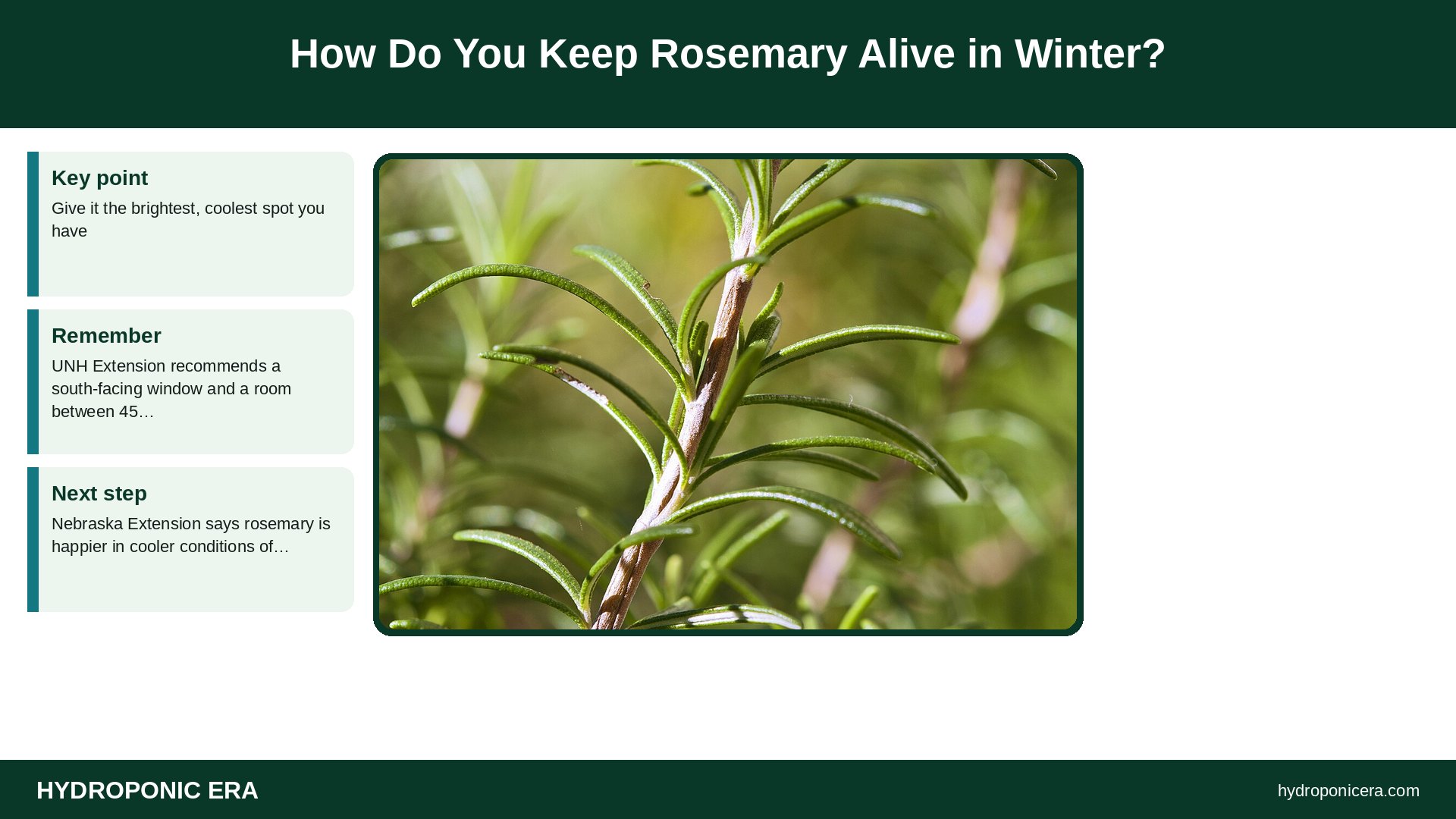
Give it the brightest, coolest spot you have. UNH Extension recommends a south-facing window and a room between 45 and 55°F (7 and 13°C), which lowers water needs. Nebraska Extension says rosemary is happier in cooler conditions of 50 to 55°F (10 to 13°C) and should be kept evenly moist to slightly dry. These steps prevent most rosemary dying indoors.
- Start with a plant grown in a container all season, as UNH advises.
- Place it in an unobstructed south window.
- Keep the room cool, ideally 45 to 55°F (7 to 13°C).
- Water only when the mix is very dry, then water until it drains (UNH).
- Empty the saucer so roots never sit in water (our guidance).
- Keep leaves a few inches from cold, drafty glass (UNH).
For a fuller winter setup, see indoor herb garden.
Do Grow Lights Help Rosemary Dying Indoors?
Yes, when window light is weak. UNH says herbs need enough light, and suggests a full-spectrum grow light for 14 to 16 hours a day when no unobstructed south window is available. That advice is for herbs in general, but it suits rosemary dying indoors from low winter light (our guidance).
- Hours: 14 to 16 hours a day under a grow light (UNH, herbs).
- Distance: follow the fixture maker’s guide; many LEDs sit 6 to 12 in (15 to 30 cm) above herbs (our guidance).
- More detail: see how much light herbs need.
How Do You Treat Pests and Mildew on Indoor Rosemary?
NC State says to watch indoor rosemary for aphids, mealybugs, whiteflies and spider mites, and notes that poor circulation and high humidity cause powdery mildew. UNH suggests spraying the foliage with a heavy stream of water every day or so to knock spider mites off.
- Spider mites: rinse leaves with a strong spray in a sink or shower (UNH).
- Heavy infestations: horticultural oil or insecticidal soap, used per the label (UNH).
- Powdery mildew: improve airflow and avoid misting rosemary (our guidance).
Can You Save Rosemary That Is Already Dying?
Sometimes. If some stems are still green and flexible, cut out dead growth, check the roots and repot rotted plants into fresh, gritty, well-drained mix (our guidance). Take a few healthy tip cuttings as backup; see rosemary cuttings in water. Rosemary dying indoors with all-brown, brittle stems will not recover.
FAQ About Rosemary Dying Indoors
What is the most common reason for rosemary dying indoors?
Overwatering, per NC State Extension.
How cold should rosemary be kept indoors?
About 45 to 55°F (7 to 13°C), per UNH Extension.
How often should I water indoor rosemary?
Only when the potting mix is very dry.
Why are my rosemary leaves curling?
UNH says it is often a sign of moisture stress.
Can rosemary live indoors all year?
It can, with bright light, cool air and careful watering.
Is rosemary dying indoors from low humidity?
Dry air matters less than watering and light (our guidance).
Sources
- North Carolina Extension Gardener Plant Toolbox — Rosemary (Salvia rosmarinus)
- University of New Hampshire Extension — Houseplant Winter Care Q&A
- Nebraska Extension in Lancaster County — Rosemary, An Herb for All Seasons
- Ask Extension — Winter Care of Rosemary
- Photo credits (Wikimedia Commons, edited with titles): Rosmarinus officinalis133095382 by THOR (CC BY 2.0); Rosmarinus officinalis (1) by T137 (CC BY-SA 3.0)