
What is K1 media in aquaponics? K1 media aquaponics growers use is a small polyethylene biofilm carrier, about 0.36 in (9.1 mm) across, that tumbles in an aerated tank so nitrifying bacteria can turn fish ammonia into nitrate. Research on Kaldnes reactors recommends filling under 70% of the tank for free movement.
Key takeaway: K1 is the original Kaldnes moving bed biofilm reactor (MBBR) carrier. Research in Aquacultural Engineering, the FarmHub Aquateach aquaponics course and a Global Seafood Alliance sizing column explain how it works, how much to use and why it needs strong aeration. This guide turns that data into K1 media aquaponics sizing for home systems.
| Factor | K1 Media Aquaponics Data | Source |
|---|---|---|
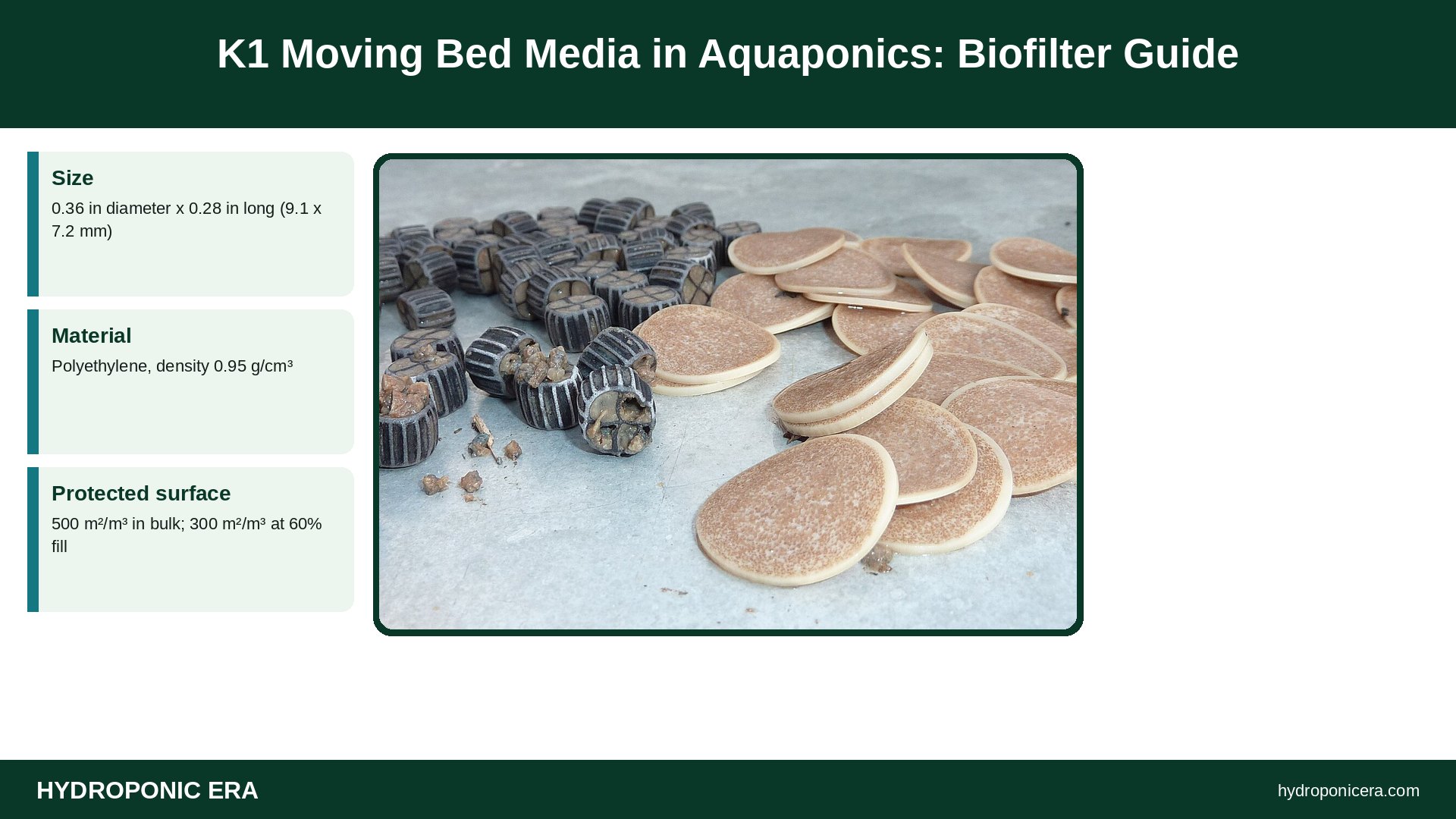
| Size | 0.36 in diameter x 0.28 in long (9.1 x 7.2 mm) | Rusten et al. 2006 |
| Material | Polyethylene, density 0.95 g/cm³ | Rusten et al. 2006 |
| Protected surface | 500 m²/m³ in bulk; 300 m²/m³ at 60% fill | Rusten et al. 2006 |
| Fill level | Under 70%; typically 40 to 60% | Rusten; FarmHub manual |
| Design conversion | About 350 g TAN/m³/day | Global Seafood Alliance |
| Movement | Aeration keeps it tumbling | FarmHub manual |
| Cleaning | Backwash about once a week | FarmHub manual |
What Is K1 Media?
K1 is a small, wheel-shaped plastic carrier with internal fins. Rusten and colleagues (Aquacultural Engineering, 2006) list K1 at 9.1 mm diameter and 7.2 mm long, made of high-density polyethylene with a density of 0.95 g/cm³, so new pieces float. Bacteria grow on the protected inner surfaces while outer surfaces are scrubbed by collisions.
In K1 media aquaponics, those bacteria do nitrification: they turn fish ammonia into nitrite, then nitrate that plants use. The FarmHub aquaponics manual calls the moving bed biofilm reactor the most commonly used biofilter type in aquaponics and recirculating aquaculture (RAS).
- Protected area: 500 m²/m³ in bulk, 300 m²/m³ at 60% fill (Rusten).
- Self-cleaning: tumbling keeps the biofilm thin (Rusten; FarmHub).
- Bonus: the air also degasses CO2 and adds oxygen (FarmHub).
For the basics of bacteria in your loop, see nitrifying bacteria in aquaponics.

How Much K1 Do You Need per Pound of Fish?
Size K1 media aquaponics filters by feed, not fish weight. The Global Seafood Alliance method estimates daily ammonia (TAN) as feed x protein x 0.5 nitrogen wasted x 0.16 g N per g protein x 1.2, then divides by a conversion rate of about 350 g TAN per cubic meter per day for moving-bed media. With 40% protein feed, each pound (0.45 kg) of feed a day needs about 13 gal (50 L) of K1.
- 1 lb (0.45 kg) feed/day: about 17 g TAN, so about 13 gal (50 L) of K1.
- Tank size: keep fill at or under 70%, so about 19 gal (71 L) of tank for 13 gal (50 L) of media.
- Per pound of fish: fish eating 1 to 2% of body weight daily need about 0.13 to 0.26 gal (0.5 to 1 L) of K1 per lb (our guidance).
- Safety margin: double it for cool water or low ammonia (our guidance).
The column warns that the lower the TAN reaching a filter, the lower its conversion rate, and aquaponics usually runs low TAN. That is why a margin matters. For stocking, see aquaponics stocking density.

Does K1 Need Aeration to Move?
Yes. K1 media aquaponics filters rely on air to keep carriers moving. The FarmHub manual says moving-bed media are kept in constant movement by aeration, and Rusten’s team describes a coarse-bubble aeration grid built for Kaldnes reactors. Sieves at the outlet keep the media in the tank.
- Too little air: FarmHub says biofilm gets too thick.
- Too much air: biofilm can be stripped off entirely (FarmHub).
- Oxygen: Rusten links higher nitrification to higher dissolved oxygen.
- Fill: stay under 70% so the media can move freely (Rusten).
Use a coarse diffuser or air ring, not fine stones that clog (our guidance). See aquaponics air pump for sizing.

How Long Does K1 Media Take to Cycle?
Expect weeks, not days. In a Norwegian trout and char system started with new Kaldnes K1 carriers, the TAN removal rate reached about 0.1 g per square meter per day after 2 weeks at low load, then rose as the load increased. Rusten notes nitrifying bacteria grow slowly, and full potential can take a long time.
- Start low: add fish and feed gradually (Rusten).
- Watch nitrite: spikes follow sudden load jumps.
- Seed it: media from a mature filter speeds startup (our guidance).
Follow the steps in aquaponics cycling while K1 media aquaponics bacteria establish.
What pH and Water Quality Suit K1 Media Aquaponics?
Nitrifiers slow down in acid water. Rusten reports that at a marine fish farm, nitrification at pH 6.7 was only half the rate seen at pH 7.3. Aquaponics often runs near pH 6.8 to 7.0 for plants (our guidance), so give K1 media aquaponics filters extra media.
- pH: keep near 7; see aquaponics pH.
- Solids: remove them first; organic load reduces nitrification (Rusten).
- Cleaning: backwash about weekly, per FarmHub.
Is K1 Better Than Gravel or Clay Media?
K1 is a dedicated biofilter, not plant support. Media beds of gravel or clay do filtration and grow plants, while the FarmHub manual rates moving-bed filters strong for nitrification but weak for solids filtration. Many builders pair a solids filter with a K1 media aquaponics reactor (our guidance). Compare with aquaponics media bed.
FAQ About K1 Media Aquaponics
Does K1 media float?
Yes, new K1 floats; density is 0.95 g/cm³.
How full should a K1 media aquaponics filter be?
Under 70%, often 40 to 60%.
How much K1 per pound of feed?
About 13 gal (50 L) per lb of 40% protein feed per day.
Can K1 work without air?
No; aeration keeps it moving and supplies oxygen.
How often should K1 be cleaned?
Backwash about once a week (FarmHub).
Is K1 media aquaponics filtration good for solids?
No; add a separate solids filter.
Sources
- Rusten et al., Aquacultural Engineering — Design and Operations of the Kaldnes Moving Bed Biofilm Reactors (2006)
- Global Seafood Alliance, Responsible Seafood Advocate — Estimating Biofilter Size for RAS Systems
- FarmHub Aquateach — The Biofilter
- Photo credits (Wikimedia Commons, edited with titles): K1 BioChip by Biosphere77 (CC BY-SA 3.0); Biofilm carrier by Akerbaek (CC BY-SA 4.0)