
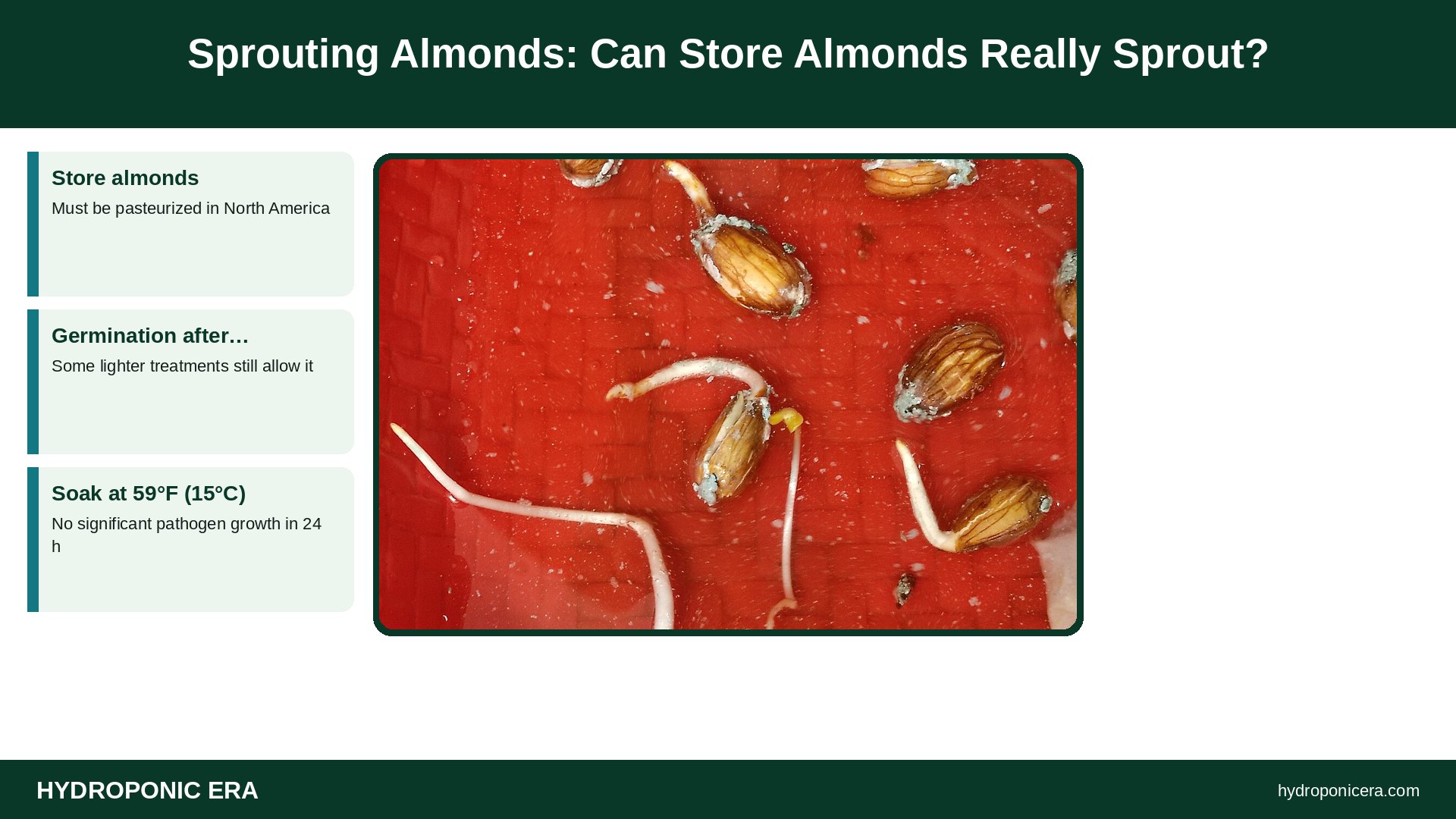
Can you sprout almonds from the store? Sometimes. Sprouting almonds bought in North America is hit or miss because they must be pasteurized. UC ANR says some lighter steam or PPO treatments still let nuts germinate, so a few may grow a tiny tail. Soak in the fridge at 59°F (15°C) or below, or under 8 hours.
Key takeaway: Sprouting almonds at home is mostly about soaking safely. The Almond Board of California says almonds sold in North America must be pasteurized, and UC ANR notes some lighter treatments keep the ability to germinate. A 2020 Journal of Food Protection study found Salmonella, E. coli O157:H7 and Listeria grew in warm soak water.
| Factor | What the Research Says | Source |
|---|---|---|
| Store almonds | Must be pasteurized in North America | Almond Board of California |
| Germination after treatment | Some lighter treatments still allow it | UC ANR Pub. 8406 |
| Soak at 59°F (15°C) | No significant pathogen growth in 24 h | Feng et al. 2020 |
| Soak at 64°F (18°C) | Salmonella up about 0.9 log in 24 h | Feng et al. 2020 |
| Soak at 73°F (23°C) | Salmonella up about 3.9 log in 24 h | Feng et al. 2020 |
| Drying at 151°F (66°C), 14 h | No significant Salmonella reduction | Feng et al. 2020 |
| Safer practice | Under 8 h, or 59°F (15°C) or cooler | Feng et al. 2020 |
Can You Sprout Store-Bought Almonds?
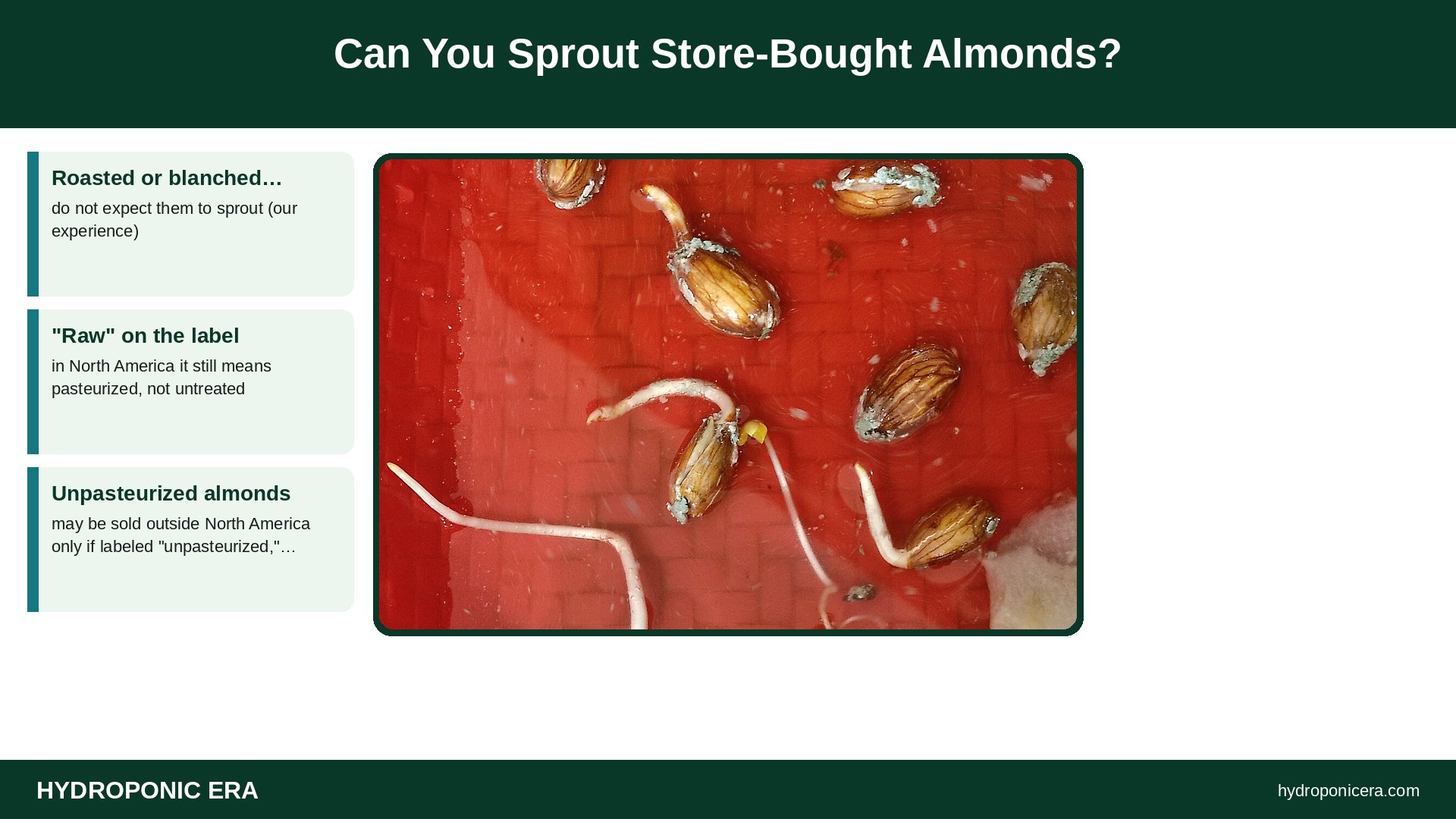
Sprouting almonds from a grocery store bag works only sometimes. The Almond Board of California requires almonds sold in North America to be pasteurized by a validated process such as steam, propylene oxide (PPO), roasting or blanching. UC ANR says some lighter steam, heat or PPO treatments are designed to kill Salmonella yet keep the nut able to germinate.
- Roasted or blanched almonds: do not expect them to sprout (our experience).
- “Raw” on the label: in North America it still means pasteurized, not untreated.
- Unpasteurized almonds: may be sold outside North America only if labeled “unpasteurized,” per the Almond Board.
- Farm-direct nuts: UC ANR warns nuts bought outside normal market channels may not be pasteurized.
Most recipes for sprouting almonds really mean soaking them. A visible root tail is a bonus, not a requirement.
How Long Should Almonds Soak?
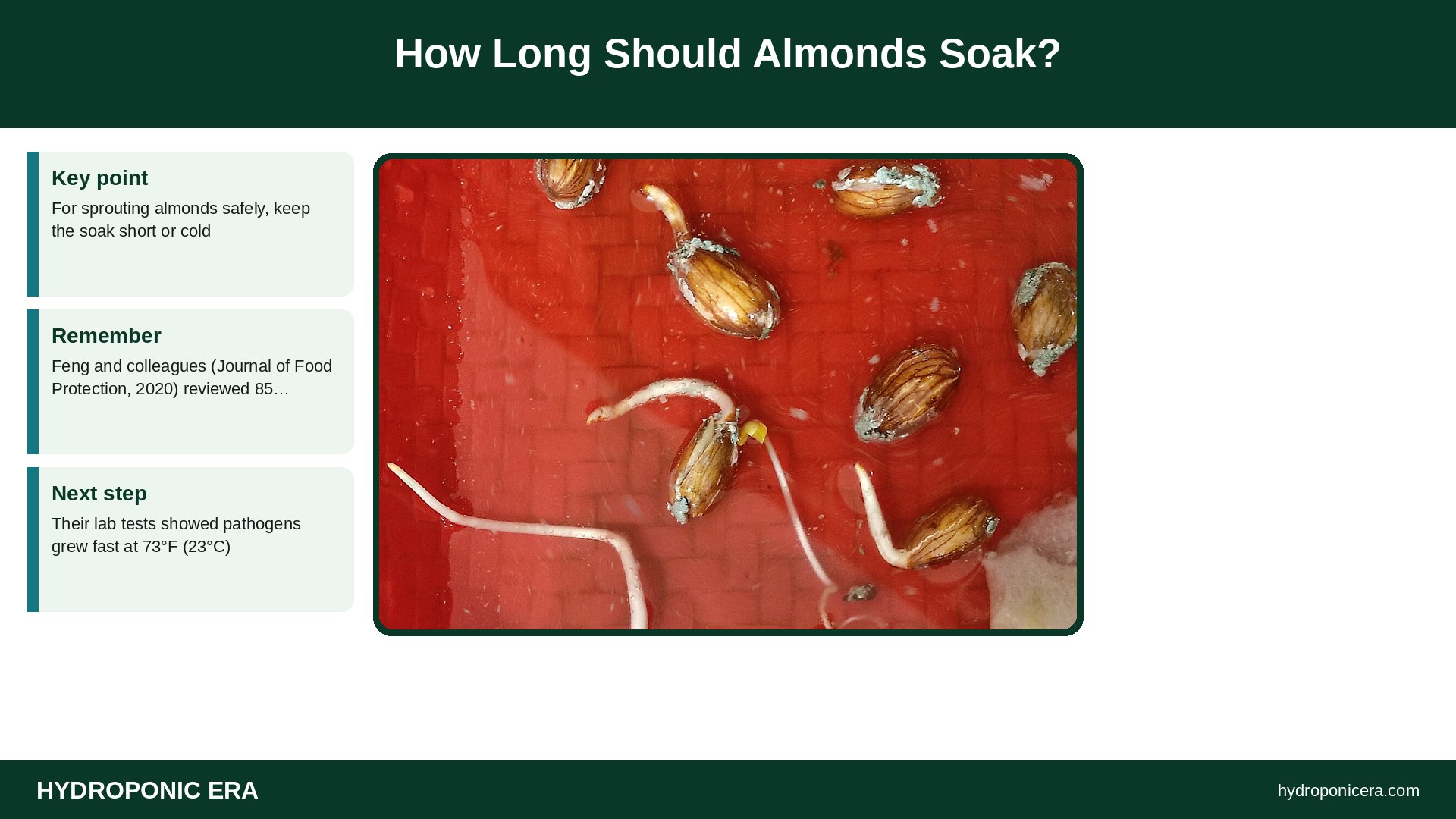
For sprouting almonds safely, keep the soak short or cold. Feng and colleagues (Journal of Food Protection, 2020) reviewed 85 online recipes: most said “overnight” or room temperature for 4 to 24 hours. Their lab tests showed pathogens grew fast at 73°F (23°C). They recommend soaking under 8 hours, or at 59°F (15°C) or cooler.
- Rinse almonds under cool running water.
- Cover with clean water in a glass jar or bowl.
- Put the container in the refrigerator, below 40°F (4°C), to stay well under 59°F (15°C).
- Soak 8 to 12 hours in the fridge, or under 8 hours if left on the counter.
- Drain, rinse again and use or store right away.
The same jar method appears in our how to grow sprouts in a jar guide. Sproutpeople notes typical seed soaks run 8 to 12 hours, but almonds carry extra risk because the nut is eaten raw.
What Did the 2020 Almond Soaking Study Find?
The study gives the clearest numbers on sprouting almonds. Researchers inoculated raw almonds or soak water with E. coli O157:H7, Listeria monocytogenes and Salmonella, then held them at 59, 64 and 73°F (15, 18 and 23°C) for up to 24 hours. Growth was minimal when cool and large when warm.
- 59°F (15°C): no significant increase for any pathogen over 24 hours.
- 64°F (18°C): Listeria rose about 1.7 log and Salmonella about 0.9 log.
- 73°F (23°C): all three rose by 3.2 to 3.9 log, or more than 1,000-fold.
- Drying: 14 hours at 151°F (66°C) dropped moisture from 40% to about 6% but did not significantly reduce Salmonella.
After sprouting almonds, a dehydrator makes them crunchy again, but it is not a kill step. The cooler, shorter soak is what limits risk.
Do Sprouted Almonds Need a Root Tail?
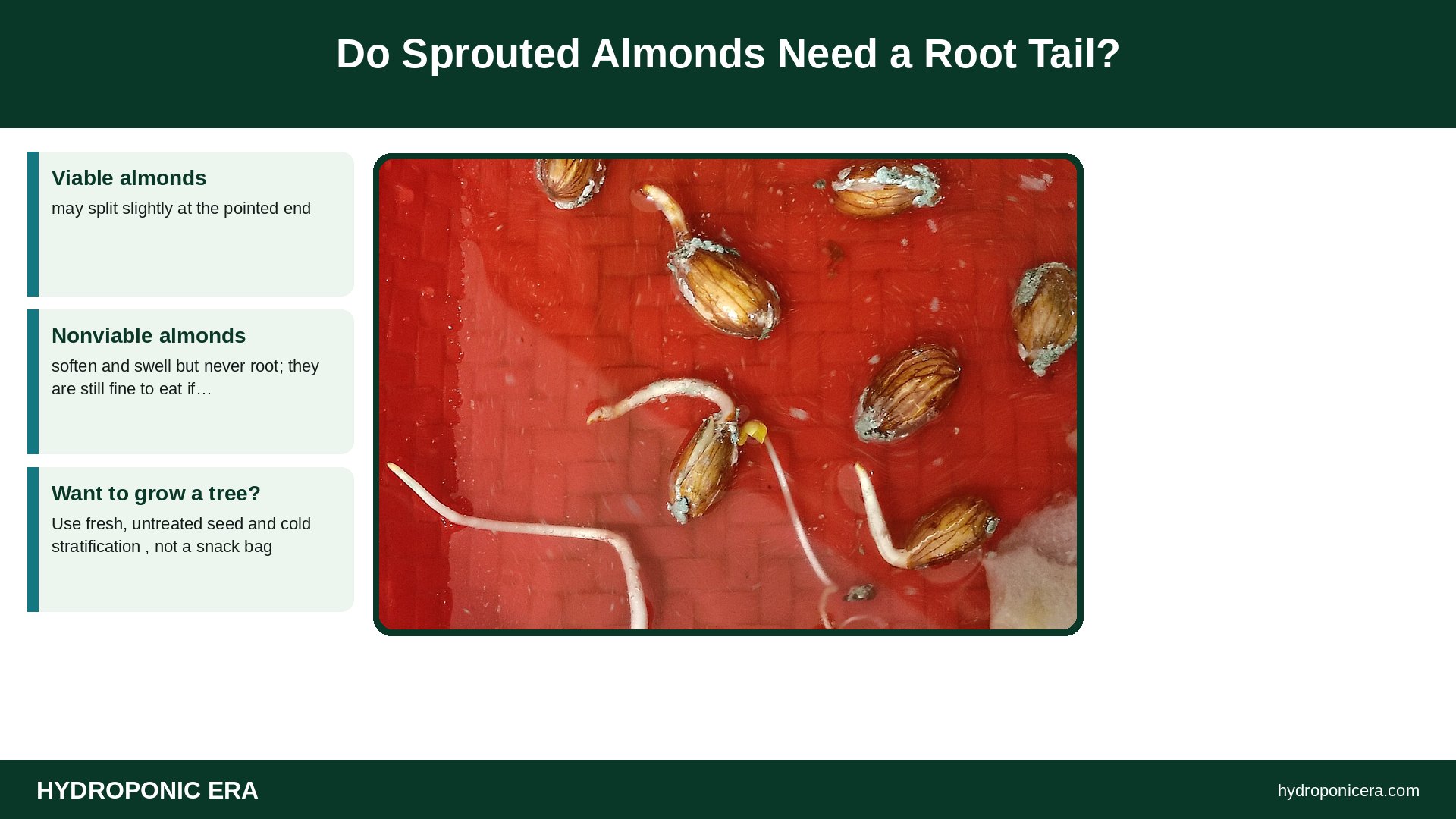
No. When sprouting almonds, a small white tip may appear after a day or two of rinsing if the nut is still viable, but many pasteurized almonds never show one (our experience). Rinse twice a day with cold water and keep the jar in the fridge if you wait for a tail. Discard any batch that smells sour or looks slimy.
- Viable almonds: may split slightly at the pointed end.
- Nonviable almonds: soften and swell but never root; they are still fine to eat if handled cold.
- Want to grow a tree? Use fresh, untreated seed and cold stratification, not a snack bag.
How Do You Store Sprouted Almonds?
Store sprouting almonds cold and use them quickly. Once soaked, the nuts are moist food, not shelf-stable nuts. UC ANR says dry nuts keep a year or more at 40°F (4°C) or below and up to two years frozen at 0°F (−18°C), but that applies to dry nuts. For soaked almonds, refrigerate and eat within a few days (our guidance).
- Fridge: keep sprouting almonds in a covered container below 40°F (4°C).
- Freezer: spread on a tray, then bag, for longer storage.
- Dehydrated: dry fully, cool and store in an airtight jar, remembering drying does not sanitize.
UC ANR also notes rancid nuts taste bad but are not a safety problem. Off smells after sprouting almonds are different and mean the batch should go.
Who Should Skip Raw Soaked Almonds?
UC ANR notes raw almonds have been linked to Salmonella outbreaks, which is why pasteurization became mandatory. Anyone at higher risk, including pregnant people, young children, older adults and people with weak immune systems, may prefer roasted almonds and skip sprouting almonds (our guidance based on general food safety advice). For safer living foods, try microgreens or sprouting seeds bought for that use.
FAQ About Sprouting Almonds
Are store almonds really raw?
In North America they must be pasteurized, even if labeled raw.
Will pasteurized almonds sprout?
Some can; UC ANR says lighter treatments may keep germination.
How long should I soak almonds?
Under 8 hours, or longer only in cold water at 59°F (15°C) or below.
Does dehydrating after sprouting almonds kill bacteria?
No; drying at 151°F (66°C) did not significantly reduce Salmonella.
Can I soak almonds overnight on the counter?
The 2020 study found big pathogen growth at 73°F (23°C); use the fridge.
Can I grow an almond tree from a store nut?
Unlikely; use untreated seed and cold stratification.
Sources
- Almond Board of California — Pasteurization Program
- UC Agriculture and Natural Resources — Nuts: Safe Methods for Consumers to Handle, Store, and Enjoy (Pub. 8406)
- Journal of Food Protection (Feng et al., 2020) — Growth and Survival of Foodborne Pathogens during Soaking and Drying of Almond Kernels
- Sproutpeople — Soaking
- Photo credits (Wikimedia Commons, edited with titles): Almond sprouts by Vis M (CC BY-SA 4.0); Almond sprouts 02 by Vis M (CC BY-SA 4.0)