
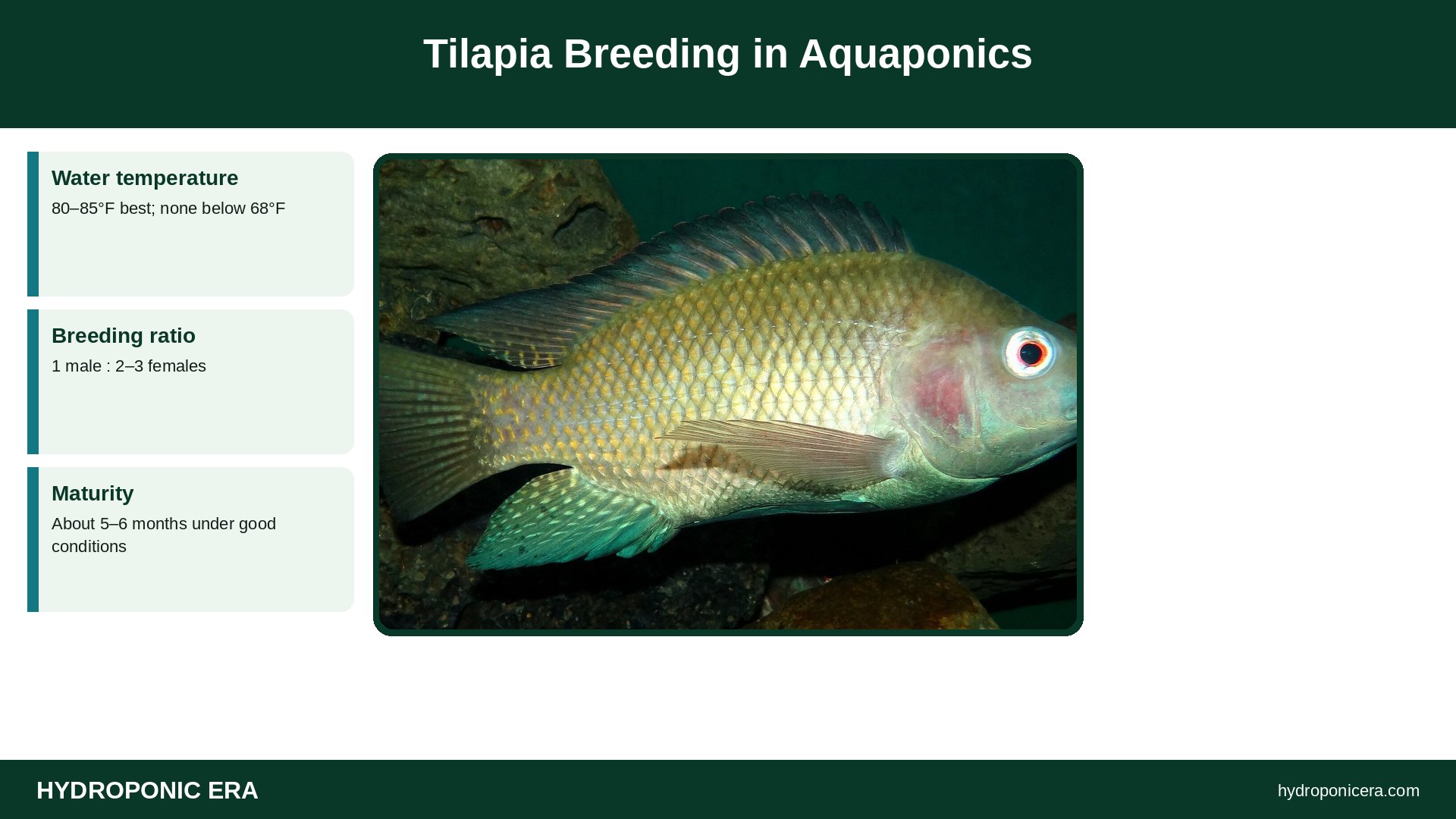
Tilapia breeding in aquaponics is easy because tilapia spawn readily once water stays above about 75°F and fish reach maturity at roughly 5–6 months. Keep one male with two or three females in a separate breeding tank at 80–85°F, give them a gravel or bare bottom to build nests, and watch for females holding eggs in their mouths. Fry are released after about two weeks; move them to a fry tank with fine powdered feed. Reproduction stops below about 68°F, so warmth is the main requirement.
Key takeaway: Breed tilapia in their own tank, not in the grow-out tank, so you control fry numbers and keep the main system from overpopulating.
| Factor | Target |
|---|---|
| Water temperature | 80–85°F best; none below 68°F |
| Breeding ratio | 1 male : 2–3 females |
| Maturity | About 5–6 months under good conditions |
| Spawning cycle | Every few weeks (16–20 day cycles in hatchery studies) |
| Brooding | Female holds eggs and fry in mouth |
| Breeding tank | 50–100+ gallons, low stocking |
How Tilapia Reproduce
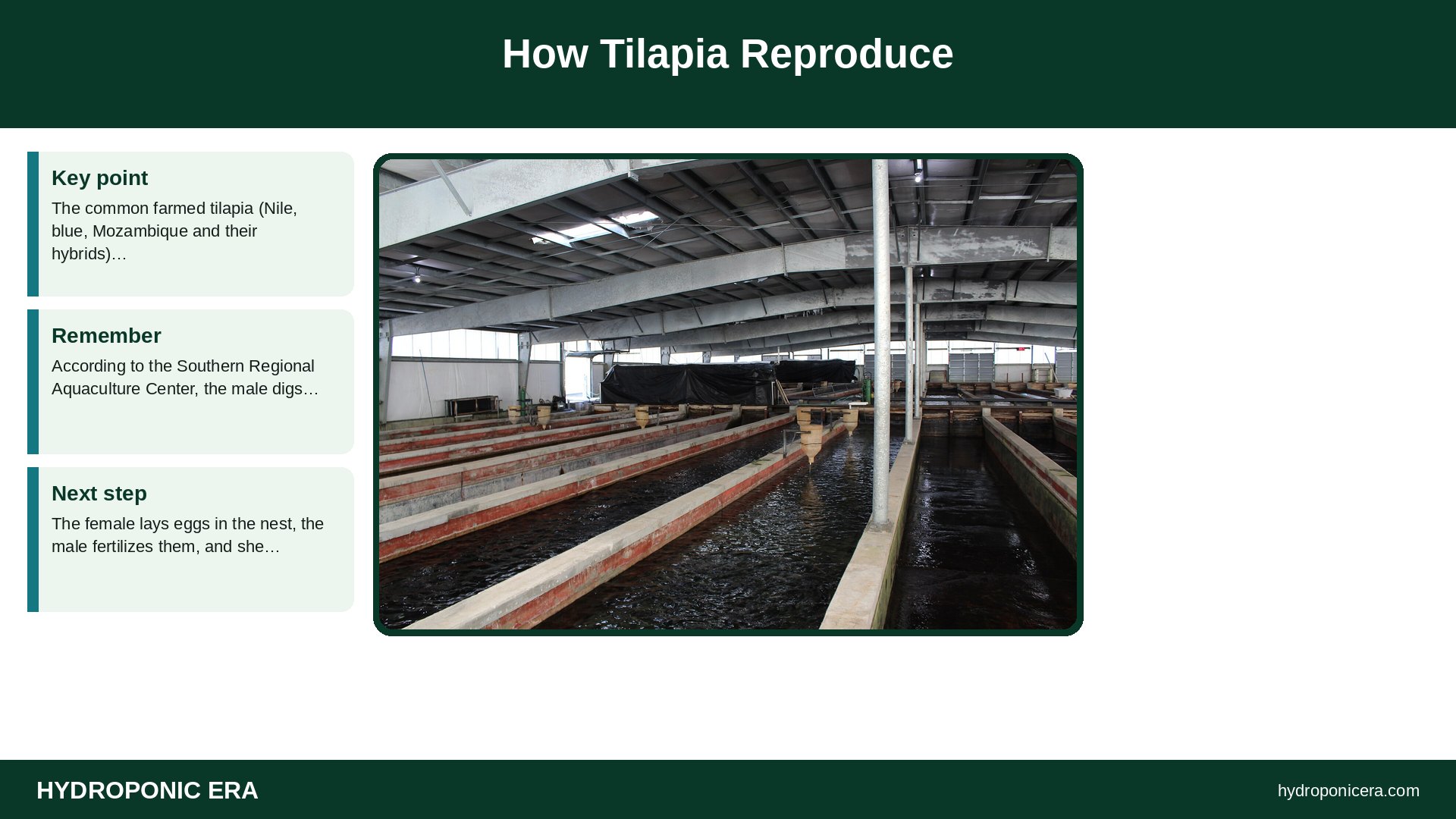
The common farmed tilapia (Nile, blue, Mozambique and their hybrids) are mouthbrooders in the genus Oreochromis. According to the Southern Regional Aquaculture Center, the male digs a nest in the bottom and mates with several females. The female lays eggs in the nest, the male fertilizes them, and she picks them up and holds them in her mouth until they hatch. Fry stay in her mouth through yolk-sac absorption and often return to it for several days after that.
When Tilapia Mature
SRAC notes that Nile tilapia in farm ponds with good growth reach sexual maturity at 5–6 months and about 5–7 ounces. Stunted fish may spawn at under an ounce. In aquaponics, this means your grow-out tilapia will often start spawning before they reach harvest size. That’s why many growers raise all-male fish for food and keep a separate breeding group.
Temperature for Tilapia Breeding
Temperature drives everything. SRAC reports that tilapia reproduction is best above 80°F and doesn’t occur below 68°F. Fry production falls sharply when average water temperature drops below 75°F: in one study, Nile tilapia produced about 600 fry per female at 82°F but only about 250 at 75°F. Use an aquarium or tank heater with a thermostat to keep breeding water steady. See aquaponics water temperature.
Setting Up a Breeding Tank
- A 50–100+ gallon tank, separate from grow-out.
- Heater set to 80–85°F, plus strong aeration.
- Bare bottom, or a few inches of gravel or flat stones where males can make nests.
- Hiding places such as PVC pipe sections or pots for females.
- A sponge or gentle filter so fry aren’t sucked into pumps.
- A cover; tilapia jump.
Keep the breeding tank connected to biofiltration or run it as a small cycled system on its own. See aquaponics biofilter.
Choosing Breeders
Pick healthy, well-shaped fish of good size. You can tell sex by the genital papilla: SRAC explains that males have a single opening for milt and urine, while females have a separate opening for eggs. Mature males often show brighter colors, especially during breeding. Use one male for two or three females to reduce aggression. Replace breeders every year or two, and avoid breeding closely related fish for many generations.
Spotting a Brooding Female
A brooding female has a swollen throat and jaw, keeps her mouth slightly open, stops eating and often hides. Some growers leave her alone until she releases fry; others gently move her to a separate tank so other fish don’t eat the fry. Some hatcheries remove eggs and hatch them artificially, but that’s rarely needed at home.
Raising Tilapia Fry
Once fry are free-swimming, move them to a fry tank or a floating mesh breeding net. Feed powdered starter feed or finely crushed pellets several times a day. Keep the water warm and clean, with gentle aeration. Fry grow quickly; in a few weeks they’ll be large enough for small pellets. See aquaponics fish food.
Controlling Overpopulation
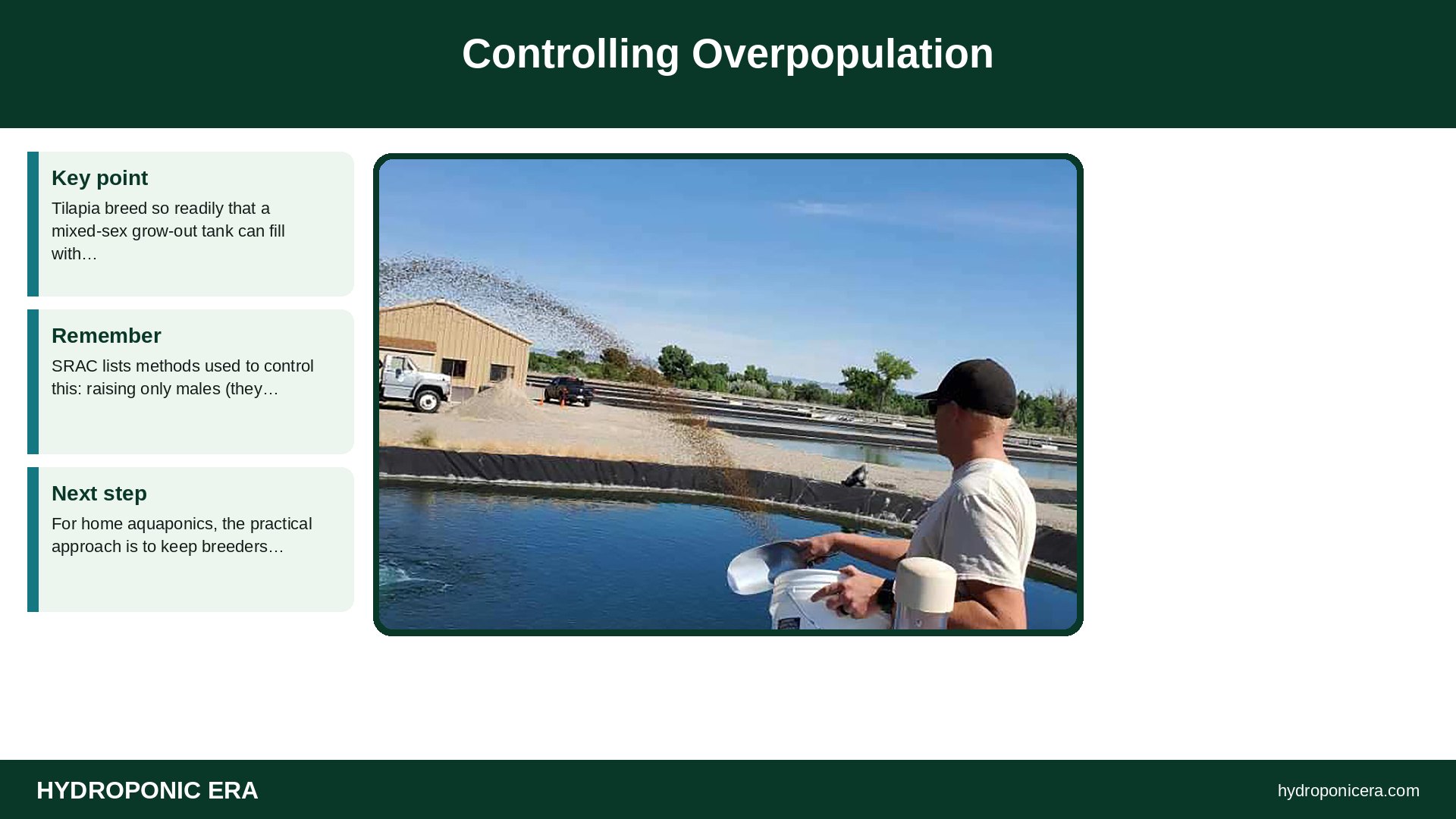
Tilapia breed so readily that a mixed-sex grow-out tank can fill with stunted fish. SRAC lists methods used to control this: raising only males (they grow about twice as fast as females), hybrid crosses that produce mostly males, hormone sex reversal of fry, and other techniques. For home aquaponics, the practical approach is to keep breeders separate and harvest or cull extra fry. See aquaponics stocking density.
Legal Rules
Tilapia are regulated in many US states because they can become invasive in warm waters. Some states ban certain species or require permits to keep or breed them. Check before you buy breeders. See aquaculture permits for aquaponics and tilapia aquaponics.
Tilapia Breeding Schedule for a Home System
- Month 0: Set up a breeding tank with one male and two or three females, heated to 80–85°F.
- Weeks 1–4: Watch for nest digging and a female with a swollen mouth.
- About 2 weeks after spawning: Fry leave the mouth. Move them or the female.
- Fry weeks 1–4: Feed powdered starter several times daily in a fry tank.
- Fry weeks 4–8: Move to a nursery tank on small crumbles; grade by size.
- From about 2–3 inches: Stock into grow-out as your own aquaponics fingerlings.
With two or three females cycling, a small breeding setup can produce far more fry than a backyard system needs. Plan ahead: share extras with other growers where legal, or limit how often you collect fry.
Tilapia Breeding Problems
- No spawning: water too cold, fish too young, poor feed, or too much stress and crowding.
- Male attacking females: add females, add hiding places, or separate the male for a while.
- Female spits out eggs: often due to stress from handling or disturbance; move her only if needed, and gently.
- Fry disappearing: other fish are eating them; separate fry sooner.
- Stunted fry: overcrowding or underfeeding; thin them out and feed more often.
Winter Tilapia Breeding
Outdoors in most of the US, tilapia breeding stops in fall as water cools, and fish can’t survive temperatures below about 50–52°F for long, according to SRAC. To keep breeders through winter, bring them indoors into a heated tank or keep them in a heated greenhouse system. A small, insulated 50–100 gallon breeder tank uses far less energy than heating a whole grow-out system. See aquaponics in winter.
Is Breeding Worth It?
Buying fingerlings is simpler and gives you predictable all-male stock. Breeding your own saves money over time and lets you restock whenever you want, but it takes extra tanks, heating and attention. Many growers buy their first batch and start tilapia breeding once their main system is stable and they understand the fish.
FAQs
How often do tilapia breed?
Females can spawn every few weeks when water stays warm.
At what temperature does tilapia breeding stop?
Below about 68°F.
How many fry does a female produce?
Hundreds per cycle, depending on her size and water temperature.
Will tilapia eat their own fry?
Adults and other fish will, so separate fry quickly.
Can I breed tilapia in my grow-out tank?
You can, but it leads to overpopulation and stunting.
Do tilapia need a special diet to breed?
A good-quality high-protein feed improves breeding condition.
Sources
- Southern Regional Aquaculture Center — SRAC 283: Tilapia: Life History and Biology
- University of Florida IFAS — Culture of Hybrid Tilapia: A Reference Profile
- FAO — Small-scale aquaponic food production
- Photo credits (Wikimedia Commons, edited with titles): Oreochromis-niloticus-Nairobi by Bjørn Christian Tørrissen (CC BY-SA 3.0); Raceways at Ennis National Fish Hatchery (51267218370) by USFWS Mountain Prairie (Public domain); Fish farming on Øksfjorden in Loppa, Troms og Finnmark, Norway, 2022 August by Ximonic (Simo Räsänen) (CC BY-SA 4.0); 2008-09-20 Thermometer reading by Ildar Sagdejev (Specious) (CC BY-SA 4.0); Feeding fish (51250565367) by USFWS Mountain Prairie (Public domain)