
Can you grow pumpkins hydroponically? Technically yes, but pumpkins are one of the crops that struggle in home hydroponics. Vines sprawl for feet, plants need strong sun-level light and warm conditions, and female flowers must be pollinated. Epcot’s greenhouse grows pumpkins hydroponically, but that’s a professionally run commercial greenhouse. At home, your best odds are a miniature variety in a Dutch bucket or large drip-fed container, in a greenhouse or sunny outdoor spot, with hand pollination.
| Factor | Why it’s hard | Workaround |
|---|---|---|
| Vine size | MSU spaces field hills 2–5 ft apart with 4–8 ft between rows | Mini varieties; trellis; prune vines |
| Time | Mini types like Jack-Be-Little take about 95 days | Plan a full season |
| Pollination | Separate male and female flowers; bees do the work outdoors | Hand-pollinate indoors or in a greenhouse |
| Wet roots | MSU says plants start to die after 48 hours in waterlogged soil | Well-drained media, drain-to-waste or Dutch buckets |
| Light and heat | Warm-season crop; seeds need 70°F+ to germinate | Greenhouse or full sun; strong supplemental light |

Why Pumpkins Struggle in Home Hydroponics
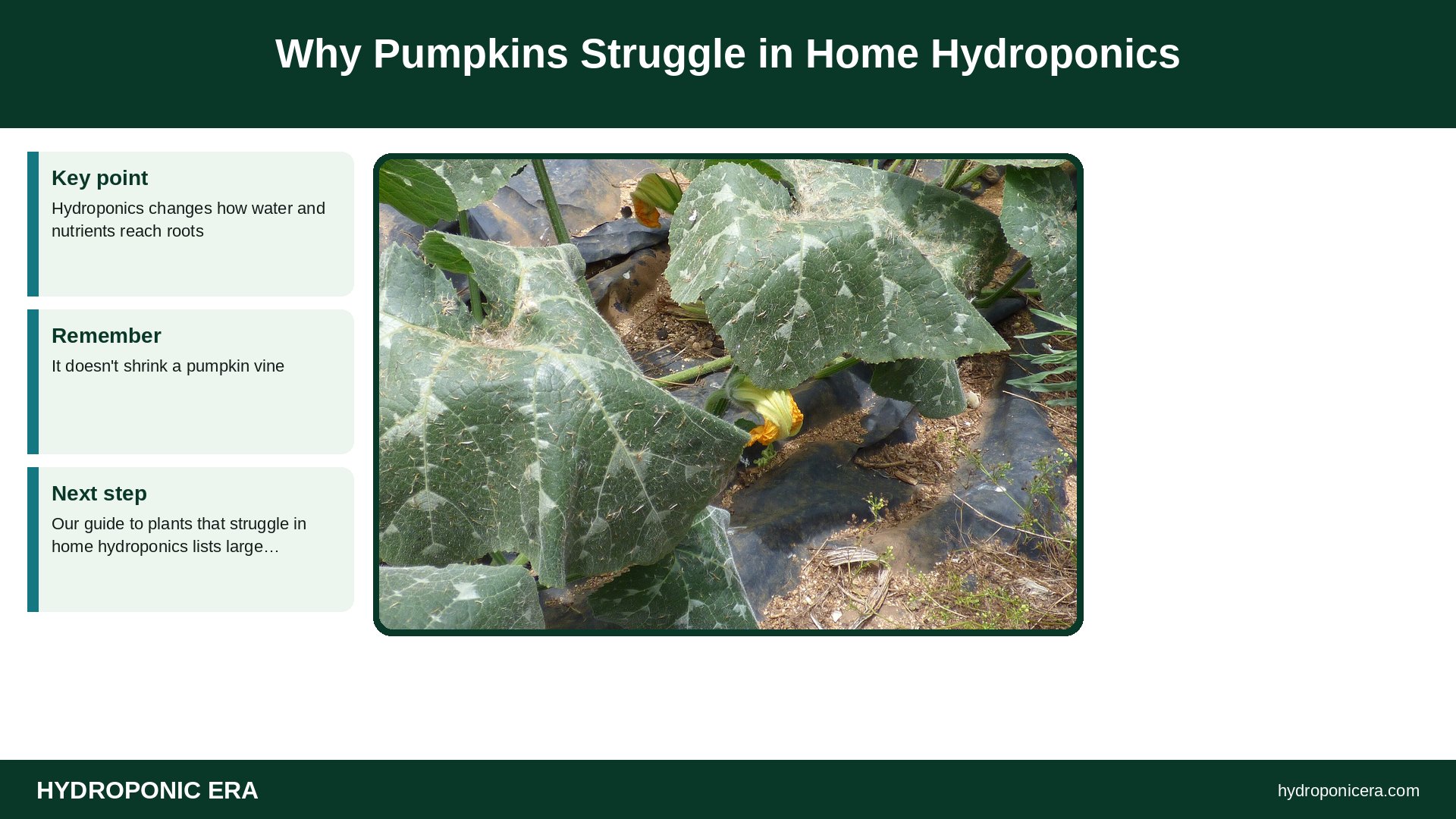
Hydroponics changes how water and nutrients reach roots. It doesn’t shrink a pumpkin vine. Our guide to plants that struggle in home hydroponics lists large squash among the crops that fight small setups because of space, pollination and heat.
Mississippi State University Extension’s pumpkin guide shows the scale. In the field, hills are spaced 2 to 5 feet apart with 4 to 8 feet between rows, and “vines will need plenty of space to grow.” Even mini varieties like Jack-Be-Little, Munchkin and Sweetie Pie (under 1 lb) take about 85–95 days to harvest.
Who Does Grow Pumpkins Hydroponically?
A paper in Acta Horticulturae (ISHS) describes The Land pavilion’s greenhouses at Epcot, about 0.4 hectares of intensive growing area. Alongside hydroponic staples like tomatoes and lettuce, the greenhouse has grown ‘Cinderella’ and ‘Atlantic Giant’ pumpkins, using “a wide variety of hydroponic techniques” and biological pest control. Our Epcot hydroponics guide covers the attraction.
The lesson: with professional staff, a large greenhouse and full-time management, you can grow pumpkins hydroponically. A 2×4 grow tent is a very different environment.
How to Grow Pumpkins Hydroponically at Home: 8 Steps
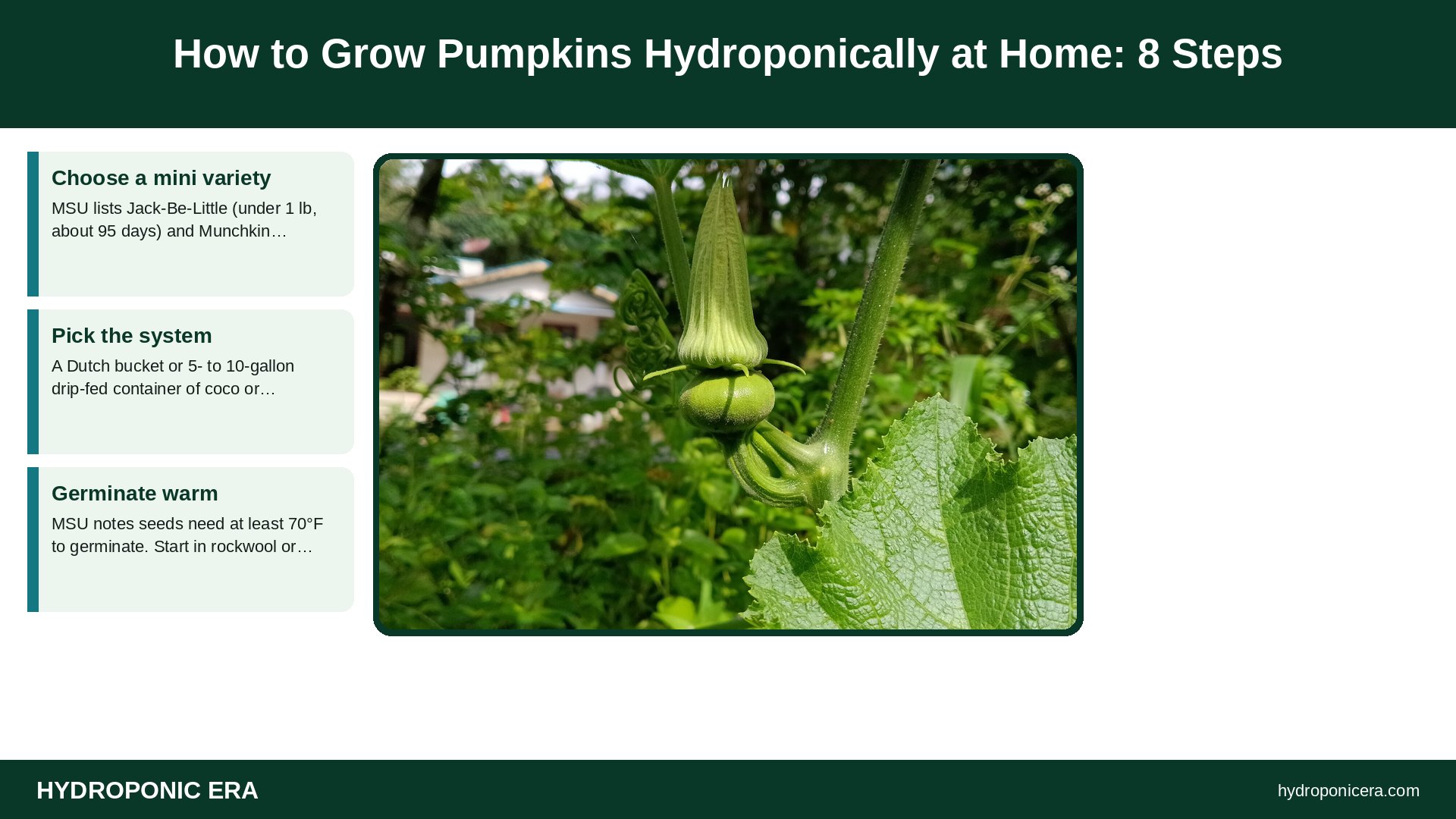
- Choose a mini variety. MSU lists Jack-Be-Little (under 1 lb, about 95 days) and Munchkin (under 1 lb, 85–95 days) among mini types.
- Pick the system. A Dutch bucket or 5- to 10-gallon drip-fed container of coco or perlite works best. See our Dutch bucket guide.
- Germinate warm. MSU notes seeds need at least 70°F to germinate. Start in rockwool or plugs; see our germination guide.
- Transplant one seedling per container once it has true leaves, as MSU recommends thinning to one seedling per hill.
- Give maximum light. A greenhouse, sunny patio or high-output LED setup. See our PPFD and DLI guide.
- Train the vine. Use a sturdy trellis and slings for fruit. See our trellising guide.
- Hand-pollinate. Transfer pollen from a male flower to the center of an open female flower (the one with a tiny fruit at its base) in the morning.
- Harvest when hard. MSU says mature pumpkins have full color and a tough rind you can’t easily puncture with a thumbnail. Leave 2–4 inches of stem.
Feeding Pumpkins in a Hydroponic System
Nutrition is the easy part when you grow pumpkins hydroponically; space and pollination are harder.
Pumpkins are heavy-feeding fruiting crops. Use a complete hydroponic nutrient designed for fruiting plants, and adjust strength with an EC meter as the plant grows. Our leafy vs fruiting nutrient recipes give starting points. Watch for calcium issues in fast-growing fruit, and keep roots well aerated.
MSU warns that pumpkins “will start to die after just 48 hours in waterlogged soils.” In hydroponics, that means good drainage and oxygen. Avoid letting media sit saturated.
Pollination: The Make-or-Break Step When You Grow Pumpkins Hydroponically
MSU explains pumpkins are monoecious: male and female flowers grow separately on the same plant, and “pollen must be transferred from the male flower to the female flower to obtain proper fruit set.” Outdoors, bees handle it. Indoors or in a closed greenhouse, you are the bee. Our indoor pollination guide walks through the technique. If flowers keep dropping, MSU notes wilting plants drop blossoms rather than set fruit, so check water supply too.
Disease and Pest Watch
MSU lists powdery mildew and downy mildew as the most common pumpkin diseases. Indoors, airflow and humidity control are the first line of defense; see our humidity and VPD guide.
If you consider a fungicide, the label is the law. Use only a product labeled for pumpkins and for your setting (indoor, greenhouse or garden), and follow its rates, intervals and pre-harvest interval exactly. Many outdoor products are not labeled for indoor or greenhouse use.
Realistic Expectations
If you decide to grow pumpkins hydroponically, set goals that match a home system:
| Setup | Realistic goal |
|---|---|
| Small grow tent | Not recommended; vine outgrows the space |
| Large tent with strong LED | One mini pumpkin plant, a few small fruits at best |
| Hobby greenhouse | A few mini plants in Dutch buckets, trained up a trellis |
| Sunny patio, drip containers | Mini or small pumpkins in summer with natural pollinators |
For most people, the patio or greenhouse is the best place to grow pumpkins hydroponically. You get real sunlight, warmth and bees, while still controlling nutrients and water through drip.
Better Alternatives If You Can’t Grow Pumpkins Hydroponically
| If you want… | Try instead |
|---|---|
| A squash-family crop | Zucchini (bush types) |
| Fruit from a vine | Cucumbers |
| Something easy and fast | Best plants for hydroponics |
FAQs: Grow Pumpkins Hydroponically
Can you grow pumpkins hydroponically indoors?
It’s possible with a mini variety, strong light, a large container and hand pollination, but it’s an advanced project with modest results.
What is the best system to grow pumpkins hydroponically?
Dutch buckets or large drip-fed containers with well-drained media. Small NFT or Kratky setups are too small.
How long does it take?
MSU lists mini varieties at about 85–95 days to harvest.
Can I grow a giant pumpkin hydroponically?
Epcot’s greenhouse has grown ‘Atlantic Giant,’ but that’s a commercial operation. At home, it isn’t practical.
Related HydroponicEra Guides
- Fruit set under LED
- Hydroponic greenhouse for beginners
- How to grow raspberries hydroponically
- Can you grow sunflowers hydroponically?
Sources
- Mississippi State University Extension — Growing Pumpkins for the Home Garden
- Fan et al., Acta Horticulturae (ISHS) 659 — Food Crop Culture in The Land Greenhouses at Epcot
- Photo credits (Wikimedia Commons, edited with titles): Miniature Pumpkins (4047781359) by Gary J. Wood from Toronto, ON, Canada (CC BY-SA 2.0); Starr-170614-0954-Cucurbita maxima-flowers leaves-Community Garden Sand Island-Midway Atoll (36311291576) by Forest and Kim Starr (CC BY 3.0 us); Female flower bud in pumpkin by Pragathi. BH (CC BY-SA 4.0); Greenhouse filled with tomato plants and a bucket on the path by Shixart1985 (CC BY 2.0)