
When hydroponic strawberries not fruiting is the problem, the usual causes are the wrong variety type (June-bearers waiting for short days), too little light, temperatures above about 85°F or below 50°F, young plants still establishing, too much nitrogen, poor pollination, or old, exhausted plants. Start by confirming you have a day-neutral variety, then check light (aim for a DLI around 15–20 mol/m²/day), temperature, and your nutrient balance. Most plants start flowering within 4–8 weeks of planting once conditions are right.
Key takeaway: Right variety, enough light, moderate temperatures, balanced feeding, and hand pollination fix most fruiting problems.
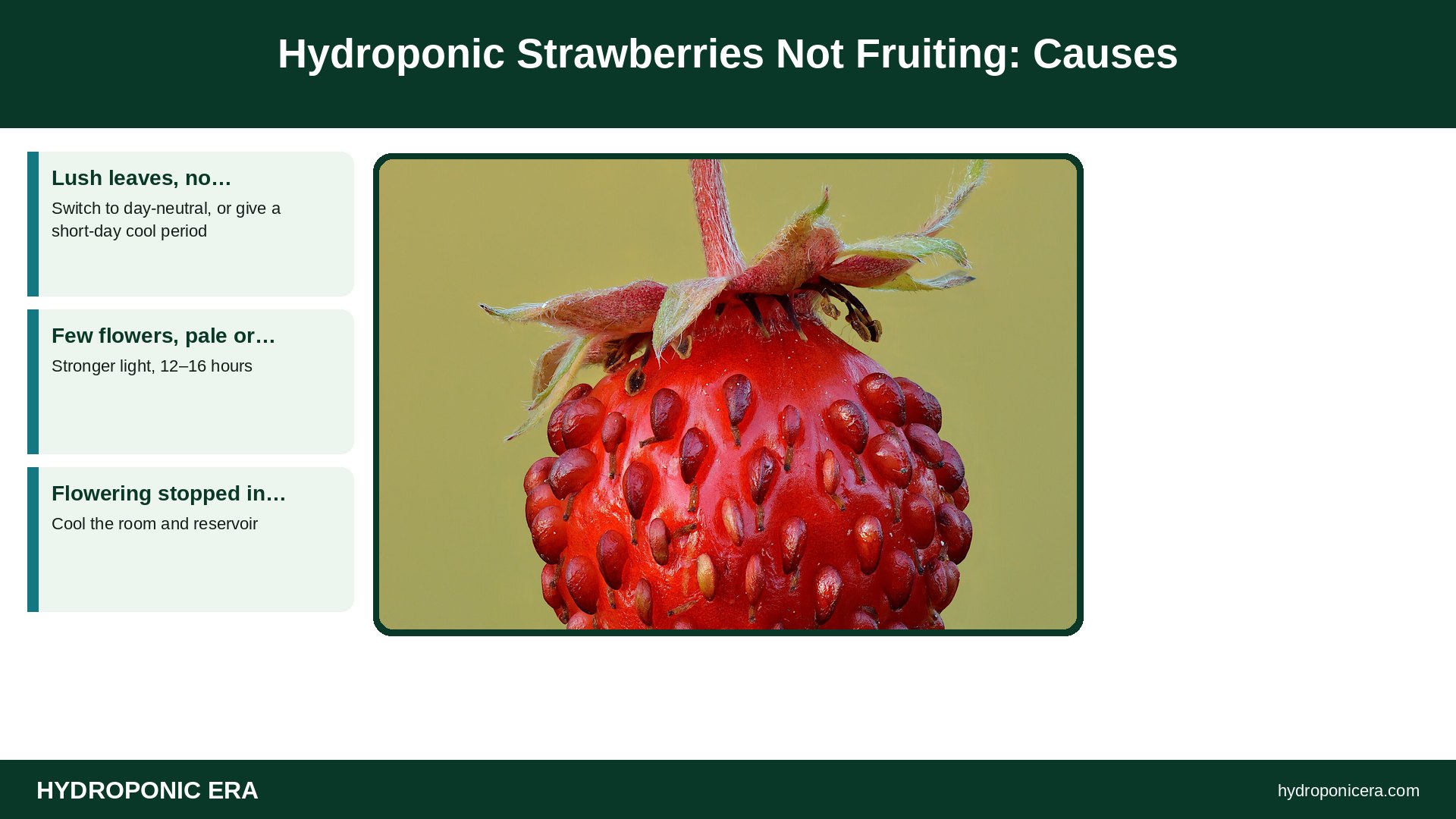
Hydroponic Strawberries Not Fruiting: Cause Checklist
| Sign | Likely cause | Fix |
|---|---|---|
| Lush leaves, no flowers, June-bearing variety | Needs short days and cool temperatures | Switch to day-neutral, or give a short-day cool period |
| Few flowers, pale or stretched plants | Low light | Stronger light, 12–16 hours |
| Flowering stopped in summer | Heat above ~85°F | Cool the room and reservoir |
| Flowers but no fruit, or tiny lumpy fruit | Poor pollination | Brush flowers or use a fan |
| Huge dark leaves, many runners | Too much nitrogen | Use a fruiting formula; reduce N |
| New plants, few flowers | Establishing roots | Wait 4–8 weeks |
| Older plants, falling yields | Plant age | Replace every 12–18 months |
Variety Type Is the Most Common Cause

Strawberries come in three types. June-bearing (short-day) plants form flower buds as days shorten and temperatures fall in autumn; they fruit once a year. Everbearing types fruit in two or three flushes. Day-neutral types flower whenever temperatures are moderate, regardless of day length.
Under 16-hour indoor lighting, a June-bearer may never get the short-day signal it needs. If your plants are big, healthy, and flowerless, check the label. The Ohio State University indoor berry program works with day-neutral strawberries for controlled environments for exactly this reason. See best strawberry varieties for hydroponics.
Light: Strawberries Need More Than Lettuce
Strawberries need much more light to flower and set sweet fruit than leafy greens. Weak window light or a small LED gives leafy plants with few flowers. Aim for a daily light integral of about 15–20 mol/m²/day, 12–16 hours a day. In towers, plants on the shaded side often fail to fruit; rotate the tower or add side lighting. See PPFD and DLI and hydroponic strawberry tower.
Temperature
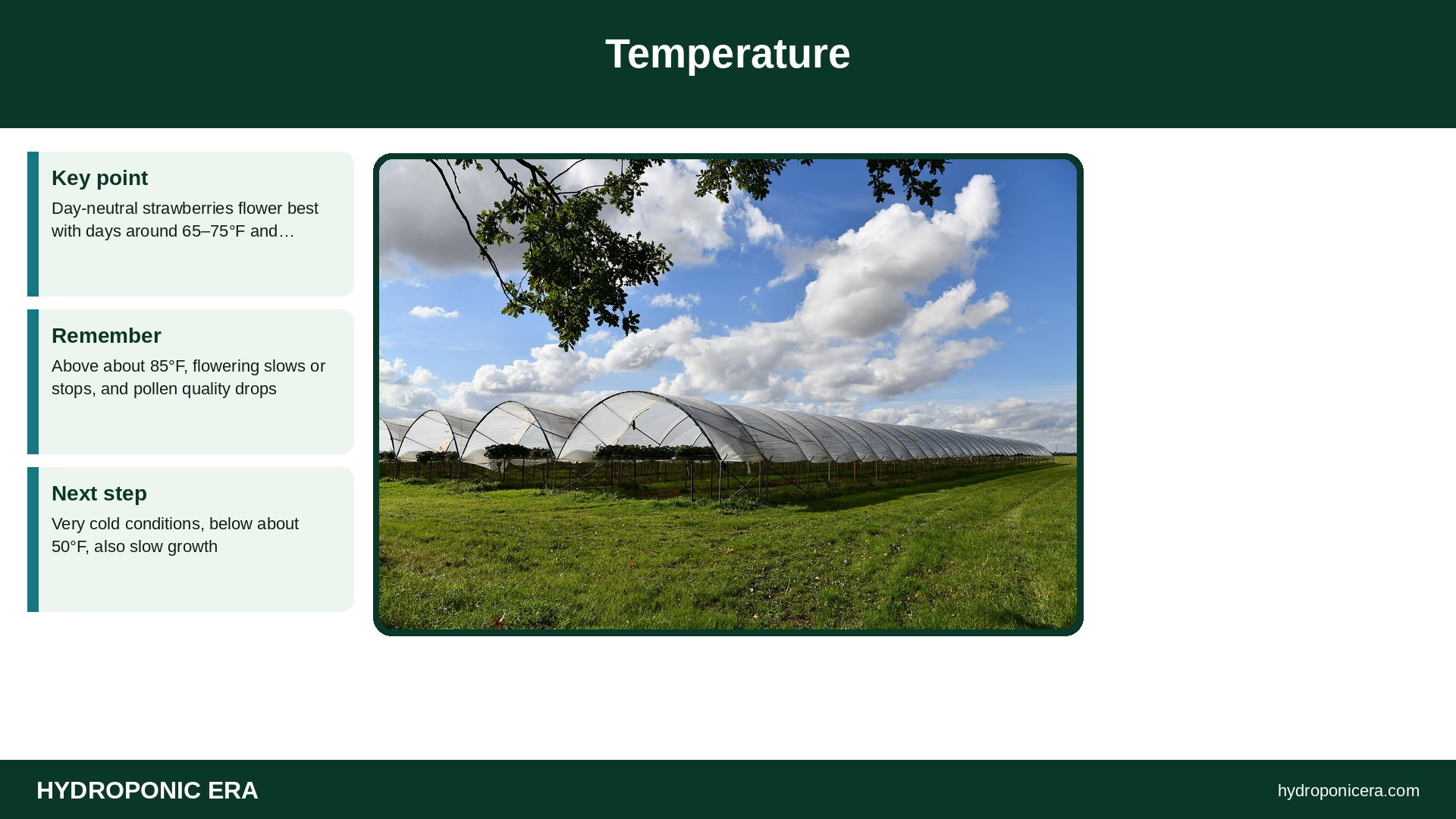
Day-neutral strawberries flower best with days around 65–75°F and nights around 55–65°F. Above about 85°F, flowering slows or stops, and pollen quality drops. Very cold conditions, below about 50°F, also slow growth. Warm nutrient solution reduces root oxygen and adds stress. Keep the reservoir below about 72°F. See reservoir temperature and hydroponics in hot climates.
Nutrient Balance
Too much nitrogen pushes leaves and runners at the expense of flowers. If plants are dark green with large leaves and many runners but few flowers, switch to a fruiting or bloom-balanced formula with less nitrogen and more potassium. Keep EC around 1.0–1.5 mS/cm and pH 5.5–6.2. Low potassium, calcium, or boron can also reduce fruit set and quality. See nutrients for strawberries and boron deficiency.
Pollination Problems
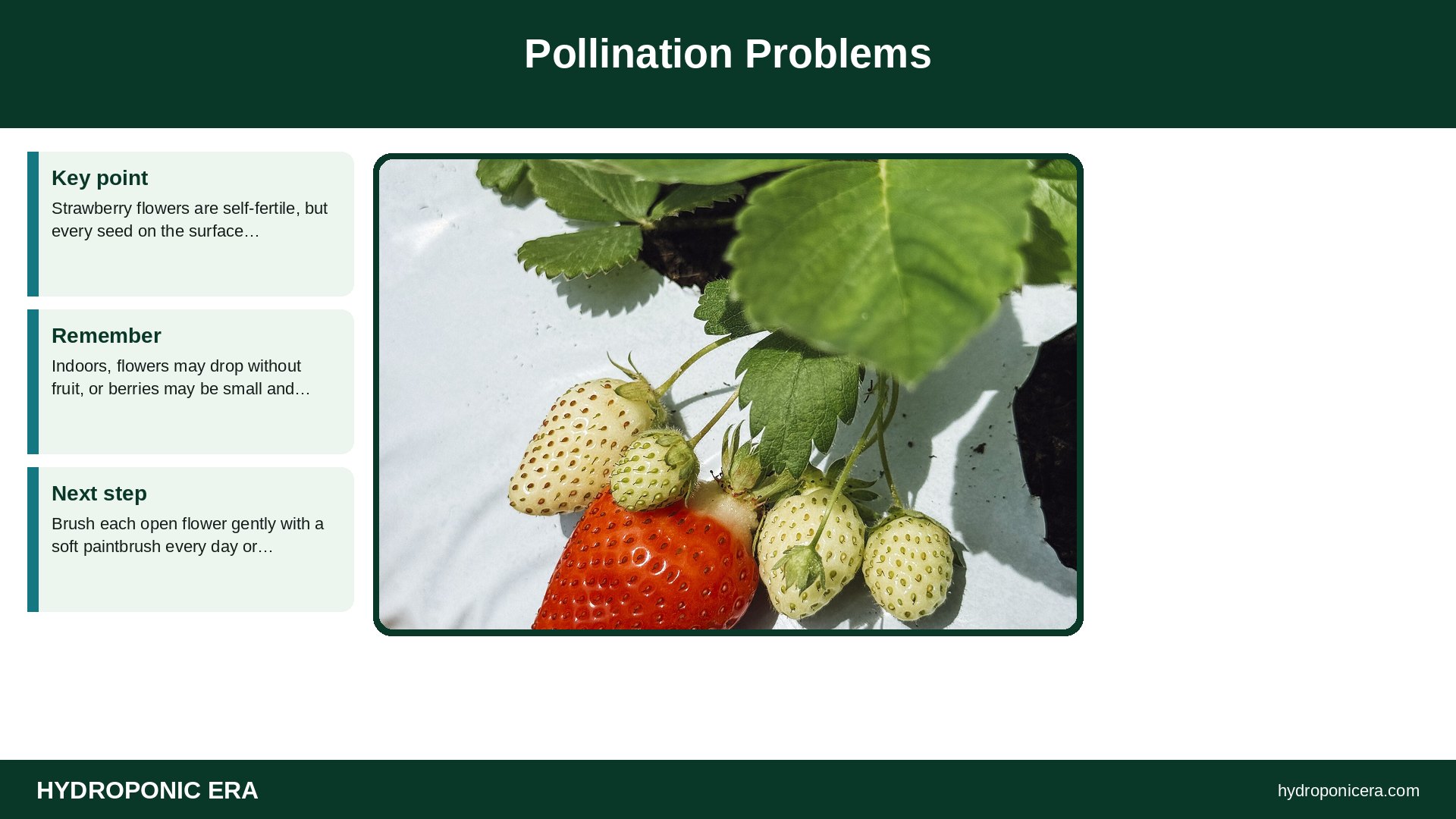
Strawberry flowers are self-fertile, but every seed on the surface must be pollinated for the berry to grow evenly. Indoors, flowers may drop without fruit, or berries may be small and misshapen. Brush each open flower gently with a soft paintbrush every day or two, or run an oscillating fan. See indoor pollination.
Runners Taking Energy
Runners are how strawberries reproduce. Each one draws energy that could go to flowers. Remove runners as soon as they appear unless you want new plants. See runner management.
Root Problems

Unhealthy roots mean fewer flowers. Check roots: they should be white to light tan. Brown, mushy roots suggest root rot from overwatering, warm water, or poor drainage. Make sure the crown sits above the medium; buried crowns rot. See Pythium root rot.
Plant Age and Stress
Newly planted crowns spend their first weeks growing roots and leaves. Many growers remove the first flowers for 3–4 weeks so plants establish. On the other end, plants older than about 12–18 months produce less. Pests like spider mites and thrips also weaken plants and damage flowers. See spider mites and thrips.
Step-by-Step Fix for Hydroponic Strawberries Not Fruiting
- Confirm the variety is day-neutral.
- Measure light; add or move lamps to reach 15–20 mol/m²/day.
- Check day and night temperatures and the reservoir temperature.
- Check EC, pH, and nutrient formula; lower nitrogen if plants are leafy.
- Remove runners.
- Hand pollinate open flowers.
- Inspect roots and crowns.
- Check for pests.
- Give changes 3–4 weeks to show results.
Forcing June-Bearers Indoors
If you have June-bearing plants and want fruit, you can mimic autumn: give about 8-hour days and temperatures around 50–60°F for several weeks to trigger flower buds, then return to longer days and warmer temperatures. This is how commercial growers program some plants. Most home growers find it easier to switch to day-neutral types.
Hydroponic Strawberries Not Fruiting in Countertop Kits
Small countertop gardens are a common place to see hydroponic strawberries not fruiting. Most kits use lights designed for herbs and lettuce, which are often too weak for fruit set, and the plants are usually started from seed, which takes months before the first flowers. Raise the light to the highest setting, keep it on 12–16 hours a day, and expect seed-grown alpine or day-neutral strawberries to take several months to fruit. Pollinate every open flower by hand, because there is no wind or insects on a kitchen counter.
Flowers but No Berries
If plants flower and then drop the blossoms, look at heat, humidity and pollination. Temperatures above about 85°F during flowering can damage pollen, and very dry air can stop it from sticking. Misshapen, seedy berries mean only part of the flower was pollinated. Brush the center of each flower with a soft paintbrush and point a small fan at the plants. These fixes solve many cases of hydroponic strawberries not fruiting after flowering.
How Long to Wait
A healthy day-neutral plant should start flowering within a few weeks of establishment under strong light, and berries ripen about four to six weeks after pollination, depending on temperature. If you still see hydroponic strawberries not fruiting after two months of good light, warm days, cool nights and balanced feeding, check the variety label; you may have a June-bearing type that needs a specific day length and chill period before it flowers.
Track the Fix
Change one thing at a time and note it. If you fix light, pollination and feeding together, you won’t know which one solved hydroponic strawberries not fruiting for the next crop.
FAQs
Why are my hydroponic strawberries not fruiting?
Usually wrong variety, low light, heat, or too much nitrogen.
How long until strawberries fruit hydroponically?
Day-neutrals often flower 4–8 weeks after planting.
Do strawberries need short days?
June-bearers do; day-neutrals don’t.
Why are my berries small and lumpy?
Poor pollination.
Should I remove runners?
Yes, unless you want new plants.
What temperature stops strawberry flowering?
Above about 85°F, flowering slows or stops.
Sources
- The Ohio State University — Indoor Berry Production
- UF/IFAS Extension — Strawberry Production
- UF/IFAS Extension — A Summary of N and K Research with Strawberry in Florida
- Photo credits (Wikimedia Commons, edited with titles): Fragaria vesca fruit – Keila by Ivar Leidus (CC BY-SA 4.0); Terrington St. Clement, Hydroponic strawberry growing – geograph.org.uk – 7897514 by Michael Garlick (CC BY-SA 2.0); Terrington St. Clement, Hydroponic strawberry growing – geograph.org.uk – 7897514 by Michael Garlick (CC BY-SA 2.0); Strawberry plants with ripe and unripe fruit growing in a garden by Shixart1985 (CC BY 2.0); Air Purifier (Levoit LV-H133) (49317867758) by Home Air Quality Guides (CC BY-SA 2.0)