
Aquaponics snails are a mixed bag. Small aquarium snails such as ramshorns and Malaysian trumpet snails eat algae, leftover feed and detritus, and many home growers keep them as a cleanup crew. But snails can also become pests. The Southern Regional Aquaculture Center reports that snails in raft tanks eat plant roots and nitrifying bacteria, and the FAO lists snails among animals that can carry fish parasites into a system. The safe approach: don’t add snails to a food-fish system on purpose unless you know their source, keep populations small by not overfeeding, and never release snails or system water outdoors.
Key takeaway: A few snails in a media bed are usually harmless. Large populations in raft or NFT systems, wild-caught snails, and banned species are the real problems.
| Snail | Notes | Source |
|---|---|---|
| Ramshorn snails | Common hitchhikers; graze algae and detritus | Aquarium hobby experience |
| Malaysian trumpet snail (red-rim melania) | Eats microalgae and detritus; burrows; hosts several fish and human parasites in the wild | USGS |
| Mystery snail (Pomacea diffusa) | The one apple snail allowed to move interstate without a permit | USDA APHIS |
| Other apple snails (Pomacea spp.) | Interstate movement banned except for approved research | USDA APHIS |
| Wild pond snails | Can bring parasites; avoid | FAO |

Are Aquaponics Snails Good or Bad?
Snails can help in a few ways. They graze algae from tank walls and pipes, eat uneaten fish food before it rots, and break down dead plant matter. In a media bed, that adds a little extra cleanup to what worms and bacteria already do. See aquaponics worms.
The research and extension literature is more cautious. In Recirculating Aquaculture Tank Production Systems: Aquaponics, SRAC Publication 454, Rakocy, Masser and Losordo write that tadpoles and snails in hydroponic tanks consume roots and nitrifying bacteria. The FAO’s small-scale aquaponics manual advises preventing access by birds, snails, amphibians and rodents because they can be vectors of pathogens or parasites. So snails aren’t required for a healthy system, and they can cause harm in the wrong place.
Where Aquaponics Snails Cause Problems
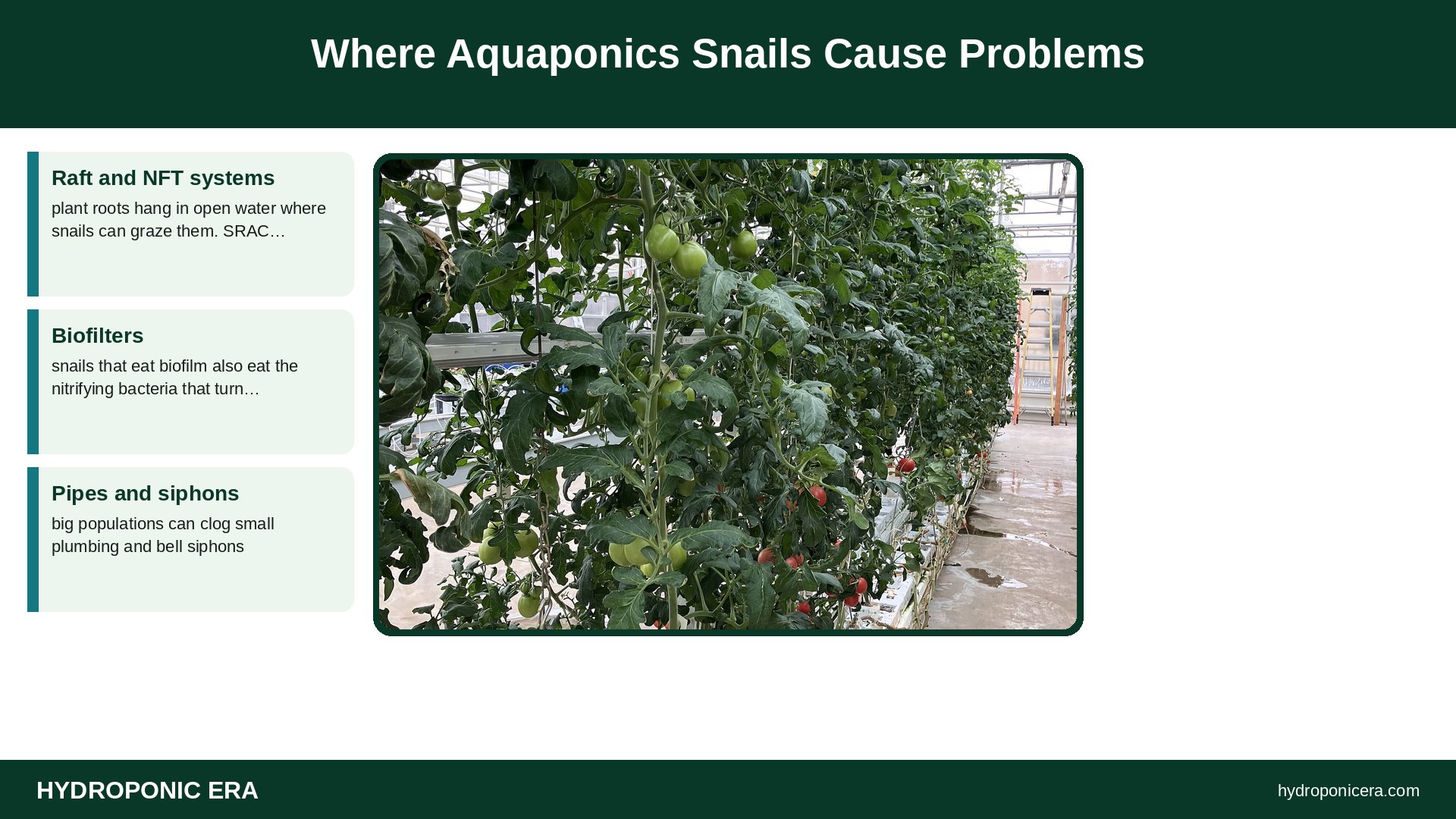
- Raft and NFT systems: plant roots hang in open water where snails can graze them. SRAC links snails to root damage and stunted growth in raft tanks.
- Biofilters: snails that eat biofilm also eat the nitrifying bacteria that turn ammonia into nitrate. See nitrifying bacteria in aquaponics.
- Pipes and siphons: big populations can clog small plumbing and bell siphons.
- Parasites: the USGS lists the Malaysian trumpet snail as an intermediate host for several flukes, including Centrocestus formosanus, a gill parasite of many fish.
- Plant pests: land snails and slugs chew seedlings and leaves in outdoor beds.
Why Aquaponics Snails Multiply So Fast
Snail numbers follow the food supply. When fish are overfed, extra pellets and waste feed a snail boom. Some species also breed fast: the USGS notes that the Malaysian trumpet snail can reproduce without mating and broods its young internally, and it can reach very high densities in gravel. In aquaponics, the fix is usually less food, not more chemicals. Feed only what fish eat in a few minutes, and remove uneaten feed. See aquaponics fish food.
How to Identify Common Aquaponics Snails
- Ramshorn snails: flat, coiled shells like a tiny ram’s horn. They lay clear, jelly-like egg clusters on glass and pipes.
- Malaysian trumpet snails: tall, cone-shaped shells, usually light brown with rust-colored spots, according to the USGS. They hide in gravel by day and come out at night.
- Bladder and pond snails: small, rounded, thin shells. Fast breeders that often hitchhike on plants.
- Mystery snails: larger, round shells, that lay pale, chalky egg clutches above the waterline.
Legal Limits on Aquaponics Snails

Snails are regulated more than most growers realize. USDA APHIS requires a plant pest permit to import or move snails across state lines when they feed on plants. Apple snails in the family Ampullariidae, such as the channeled apple snail, can’t be imported or moved interstate except for research in approved containment. The one exception is Pomacea diffusa, the common mystery snail, which APHIS allows because it’s primarily an algae feeder and not a known agricultural pest. Giant African land snails are banned outright.
APHIS also says permitted live snails must never be released into the environment. The USGS notes that early U.S. populations of Malaysian trumpet snails most likely came from aquarium releases, and the snail is now established in many states. Never dump snails, plants or system water into ponds, ditches or streams.
How to Keep Aquaponics Snails Under Control

- Quarantine new plants. Rinse roots and inspect for snails and egg masses before planting. The FAO advises against introducing raw plants or snails.
- Don’t use pond or stream water. Kentucky State University warns that surface water can bring in snails, pathogens and algae.
- Feed less. Less leftover feed means fewer snails.
- Hand-pick and trap. A lettuce leaf or blanched vegetable left in the tank overnight attracts snails you can remove in the morning.
- Use predator fish where legal. SRAC describes stocking carnivorous fish, such as redear sunfish (shellcrackers), in hydroponic tanks to prey on snails and tadpoles.
- Screen inlets so snails can’t move freely between tanks.
- Block land snails. The FAO suggests a ring of copper flashing on bed legs to stop snails and slugs from climbing up.
What Not to Do
- Don’t use snail-killing chemicals. Copper-based snail treatments and many pesticides are toxic to fish and nitrifying bacteria.
- Don’t add wild-caught snails to a system that grows food fish.
- Don’t buy banned apple snails online or across state lines.
- Don’t release unwanted snails. Freeze them in a sealed bag and put them in the trash.
For safe pest options, see aquaponics pest control.
Aquaponics Snails, Fish Health and Food Safety

Because some snails can carry parasites, the FAO lists snail exclusion with other biosecurity steps: source fish from a reliable supplier, quarantine new fish, keep animals and pets away, and wash hands and gear. Fish that show white spots, flashing or gill problems should be checked by a fish health professional. See quarantine for new fish, aquaponics fish diseases and aquaponics food safety.
FAQs
Should I add aquaponics snails on purpose?
It isn’t necessary. A few in a media bed are usually fine, but avoid them in raft systems.
Do snails eat plant roots in aquaponics?
Yes. SRAC reports snails eating roots and nitrifying bacteria in raft tanks.
Are Malaysian trumpet snails good for aquaponics?
They clean detritus, but they breed fast and can host fish parasites.
Can I keep apple snails in aquaponics?
Only the mystery snail, Pomacea diffusa, is allowed to move interstate without a permit.
How do I get rid of aquaponics snails safely?
Feed less, hand-pick or trap them, and avoid chemical snail killers.
Where do aquaponics snails come from?
Usually from new plants, pond water or added gravel.
Sources
- Rakocy, Masser and Losordo, Southern Regional Aquaculture Center Publication 454 — Recirculating Aquaculture Tank Production Systems: Aquaponics
- FAO Fisheries and Aquaculture Technical Paper 589 — Small-scale aquaponic food production: Integrated fish and plant farming
- USDA APHIS — Snails and Slugs
- U.S. Geological Survey, Nonindigenous Aquatic Species — Melanoides tuberculata (red-rim melania)
- Kentucky State University — Aquaponics Handbook
- Photo credits (Wikimedia Commons, edited with titles): Melanoides tuberculata (O. F. Müller, 1774) upper view – iNaturalist.org by Rebelo, Tony (CC BY-SA 4.0); Solanum lycopersicum in aquaponics at the NC Greenhouse Nursery by Gogerr (CC BY-SA 4.0); Deepwater Aquaponics Floating Rafts Growing Lettuce, Basil and Arugula by Alabama Extension (CC0); 2009-03-30 Lettuce roots by Ildar Sagdejev (Specious) (CC BY-SA 4.0); Fountain with goldfish in Jardí del Bisbe 03 by Kritzolina (CC BY-SA 4.0)