
How do you care for red root floater? Red root floater (Phyllanthus fluitans) is a small floating plant that needs bright light, calm water and room on the surface. Tropica rates it low light and low CO2, but says leaves turn browner as light gets stronger. The USDA rates it High Risk as a weed, so never release it outdoors.
Key takeaway: Red root floater grows in a flat mat of round, water-repellent leaves with red-tinted roots. More light gives deeper color, per Tropica. Thin it often so it does not shade plants below, keep surface splashing low, and bag excess plants for the trash. It has naturalized along Florida’s Peace River after escaping the aquarium trade.
| Fact | Detail | Source |
|---|---|---|
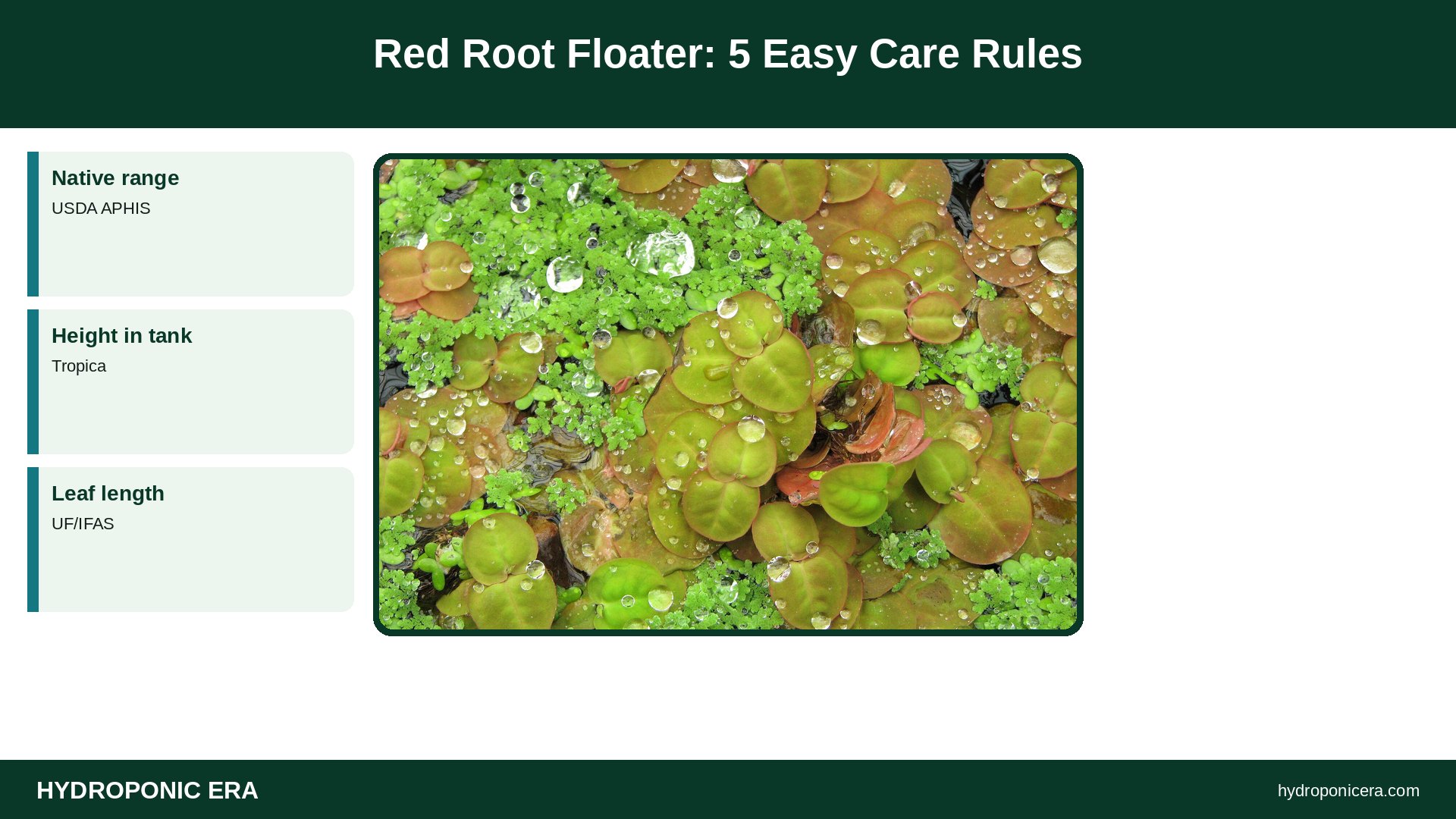
| Native range | Amazon basin, Colombia to northern Argentina | USDA APHIS |
| Height in tank | About 1–2 in (3–5 cm) | Tropica |
| Leaf length | 0.35–0.67 in (9–17 mm) | UF/IFAS |
| Light and CO2 | Low (Tropica); high light in cultivation (USDA) | Tropica, USDA APHIS |
| Weed risk | High Risk | USDA APHIS |
| US sightings | DeSoto and Charlotte counties, Florida | UF/IFAS |
What Is Red Root Floater?
Red root floater is a free-floating South American plant in the Phyllanthaceae family. Tropica says it resembles Salvinia but has a single leaf at each node, with water-repellent, heart-shaped leaves that can produce small white flowers. UF/IFAS describes brittle stems up to about 5 in (130 mm) long and light blue-green leaves with two air pockets.
USDA APHIS notes the leaf pockets trap air and help the plant float, and that it can be confused with Salvinia, duckweed or young water lettuce.
How Much Light Does Red Root Floater Need?
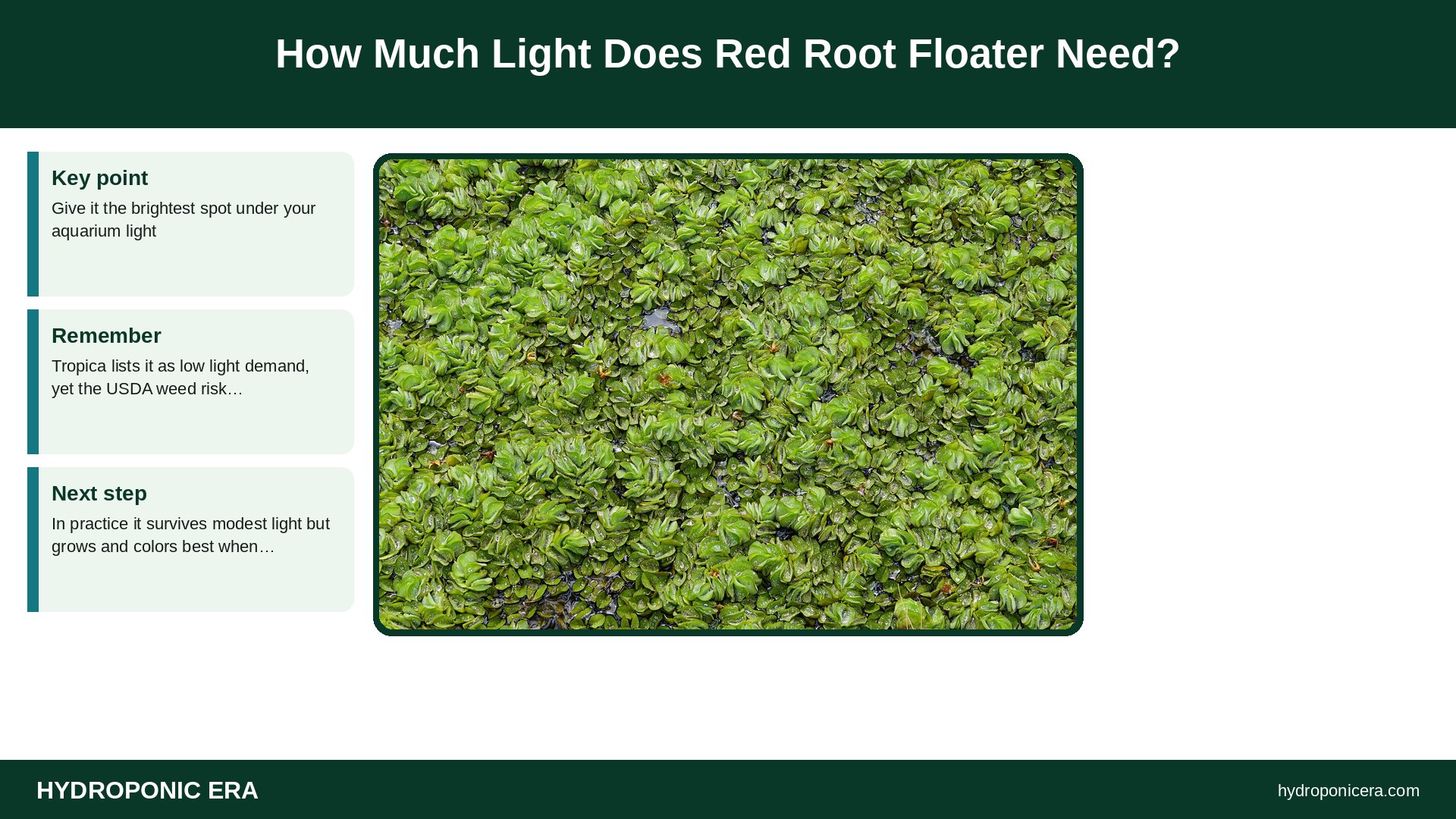
Give it the brightest spot under your aquarium light. Tropica lists it as low light demand, yet the USDA weed risk assessment cites sources saying it needs high to very high light in cultivation and is shade intolerant. In practice it survives modest light but grows and colors best when the lamp sits close to the surface.
- Keep the lid slightly open so leaves stay dry on top.
- Pick a fixture using our grow light for aquarium guide.
- Watch for leaves curling under the light, which can signal heat or condensation.
How Do You Get Red Root Floater to Turn Red?
Light intensity is the main driver Tropica names. It says the more intense the light, the browner the leaves become, so a strong lamp close to the surface brings out the red-bronze tones. Green leaves under weak light are normal, not a sign of disease, and color usually shifts back once light improves.
Hobbyists also link color to nutrient levels, but there is little published data. Keep feeding steady rather than starving the tank; our fertilizer for plants in water guide covers safe dosing.
How Do You Keep Red Root Floater Healthy?
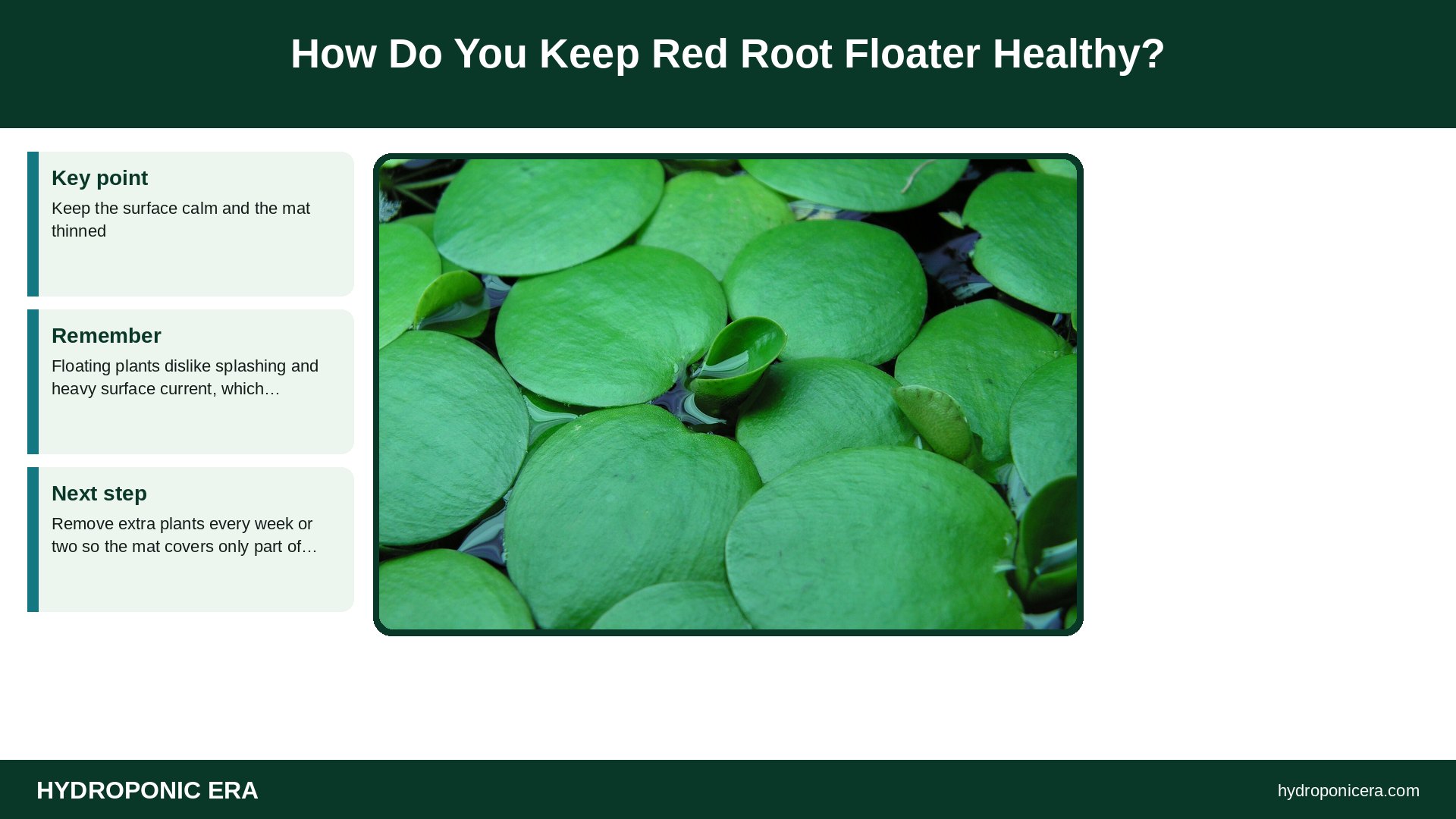
Keep the surface calm and the mat thinned. Floating plants dislike splashing and heavy surface current, which pushes leaves under. Remove extra plants every week or two so the mat covers only part of the surface, letting light reach rooted plants. USDA APHIS notes dense mats shade out species growing below them.
- Reduce filter outflow ripple or add a baffle.
- Net out a portion of the mat weekly.
- Leave open water for gas exchange and feeding.
- Bag trimmings for the trash, never the drain or a pond.
How Does Red Root Floater Spread?
It spreads mainly by breaking apart. The USDA weed risk assessment says the stems are brittle and produce side shoots, so the plant reproduces vegetatively, tolerates being torn up, and is carried by water. It also produces capsules with six seeds each, though USDA notes it is unknown whether seeds made in Florida each fall are viable.
- Each broken piece can grow into a new plant.
- Wind can push plants together into dense mats, per USDA.
- Tropica rates its growth rate as medium.
That makes propagation easy in a tank: just split the mat and share the pieces with other hobbyists rather than discarding them outdoors.
Is Red Root Floater Invasive?
It can be in warm climates. UF/IFAS reports that in 2010 it turned up in a canal and tributaries near the Peace River in DeSoto County, Florida, and in Charlotte County in 2016, probably from the aquarium trade. The USDA weed risk assessment rates it High Risk and estimates about 8% of the US is climatically suitable.
- USDA says it is hardy in zones 9–11.
- The Southwest Florida Water Management District has treated 67 acres along the Peace River, per USDA.
- UF/IFAS warns there is little information on control, so prevention is key.
How Does It Compare With Other Floating Plants?
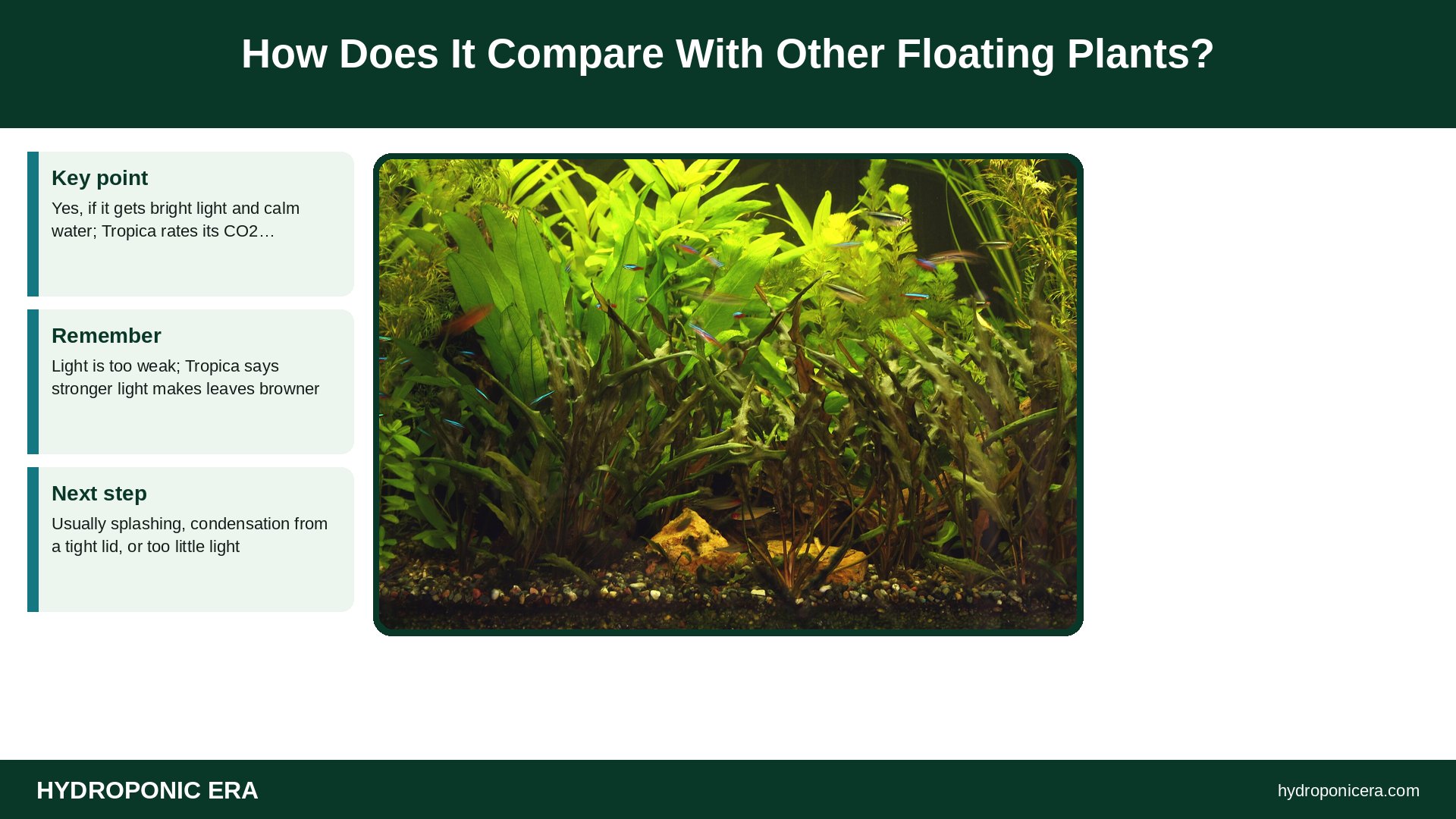
It is smaller and slower than water lettuce or duckweed, which makes it easier to manage in a tank. Its dense surface mats still behave like other floaters, so the same rules apply: thin often and never release it. Compare our frogbit, water lettuce and how to grow duckweed guides.
Is red root floater a beginner plant?
Yes, if it gets bright light and calm water; Tropica rates its CO2 need as low.
Why are my red root floater leaves green?
Light is too weak; Tropica says stronger light makes leaves browner.
Why is red root floater melting?
Usually splashing, condensation from a tight lid, or too little light.
Is red root floater illegal?
It is not on the federal noxious list, but USDA rates it High Risk; check state rules.
Does red root floater flower?
Yes. UF/IFAS describes white or greenish-white flowers 0.08–0.14 in (2–3.5 mm) wide.
Sources
- Tropica Aquarium Plants. Phyllanthus fluitans/22848).
- USDA APHIS. Weed Risk Assessment for Phyllanthus fluitans (Red root floater).
- University of Florida IFAS Center for Aquatic and Invasive Plants. Phyllanthus fluitans.
- Photo credits (Wikimedia Commons, edited with titles): Phyllanthus fluitans 2010-06-20 01 by Agnieszka Kwiecień, Nova (CC BY-SA 4.0); Salvinia molesta 00904 by Vengolis (CC BY-SA 4.0); Limnobium laevigatum by Cardex (Public domain); Planted Tank 03 – Flickr – The Wandering Angel by The Wandering Angel from Makati City, Philippines (CC BY 2.0)