
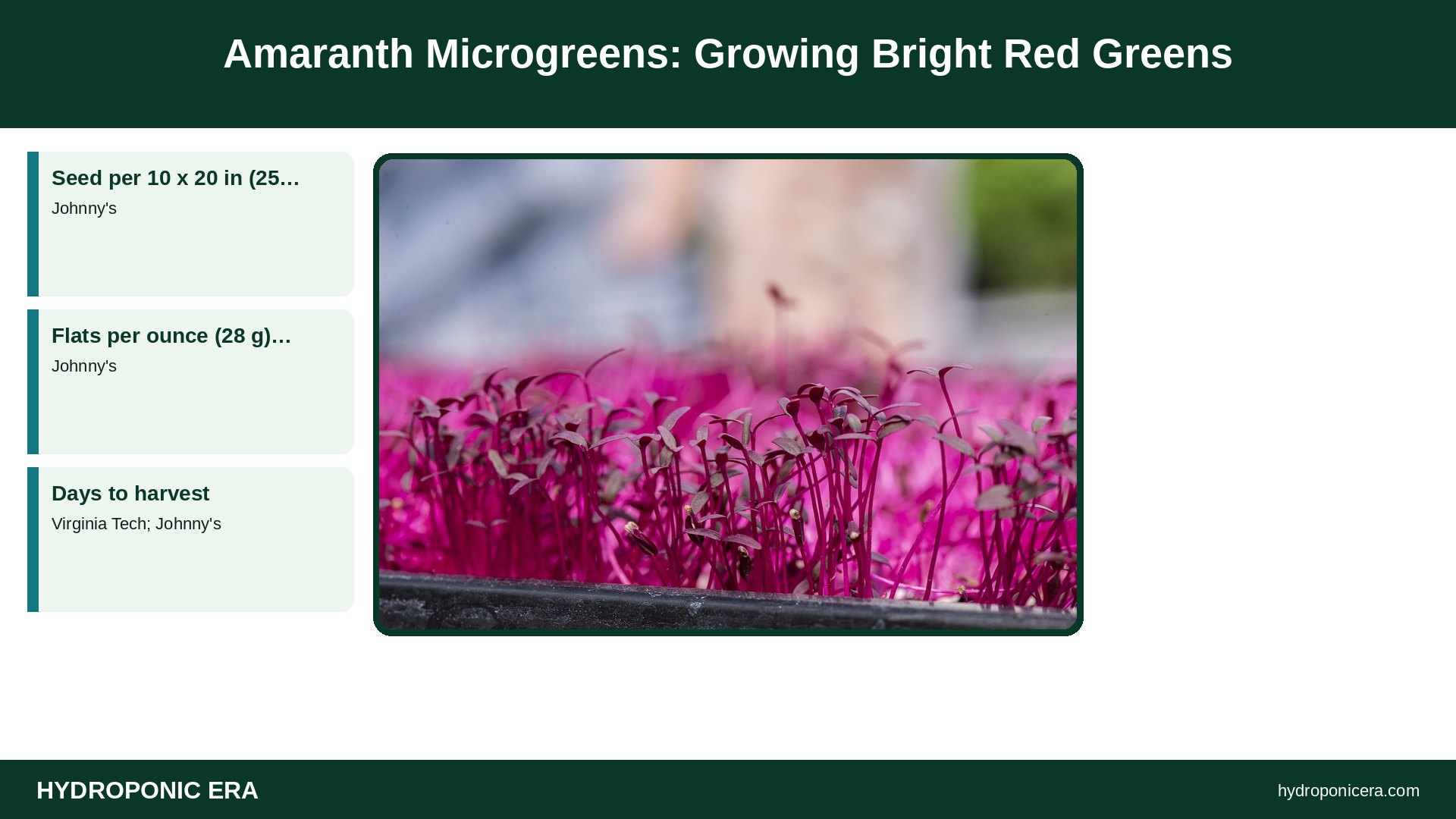
Amaranth microgreens are tiny, bright magenta seedlings with a mild, earthy flavor. Sow about 7–8 grams of seed per 10 x 20 inch (25 x 51 cm) tray on the surface of moist media, keep them warm and covered for a few days, and harvest at about 10–17 days. They’re delicate and slow to bulk up, but Garnet Red amaranth had the highest vitamin K of 25 microgreens in a USDA-led nutrient study, and few crops beat its color.
Key takeaway: Amaranth likes warmth, a fairly dry surface and gentle handling. Sow very light, bottom water, and don’t expect a heavy tray.
| Amaranth microgreens at a glance | Value | Source |
|---|---|---|
| Seed per 10 x 20 in (25 x 51 cm) tray | About 7.5 g (Garnet Red) | Johnny’s |
| Flats per ounce (28 g) of seed | About 3.5 | Johnny’s |
| Days to harvest | 10–17 days; 17 days in Johnny’s trial | Virginia Tech; Johnny’s |
| Yield per tray | About 6.5 oz (184 g) | Johnny’s |
| Germination temperature | About 75°F (24°C) soil | Johnny’s |
| Flavor | Mild, earthy | Johnny’s |
Varieties for Amaranth Microgreens
- Garnet Red: fuchsia-colored leaves and stems. The variety in Johnny’s yield trial and the USDA nutrient study.
- Bicolor: coppery leaves with magenta centers, backs and stems.
Johnny’s places both in its slow-growing group (16–25 days), though under warm indoor conditions they can be ready sooner. Virginia Cooperative Extension lists Amaranthus cruentus and A. tricolor among common microgreen species, and Maryland Extension notes the amaranth family, which also includes beet and chard, is especially well suited to microgreens.
How to Grow Amaranth Microgreens
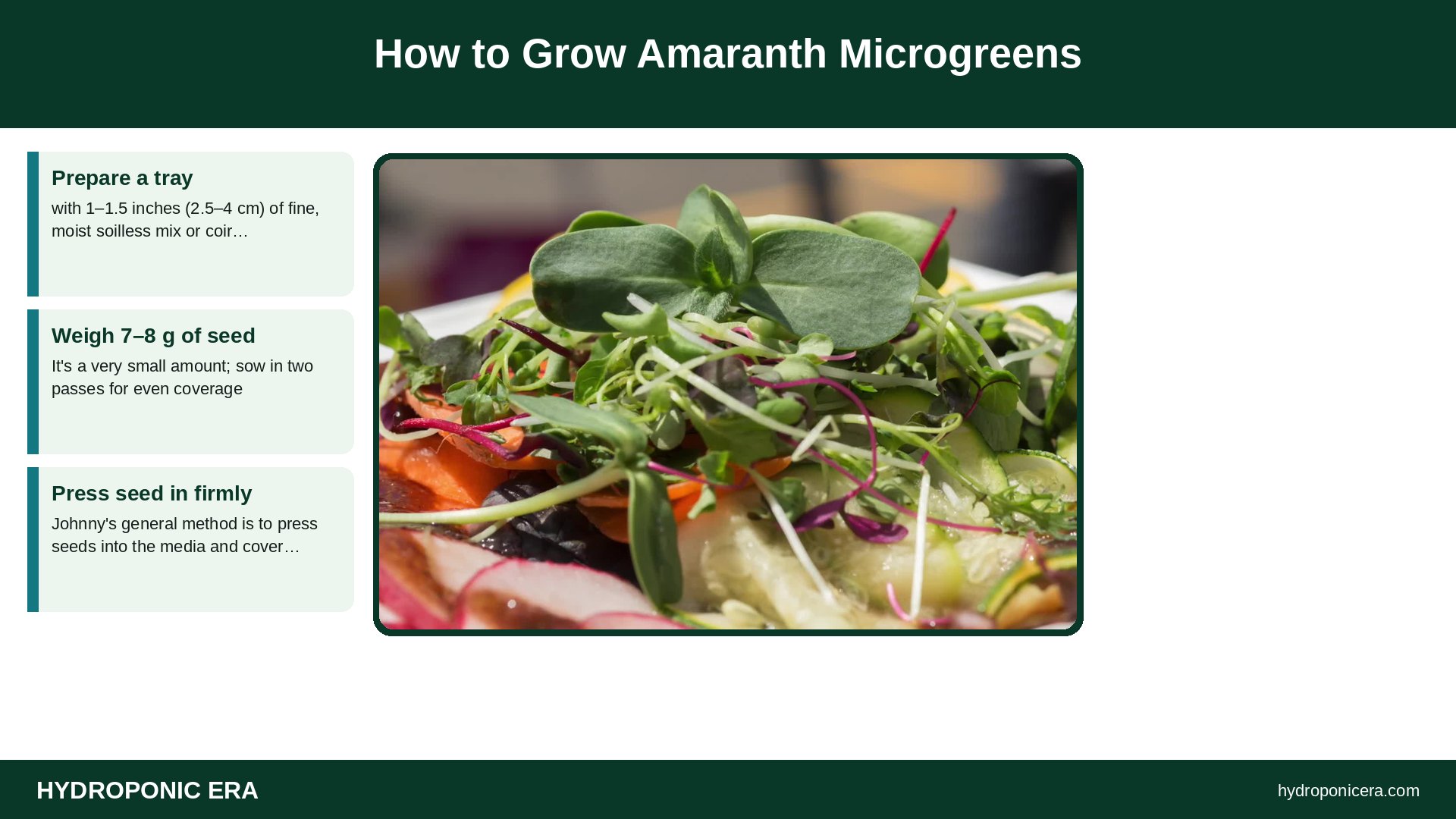
- Prepare a tray with 1–1.5 inches (2.5–4 cm) of fine, moist soilless mix or coir, leveled smooth. Tiny seeds fall into gaps in coarse media.
- Weigh 7–8 g of seed. It’s a very small amount; sow in two passes for even coverage.
- Press seed in firmly. Johnny’s general method is to press seeds into the media and cover lightly with sowing mix or vermiculite.
- Mist and cover with a tray or dome to hold humidity. Skip heavy weights; the seedlings are fragile.
- Keep warm. Johnny’s suggests about 75°F (24°C) soil until germination. A seedling heat mat helps in a cool room.
- Uncover as soon as most seeds sprout, usually in a few days.
- Give strong light for 16–18 hours to bring out the magenta color.
- Bottom water only; top watering knocks the tiny seedlings over. Mississippi State Extension notes amaranth needs to be grown very dry, so water sparingly once it’s up.
- Harvest at 10–17 days, when cotyledons are open and colored.
Light and Temperature for Amaranth Microgreens
Johnny’s says ambient temperatures of 65–75°F (18–24°C) are generally favorable and that temperatures above 75°F (24°C) can increase disease pressure. Grow amaranth at the warm end of that range but keep air moving. Color develops under bright light: aim for the general microgreen DLI of 9–16 mol/m²/day from Virginia Cooperative Extension, closer to the top of the range for vivid color. See microgreens light requirements.
Nutrition
In Xiao et al. (2012), a USDA-led analysis of 25 commercial microgreens, Garnet amaranth had the highest phylloquinone (vitamin K1) concentration; values across the 25 crops ranged from 0.6 to 4.1 µg per gram of fresh weight. Red cabbage led for vitamin C, cilantro for carotenoids and green daikon radish for vitamin E. Because vitamin K affects blood clotting, people taking blood thinners should talk with their doctor before eating large amounts of any vitamin K-rich greens.
Yield and Cost
Amaranth is a low-bulk crop. Johnny’s trial produced about 6.5 oz (184 g) per tray from 7.5 g of seed, harvested at about 17 days, and 1 oz (28 g) of seed sowed about 3.5 flats. Seed cost per tray is low because so little seed is used, but the crop occupies shelf space for longer than fast brassicas. Many growers sell it in mixes for color rather than as a standalone tray. See microgreen seed density.
Common Problems With Amaranth Microgreens
| Problem | Likely cause | Fix |
|---|---|---|
| Poor germination | Cool media or seed buried too deep | Warm to about 75°F (24°C); sow on the surface |
| Seedlings collapsing | Damping-off in warm, wet trays | Lower density, airflow, bottom water |
| Seedlings knocked flat | Top watering | Water from below |
| Weak color | Low light | Brighter light, longer photoperiod |
| Media stuck to leaves | Splashing or coarse media | Bottom water; fine media |
Virginia Cooperative Extension identifies damping-off, caused by Pythium and Phytophthora, as a common microgreen disease. See damping-off and microgreens mold.
Harvesting Amaranth Microgreens
Amaranth is short, often only about 1–2 inches (2.5–5 cm) tall at harvest, so cut carefully just above the media with sharp scissors. Johnny’s notes micros typically range from ½–2 inches (1–5 cm) tall. Hold a small bunch, cut, and lay it gently in a container. Handle as little as possible; the stems bruise easily. See how to harvest microgreens.
Storage and Uses
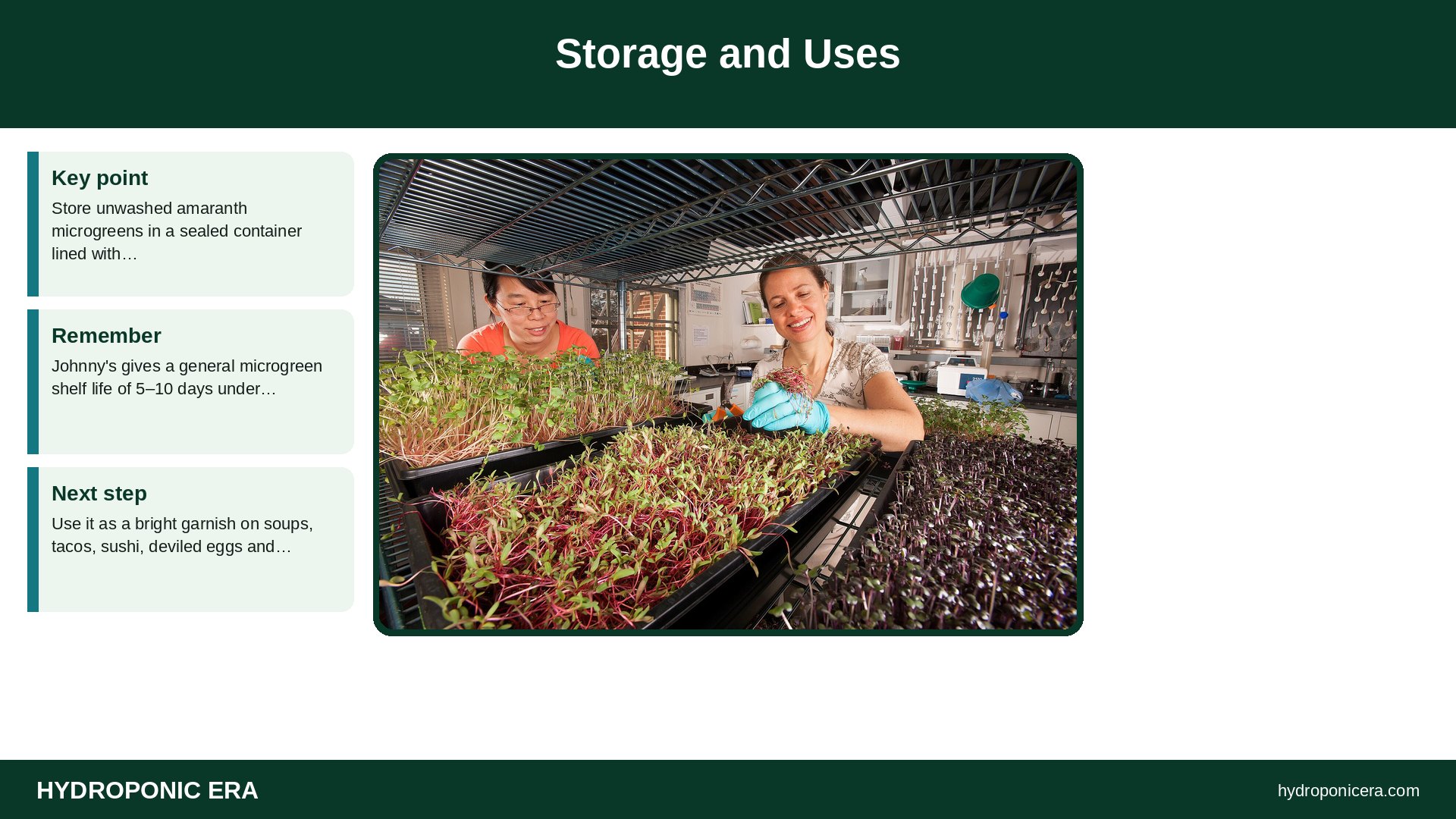
Store unwashed amaranth microgreens in a sealed container lined with a dry paper towel in the fridge, and wash gently right before eating. Johnny’s gives a general microgreen shelf life of 5–10 days under proper storage; delicate amaranth tends toward the short end. Use it as a bright garnish on soups, tacos, sushi, deviled eggs and desserts, or mix it into salads for color. See how long microgreens last.
Amaranth microgreens reward a careful grower with the most striking color in the microgreen world. Keep them warm, light and dry on top, and they’ll brighten every plate. See best microgreens to grow.
Can You Grow Amaranth Microgreens Hydroponically?
Yes. Johnny’s notes that all microgreens are suitable for hydroponic growing. Amaranth’s tiny seeds sit well on a thin, fine-textured mat, such as felt or a fine hemp mat, as long as it stays evenly damp. Coarse mats can let seeds slip into gaps. Virginia Tech suggests an EC of at least 1.0 and a pH of 5.5–6.0 for hydroponic microgreens. Keep the mat moist, not flooded, and empty the reservoir tray between waterings so the warm, damp conditions amaranth likes don’t turn into a mold problem. See microgreen grow mats.
Planning an Amaranth Tray
Garnet Red amaranth averaged about 17 days and 6.5 oz (184 g) per tray in Johnny’s 2017 trial, so it’s slower and lighter than most brassicas. Give it its own tray and use it as a colorful garnish rather than a bulk salad green.
FAQs
How long do amaranth microgreens take?
About 10–17 days.
Should I soak amaranth seeds?
No; the seeds are tiny and sow best dry.
How much amaranth seed per tray?
About 7.5 g per 10 x 20 inch (25 x 51 cm) tray.
Why do my amaranth microgreens fall over?
Usually damping-off or top watering; bottom water and improve airflow.
Do amaranth microgreens need heat?
They germinate best near 75°F (24°C).
Are amaranth microgreens nutritious?
Garnet amaranth had the highest vitamin K in a USDA-led study.
Sources
- Johnny’s Selected Seeds — Microgreens Comparison Chart
- Johnny’s Selected Seeds — Micro Greens Yield Trial 2017
- Xiao et al. (2012), Journal of Agricultural and Food Chemistry — Vitamin and Carotenoid Concentrations of Edible Microgreens
- Mississippi State University Extension — Microgreen Varieties for the Mississippi Gardener
- Virginia Cooperative Extension — Introduction to Microgreen Production
- University of Maryland Extension — Growing Microgreens and Baby Greens Indoors
- Photo credits (Wikimedia Commons, edited with titles): Veteran New Farmer Green Bexar Farm (20201021-NRCS-LSC-0456) by USDAgov (Public domain); 20160617-AMS-LSC-9000 (61-sec.) (27334710733) by U.S. Department of Agriculture (Public domain); Fleece lined greenhouse potting tray and seed pots – Flickr – peganum by peganum from Small Dole, England (CC BY-SA 2.0); Lufa Farms Microgreens in Trays by Lufa Farms (CC BY-SA 2.0); Liping Kou observes microgreens by Peggy Greb (Public domain)