hydroponic nutrients for strawberries — Hydroponic Nutrients for Strawberries

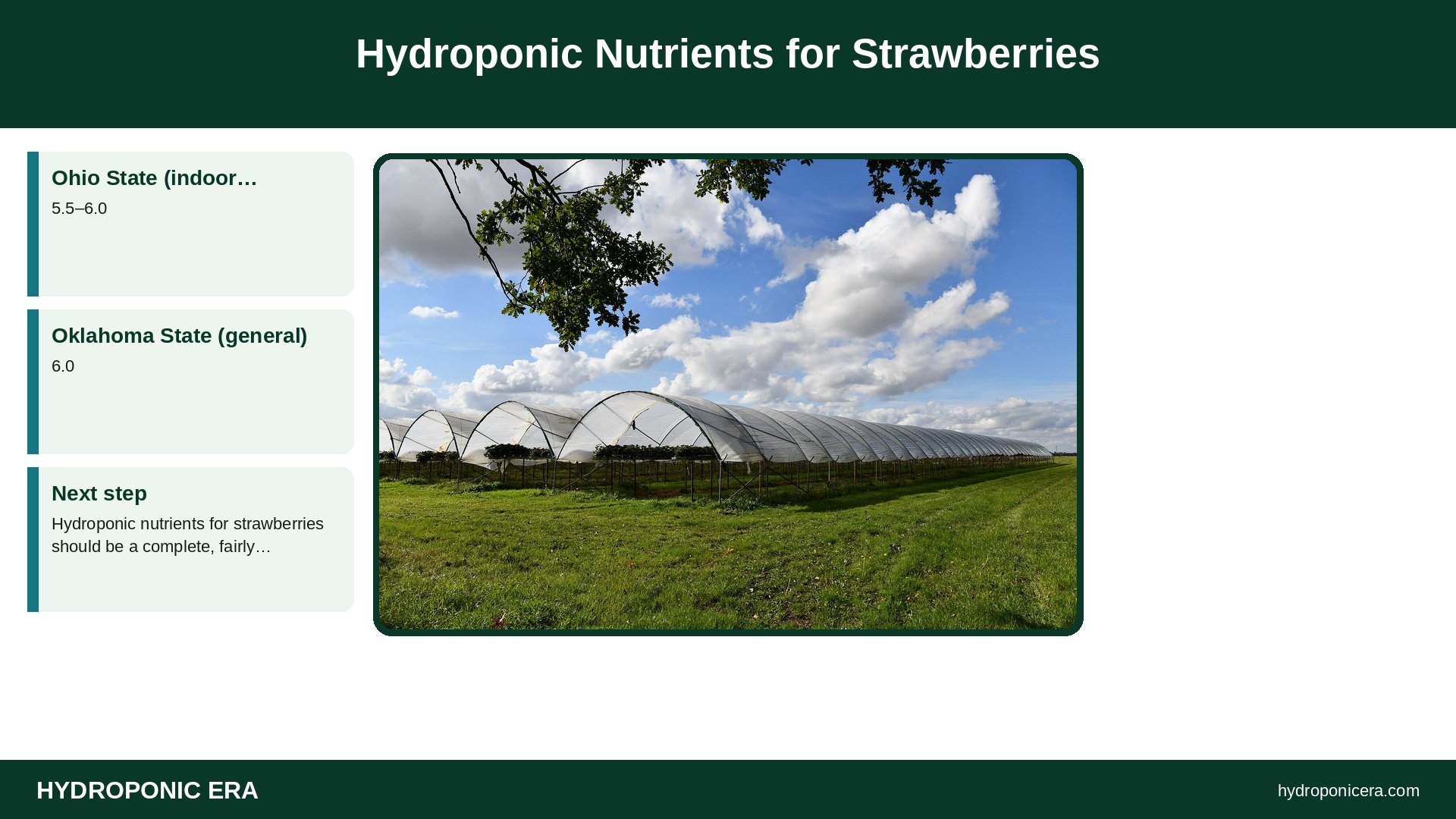
Hydroponic nutrients for strawberries should be a complete, fairly mild mix, because strawberries are sensitive to salt buildup. Ohio State University’s indoor berry program uses strawberry solutions at an EC of about 1.0 dS/m (mS/cm) at full strength, much lower than the roughly 2.4 used for tomatoes, keeps pH at 5.5–6.0, and notes growers often flush the root zone with water when root-zone EC goes above 1.2. Oklahoma State’s general table lists a higher range of 1.8–2.2 and pH 6.0. Start low, watch the plants, and raise strength only if they need it.
hydroponic nutrients for peppers — Hydroponic Nutrients for Peppers: Feeding by Stage

Hydroponic nutrients for peppers should be a complete mix with steady calcium and more potassium once fruit sets. Oklahoma State University lists peppers at an EC of 0.8–1.8 mS/cm and pH 5.5–6.0, a lower EC range than tomatoes. University of Tennessee and UF Extension note bell peppers can be grown in soilless systems on a schedule similar to tomatoes, but that when conditions aren’t right peppers often drop blooms or small fruit. Start in the lower EC range for young plants, raise it as plants fruit, and keep pH steady.

hydroponic nutrients for tomatoes — Best Hydroponic Nutrients for Tomatoes

Hydroponic nutrients for tomatoes should supply a complete mix with extra potassium and steady calcium, rising in strength as fruit clusters form. UF/IFAS’s tomato formulation (Hochmuth) raises nitrogen from 70 ppm at transplant to 150 ppm late in the season and potassium from 120 to 200 ppm, with a final pH of 5.8–6.2. Oklahoma State lists tomatoes at an EC of 2.0–4.0 mS/cm and pH 6.0–6.5. For home growers, a two- or three-part hydroponic base or a tomato-specific mix with calcium nitrate does the job.

canna aqua feeding schedule — CANNA Aqua Feeding Schedule (Vega and Flores)

The CANNA Aqua feeding schedule for recirculating systems uses CANNA Aqua Vega A and B in rooting and vegetative growth, then Aqua Flores A and B once flowers or fruit form. CANNA’s US grow schedule lists Vega at 9.3 mL per gallon of each part during rooting (days 1–5), 10.7 mL/gal from days 6–25, and 12.2 mL/gal in the next two weeks, then Flores at 12.9 mL/gal of each part, dropping to 11.4 mL/gal late in the cycle. Target total EC runs from 1.6 to about 2.5 mS/cm, and CANNA recommends pH 5.5–6.2.

advanced nutrients feeding chart — Advanced Nutrients Feeding Chart for Hydroponics

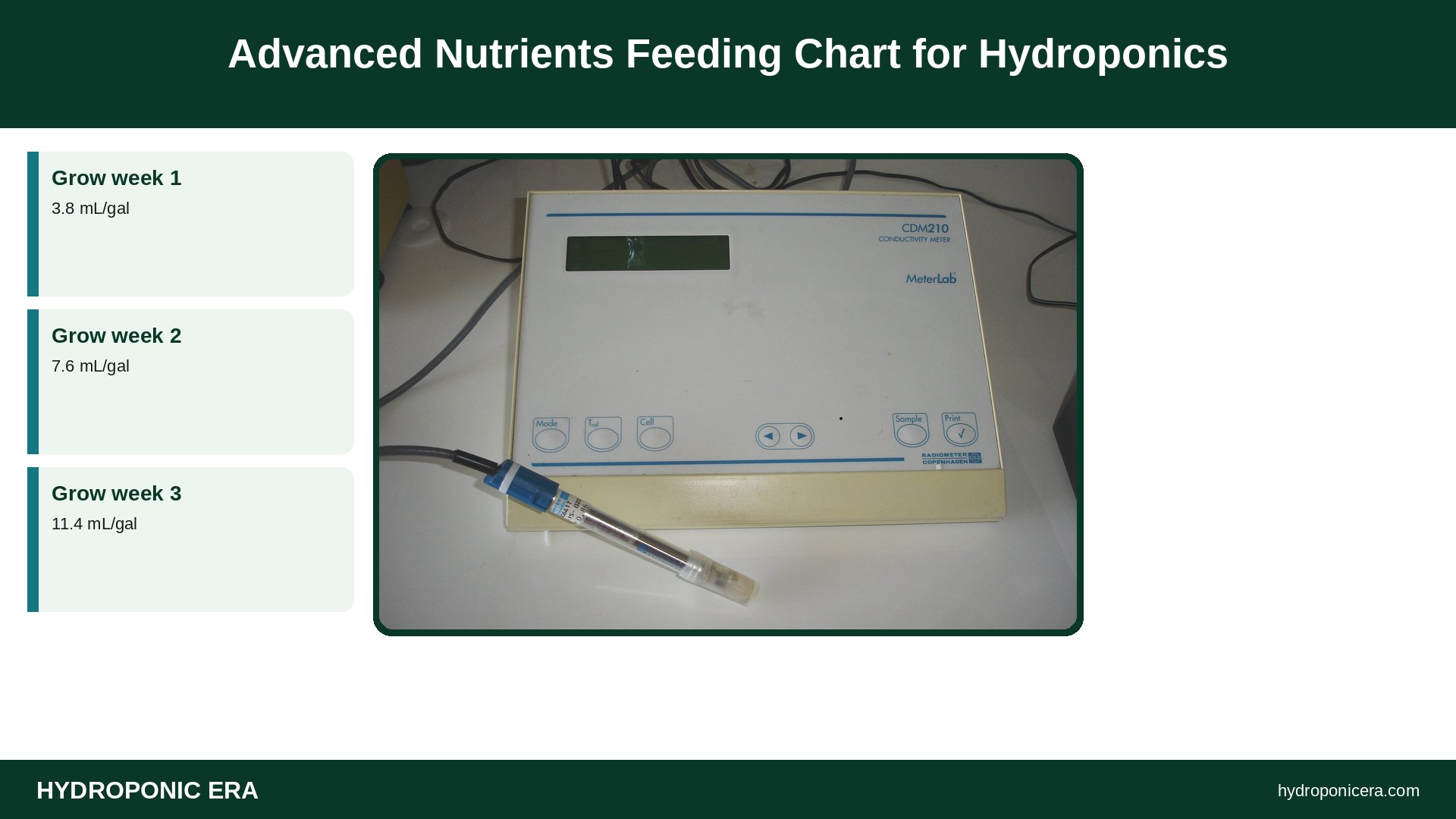
The Advanced Nutrients feeding chart for pH Perfect Grow, Micro, Bloom is simple: mix all three parts 1:1:1, start at 1 mL per liter of each in week 1 of the grow phase, step up to 2, 3, then 4 mL/L by week 4, and hold 4 mL/L of each through the bloom phase. In US units that’s about 3.8 mL per gallon of each part rising to about 15 mL per gallon. Advanced Nutrients says to add Micro first, then Grow, then Bloom, and to shake bottles first. For a custom schedule by reservoir size and stage, use the company’s official nutrient calculator.

how to lower ec — How to Lower EC in Hydroponics

The fastest answer to how to lower EC in hydroponics is to dilute: add plain, low-EC water to the reservoir, mix, and re-measure. If the reservoir is full, remove some nutrient solution first, then refill with fresh water. If EC is far too high or has crept up for weeks, drain and replace the whole solution at the target strength. For lettuce, UF/IFAS Extension gives a target of 1.2–1.8 mS/cm. Because EC is roughly proportional to concentration, replacing a fraction of the solution with plain water lowers EC by about that fraction.

homemade hydroponic nutrients — Homemade Hydroponic Nutrients: What Works and What Doesn't

Homemade hydroponic nutrients work when you mix them from proper water-soluble fertilizer salts, such as calcium nitrate, potassium nitrate, monopotassium phosphate, magnesium sulfate (Epsom salt), and a chelated micronutrient mix. That’s exactly how university and research recipes are built. Kitchen hacks like banana peel water, coffee grounds, or compost tea alone don’t work as a complete hydroponic feed, because they can’t supply all the essential nutrients in the right balance. Penn State Extension describes three reliable approaches: fertilizer programs (a base fertilizer plus calcium nitrate and Epsom salt), crop recipes built from individual salts, and complete hydroponic fertilizers.

banana peel water for plants — Banana Peel Water for Plants: Does It Work?

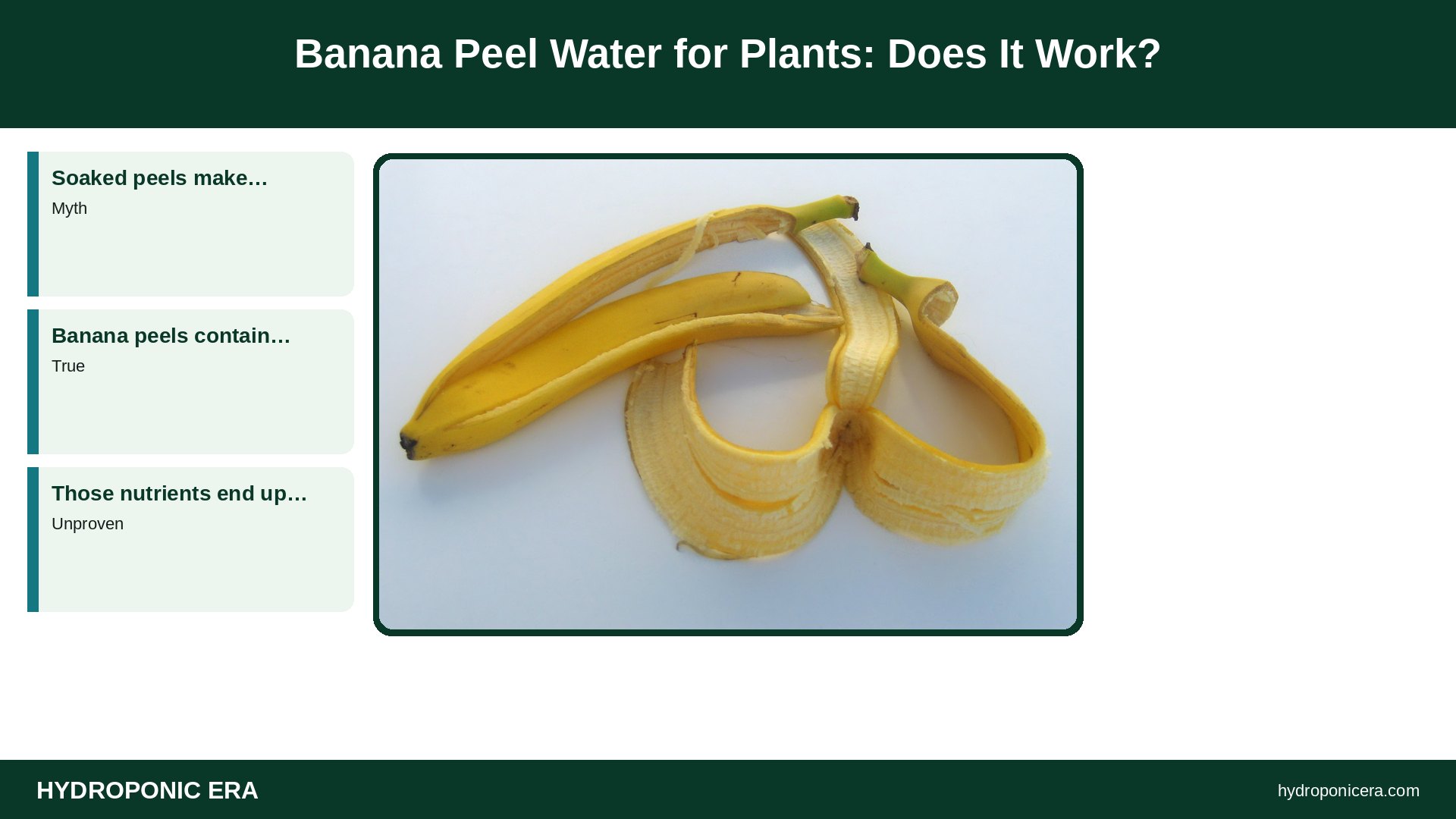
Banana peel water for plants is mostly a myth. Banana peels do contain potassium, but University of Maryland Extension says it is “not aware of any research” showing that soaking peels makes fertilizer-strength water. A Clemson Extension director adds that nobody knows what, if anything, leaches into the jar. Compost the peels instead, and feed plants with a labeled fertilizer based on a soil test.

aspirin for plants — Aspirin for Plants: What the Research Shows

Aspirin for plants is based on real science but oversold online. Plants use salicylic acid (SA), the compound aspirin breaks down into, as a signal to switch on their own defenses. However, University of Minnesota Extension Master Gardeners found the evidence “very thin” that spraying aspirin helps tomatoes. The only replicated home-garden trial we found, at the University of Rhode Island, couldn’t test disease control because no disease occurred. Aspirin is not a disease cure.

superthrive hydroponics — Superthrive Hydroponics: Does It Actually Work?

Superthrive hydroponics use is popular, but the evidence is mixed. Superthrive’s label ingredients include vitamin B1 (thiamine), a small amount of the synthetic auxin NAA (1-naphthaleneacetic acid), nitrogen and kelp. Extension research says vitamin B1 alone does not stimulate root growth in whole plants, while auxins like NAA can affect rooting. If you try it, use the maker’s low rates (¼ tsp per gallon for seedlings and clones), keep your base nutrients unchanged, and judge it with a side-by-side test.