
Chia microgreens are mild, fresh-tasting greens grown from the same chia seeds you eat. Don’t soak the seed: chia forms a gel within minutes of getting wet, so sprinkle it dry onto a fully saturated mat or fine media, mist it, and keep it covered and damp for about 4–5 days. Then give it light and harvest at about 7–14 days. The gel actually helps: University of Kentucky research found chia seeds with their mucilage germinated faster than seeds with it removed.
Key takeaway: Sow dry, keep the seeds constantly damp until they root, and use a flat, water-holding surface. The gel is normal, not mold.
| Chia microgreens at a glance | Value | Source |
|---|---|---|
| Presoak | No; sow dry on a saturated pad | True Leaf Market |
| Seed rate | About 2 tablespoons (up to 3) per kit tray | True Leaf Market |
| Covered time | About 4–5 days | True Leaf Market |
| Ideal temperature | 65–75°F (18–24°C) | True Leaf Market |
| Days to harvest | 7–14 days; about 10 is ideal | True Leaf Market |
Why Chia Seeds Are Different: Mucilage
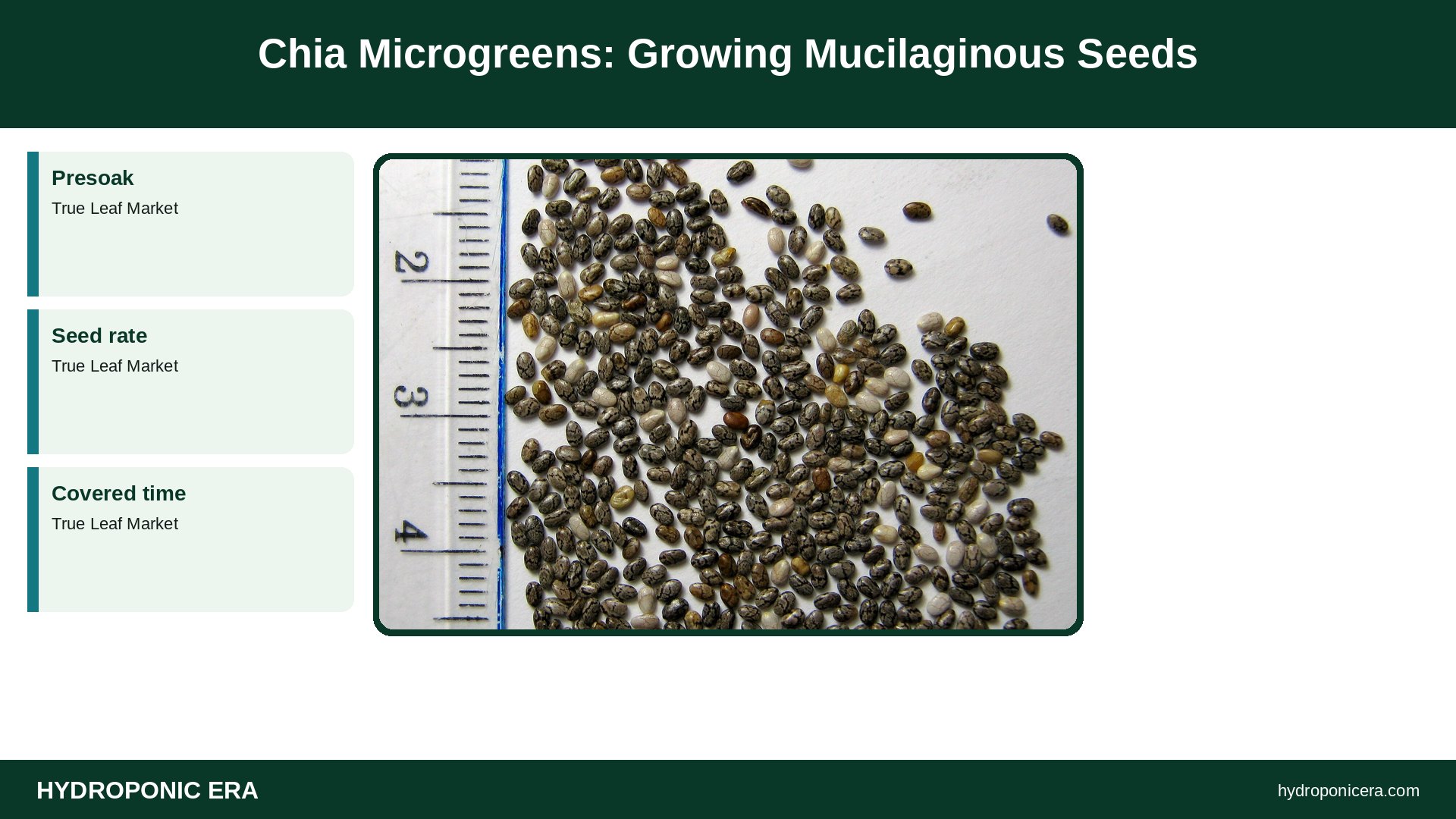
Chia (Salvia hispanica) is a mint-family plant whose seeds are technically small nutlets. Researchers at the University of Kentucky (Geneve et al.) found that mucilage starts to emerge within minutes of contact with water and reaches full size in about 1.5 hours, when it makes up about 92% of the water the seed has absorbed. In their Crop Science study, seeds with mucilage removed germinated more slowly, with 63% germination after 26 hours versus 97% for seeds producing mucilage. Mucilage-producing seeds also did better through cycles of wetting and drying. In short, the gel is a built-in water reservoir.
That’s why soaking is a bad idea: soaked chia turns into a sticky clump you can’t spread evenly. True Leaf Market’s instructions say chia should not be presoaked and should be spread dry on a saturated grow pad. Basil seed behaves the same way. See basil microgreens.
How to Grow Chia Microgreens
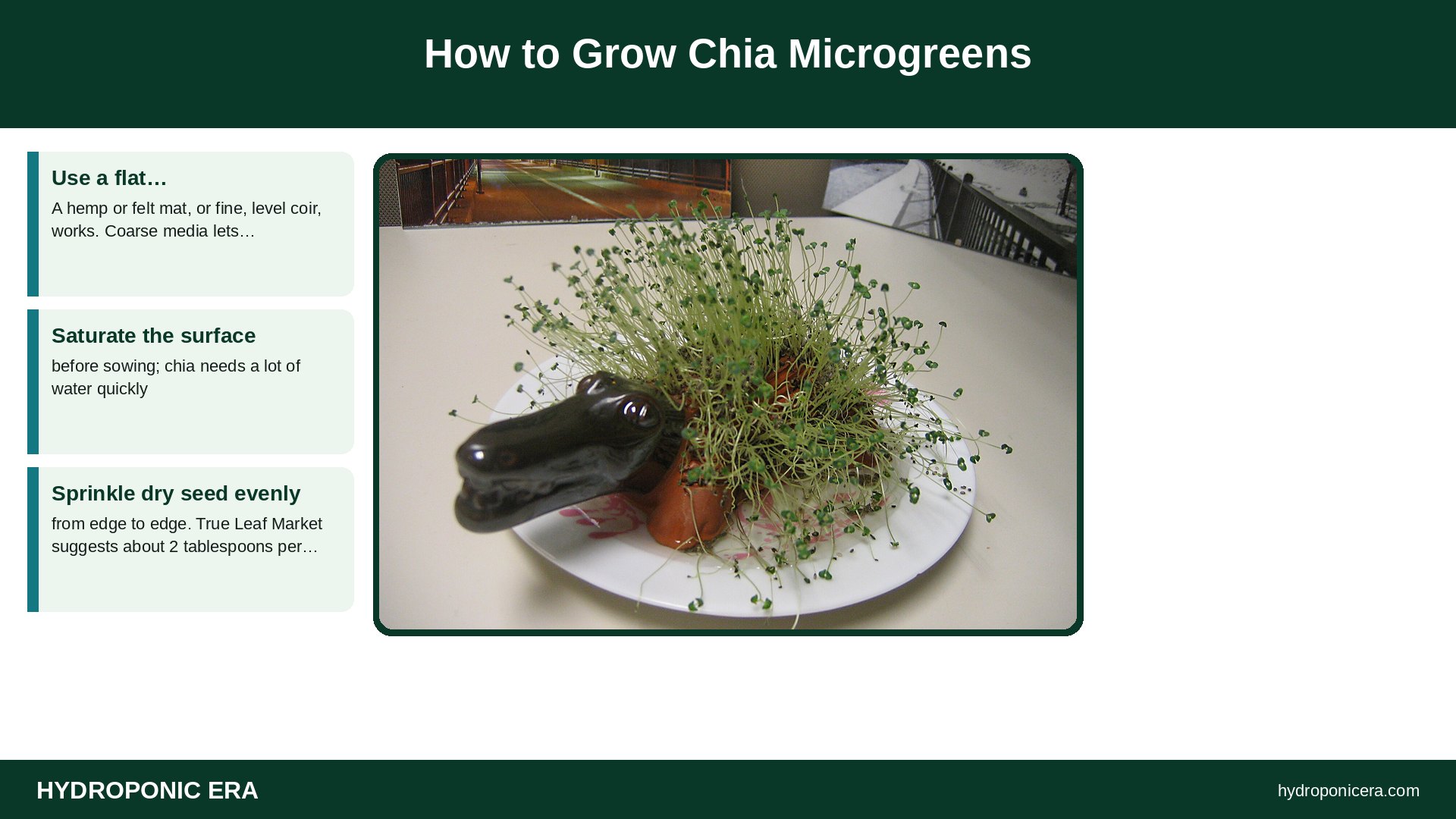
- Use a flat, water-holding surface. A hemp or felt mat, or fine, level coir, works. Coarse media lets seeds slip into gaps.
- Saturate the surface before sowing; chia needs a lot of water quickly.
- Sprinkle dry seed evenly from edge to edge. True Leaf Market suggests about 2 tablespoons per kit tray, up to 3 for a denser crop.
- Mist thoroughly so every seed is wet; the gel will form and glue the seeds in place.
- Cover with a misted tray as a blackout and humidity dome.
- Mist every 12 hours during the covered period. Don’t let the gel dry out.
- Uncover after 4–5 days, about a day after the first cotyledons show.
- Give light for 16–18 hours and keep the mat damp from below.
- Harvest at 7–14 days, ideally around day 10.
Light and Temperature
True Leaf Market recommends 65–75°F (18–24°C) during the covered stage, which matches the 65–75°F (18–24°C) range Johnny’s gives as generally favorable for microgreens. After uncovering, chia needs good light to green up; pale crops are a sign of weak light. Aim for the general microgreen DLI of 9–16 mol/m²/day that Virginia Cooperative Extension recommends. Rotate the tray if you’re using a window so seedlings don’t lean. See microgreens light requirements.
Chia Microgreens on Paper Towels or a Chia Pet
Because the gel sticks seeds to almost any wet surface, chia is one of the best crops for growing on damp paper towels, and it’s the seed behind the famous terracotta Chia Pet. These methods work for a small, fun harvest, but a mat in a tray gives a cleaner, more even crop. See microgreens on paper towels.
Common Problems With Chia Microgreens
| Problem | Likely cause | Fix |
|---|---|---|
| Seeds clumped in a gel blob | Seed was soaked or poured | Sow dry and sprinkle evenly |
| Poor germination | Gel dried out | Mist every 12 hours while covered |
| Slimy, smelly patches | Too thick or overwatered | Sow lighter; drain extra water |
| Pale, weak seedlings | Low light | Brighter light once uncovered |
| Odor near day 10 | Pad breaking down | Harvest around 10 days |
True Leaf Market notes rot can come from overwatering or thick sowing, and that a mild odor from the pad is common near day 10. The gel around unsprouted seeds is easy to confuse with mold; mold forms fuzzy threads that spread. See microgreens mold.
Food Safety Note
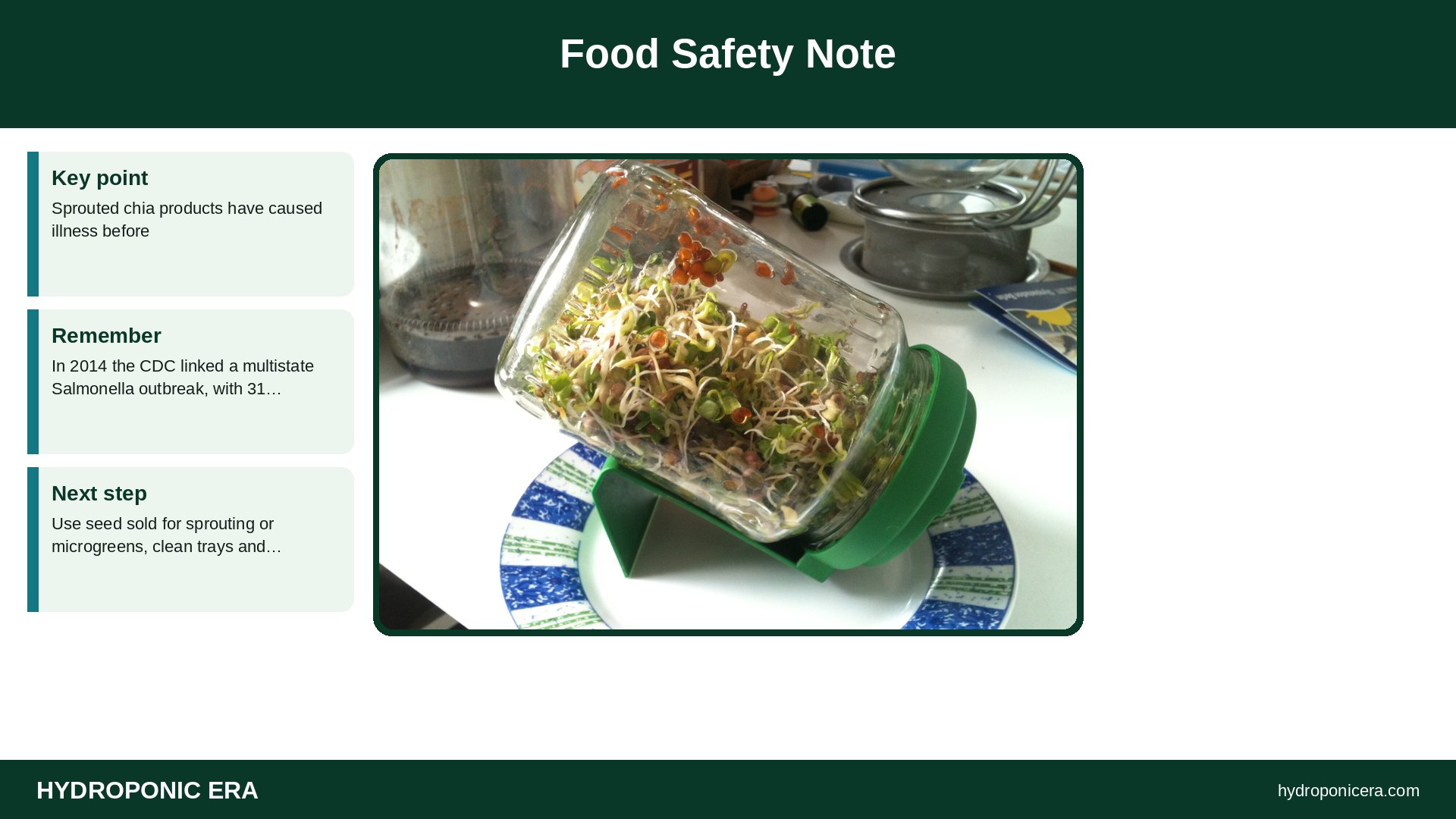
Sprouted chia products have caused illness before. In 2014 the CDC linked a multistate Salmonella outbreak, with 31 reported illnesses in 16 states, to organic sprouted chia powder, made from chia seeds that were sprouted, dried and ground. Use seed sold for sprouting or microgreens, clean trays and drinking-quality water, and wash the greens before eating. Penn State recommends untreated seed for microgreens. See microgreens vs sprouts.
Harvesting and Storage
True Leaf Market recommends harvesting in a cool part of the day so greens don’t wilt, then rinsing and drying them well. Cut with scissors above the mat, or pull up a clump and trim off the roots. Store dry, in a sealed container in the fridge. Penn State reports microgreens stored at 41°F (5°C) in the dark can last 10–14 days, though delicate greens like chia are best eaten within a few days. See how long microgreens last.
How to Use Chia Microgreens
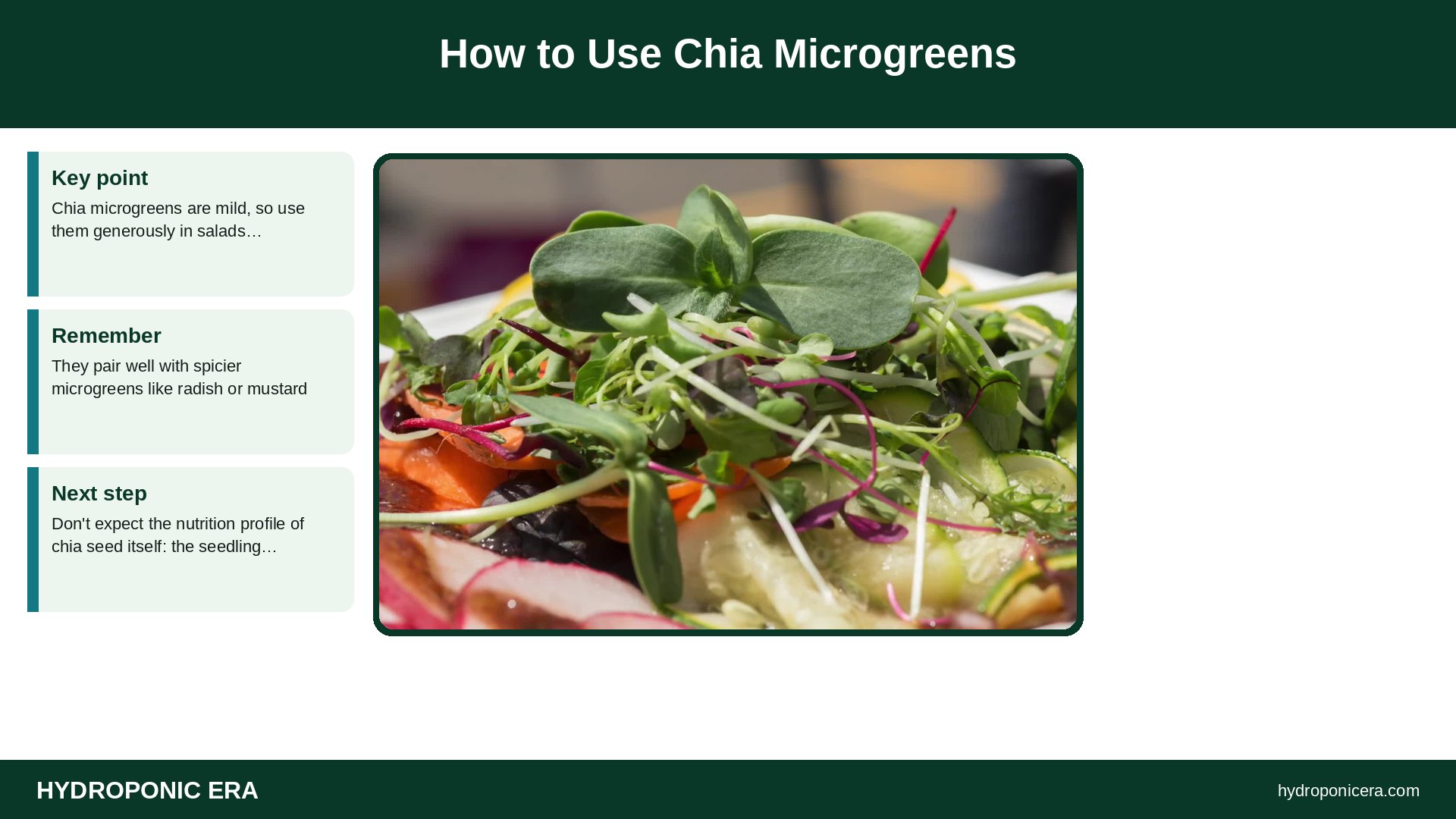
Chia microgreens are mild, so use them generously in salads, sandwiches, wraps, smoothies and as a topping for soups and avocado toast. They pair well with spicier microgreens like radish or mustard. Don’t expect the nutrition profile of chia seed itself: the seedling has used much of the oil and protein stored in the seed to grow. Enjoy them as a fresh green. See best microgreens to grow.
Keeping Trays Clean Between Crops
Chia’s gel stays moist for days, which is good for germination but also gives mold a head start if a tray or mat carries spores from the last crop. A simple routine helps:
- Use fresh media or a new mat for each crop rather than reusing an old one.
- Wash trays and lids with hot, soapy water after each harvest, rinse well and let them dry fully.
- Keep seed clean and dry in a sealed container, and buy seed sold for sprouting or microgreens.
- Wash your hands before sowing and harvesting.
Good airflow matters too. Once the seedlings are uncovered, a small fan on low keeps the surface from staying wet. See microgreens mold for how to tell mold from normal root hairs.
FAQs
Should I soak chia seeds for microgreens?
No; sow them dry on a saturated surface.
How long do chia microgreens take?
About 7–14 days, with day 10 ideal.
Why are my chia seeds slimy?
That’s natural mucilage, not mold.
Can I use grocery store chia seeds?
Seed sold for sprouting or microgreens is the safer choice.
How long should chia stay covered?
About 4–5 days, misting every 12 hours.
Do chia microgreens need light?
Yes, after the covered period.
Sources
- Geneve et al. (2017), Crop Science — Stress Influences Seed Germination in Mucilage-Producing Chia
- Geneve et al. (2019), Acta Horticulturae — Seed Germination and Mucilage Production in Chia
- True Leaf Market — How to Grow Chia Microgreens
- Centers for Disease Control and Prevention — Salmonella Infections Linked to Organic Sprouted Chia Powder (2014)
- Johnny’s Selected Seeds — Microgreens Comparison Chart
- Virginia Cooperative Extension — Introduction to Microgreen Production
- Penn State Extension — Growing Microgreens
- Photo credits (Wikimedia Commons, edited with titles): Semillas de Chía by Magister Mathematicae (CC BY-SA 3.0); Alligator Chia Pet by Jeremy Noble (CC BY 2.0); Lufa Farms Microgreens in Trays by Lufa Farms (CC BY-SA 2.0); Growing bean sprouts by User:tlcoles (CC BY-SA 3.0); 20160617-AMS-LSC-9000 (61-sec.) (27334710733) by U.S. Department of Agriculture (Public domain)