
Quick Answer
Grow bok choy hydroponically as a cool-season Asian green: keep temperatures moderate, deliver steady moisture to oxygenated roots, use mild leafy nutrients, and harvest before heat pushes flowering. University of Minnesota Extension notes bok choy (pak choi) forms upright clumps of thick-stalked leaves and can be harvested leaf-by-leaf or as whole plants. University of Maryland Extension lists bok choy among cool-season vegetables with spring and fall planting windows—indoors, that cool preference still drives quality.
Pair this guide with pH control, hydroponic nutrients, and the water-change guide.
Key Takeaways
- UMN Extension describes bok choy as a thick-stalked leafy brassica suited to cool conditions and steady water/nutrient uptake.
- UMD Extension’s planting calendar treats bok choy as a cool-season crop with distinct spring/fall windows outdoors.
- UF HS1279 is a useful protected leafy framework for hydroponic greens.
- Bolting risk rises with heat and stress—harvest earlier rather than “waiting for bigger.”
- Baby bok choy cycles fit home NFT/DWC better than oversized field heads.
- See related greens: lettuce, spinach, and kale (this batch).
- Root oxygen and reservoir temperature matter—DO, reservoir temp.
Related HydroponicEra guides
- Best plants for hydroponics
- How to grow lettuce hydroponically
- How to grow spinach hydroponically
- How to grow basil hydroponically
- Deep water culture for beginners
- NFT hydroponics for beginners
- PPFD and DLI light levels
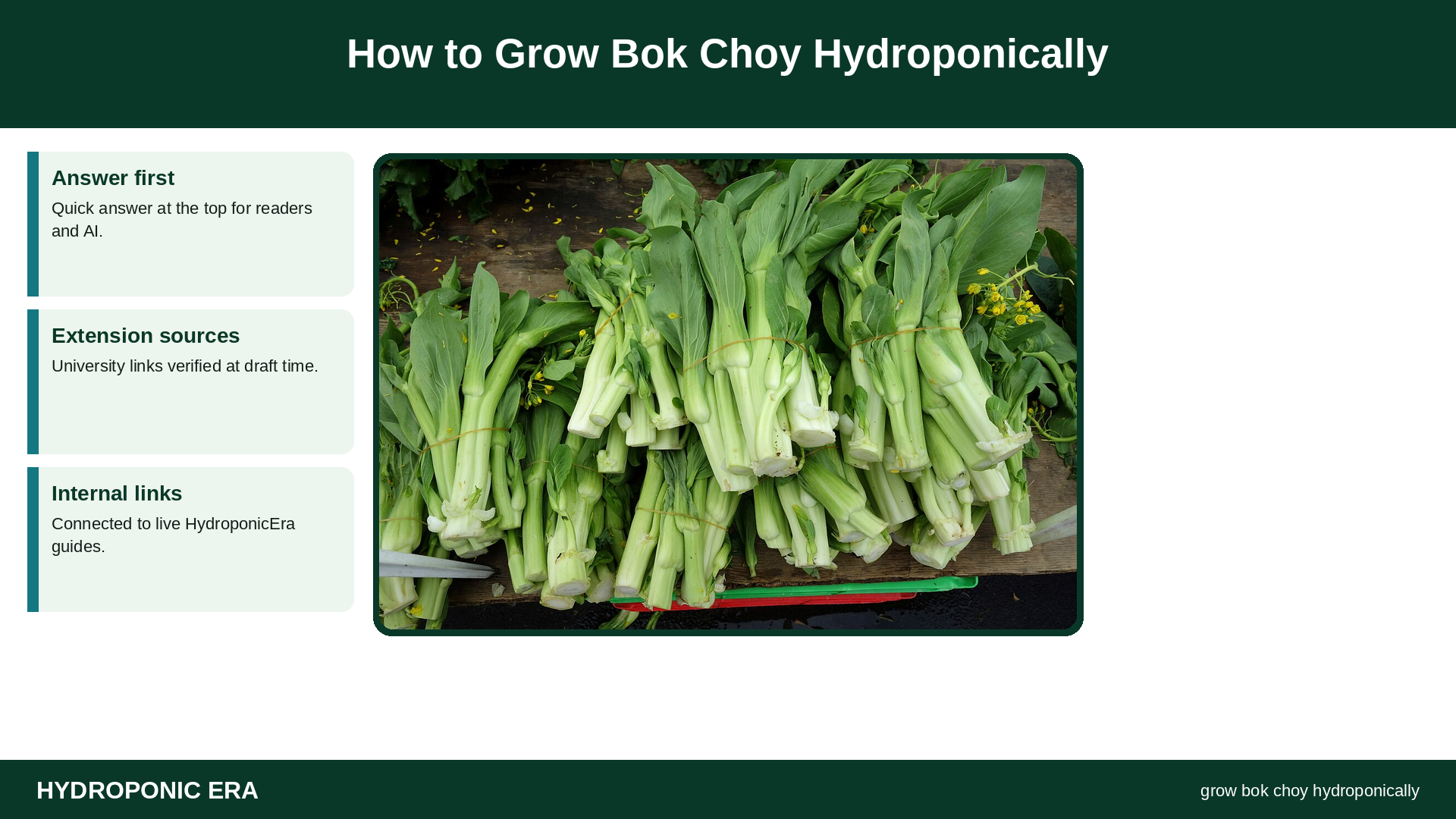
Grow Bok Choy Hydroponically: Why Bok Choy Is a Fast Hydroponic Green

Bok choy (Brassica rapa chinensis group) is grown for crisp petioles and mild leaves. UMN Extension emphasizes fertile, moisture-retentive conditions outdoors and warns that cabbage-family crops need steady water and nutrient uptake. Hydroponics can meet that steadiness—if temperatures stay in a cool-season comfort zone.
Maryland Extension’s vegetable timing resource places bok choy in cool-season slots. Indoors, a hot LED tent that grows peppers will often bolt bok choy. Choose baby types for faster kitchen harvests and better fit in net pots.
UF leafy hydroponic guidance (HS1279) reminds growers that cultivar and environment interact. Do not treat every brassica like lettuce, and do not treat every warm room like a leafy room.
Grow Bok Choy Hydroponically: Choose a System for Hydroponic Bok Choy
| System | Beginner fit | Watch-outs |
|---|---|---|
| NFT | Excellent for baby bok choy | Keep flow reliable; avoid heat in channels |
| DWC / raft | Good if cool and aerated | Warm rafts raise bolt and root risk |
| Media / drip | Good | Do not leave media anaerobic |
| Kratky | Small trials | Oxygen/heat limits |
| Dutch bucket | Optional | Usually unnecessary for baby crops |
Compare layouts in DWC vs NFT vs Dutch bucket. For media and plugs, see growing media and seedlings and transplanting.
Step-by-Step: Grow Bok Choy Hydroponically
- Choose baby or full-size cultivars based on system spacing.
- Start seeds in clean plugs; brassicas usually germinate promptly in moderate temperatures.
- Transplant early once true leaves appear and roots hold the plug.
- Use mild leafy nutrients; avoid fruiting strength.
- Set pH near 5.5–6.5 after mixing.
- Keep the canopy cool relative to fruiting zones; review lights and heat load.
- Maintain aeration or film flow continuously.
- Scout for aphids on soft new growth.
- Harvest outer leaves early or cut whole baby heads before bolting.
- Succession sow every 1–2 weeks for continuous supply.
Grow Bok Choy Hydroponically: Important Growing Variables
| Variable | Practical beginner guidance | Notes |
|---|---|---|
| Temperature | Cool-season targets | Heat → bolting and quality loss |
| Nutrient strength | Mild leafy EC | High EC toughens leaves |
| pH | ~5.5–6.5 | Watch new-leaf color |
| Oxygen | High priority in DWC | Low DO invites root issues |
| Spacing | Room for upright petioles | Crowding softens quality |
| Harvest timing | Earlier than you think | Beat the flower stalk |
Track solution strength with the EC and TDS guide. If leaves yellow, diagnose before dumping random bottles: yellow leaves guide.
Grow Bok Choy Hydroponically: Common Mistakes
- Growing bok choy next to heat-loving cucumbers without climate separation
- Waiting for “giant heads” in a warm indoor room
- Using tomato nutrient recipes on baby greens
- Ignoring first signs of a flower stalk
- Letting raft water warm above leafy comfort
- Skipping pest scouting on soft brassica tips
Grow Bok Choy Hydroponically: Troubleshooting Bok Choy Problems

| Symptom | Likely causes | What to do |
|---|---|---|
| Tall flower stalk | Heat / age / stress | Harvest remaining leaves; restart cool cycle |
| Tip burn | High EC / low airflow / Ca uptake | Moderate EC; Ca/Mg |
| Yellow new growth | pH / micronutrients | Lockout |
| Wilting wet roots | Low DO / Pythium risk | Brown roots; cool and aerate |
| Aphids | Common on brassicas | Pest guide |
| Bitter stems | Heat / late harvest | Harvest younger; cool room |
What to Check in Your Own Bok Choy System
- Afternoon canopy and reservoir temps
- Any central stalk elongating
- EC drift between top-offs
- Root appearance
- Aphid scouting on newest leaves
- Whether succession trays are started
Suggested Beginner Schedule
| Stage | Focus | Actions |
|---|---|---|
| Germination | Quick even sprouts | Moderate temp; even moisture |
| Seedling | Compact plants | Mild feed; steady light |
| Vegetative | Thick petioles | Hold cool conditions |
| Harvest | Baby heads or outer leaves | Before bolting |
| Reset | Clean channels/rafts | Especially after warm failures |
Bolting decision tree: If days are warm and a central stalk is rising, harvest now. Starting a new plug tray beats nursing a flowering plant.
Flavor: Mild sweetness tracks cool growth and timely harvest more than any specialty additive.
Final Bok Choy Success Checklist
- Cool-leaning temperatures
- Mild leafy nutrition and stable pH
- Oxygenated roots
- Early harvest habit
- Succession planting
- Aphid scouting
Deeper Practical Notes
Bok choy is a cool-season brassica green that can bolt when temperatures rise. Treat it more like spinach and lettuce than like basil. UF/IFAS leafy hydroponic materials and cool-season garden guidance from university extensions support the idea that environment drives quality.
Harvest baby bok choy earlier for tenderness if your indoor climate is imperfect. Crowding raises humidity and disease risk inside dense Asian green canopies—leave airflow lanes.
Nutrient strength should stay in a mild leafy range. Overfeeding does not stop bolting. If plants elongate a flower stalk, harvest remaining leaves and restart under cooler conditions.
Flavor, Texture, and Kitchen Use
Baby bok choy shines in quick stir-fries and soups because petioles stay crisp when harvested on time. If stems turn spongy or hollow and a flower stalk rises, quality is already declining—harvest what remains and restart. Keep postharvest leaves cool and lightly moist in the refrigerator; do not leave cut heads in a hot kitchen.
For mixed salad use, harvest younger leaves and pair with milder lettuce. For cooking, slightly larger plants are fine if they never bolted. Define the end use before you sow density and EC targets.
If shared reservoirs also grow fruiting crops, expect bok choy to show stress first when temperatures climb. Separate climate zones when you can, or accept shorter cycles.
FAQs
Is bok choy easier than spinach hydroponically?
Often yes in moderately cool rooms, but heat still causes bolting. Neither crop loves a hot fruiting tent.
Can I grow bok choy in NFT?
Yes—especially baby types—if flow is reliable and temperatures stay moderate.
Whole head or leaf harvest?
Both work. Leaf harvest extends a plant; whole baby heads fit meal prep and succession planning.
What about pH?
Aim near a soilless hydroponic band around 5.5–6.5 and adjust from plant response.
Why did my bok choy bolt indoors?
Heat, plant age, and stress are common drivers. Harvest and restart under cooler conditions.
Practice log and next steps
Keep a simple logbook for this topic: date, meter readings when relevant, what you changed, and what the plants did over the next three to seven days. Hydroponics rewards slow feedback loops more than frantic daily recipe rewrites.
When in doubt, return to calibrated pH and EC, root inspection, and light adequacy before buying another bottle. Extension hydroponic and plant nutrition resources emphasize fundamentals for a reason.
Link outward to the matching HydroponicEra cluster pages so readers can continue into systems, water, crops, or troubleshooting without dead ends. Internal links are part of topical authority, not decoration.
Sanitation and opaque reservoirs prevent many secondary problems that look like nutrient mysteries. Clean systems make diagnosis clearer.
If you sell produce or teach workshops, document procedures. Consistency protects customers and your future self.
Grow Bok Choy Hydroponically: Practical Checklist
Grow Bok Choy Hydroponically matters every week in a home system. Recheck grow bok choy hydroponically after transplants, heat spikes, and canopy fill-in. Strong grow bok choy hydroponically habits beat one-time guesses. When grow bok choy hydroponically drifts, leaves crowd, roots stress, or harvest quality drops. Write grow bok choy hydroponically targets into your log so you do not rely on memory. Teach helpers your grow bok choy hydroponically checklist before you leave town. Improve grow bok choy hydroponically in small steps—measure, adjust, then wait a day. Compare grow bok choy hydroponically notes against light, airflow, and reservoir temperature. Keep grow bok choy hydroponically realistic for your shelf depth and cultivar size.
Sources
- University of Minnesota Extension — Growing Chinese cabbage and bok choy in home gardens
- University of Maryland Extension — When to Plant Vegetables
- University of Florida IFAS — HS1279: Leafy Greens in Hydroponics and Protected Culture for Florida
- University of Florida IFAS — HS1422: Growing Lettuce in Small Hydroponic Systems
- Oklahoma State University Extension — Electrical Conductivity and pH Guide for Hydroponics
- Virginia Cooperative Extension — SPES-720: Calculating and Using Daily Light Integral (DLI)
- University of Kentucky CCD — Hydroponic Lettuce Production in Controlled Environments (PDF)