
Quick Answer
Grow green onions hydroponically (scallions / bunching onions) from seed for the cleanest long-term crop, or regrow kitchen bases for a short demonstration harvest. Provide steady light, mild complete nutrients, pH near 5.5–6.5, and enough spacing for upright leaves. University of Maryland Extension lists onion-family crops among common garden vegetables with cool-season foliage growth. University of Minnesota Extension’s herbs and allium-adjacent garden guidance supports treating leafy alliums as regular, cut-friendly producers rather than bulb-onion projects.
This guide focuses on green shafts for cooking—not large storage bulbs. Pair with pH, nutrients, and lettuce system habits.
Key Takeaways
- Green onions are a different goal than bulb onions—harvest leafy shafts early and often.
- Seed-grown scallions usually outperform endless regrowth of grocery butts for sustained hydroponic production.
- UMD planting resources place onions/scallion-type crops in cool-to-moderate seasonal logic outdoors; indoors, avoid extreme heat.
- Mild EC and stable pH matter more than exotic additives.
- NFT, shallow DWC, or media cups all work when roots stay oxygenated.
- Cut above the white base to allow regrowth on established plants.
- Hygiene still matters after onion sulfur smells build in reservoirs—change water on a schedule (water-change guide).
Related HydroponicEra guides
- Best plants for hydroponics
- Grow lettuce hydroponically
- Hydroponic seedlings and transplanting
- DWC for beginners
- NFT for beginners
- Growing media
- PPFD and DLI
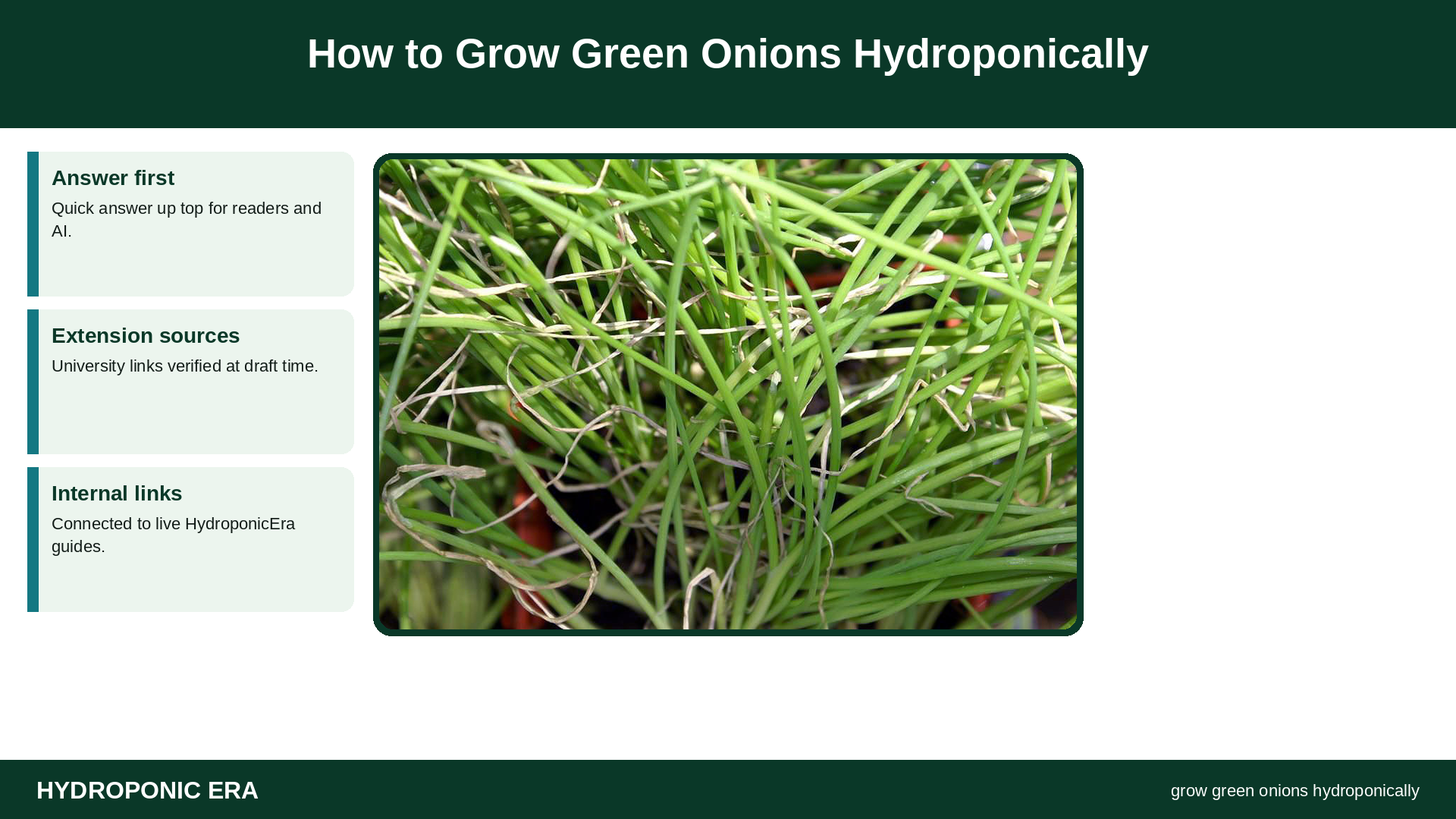
Grow Green Onions Hydroponically: Seed vs Regrown Grocery Bases
There are two beginner paths. Seed gives uniform bunches and a real production habit. Regrowing white bases from grocery green onions is a useful learning project and can yield a short flush of greens, but it is not the same as a planned hydroponic crop: bases vary in quality, may carry decay, and often decline after one or two cuts.
If you regrow bases, sanitize tools, trim slime, and place only clean bases into cups with the roots/wet zone supported. For ongoing kitchen supply, start a seed tray every couple of weeks.
Maryland Extension’s vegetable timing tables remind growers that allium foliage prefers cooler seasonal windows outdoors. Indoors, translate that as moderate temperatures and steady light—not a pepper-heat schedule.
Grow Green Onions Hydroponically: Choose a System for Green Onions
| System | Beginner fit | Watch-outs |
|---|---|---|
| NFT | Good for dense scallion rows | Keep inlets clear of debris |
| DWC / raft | Good with aeration | Do not submerge crowns |
| Media cups / drip | Excellent for upright clumps | Avoid waterlogged cups |
| Jar regrow | Demo only | Not a full production method |
| Dutch bucket | Overkill | Better for fruiting crops |
See system comparisons and media choices.
Step-by-Step: Grow Green Onions Hydroponically
- Decide seed vs regrow. Choose seed for ongoing supply.
- Sow several seeds per plug if you want clumped bunches, or single seeds for uniform singles.
- Provide light immediately after emergence to prevent floppy leaves.
- Transplant when roots hold media and leaves are sturdy.
- Mix mild complete nutrients and set pH near 5.5–6.5.
- Give steady leafy light using grow-light basics and DLI thinking.
- Keep crowns above the waterline in DWC; wet roots, dry stem bases.
- Maintain aeration (air stones) or reliable film flow.
- Harvest by cutting green leaves above the base; leave growing points for regrowth on seed-grown plants.
- Succession sow so you always have a young tray coming.
Grow Green Onions Hydroponically: Important Growing Variables
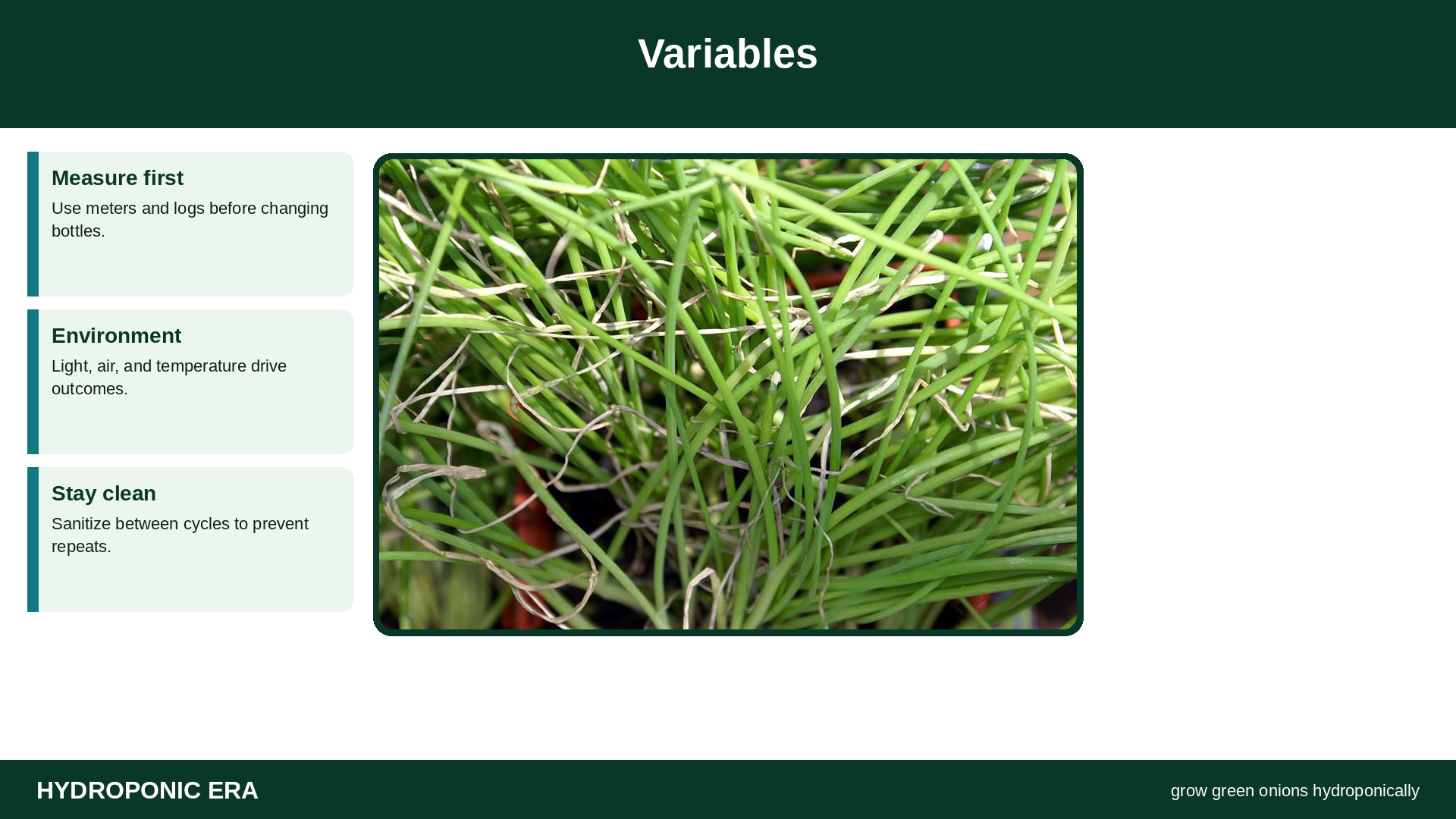
| Variable | Guidance | Notes |
|---|---|---|
| Temperature | Moderate | Extreme heat softens quality |
| Light | Steady leafy DLI | Low light → weak leaves |
| pH | ~5.5–6.5 | OSU soilless framing |
| EC | Mild | Watch tip burn on fast growth |
| Crown position | Not submerged | Prevents rot at base |
| Spacing | Airflow between clumps | Dense mats stay wet |
Grow Green Onions Hydroponically: Common Mistakes
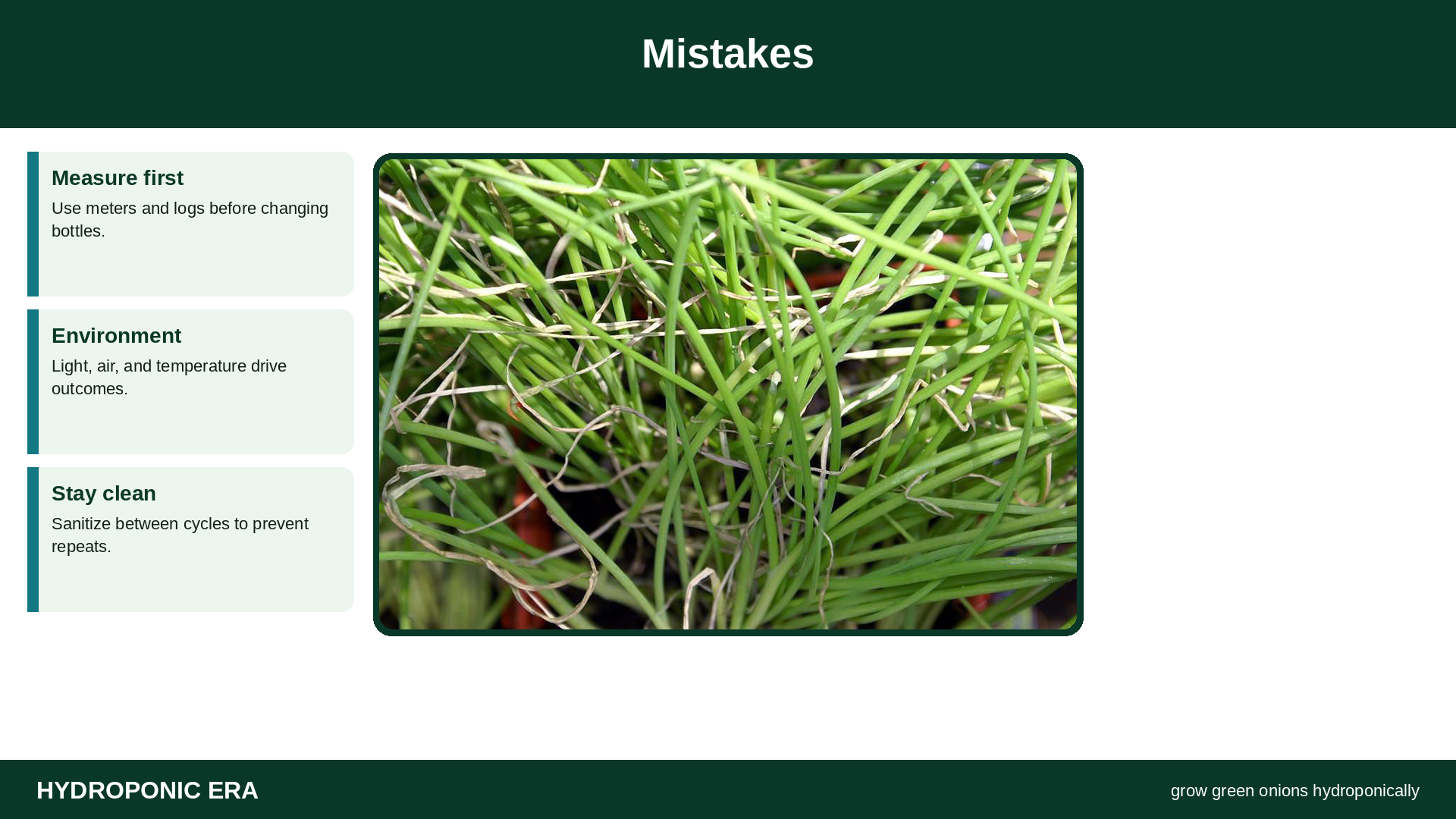
- Expecting grocery butts to produce forever
- Submerging the entire white shaft in DWC
- Using fruiting-crop nutrient strength
- Harvesting so low you remove the growing point
- Ignoring reservoir odor and biofilm on long runs
- Insufficient light leading to pale, floppy leaves
Grow Green Onions Hydroponically: Troubleshooting
| Symptom | Likely causes | What to do |
|---|---|---|
| Slimy bases | Crown submerged / dirty water | Raise plants; clean reservoir; restart |
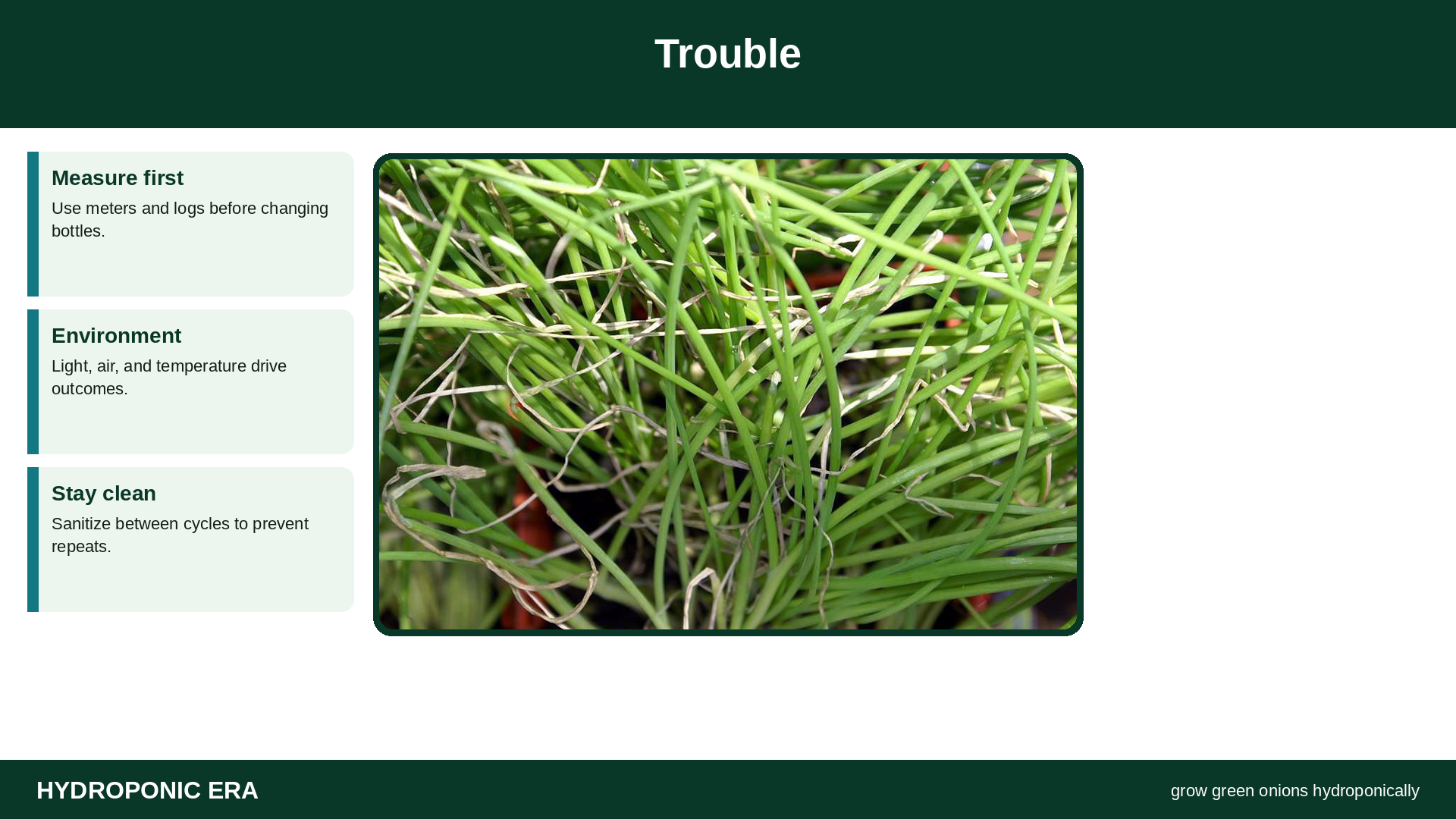
| Yellow tips | Age / salts / uneven moisture | Check EC; harvest; refresh solution |
| Weak floppy leaves | Low light | Increase DLI carefully |
| Slow regrowth | Over-harvest / old grocery bases | Switch to seed-grown plants |
| Root browning | Low DO / heat | Brown roots guide; aerate; cool |
| Yellow new leaves | pH lockout | Lockout |
What to Check
- Crown height relative to waterline
- Afternoon reservoir temperature
- pH/EC after top-offs
- Whether you are cutting too low
- Seed succession tray status
- Reservoir cleanliness and smell
Suggested Beginner Schedule
| Stage | Focus | Actions |
|---|---|---|
| Sow | Even germination | Moist plugs; label dates |
| Seedling | Upright leaves | Immediate light |
| Production | Mild feed + oxygen | Hold pH/EC |
| Harvest | Cut-and-regrow | Leave bases intact |
| Reset | Hygiene | Clean cups and lines |
Kitchen Production Notes
Plan harvests around cooking: scissors-cut what you need rather than pulling whole clumps every time. Keep a “ready” row and a “recovering” row. If flavor turns harsh, check heat and EC before buying a new seed variety.
Green onions share reservoirs with lettuce well. Heavy fruiting crops may outcompete them for potassium and demand different light—separate when possible.
For media, see growing media. For oxygen issues, see dissolved oxygen and reservoir temperature.
Final Checklist
- Seed-based succession for real supply
- Crowns above waterline
- Mild nutrients and stable pH
- Steady light and airflow
- Cut-and-regrow harvest habit
- Clean reservoirs on a schedule
Production Math for a Household
Instead of one giant planting, keep three small cohorts: germinating, sizing up, and harvesting. A scissors harvest from the ready row twice a week usually beats pulling whole clumps. When regrowth slows, retire that cup and transplant the next cohort.
Grocery-base regrowth is still useful for teaching kids or proving a jar demo, but seed-grown plants give cleaner long-term supply. If bases smell sulfurous and slimy, discard—do not “save” rotten tissue in a shared reservoir.
Track how many usable handfuls you cut per week for a month. That personal measurement beats generic yield claims and tells you whether to expand sites or simply sow denser trays.
Lighting that works for lettuce generally works for scallions; pale floppy leaves almost always mean more DLI is needed before more fertilizer.
Nutrient and pH Habits for Alliums
Green onions rarely need exotic additives. A complete mild hydroponic formula, stable pH near a soilless band, and clean water changes outperform constant tinkering. If tips yellow while EC climbs, refresh the reservoir rather than stacking stimulants. Keep crowns dry in DWC so you are not fighting basal rot while chasing nutrient perfection.
FAQs
Can I grow green onions in water only forever?
Regrowth in plain water is a short demo. For ongoing production, use a complete hydroponic nutrient at mild strength.
Seed or grocery leftovers?
Seed for reliability. Leftovers for learning.
DWC or NFT?
Both work. Keep crowns from sitting in stagnant water and maintain oxygen or flow.
What pH?
Near 5.5–6.5 for many soilless hydroponic crops (Oklahoma State framing). Verify with a calibrated meter.
How often to harvest?
When leaves reach usable kitchen size. Leave enough green tissue for recovery.
Grow Green Onions Hydroponically: Practical Checklist
Grow Green Onions Hydroponically matters every week in a home system. Recheck grow green onions hydroponically after transplants, heat spikes, and canopy fill-in. Strong grow green onions hydroponically habits beat one-time guesses. When grow green onions hydroponically drifts, leaves crowd, roots stress, or harvest quality drops. Write grow green onions hydroponically targets into your log so you do not rely on memory. Teach helpers your grow green onions hydroponically checklist before you leave town. Improve grow green onions hydroponically in small steps—measure, adjust, then wait a day.
Sources
- University of Maryland Extension — When to Plant Vegetables
- University of Minnesota Extension — Growing herbs in home gardens
- University of Florida IFAS — HS1279: Leafy Greens in Hydroponics and Protected Culture for Florida
- Oklahoma State University Extension — Hydroponics
- Oklahoma State University Extension — Electrical Conductivity and pH Guide for Hydroponics
- Virginia Cooperative Extension — SPES-720: Calculating and Using Daily Light Integral (DLI)
- Penn State Extension — Hydroponics Systems and Principles of Plant Nutrition
1 thought on “How to Grow Green Onions Hydroponically: Scallion Basics”