
Quick Answer
Hard water and RO water both can work for hydroponics if you understand what they contribute. Hard tap water often brings calcium, magnesium, and alkalinity that push pH upward and add base ions before you fertilize. Reverse osmosis (RO) water strips most minerals, giving a blank slate—but you must supply a complete nutrient program and may need to manage cost and wastewater. Test your source, read EC/pH, and choose straight tap, RO, or a blend based on measurements—not slogans.
Pair with pH beginners, fix high/low pH, EC/TDS, Ca/Mg, and nutrients.
Key Takeaways
- Penn State’s irrigation water interpretation and water-quality toolkit explain how to read water reports for greenhouse/nursery production.
- Oklahoma State EC/pH hydroponic guidance helps you manage solution numbers after choosing a water source.
- Alkalinity (not only “hardness” in casual speech) often drives pH rise after mixing.
- RO water is not automatically “better”—it is more controllable if you fertilize completely.
- Blending RO and tap can reduce alkalinity while retaining some Ca/Mg.
- Never invent lab numbers—test or use utility reports as approximate starting clues.
- Filters age; RO membranes fail; retest when pH behavior changes suddenly.
Related HydroponicEra guides

What “Hard Water” Means for Hydroponics

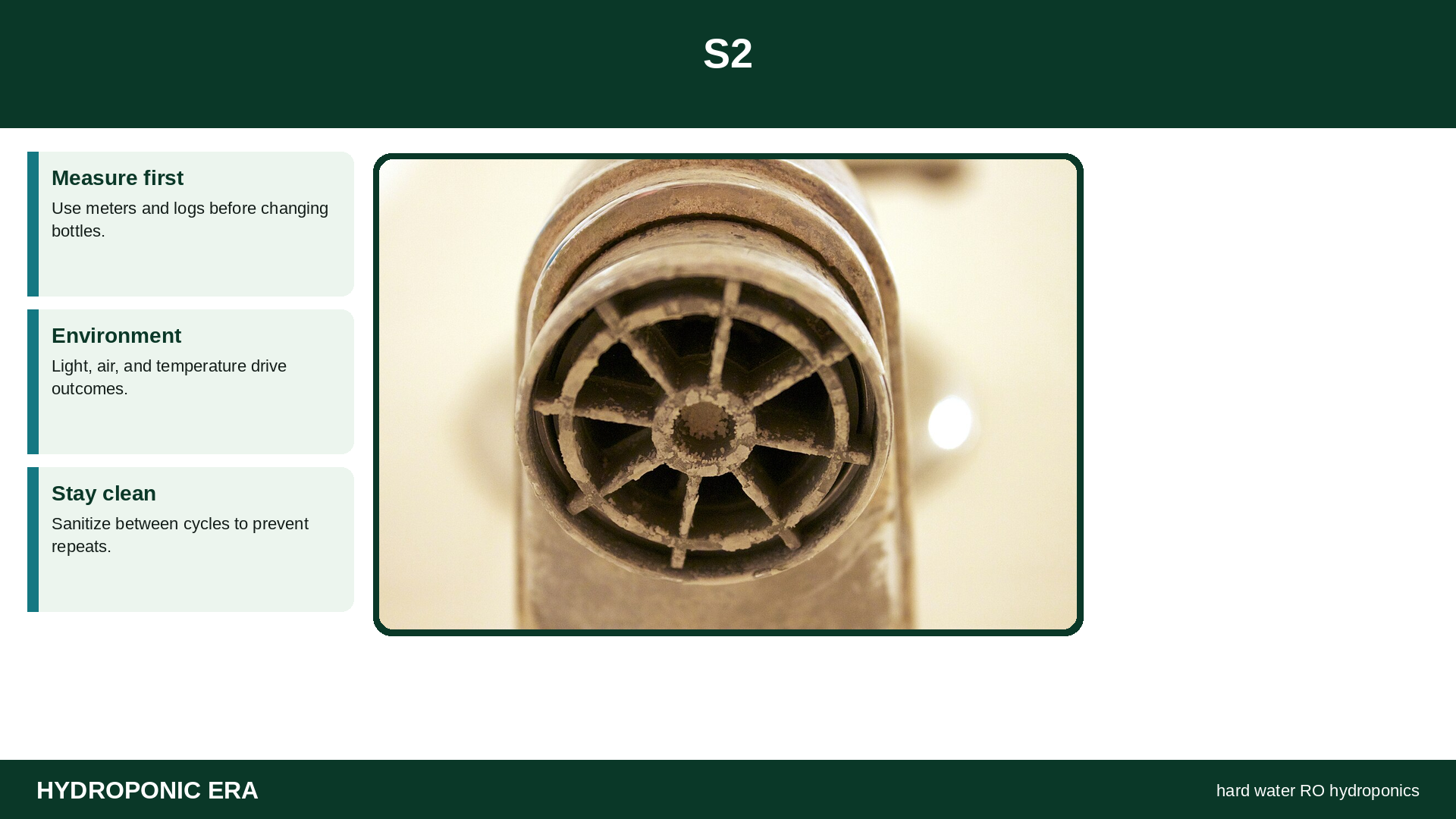
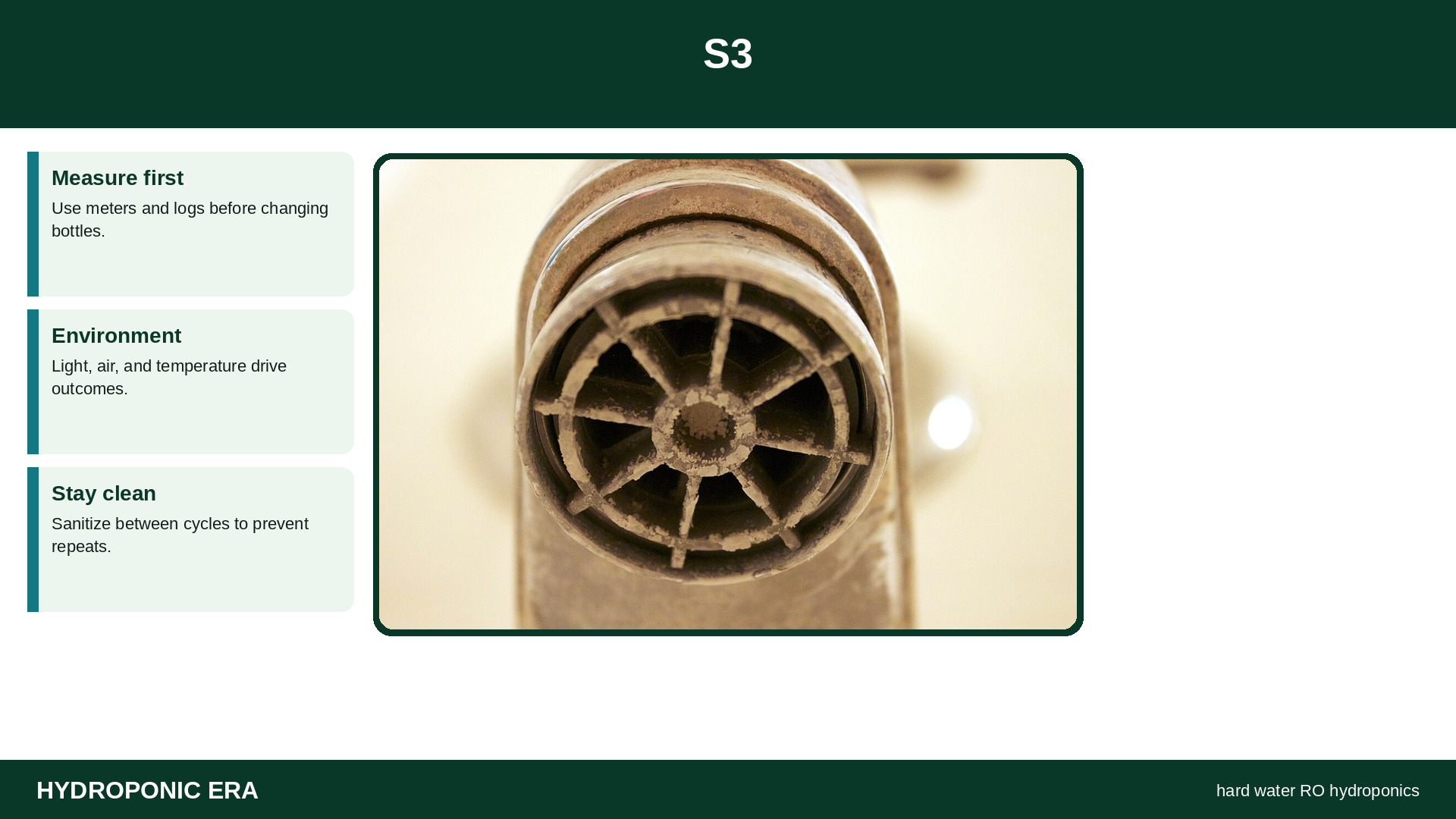
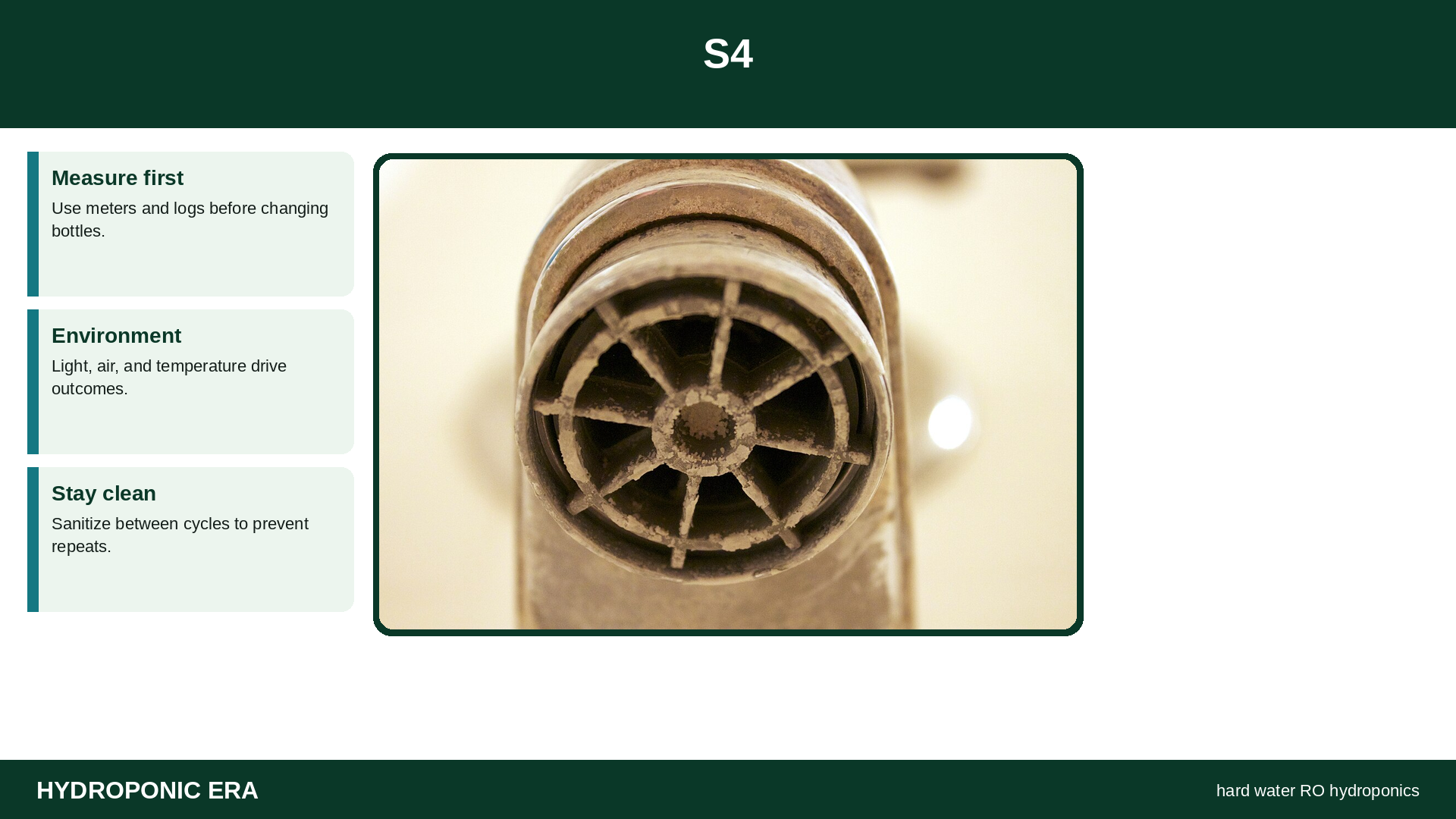
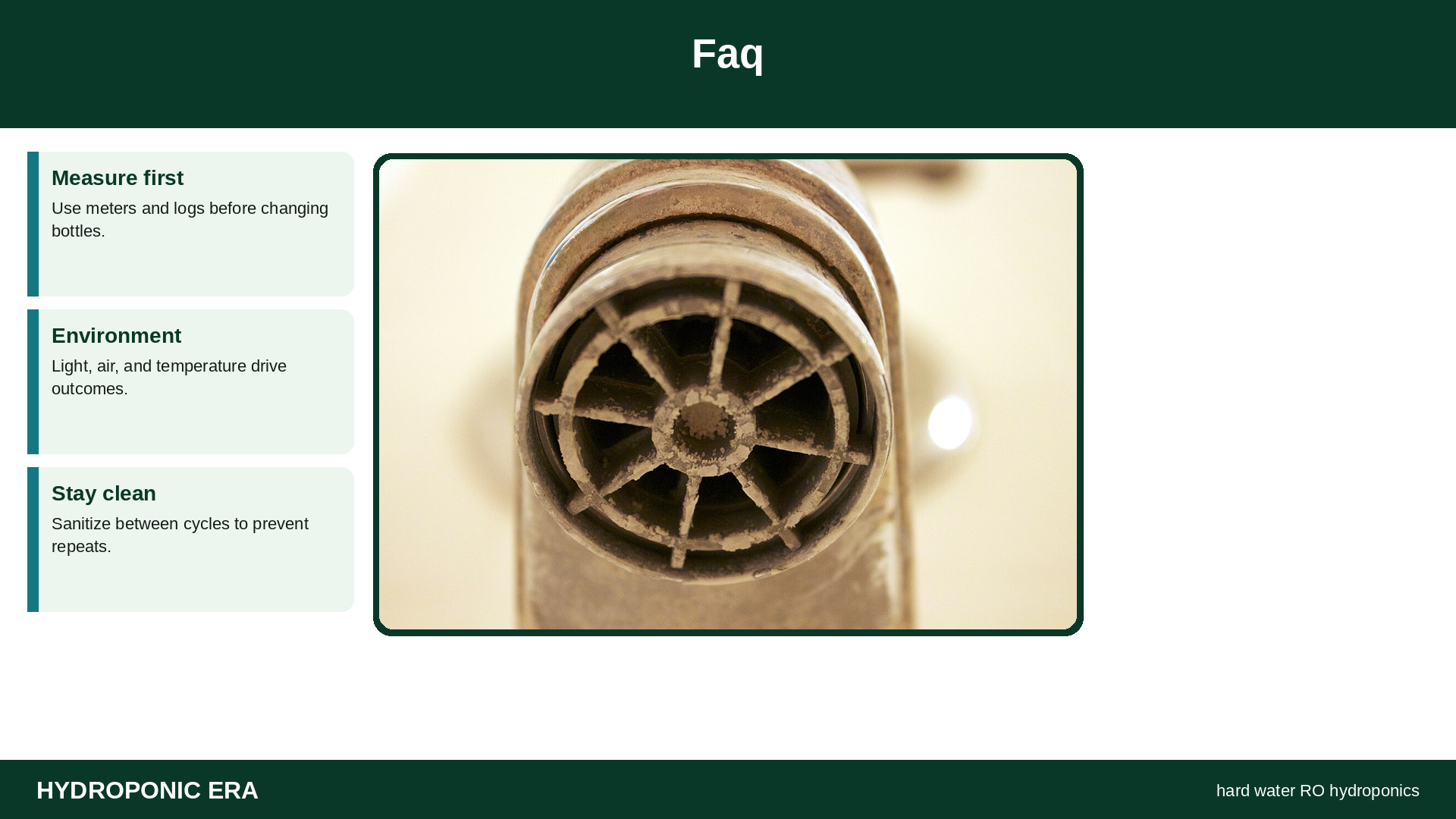
In everyday language, hard water means lots of calcium and magnesium. For hydroponic management, you also care about alkalinity—carbonates and bicarbonates that buffer pH upward when you add acid. A water source can be challenging because it is high in alkalinity even when casual hardness talk is vague.
Penn State Extension’s interpreting irrigation water tests resource teaches growers to look at multiple parameters, not a single slogan. Their water quality toolkit for greenhouse and nursery production similarly frames irrigation water as an input you manage.
Practically, hard alkaline water often shows up as: pH that climbs after every adjustment, higher baseline EC before fertilizer, and confusion about how much calcium your fertilizer should add. That does not mean hard water is unusable. It means you must measure and design around it.
When RO Water Helps
Reverse osmosis removes most dissolved salts, producing low-EC water. That helps when tap water is extremely alkaline, sodium-rich, or inconsistent. With RO, your fertilizer program becomes the main mineral source—which is powerful if you use a complete hydroponic formula and measure EC/pH.
Tradeoffs include water waste on many home RO units, filter replacement, and the need for discipline: topping off with plain RO without nutrients will drop EC over time if plants take up water and salts at different rates—actually plants taking up water faster concentrates salts, while topping only with water dilutes—track EC either way. See the EC/TDS article.
Oklahoma State’s hydroponics and EC/pH fact sheets remain relevant regardless of water source: you still target a workable pH band and an EC appropriate to crop stage.
Decision Framework: Tap, RO, or Blend
| Situation | Lean toward | Why |
|---|---|---|
| Mild tap, stable pH, modest EC | Tap + complete fertilizer | Simplest if numbers behave |
| Strong pH rise daily, high alkalinity | RO or RO+tap blend | Reduces buffering fight |
| Very high sodium or odd contaminants | RO (and investigate source) | Blank slate; verify filters |
| Want some Ca/Mg from tap | Blend | Lower alkalinity without total demineralization |
| Unreliable well chemistry | Test + possibly RO | Guessing is expensive in crop losses |
Do not fabricate a universal blend ratio. Start with measurements: source EC, pH, and—if possible—a lab report for alkalinity and key ions. Adjust blend percentages based on how your reservoir pH behaves over 24 hours.
Step-by-Step: Evaluate Your Water
- Measure tap (or well) EC and pH straight from the source.
- Mix a small trial reservoir with your normal fertilizer dose; log pH at mix and +24 hours.
- If pH rockets up, read Penn State water interpretation concepts and consider alkalinity management or RO blending.
- If using RO, confirm product water EC is actually low—failed membranes pass salts.
- Match fertilizer to water: some programs assume soft water; follow manufacturer guidance.
- Keep opaque reservoirs and clean habits regardless of water source.
- Retest when seasons change or plumbing work occurs.
Common Mistakes

- Calling all problems “hard water” without measuring alkalinity or EC
- Buying RO then underfeeding micronutrients because “water is pure”
- Ignoring sodium issues that RO would help but vanity filters do not
- Never replacing RO prefilters/membranes
- Fighting high alkalinity only with huge daily acid dumps instead of fixing the source strategy
Hard Water, Iron, and Lockout

Alkaline drift is a frequent partner of iron chlorosis and general lockout patterns. If new leaves yellow between veins while pH sits high, fix water/pH strategy before stacking iron bottles. See iron deficiency and lockout articles.
Calcium and magnesium already present in hard water also change how you think about Ca/Mg supplementation—measure rather than double-adding. The Ca/Mg guide explains deficiency patterns; water chemistry explains why your baseline may already include those ions.
What to Check
- Source EC/pH today
- Reservoir pH drift over 24 hours
- RO product-water EC if applicable
- Filter change dates
- Leaf clues: new-leaf chlorosis vs salt burn
- Whether top-off water matches reservoir chemistry plan
Blending Examples as Frameworks
Some growers run 50/50 RO and source water, then adjust based on alkalinity and plant response. Others run 100% RO with a complete nutrient line designed for pure water. Neither ratio is universal. Re-test when seasons change municipal blends, and recalibrate meters after major water-source switches.
Remember RO concentrate waste: plan where reject water goes. Indoor closets need overflow planning as much as greenhouses do.
FAQs
Is RO required for hydroponics?
No. Many growers succeed on decent tap water with monitoring. RO is a tool for difficult water.
Can I mix RO and tap?
Yes—blending is common. Use measurements to choose proportions.
Does boiling water help?
Boiling is not a practical substitute for RO or proper testing in hydroponic reservoirs.
Will a pitcher filter fix alkalinity?
Most consumer pitcher filters are not designed as hydroponic alkalinity solutions. Verify with meters.
How often should I test?
Check behavior when you change sources/filters and whenever pH becomes unstable. Lab tests are periodic tools, not daily chores.
Practice log and next steps
Keep a simple logbook for this topic: date, meter readings when relevant, what you changed, and what the plants did over the next three to seven days. Hydroponics rewards slow feedback loops more than frantic daily recipe rewrites.
When in doubt, return to calibrated pH and EC, root inspection, and light adequacy before buying another bottle. Extension hydroponic and plant nutrition resources emphasize fundamentals for a reason.
Link outward to the matching HydroponicEra cluster pages so readers can continue into systems, water, crops, or troubleshooting without dead ends. Internal links are part of topical authority, not decoration.
Sanitation and opaque reservoirs prevent many secondary problems that look like nutrient mysteries. Clean systems make diagnosis clearer.
If you sell produce or teach workshops, document procedures. Consistency protects customers and your future self.
Field notes
Label storage barrels clearly as TAP, RO, or BLEND. Accidental top-offs with the wrong water reset weeks of stable chemistry.
When RO product water EC rises over months, replace filters/membranes. A failed RO unit silently returns you to hard-water problems while you blame fertilizer.
Utility water reports are starting clues, not day-specific guarantees. Wells especially need periodic retesting.
Sources
- Penn State Extension — Interpreting Irrigation Water Tests
- Penn State Extension — A Water Quality Toolkit for Greenhouse and Nursery Production
- Oklahoma State University Extension — Electrical Conductivity and pH Guide for Hydroponics
- Oklahoma State University Extension — Hydroponics
- Penn State Extension — Hydroponics Systems and Principles of Plant Nutrition
- University of Florida IFAS — HS1279: Leafy Greens in Hydroponics and Protected Culture for Florida
4 thoughts on “Hard Water and RO Water for Hydroponics: When to Filter”