
Quick Answer
Continuous Harvest Planning Hydroponics (continuous harvest planning hydroponics) — Continuous Harvest Hydroponics (continuous harvest hydroponics) is the practical focus of this guide for home growers.
Continuous harvest planning for home hydroponics uses staggered seeding so leafy crops keep producing instead of one glut followed by empty net pots. Think calendar, not single transplant day.
See germination, lettuce, best plants, and yield expectations.
Key takeaways for continuous harvest planning hydroponics
- Seed every 7–14 days in small batches for lettuce-class crops.
- Reserve nursery space so the main system never goes bare.
- Cut-and-come-again herbs need pruning plans, not only head harvests.
- UF/IFAS leafy greens hydro materials support succession thinking in protected culture.
- Track days-to-harvest from your logs—not generic internet promises.
- Fruiting crops succession differs—flowering cycles ≠ lettuce slots.
- Original calendar: seed | transplant | first cut | replace.
- Empty pots are a planning failure, not bad luck.
Related HydroponicEra guides
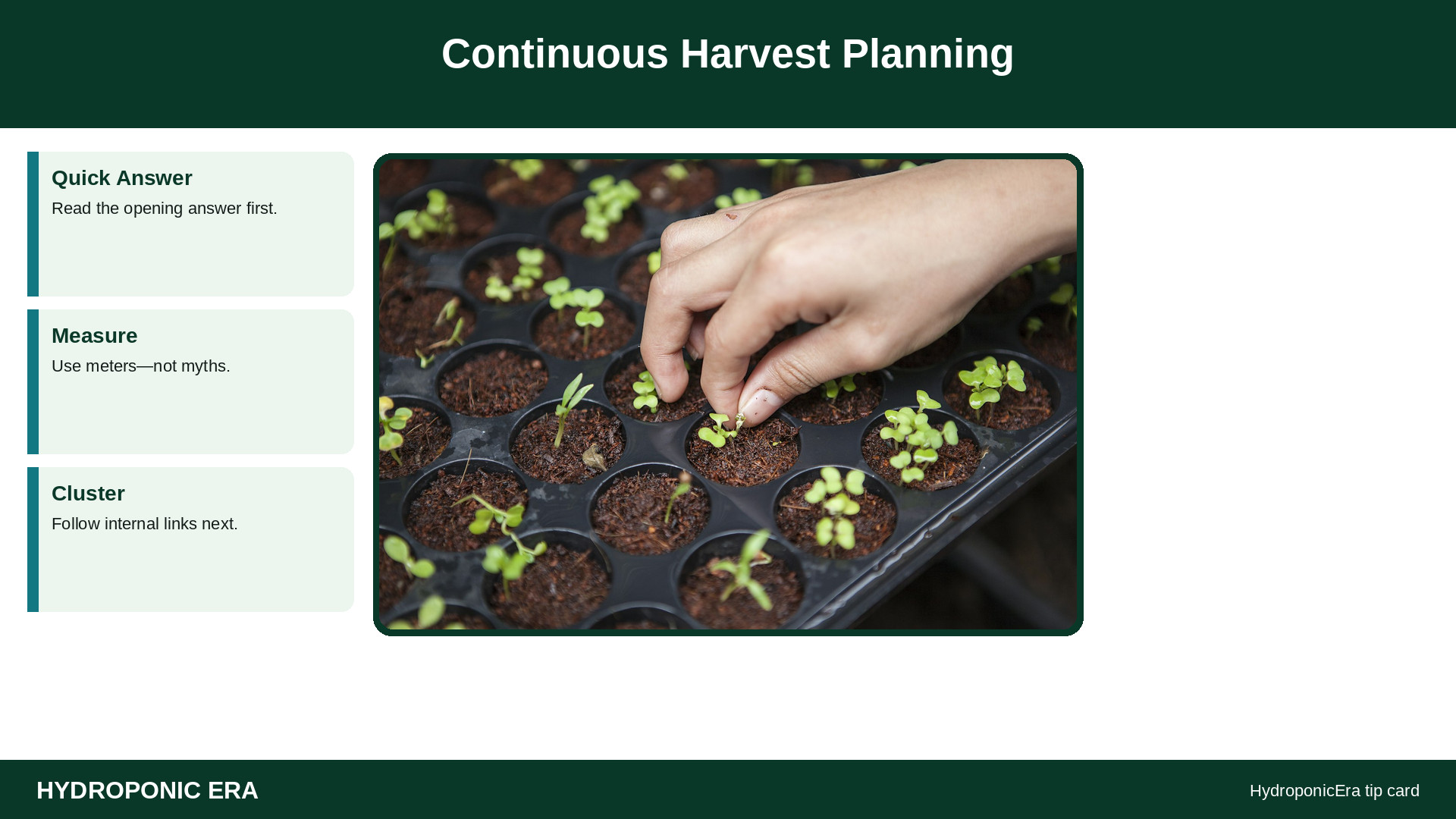
Continuous Harvest Hydroponics: Why One Big Transplant Creates Feast-Famine
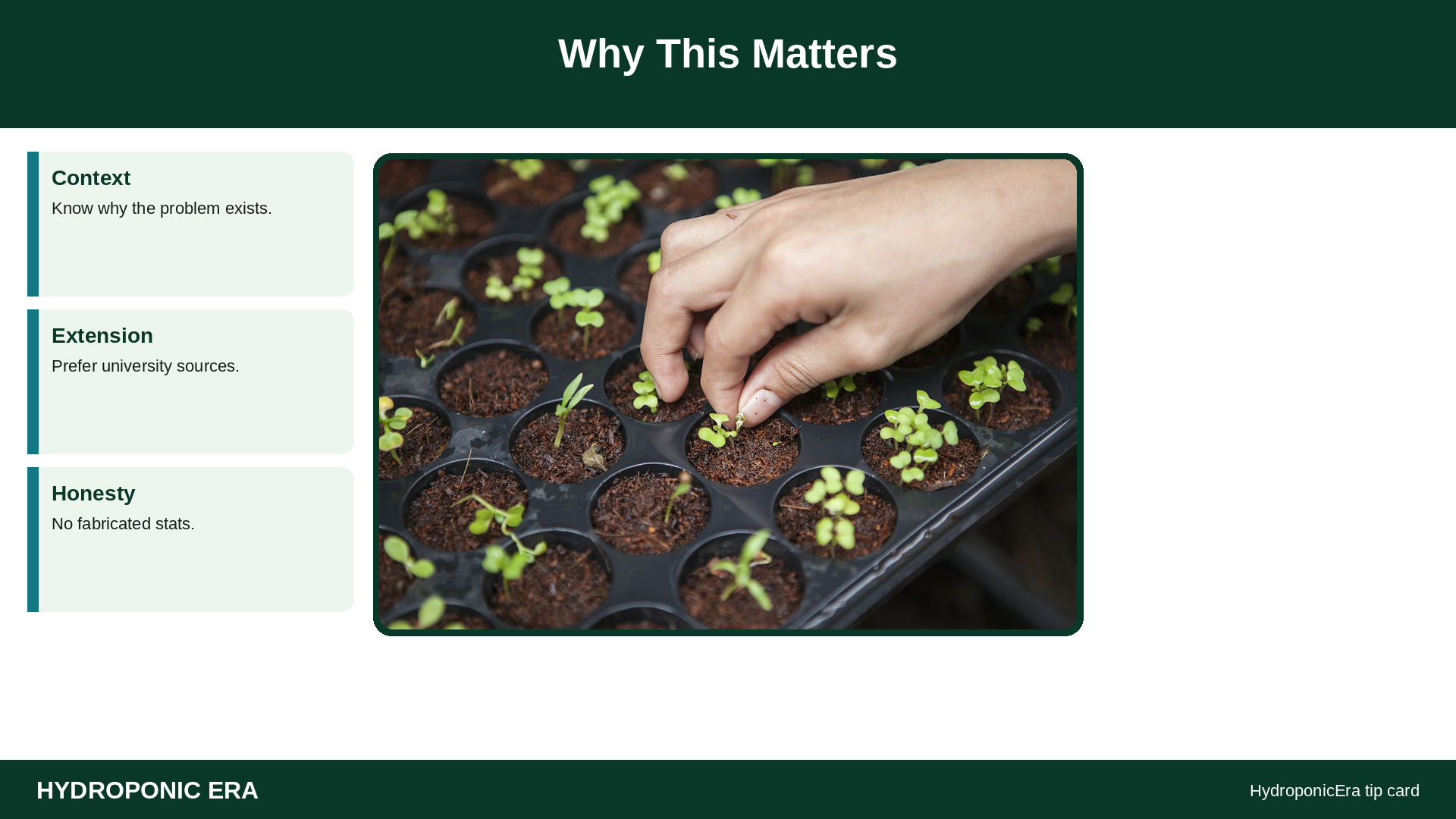
If every site is the same age, every site finishes together. Home kitchens want weekly salads. Succession planting—standard in soil gardening—transfers cleanly to rafts and NFT when you keep a nursery (germination, transplanting).
UF/IFAS leafy greens in hydroponics guidance supports managed production quality; continuous harvest is the home-scale calendar expression of that mindset.
Continuous Harvest Hydroponics: Succession Patterns by Crop Class
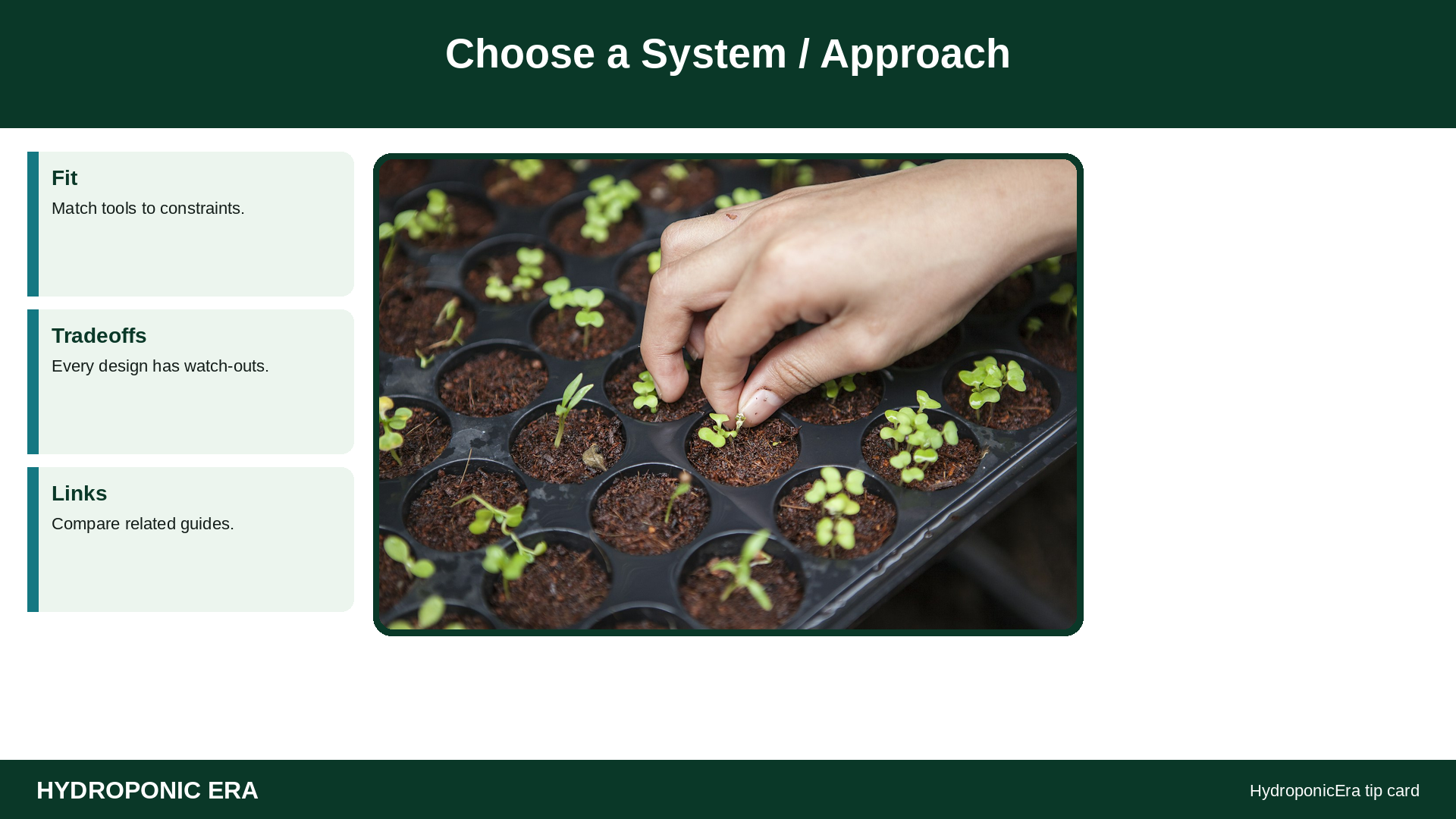
| Crop | Pattern | Notes |
|---|---|---|
| Lettuce heads | Seed every 1–2 weeks | Replace whole plants |
| Loose leaf | Seed + partial harvest | Can extend with cuts |
| Basil | Prune + occasional replacement | basil |
| Fruiting crops | Fewer, longer cycles | Not weekly reseeds |
Best plants for realistic home choices.
Continuous Harvest Hydroponics: Step-by-Step Continuous Calendar
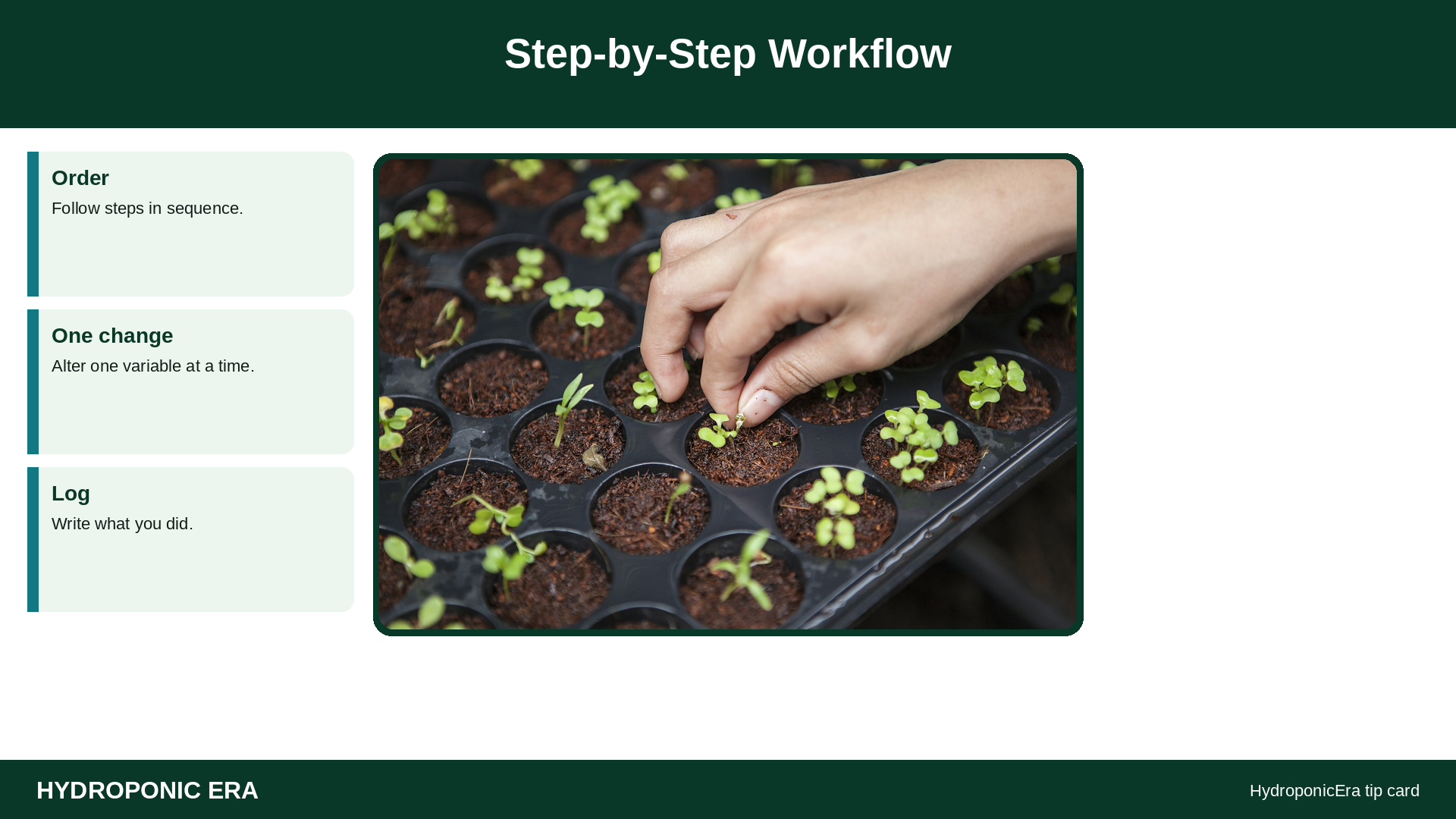
- Pick 1–2 leafy crops to succession first.
- Create a nursery tray under lower light.
- Seed a small batch on a fixed weekday (germination).
- Transplant when roots hold plugs—into empty sites only.
- Harvest oldest sites first; immediately note empty holes.
- Have the next plugs ready before gaps appear.
- Sanitize emptied net pots between rounds ({a(‘clean’,’cleaning’)}).
- Log days from seed to first harvest for your room.
- Adjust interval if you waste produce or run out.
- Add a second crop only after the calendar works.
Continuous Harvest Hydroponics: Variables

| Variable | Impact | Link |
|---|---|---|
| Temperature | Speeds/slows schedule | temp |
| Light | Days to size | PPFD |
| Density | Quality vs bulk | Spacing guide in this batch |
| EC mistakes | Stalls succession | EC |
Continuous Harvest Hydroponics: Mistakes
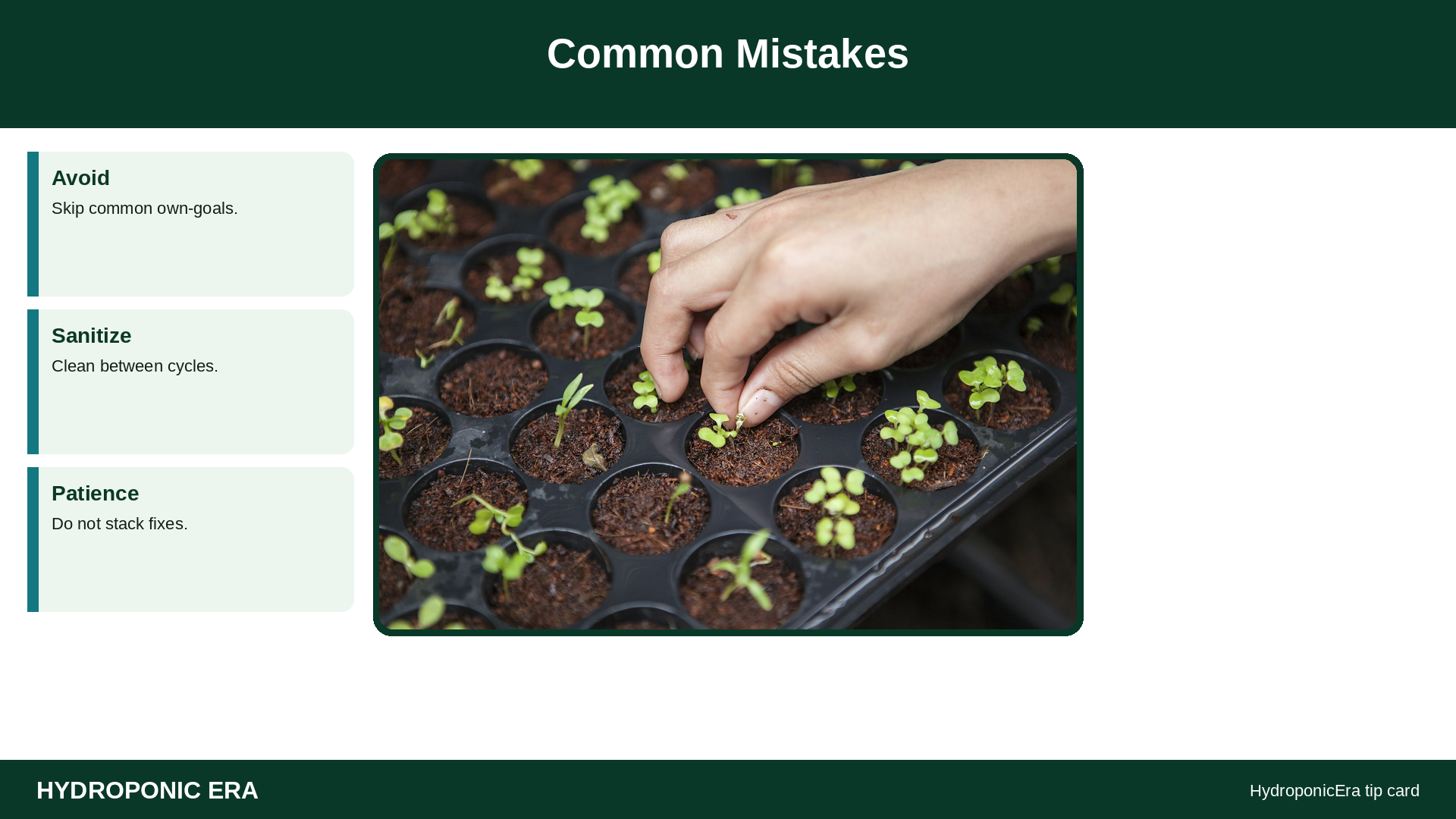
- Seeding 30 plugs once then nothing for a month
- No nursery—waiting for empty pots to start seed
- Treating tomatoes like lettuce succession
- Never sanitizing cups between cycles
- Ignoring your own day-count logs
Troubleshooting Gaps
| Gap cause | Fix | Link |
|---|---|---|
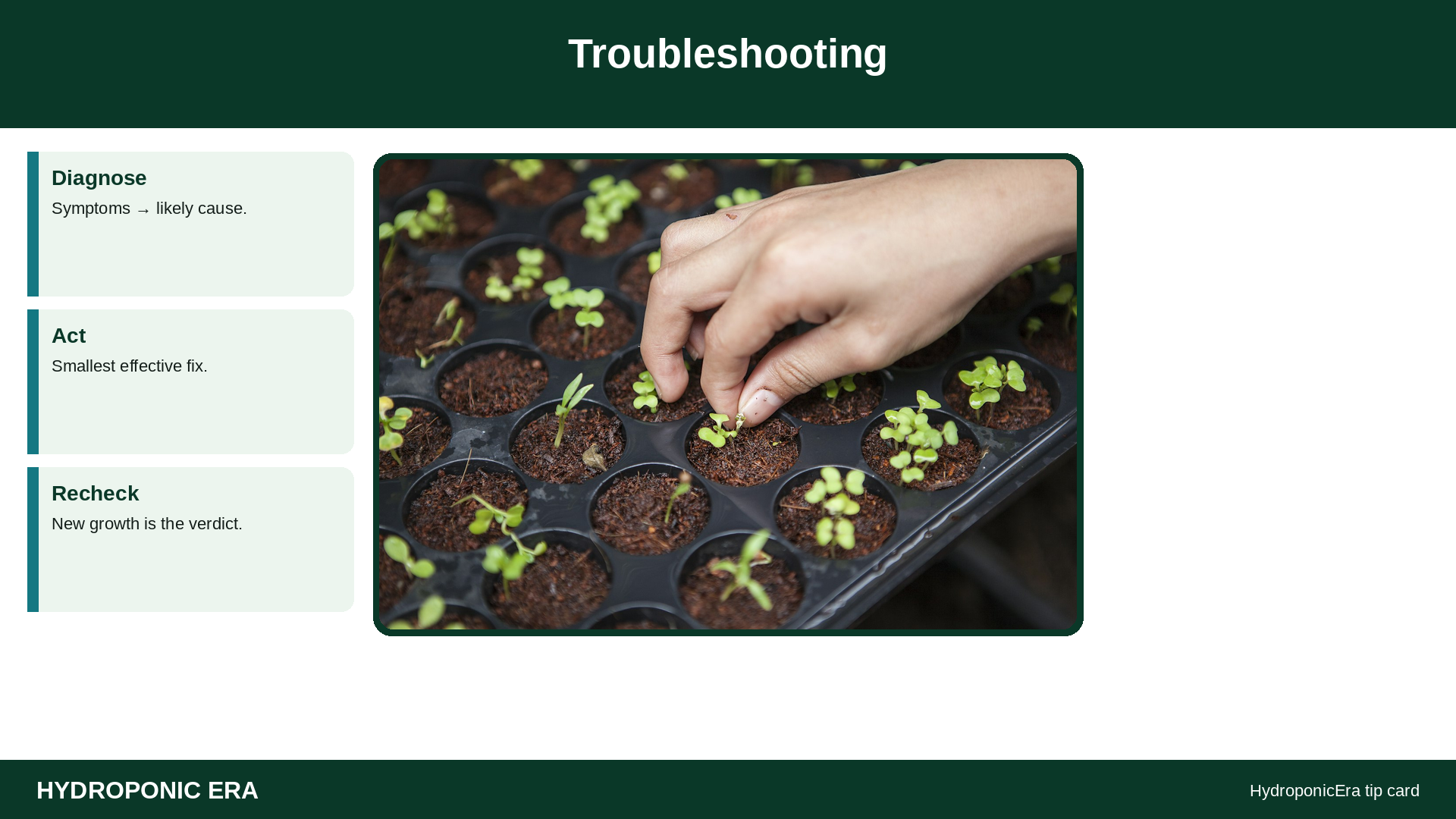
| Germination failure | Fix moisture/temp; reseed | germ |
| Transplant shock losses | Gentler EC; better plugs | seedlings |
| Ate everything early | Shorten interval; more sites in nursery | yield |
Original Seed–Transplant–Cut–Replace Loop
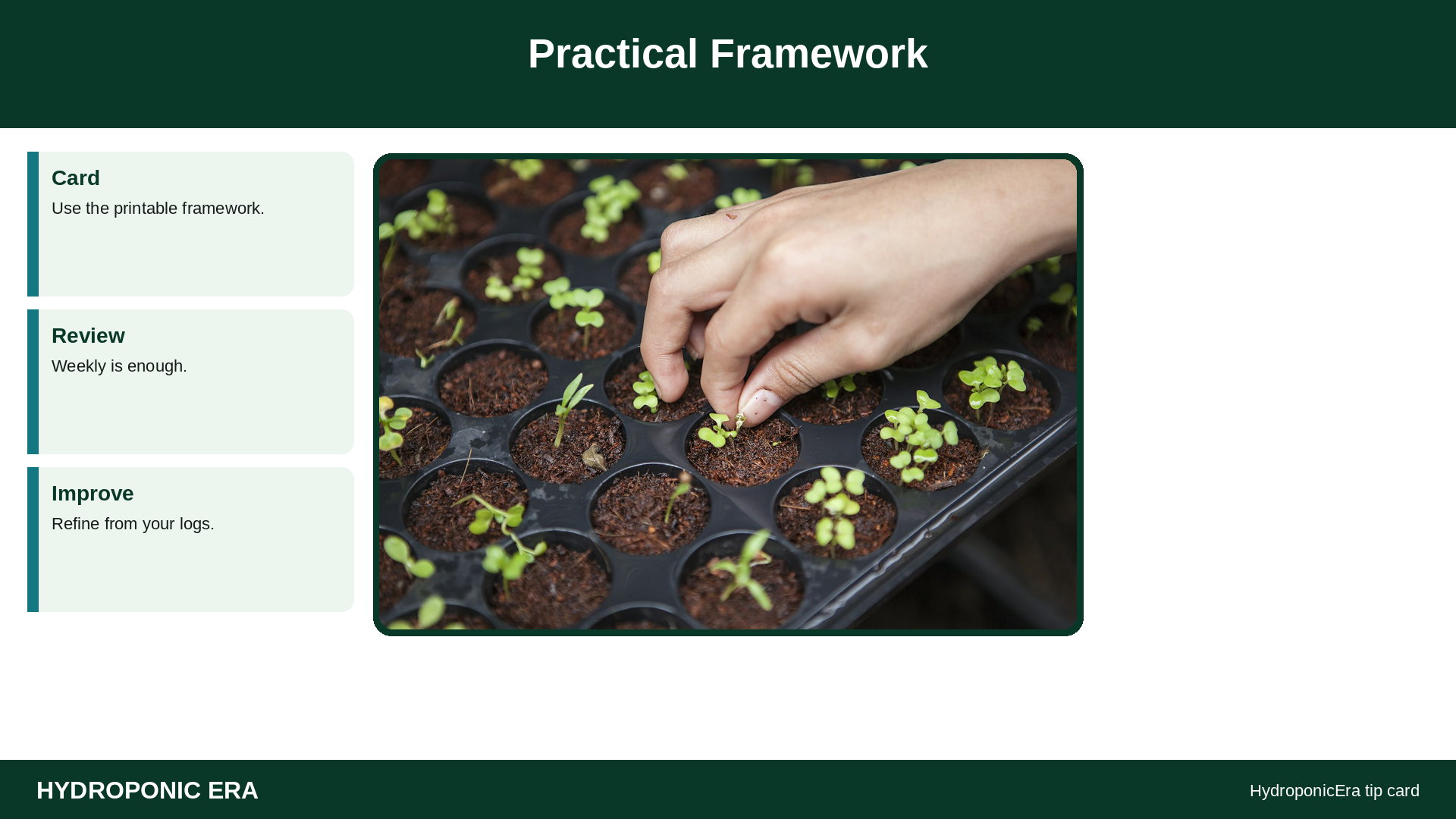
Draw a four-box loop on the fridge: Seed → Transplant → Cut → Replace. Assign weekdays. That original planner prevents empty rafts. Review with lettuce and yield guides.
What to Check Before Your Raft Goes Empty
- Nursery space reserved?
- Fixed seed weekday?
- Days-to-harvest logged?
- Net pots sanitized between?
- Interval matched to kitchen use?
- Second crop delayed until stable?
FAQs about continuous harvest planning hydroponics

How often to seed lettuce?
Commonly every 7–14 days—tune to your use.
Can herbs succession?
Yes via pruning and periodic replacement.
Fruiting crops?
Plan long cycles, not weekly reseeds.
What if I travel?
Pause seeding before trips; see vacation checklist.
Raft empty in center?
Fill from nursery immediately.
Yield expectations?
Use the yield guide—avoid fantasy kg claims.
Nursery Discipline and Kitchen-Matched Intervals
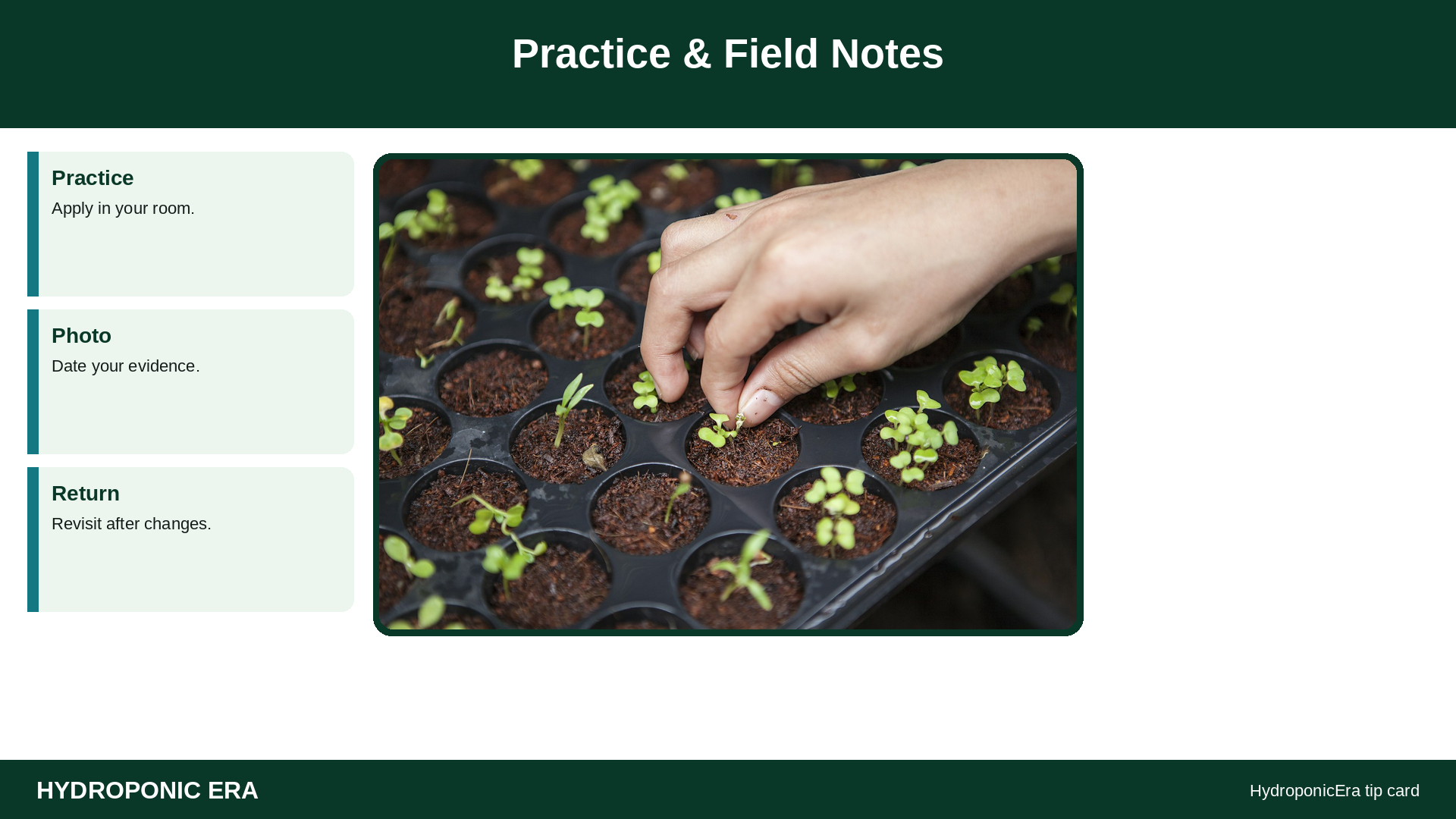
Continuous harvest fails when the nursery is an afterthought. Keep a dedicated germination shelf even if it is one tray under a small LED (germination, lights). Seed on a recurring weekday so the habit sticks.
Match intervals to eating. If your household finishes four heads a week, seed accordingly—not thirty at once for a fantasy restaurant. Honest kitchen math pairs with yield expectations.
Sanitize net pots between cycles to avoid transferring biofilm and fungus gnat habitat (cleaning, gnats). Empty sites should mean “plug ready,” not “start shopping for seed tomorrow.”
Original kanban: To Germinate | Nursery Ready | In System | Harvest Due. Move cups physically between bins. That tactile board is original operational value.
Fruiting crops need a parallel calendar with longer spacing—do not force tomato logic onto lettuce or vice versa (tomatoes, lettuce, best plants).
When travel approaches, stop seeding early so you are not leaving fragile seedlings (automation readiness).
Practice closer: after three cycles, compute your real average days seed→harvest from logs and adjust the interval—your room’s number beats a generic blog.
Putting This Guide Into Practice
Pick a seed weekday and defend it. Keep nursery plugs ready before pots empty. Sanitize cups between rounds (cleaning, germination).
Compute your real days-to-harvest from logs after three cycles—then set intervals for your kitchen, not a blog. Fruiting crops get a separate long-cycle calendar (tomatoes, lettuce).
UF/IFAS leafy greens hydro thinking supports managed succession quality. Empty rafts are planning gaps, not bad luck.
Bottom line: Seed → Transplant → Cut → Replace on a loop. Continue with best plants and yield expectations.
Advanced tip: keep 20–30% of sites as “flex holes” for emergency transplants when germination fails, so the calendar does not collapse. Track germination percentage in the nursery—if it drops, fix moisture/temp before blaming the raft (germination, seedlings).
Second-pass note: kitchen demand drives intervals. Link lettuce, best plants, and yield expectations without invented weekly kg promises.
Operational Checklist Card
Print loop: Seed weekday | Nursery ready count | Sites empty | Harvest due | Reseed interval days | Germ % | Sanitized cups. Defend the seed weekday. Keep flex holes for failures (germination, cleaning, lettuce).
Final reminder: empty rafts are calendar gaps. Compute your real days-to-harvest from logs. Related: best plants, yield, seedlings.
Continuous Harvest Hydroponics: Practical Checklist
Continuous Harvest Hydroponics matters every week in a home system. Recheck continuous harvest hydroponics after transplants, heat spikes, and canopy fill-in. Strong continuous harvest hydroponics habits beat one-time guesses. When continuous harvest hydroponics drifts, leaves crowd, roots stress, or harvest quality drops. Write continuous harvest hydroponics targets into your log so you do not rely on memory.
Treat continuous harvest planning hydroponics as a weekly habit: scan, note, then adjust only when data says so.
Share continuous harvest planning hydroponics basics with anyone covering your system while you are away.
Print a short continuous harvest planning hydroponics note and leave it near the reservoir.
Update continuous harvest planning hydroponics after storms, heat waves, or DIY plumbing changes.
Good continuous harvest planning hydroponics beats last-minute guessing when something drifts overnight.
Archive last month’s continuous harvest planning hydroponics notes; patterns beat memory.
Teach one other person your continuous harvest planning hydroponics so coverage is not a single point of failure.
When continuous harvest planning hydroponics is clear, you waste less time chasing the wrong variable.
Revisit continuous harvest planning hydroponics whenever you change lighting, EC, or who waters the system.
Write one line on continuous harvest planning hydroponics after each reservoir check so patterns show up early.
Sources
- University of Florida IFAS — HS1279: Leafy Greens in Hydroponics and Protected Culture for Florida
- University of Florida IFAS — HS1265: Nitrogen Fertilization of Hydroponic Leafy Greens
- University of Florida IFAS — HS184: Building a Floating Hydroponic Garden
- University of Florida IFAS — HS1421: Growing Herbs in Small Hydroponic Systems
- Oklahoma State University Extension — Hydroponics
- Michigan State University Extension — Hydroponics as an agricultural production system
- Virginia Cooperative Extension — SPES-720: Calculating and Using Daily Light Integral (DLI)
- Penn State Extension — Hydroponics Systems and Principles of Plant Nutrition
1 thought on “Continuous Harvest Planning for Home Hydroponics”