
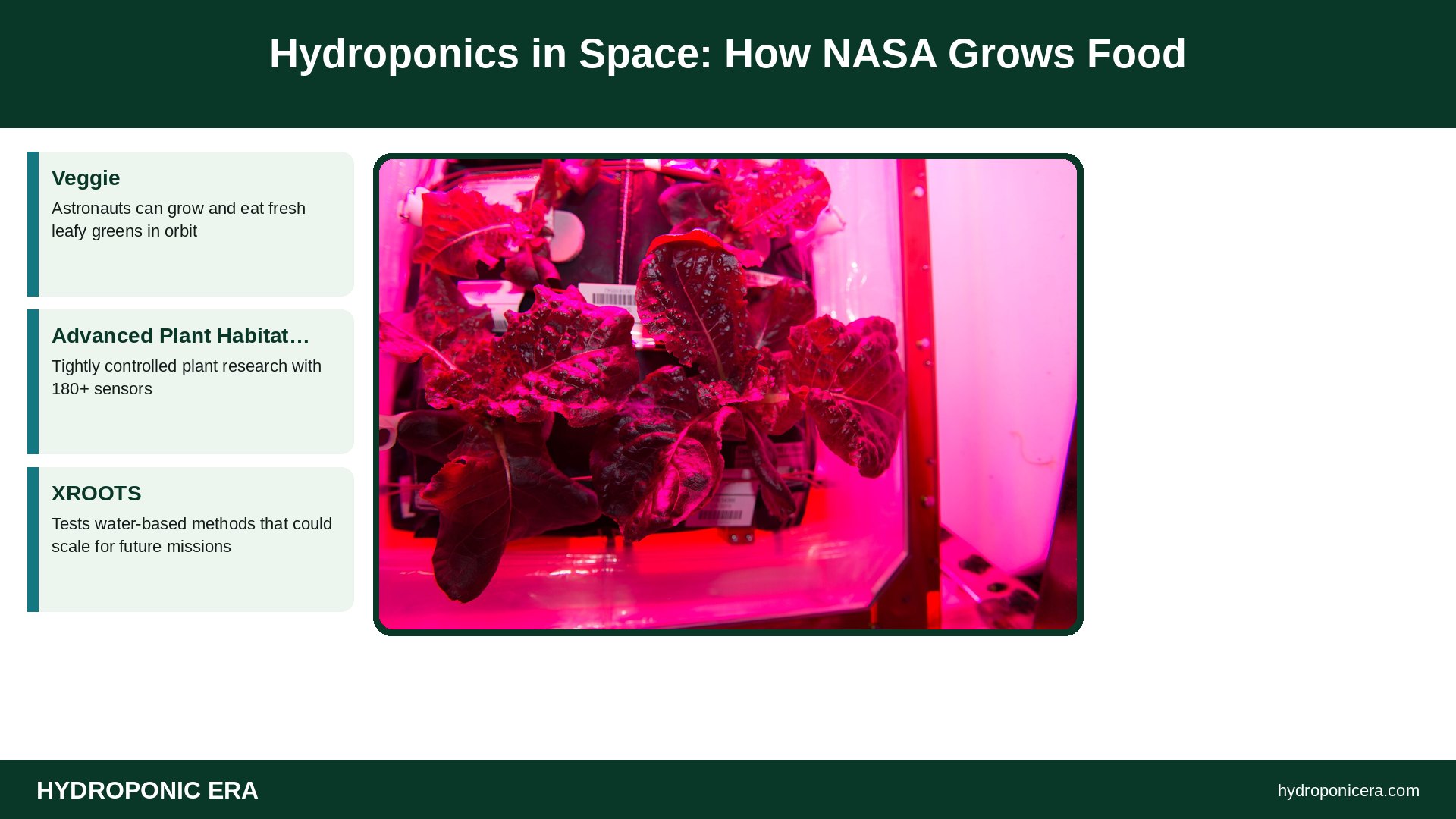
Hydroponics in space works differently than on Earth. NASA’s main station gardens, Veggie and the Advanced Plant Habitat, grow plants in clay-based media that wick water and nutrients to the roots, because loose water forms floating bubbles in microgravity. True water-based hydroponic and aeroponic methods have been tested on the International Space Station with the XROOTS experiment.
| NASA system | How roots get water and nutrients | What it showed |
|---|---|---|
| Veggie | Plant “pillows” filled with clay-based media and fertilizer | Astronauts can grow and eat fresh leafy greens in orbit |
| Advanced Plant Habitat (APH) | Porous clay substrate with controlled-release fertilizer; enclosed and automated | Tightly controlled plant research with 180+ sensors |
| XROOTS | Hydroponic and aeroponic delivery with no soil or growth media | Tests water-based methods that could scale for future missions |
How Does Hydroponics in Space Work Without Gravity?
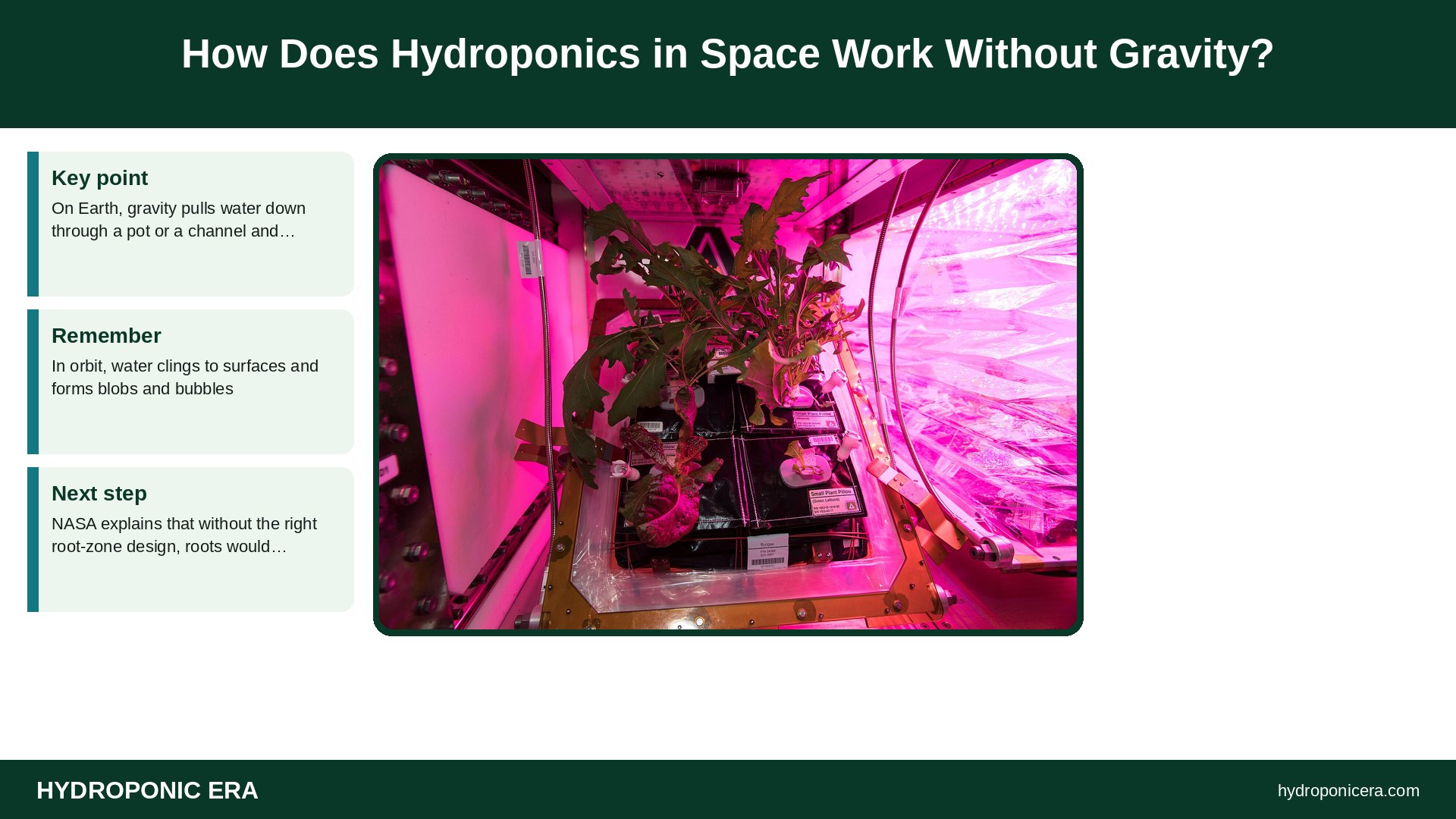
On Earth, gravity pulls water down through a pot or a channel and lets air rise. In orbit, water clings to surfaces and forms blobs and bubbles. That is the core problem hydroponics in space has to solve. NASA explains that without the right root-zone design, roots would either drown in water or be surrounded by air.
That is why most hydroponics in space so far has used a soilless substrate. The clay particles hold water and air in balance around the roots, a bit like a perlite and coco mix on Earth. Plants still orient themselves, using light instead of gravity to guide which way shoots grow.
What Is NASA’s Veggie Garden?
Veggie, the Vegetable Production System, is about the size of a carry-on suitcase and typically holds six plants. Each plant grows in a “pillow” filled with clay-based growth media and fertilizer. Red and blue LEDs provide the light plants use most efficiently, and green LEDs were added so the plants look like food rather than purple decorations, according to NASA’s Kennedy Space Center.
On August 10, 2015, Expedition 44 astronauts Scott Kelly and Kjell Lindgren harvested and ate “Outredgeous” red romaine lettuce grown in Veggie. They cleaned the leaves first with citric acid-based, food-safe wipes. Later crops included mizuna mustard, red Russian kale, dragoon lettuce and zinnia flowers. In 2018, astronaut Serena Auñón-Chancellor harvested kale and lettuce in time for Thanksgiving.
What Is the Advanced Plant Habitat?

The Advanced Plant Habitat (APH) is also a growth chamber on the station, but it is enclosed and automated. NASA says it uses LED lights and a porous clay substrate with controlled-release fertilizer, plus cameras and more than 180 sensors that report to a team on the ground. NASA’s Plant Habitat-04 experiment used APH to grow chile peppers on the station for the first time.
For home growers, APH is a reminder of what really drives results: stable light, temperature, humidity and root-zone moisture. You can’t add 180 sensors to a grow tent, but you can log the basics. See our record-keeping guide.
Has NASA Tested True Hydroponics in Space?
Yes. The eXposed Root On-Orbit Test System (XROOTS) investigation, delivered to the station on Northrop Grumman’s 17th commercial resupply mission, used hydroponic and aeroponic techniques to grow plants without soil or other growth media. NASA says cameras tracked multiple independent growth chambers from germination to maturity, with the goal of identifying methods that could produce crops on a larger scale for future missions.
This matters because media-based pillows are bulky and single-use. Water-based hydroponics in space could cut launch mass and allow continuous production, which is why it is a focus for long missions to the Moon and Mars. If you are curious about the mist-based approach, read our aeroponics for beginners guide.
A Short Timeline of Hydroponics in Space
| Year | Milestone | Why it matters |
|---|---|---|
| 2015 | Expedition 44 crew eats Veggie-grown red romaine lettuce (Aug. 10) | First NASA astronaut taste of space-grown food |
| 2016 | Scott Kelly nurses Veggie zinnias back to health and photographs the blooms | Flowering plants proved harder to keep healthy than leafy greens |
| 2018 | Serena Auñón-Chancellor harvests red Russian kale and dragoon lettuce before Thanksgiving | Repeat harvests showed space gardens can be routine |
| 2022 | XROOTS arrives on Northrop Grumman’s 17th resupply mission | Tests media-free hydroponic and aeroponic growing in orbit |
Each step moved hydroponics in space from a one-off demo toward a dependable food source. NASA’s Plant Habitat-04 later added chile peppers, a fruiting crop that needs much more care than lettuce.
What Can Home Growers Learn From Hydroponics in Space?
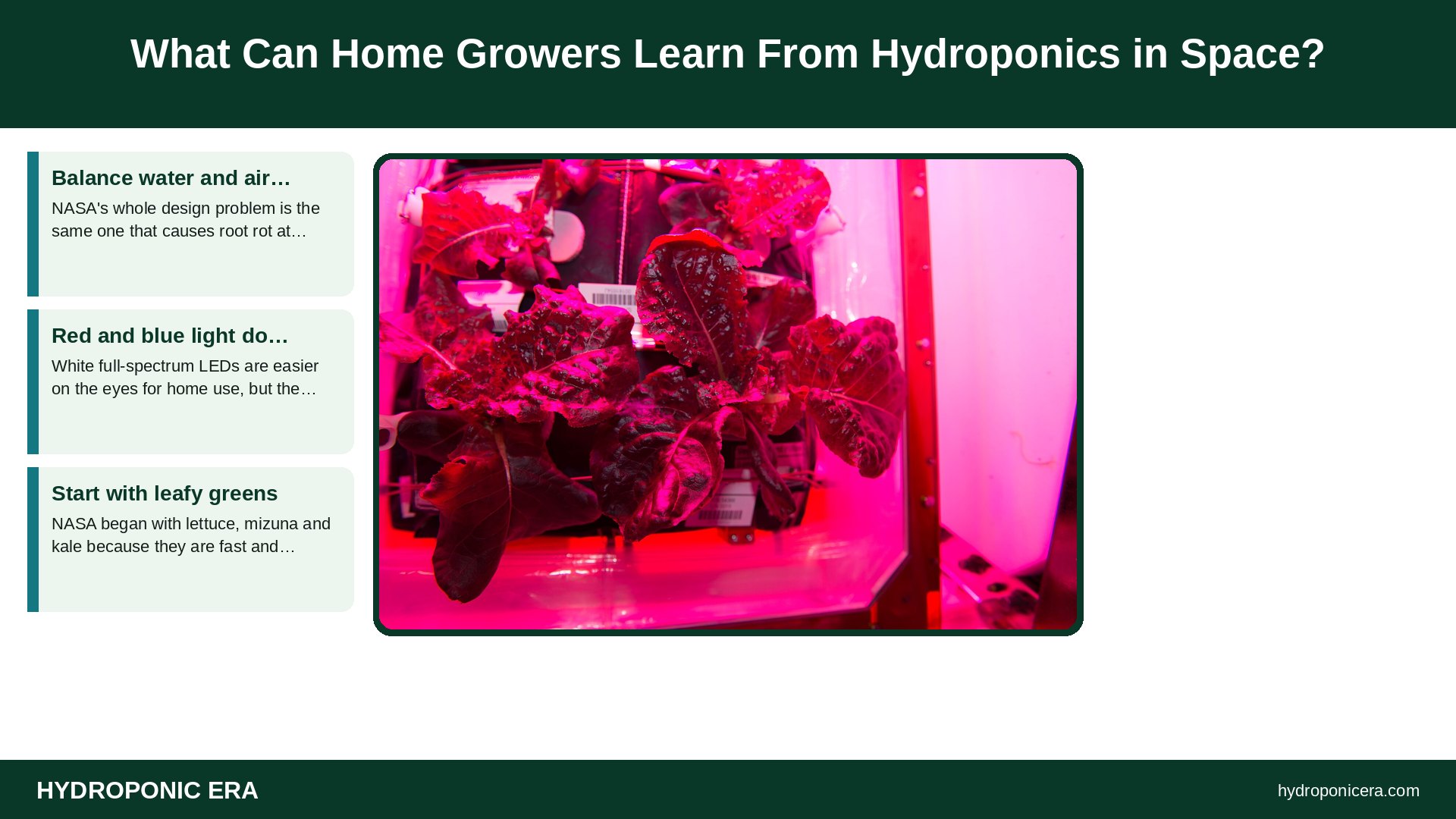
- Balance water and air at the roots. NASA’s whole design problem is the same one that causes root rot at home. See dissolved oxygen.
- Red and blue light do most of the work. White full-spectrum LEDs are easier on the eyes for home use, but the principle holds. See grow lights for hydroponics.
- Start with leafy greens. NASA began with lettuce, mizuna and kale because they are fast and reliable. So should you; see best plants for hydroponics.
- Clean what you eat. Even in orbit, crews sanitize produce before eating. Read hydroponic food safety at home.
- Measure, don’t guess. Sensors drive APH; a pH and EC meter does the same job for you. See pH and EC meters.
Space Gardens vs Home Hydroponics: How Do They Compare?
| Factor | ISS gardens | Home hydroponics |
|---|---|---|
| Main challenge | Water behaves unpredictably without gravity | Keeping roots oxygenated and solution balanced |
| Root zone | Clay media pillows (Veggie), porous clay (APH), water/mist (XROOTS) | DWC, NFT, Kratky, wick, media beds |
| Light | Red, blue and green LEDs | Full-spectrum white or blurple LEDs |
| First crops | Lettuce, mizuna, kale | Lettuce, herbs, greens |
| Food safety | Lab testing and sanitizing wipes | Clean equipment, washing produce |
Myths About Hydroponics in Space
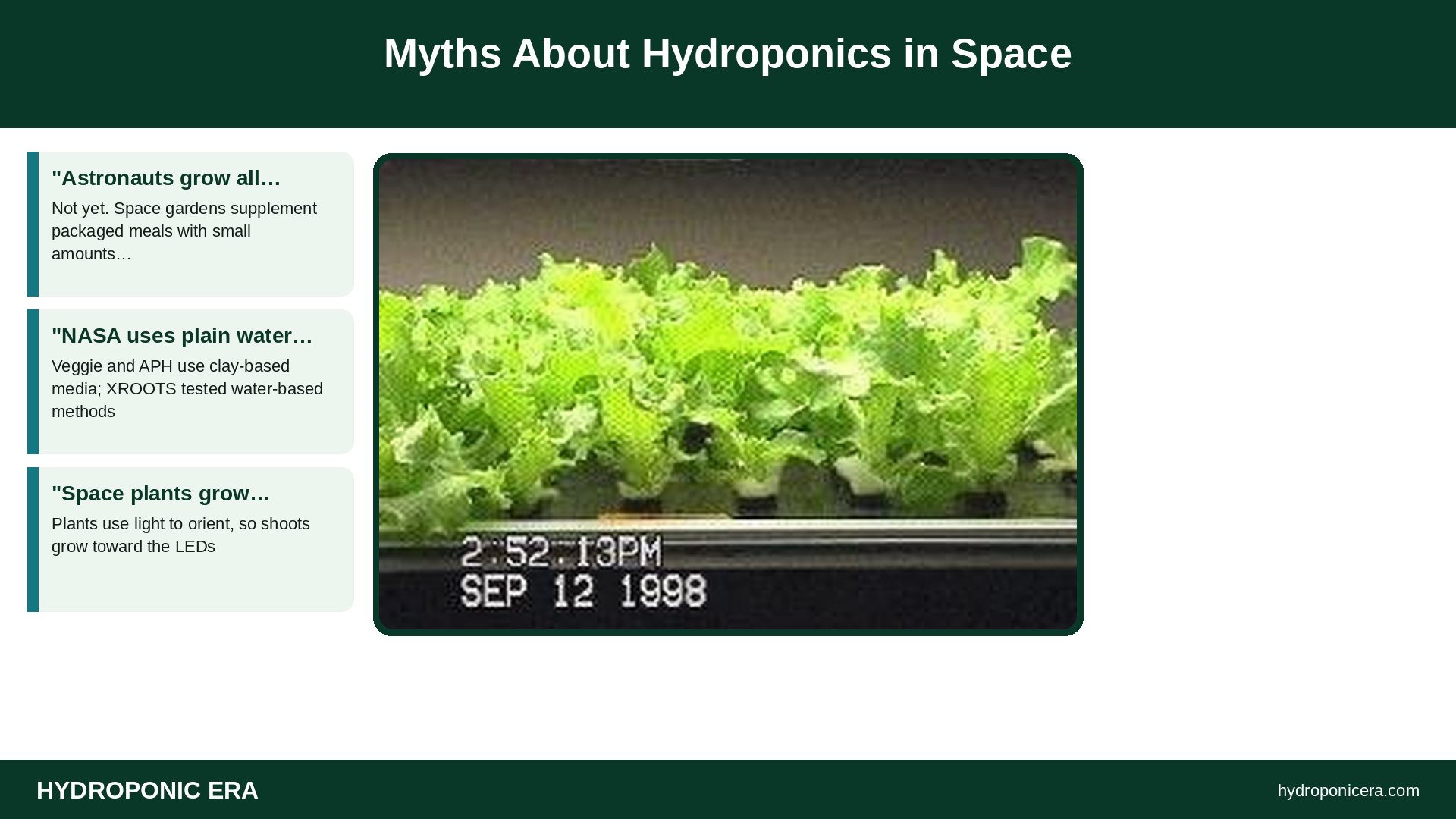
- “Astronauts grow all their food.” Not yet. Space gardens supplement packaged meals with small amounts of fresh produce.
- “NASA uses plain water hydroponics on the station.” Veggie and APH use clay-based media; XROOTS tested water-based methods.
- “Space plants grow upside down.” Plants use light to orient, so shoots grow toward the LEDs.
- “NASA invented hydroponics.” Soilless growing is much older. Read who invented hydroponics.
FAQs About Hydroponics in Space
What was the first food astronauts ate from a space garden?
NASA astronauts first ate red romaine lettuce grown in Veggie on August 10, 2015.
Why don’t astronauts use soil?
Soil is heavy, messy in microgravity and can carry microbes. That’s why hydroponics in space relies on lightweight clay media and water-based systems, which are easier to control.
What plants have been grown on the ISS?
NASA lists crops such as lettuce, mizuna mustard, red Russian kale, zinnias and chile peppers among the plants grown on the station.
Can hydroponics in space feed a Mars crew?
That is the long-term research goal. Current systems are small, and NASA describes them as steps toward scalable crop production for future missions.
Can I build a NASA-style garden at home?
You can borrow the principles of hydroponics in space with an LED-lit countertop system or a small DWC tote. See how to start hydroponics at home.
Related HydroponicEra Guides
Sources
- NASA — Growing Plants in Space
- NASA Science — eXposed Root On-Orbit Test System (XROOTS) Tech Demo
- NASA Kennedy Space Center — Spaceport Magazine, September 2015: “Lettuce Eat” (PDF)
- NASA Technical Reports Server — Veggie: Space Vegetables for the International Space Station and Beyond
1 thought on “Hydroponics in Space: How NASA Grows Food”