
A DIY PVC NFT system (nutrient film technique) runs a thin stream of nutrient solution down sloped channels while plant roots sit in net cups above. A homemade NFT system built from PVC is a cheap, expandable way to grow lettuce, herbs, and other leafy greens. The core parts are rectangular or round channels, net cups, a small submersible pump, a reservoir, and return plumbing. The key design rules are a gentle slope, a shallow flow, and pipe that is safe for food crops.
Key takeaway: NFT works beautifully for greens but has no water buffer. If the pump stops, roots can dry in an hour or two, so plan for reliability.
| Design factor | Typical target |
|---|---|
| Slope | Roughly 1:30 to 1:40 (about 1 inch drop per 3 feet) |
| Flow | Thin film; roughly 1–2 liters per minute per channel is a common starting point |
| Channel length | Keep home channels short, around 10–12 feet or less |
| Hole spacing | About 6–8 inches for lettuce |
| Best crops | Lettuce, basil, arugula, bok choy, other quick greens |

How an NFT System Works

A pump lifts solution from the reservoir to the high end of each channel. The solution trickles down as a shallow film, touching the bottom of the root mat while the top stays in moist air. At the low end, it drains back to the reservoir. Because roots get both water and air, NFT grows greens fast. Our NFT for beginners guide covers the theory in more depth.
Is PVC Safe for a PVC NFT Build?
Standard white Schedule 40 PVC pipe is designed for water, but not all PVC fittings and fence posts are rated for potable use. Look for pipe marked NSF-61 (drinking water) and avoid vinyl fence posts or downspouts unless the manufacturer states they are food- or potable-safe. Commercial NFT channels made for hydroponics are another option. Read our guide to PVC and food-grade tubing mistakes before you buy.
Round pipe works, but the film spreads less evenly on a curved floor. Flat-bottomed channels give roots a wider, more even sheet of water.
Parts List

- 3–4 inch PVC pipe or flat NFT channels, plus end caps
- Hole saw sized for 2–3 inch net cups
- Net cups and starter plugs (rockwool or Oasis cubes)
- Submersible pump sized for your head height (see pump sizing)
- 1/2 inch feed tubing, a manifold, and small valves to balance flow
- Larger drain fittings (3/4–1 inch) so channels never back up
- Opaque reservoir with lid, ideally 10–20 gallons for a small rig
- A stand, rack, or sawhorses to set the slope
NFT System Build Steps
- Plan the layout. Decide the number of channels and their length. Short channels limit nutrient and temperature changes along the run.
- Mark and cut holes. Space holes about 6–8 inches apart for lettuce, wider for basil or bok choy.
- Deburr and clean. Remove plastic shavings that can clog drains.
- Cap and plumb. Install an inlet at the high end and a generous drain at the low end.
- Mount with slope. Set a drop of about 1 inch per 3 feet. Check with a level and a tape measure.
- Connect the pump. Run a manifold with a small ball valve per channel and a bypass back to the reservoir to fine-tune flow.
- Leak test with plain water. Run for a day before adding plants. Our guide to fixing leaks helps if drips appear.
Tuning Flow and Slope

In a well-tuned NFT system, the film should be shallow, just a few millimeters. Too much flow floods roots and can push water out of the holes; too little leaves the far end dry. Watch the drain outlet: a steady trickle that doesn’t pool is the goal. As root mats grow, they can dam the channel. Our article on NFT clogs and dry-outs explains how to spot and clear them.
NFT System Reliability and Fail-Safes
Because roots in an NFT system have almost no water reserve, a pump failure is the main risk. Practical safeguards:
- Use a reliable pump and keep a spare. See spare parts kit.
- Run the pump continuously, or on very short off-cycles only after testing.
- Add a water-level or flow alarm. See timer fail-safes and pump redundancy.
- Consider a small battery backup for outages: backup power for pumps.
Nutrients, pH, and Temperature
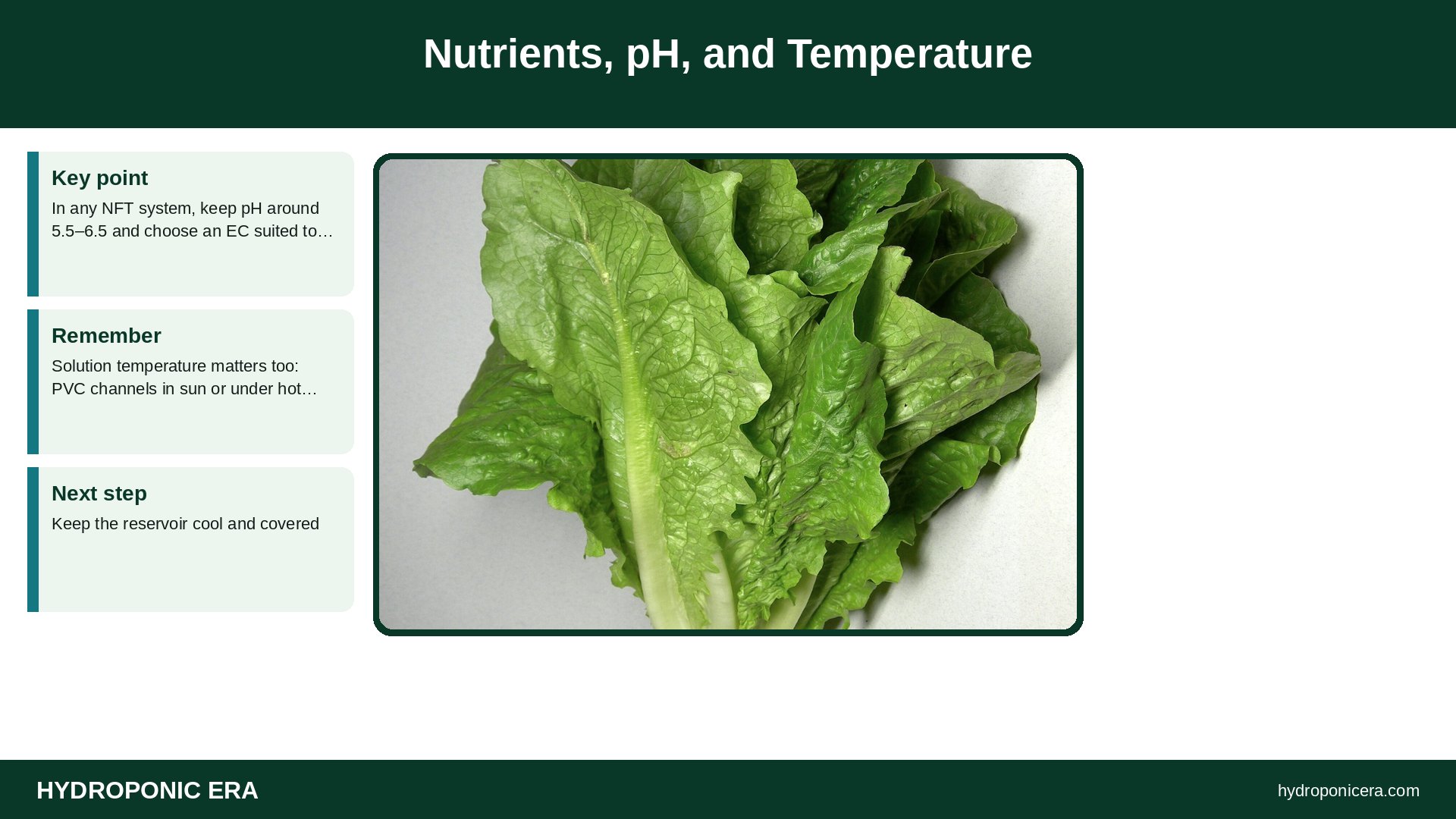
In any NFT system, keep pH around 5.5–6.5 and choose an EC suited to leafy greens. Solution temperature matters too: PVC channels in sun or under hot lights can warm the film quickly, so shade outdoor rigs and paint channels white. Keep the reservoir cool and covered. Our guide to controlling pH and reservoir temperature cover the details.
Sizing the Reservoir and Pump
A small four-channel NFT system holds very little water in the channels themselves, so the reservoir does the buffering. A larger reservoir changes pH and EC more slowly and stays cooler, which makes daily checks less stressful. As a rough rule, more plants and warmer rooms call for more gallons. Our guide to reservoir sizing by plant count helps you estimate how much the plants will drink.
When choosing a pump, look at the flow at your actual lift height, not the maximum flow on the box. A pump rated for a certain gallons per hour at zero lift moves much less when pushing water up four or five feet to the top channel. Pick one with spare capacity and throttle it back with the bypass valve.
Best and Worst Crops for a PVC NFT System
Leafy greens and herbs are ideal: lettuce, basil, arugula, mizuna, and bok choy. Heavy fruiting plants such as tomatoes develop large root masses that clog small channels and need support; they usually do better in Dutch buckets. Root crops do not suit NFT at all.
NFT System Maintenance Routine
- Daily: check flow at each channel outlet and look for wilting.
- Every 1–2 days: test pH and EC.
- Weekly or biweekly: change or refresh the solution.
- Between crops: flush channels and clean biofilm. See cleaning and sterilizing.
FAQs: DIY NFT System Questions
What slope should an NFT system channel have?
Roughly 1:30 to 1:40, or about an inch of drop for every three feet. Too flat causes pooling; too steep can leave roots dry.
What size PVC pipe is best?
3–4 inch pipe is common for lettuce and herbs. Larger crops need wider channels or a different system.
Can I turn the pump off at night?
Some growers cycle it briefly, but NFT has little buffer. Running continuously is safer for beginners.
Is fence post PVC safe?
Not necessarily. Vinyl fence products are not made for food contact. Choose potable-rated pipe or hydroponic channels.
How long should channels be?
For home systems, about 10–12 feet or less keeps nutrients and temperature more even along the run.
Sources
- University of Florida IFAS Extension — Leafy Greens in Hydroponics and Protected Culture for Florida
- Penn State Extension — Hydroponics Systems: Nutrient Solution Programs and Recipes
- USDA National Agricultural Library — Hydroponics resources
- Photo credits (Wikimedia Commons, edited with titles): Deep water culture by ArcadiYay (CC BY-SA 4.0); Greenhub, Agritechnica 2023, Hanover (P1140976) by Matti Blume (CC BY-SA 4.0); Hydroponic lettuce @ Plaine des Cafres 03 by Rémih (CC BY-SA 4.0); 2009-03-30 Lettuce roots by Ildar Sagdejev (Specious) (CC BY-SA 4.0); Romaine lettuce by Rainer Zenz (CC BY-SA 3.0)