
An aquaponics power outage is dangerous mainly because aeration and water circulation stop, so dissolved oxygen in the fish tank can fall to lethal levels within one to a few hours in warm, heavily stocked systems. Your plan should do four things: keep air going to the fish (battery air pump, inverter or generator), stop feeding, keep plant roots from drying out, and restart the system slowly and safely when power returns. A battery-backup air pump that switches on automatically is the cheapest and most important single item.
Key takeaway: Fish need air first, plants second. Protect aeration in the fish tank, then worry about pumps, heaters and lights.
| Time without power | Risk | Action |
|---|---|---|
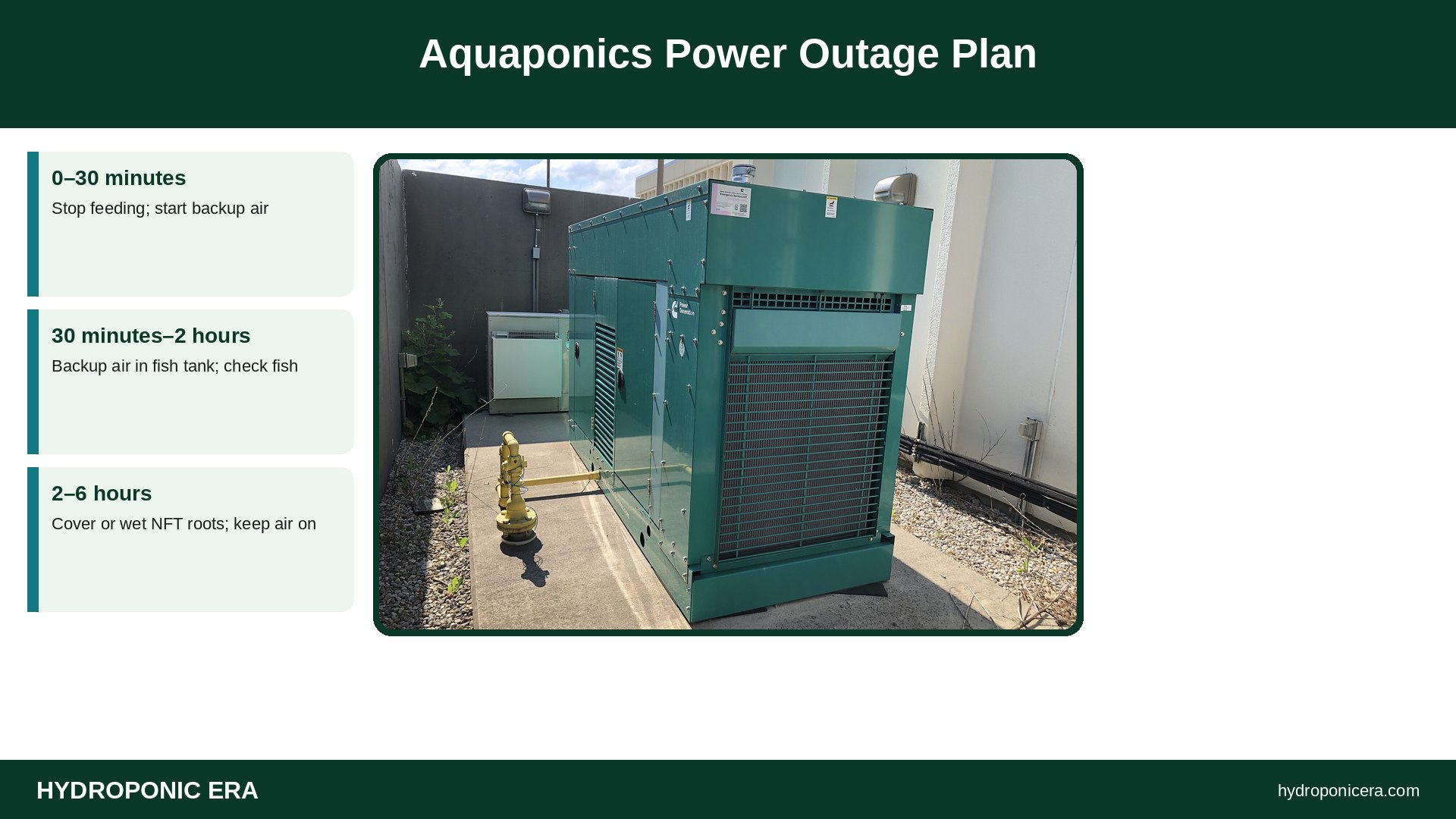
| 0–30 minutes | Low in cool, lightly stocked tanks | Stop feeding; start backup air |
| 30 minutes–2 hours | High in warm or crowded tanks | Backup air in fish tank; check fish |
| 2–6 hours | Plant roots in NFT dry out; DO falls | Cover or wet NFT roots; keep air on |
| 6–24 hours | Bacteria in filters begin to suffer | Generator for water pump if possible |
| Over 24 hours | Major losses likely without power | Generator, reduce fish load, partial water change |
Why an Aquaponics Power Outage Is an Emergency
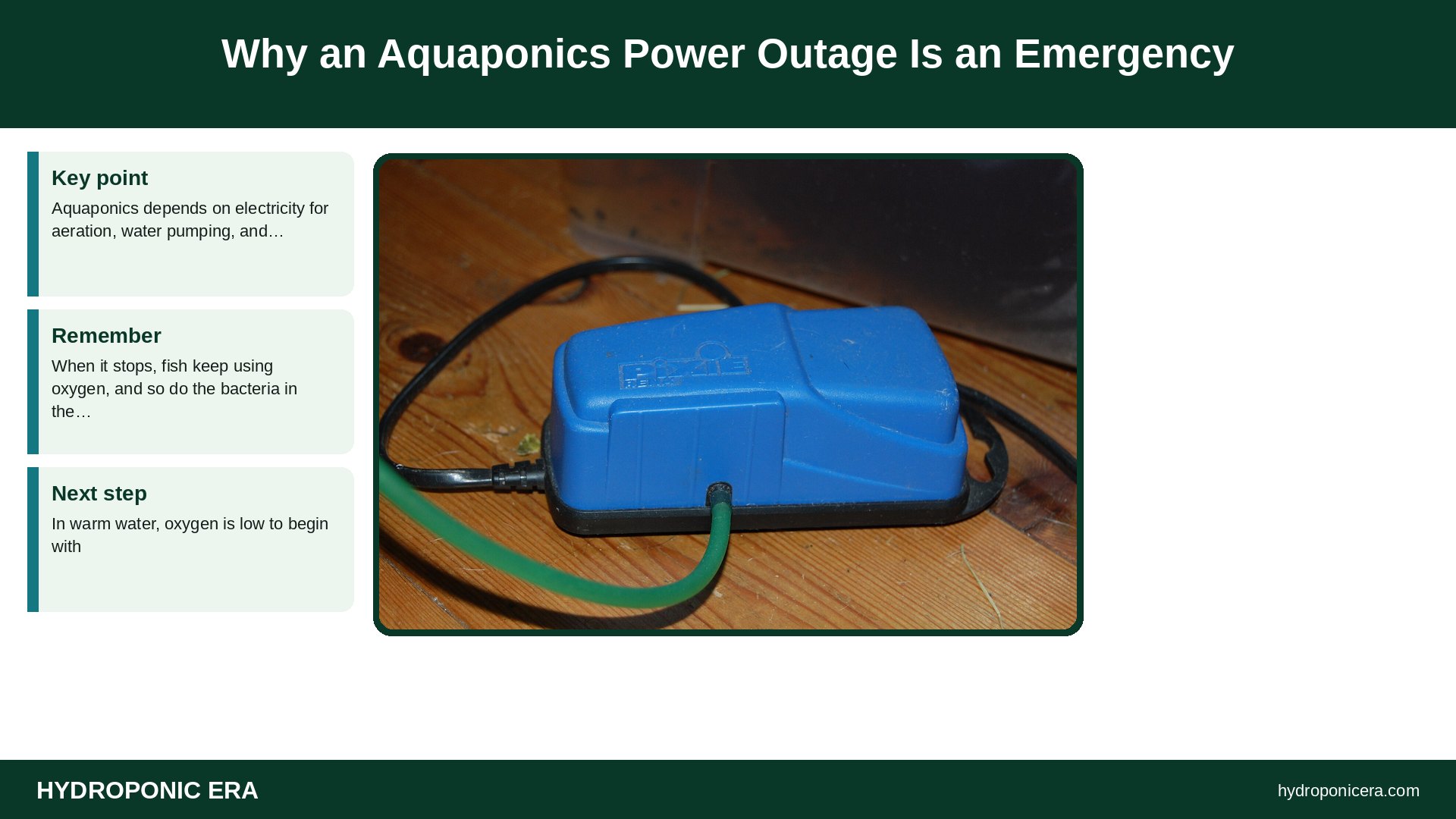
Aquaponics depends on electricity for aeration, water pumping, and sometimes heating, cooling and lights. When it stops, fish keep using oxygen, and so do the bacteria in the biofilter and the organic matter in the system. In warm water, oxygen is low to begin with. UF/IFAS notes that nitrifying bacteria stop working when oxygen runs short, so ammonia and nitrite can rise after a long outage too. See aquaponics dissolved oxygen and nitrifying bacteria.
What to Do in the First Hour
- Stop feeding. Digestion uses oxygen, and uneaten feed rots.
- Start backup aeration in the fish tank: battery air pump, inverter or generator.
- Check the fish. If they’re gasping at the surface, increase aeration or stir the surface by hand with a clean paddle or bucket pour.
- Close any drain valves that could empty the fish tank if water flow stops in a strange way.
- Note the time so you know how long the outage has lasted.
Aquaponics Power Outage Backup Options
- Battery-backup air pumps: small units that switch on automatically and run for many hours on D-cells or a rechargeable battery. Good for small tanks.
- Inverter and battery: a 12-volt deep-cycle battery and a pure sine wave inverter can run a linear air pump for many hours.
- Portable generator: runs air and water pumps for days. Keep fuel fresh and run it outdoors only.
- Standby generator: starts automatically; best for commercial systems.
- Solar with battery: works well for small air pumps. See off-grid solar planning.
Sizing Backup Power
Add up the watts of what must run. A 60 LPM linear air pump might draw about 40–50 watts; a 600 GPH water pump about 40–60 watts. Running both for 12 hours uses about 1–1.3 kWh. A 100 Ah, 12-volt deep-cycle battery stores about 1.2 kWh, but you should only use about half of that on lead-acid batteries, so plan two batteries or a lithium unit for a 12-hour run. Heaters draw far more and are hard to run on batteries. See aquaponics air pump sizing.
Protecting Plants During an Aquaponics Power Outage
Media beds hold moisture for many hours, so plants usually survive a day. DWC rafts keep roots in water, but without aeration the water slowly loses oxygen; add a stone if you have enough backup air. NFT and vertical towers are the most vulnerable, because roots can dry out in an hour or two on a hot day. Drape wet towels over NFT channels or hand-pour water through them. See NFT dry-out failures.
Temperature During an Outage
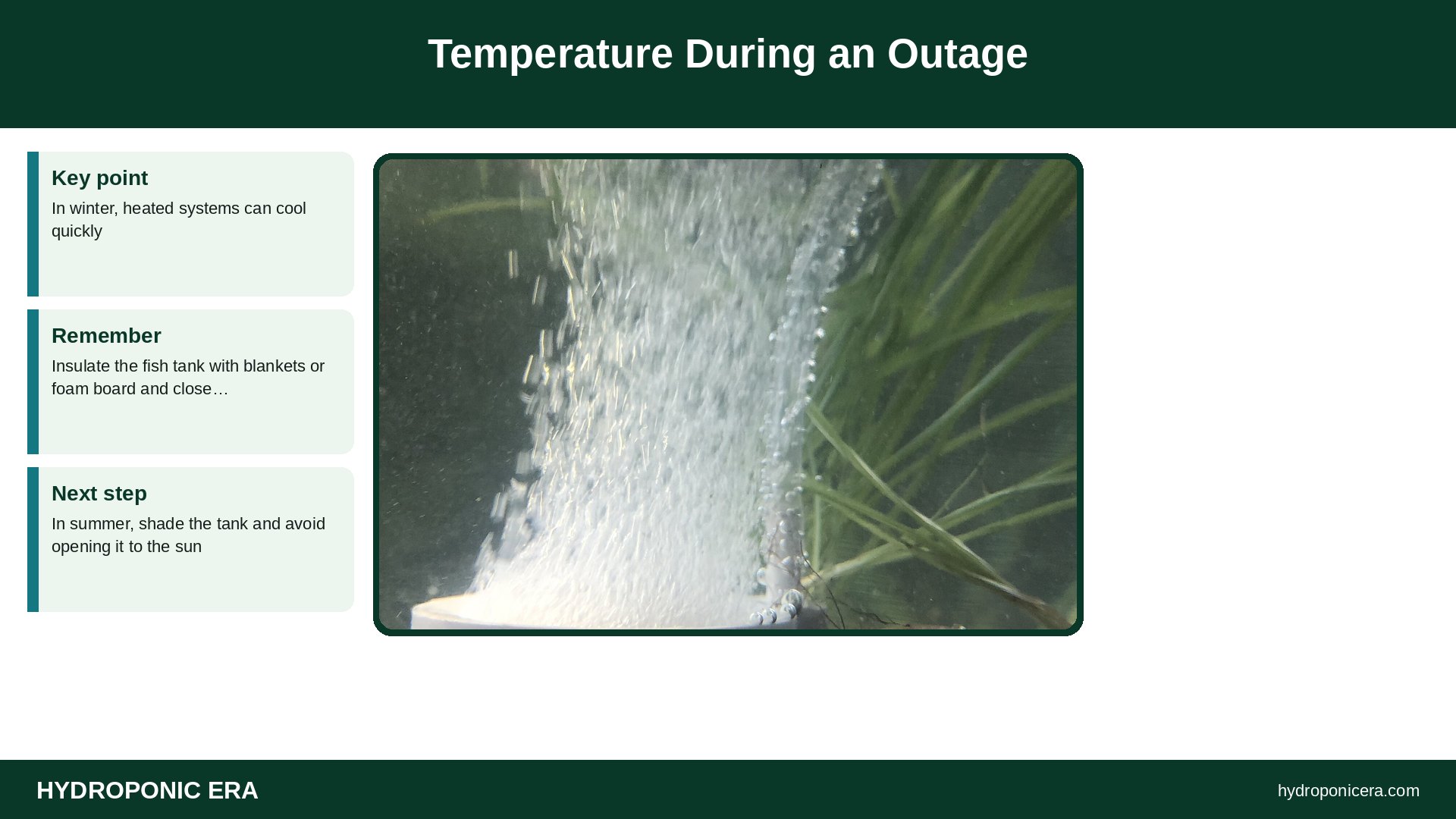
In winter, heated systems can cool quickly. Insulate the fish tank with blankets or foam board and close greenhouse vents. In summer, shade the tank and avoid opening it to the sun. A large water volume changes temperature slowly, which buys time. See aquaponics water temperature and aquaponics in winter.
Restarting After Power Returns
- Check that the water pump primes and flows; clear air locks.
- Look for solids that settled in pipes and filters and flush them.
- Test ammonia, nitrite, pH and, if you can, DO.
- Restart feeding at half rations for a day or two.
- Remove any dead fish immediately.
- Check heaters, timers and controllers; reset clocks.
See power outage recovery checklist and air lock diagnosis.
Alarms
A power-failure alarm that texts or calls you is essential if the system is outside or you travel. Some smart plugs and Wi-Fi controllers report outages, but they fail when the internet goes down too, so a battery-powered cellular alarm is more reliable. See Wi-Fi controllers and smart plugs.
Reducing Risk Before an Aquaponics Power Outage
- Stock fish at moderate densities; crowded tanks crash fastest.
- Keep the fish tank deep and large relative to fish weight.
- Use two air pumps on separate circuits.
- Store backup batteries fully charged and test monthly.
- Keep a printed outage checklist next to the system.
- Know your local utility’s outage alerts and storm season.
Gravity and Passive Aeration
Some growers design systems so that water can drain by gravity to a sump that sits lower than the fish tank, which prevents overflows when pumps stop. Bucket pours and surface stirring add small amounts of oxygen in an emergency. These help but don’t replace a real backup air supply.
Insurance and Records
If you sell fish or produce, note outage dates, durations and losses. Records help with insurance claims and show where to invest in backup power. See insurance and risk questions.
Aquaponics Power Outage Kit
Keep everything you need for an aquaponics power outage in one labeled bin near the system, so anyone in the household can respond:
- A charged battery air pump with spare batteries, plus tubing and two stones.
- A flashlight or headlamp.
- Ammonia and nitrite test kits.
- A clean bucket and a fish net.
- Towels or burlap to keep NFT and tower roots wet.
- Insulating blankets or foam board for the fish tank.
- A printed copy of your outage checklist and restart steps.
Planning for Long Aquaponics Power Outages
Storms, ice and heat waves can cut power for days. If outages longer than a day are common where you live, a generator sized to run the air pump and water pump is worth the cost. Before storm season, test it under load, store fuel safely, and work out where the cord will run. During a long aquaponics power outage, consider harvesting some fish to cut oxygen demand, and replace about 10–20% of the water with dechlorinated water if ammonia climbs.
FAQs
How long can aquaponics fish survive without air?
From under an hour to many hours, depending on temperature and stocking.
What is the best backup for a power outage?
An automatic battery air pump for small systems; a generator for larger ones.
Should I feed fish during an outage?
No; stop feeding until power and aeration return.
Will my biofilter die?
Short outages are fine; long ones without oxygen can set it back.
How do I protect NFT plants?
Keep roots wet with towels or hand watering.
Can I run a generator indoors?
Never. CPSC advises running generators outdoors, at least 20 feet from the home, because carbon monoxide can kill.
Sources
- UF/IFAS Extension — Ammonia in Aquatic Systems
- New Mexico State University — Important Water Quality Parameters in Aquaponics Systems
- Southern Regional Aquaculture Center — Aquaponics: Integrating Fish and Plant Culture (SRAC 454)
- US Consumer Product Safety Commission — What to Know: Generators and CO
- Photo credits (Wikimedia Commons, edited with titles): Cummins Generator by Mbrickn (CC BY 4.0); Aquarium-air-pump by User:Corydoras-adolfoi (CC BY-SA 4.0); Fish farming on Øksfjorden in Loppa, Troms og Finnmark, Norway, 2022 August by Ximonic (Simo Räsänen) (CC BY-SA 4.0); Air Stone Disk aquarium Germany 2024 by Nimmerwelk (CC BY-SA 4.0); Intermediate Bulk Container (fcm) by Photograph: Frank C. Müller, Baden-Baden (CC BY-SA 4.0)