
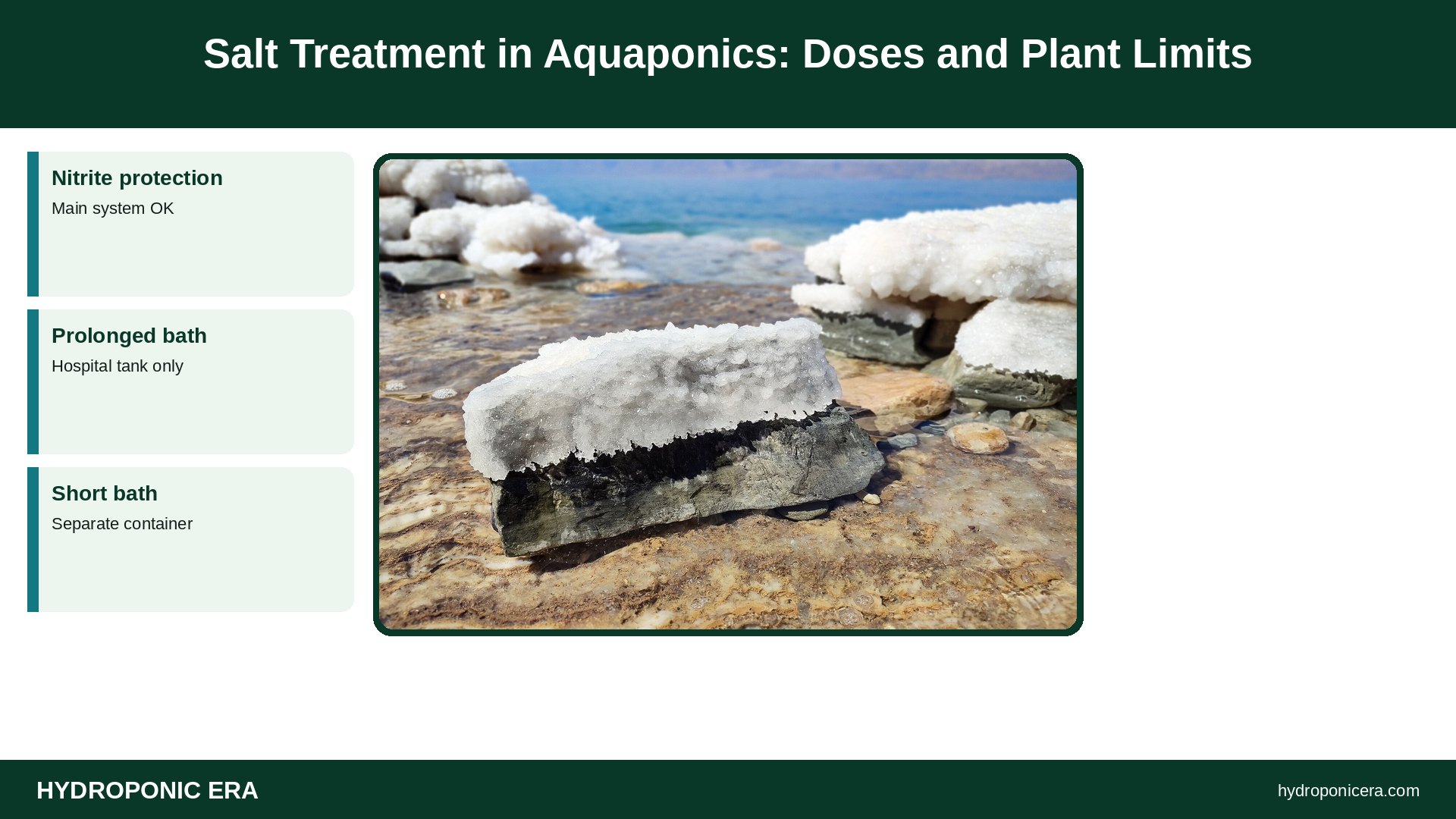
Salt treatment in aquaponics is useful but must be done carefully, because doses that help fish can damage plants. Low chloride levels (about 10–50 ppm) used to block nitrite are usually safe in the main system. Therapeutic doses for parasites and stress, typically 1–3 parts per thousand (ppt, or 1–3 grams per liter) for prolonged baths, 10 ppt for short baths, and about 30 ppt for brief dips, should be given in a separate hospital or quarantine tank, never in the plant system. One gram of salt per liter raises EC by roughly 2 mS/cm, which is already above the salt tolerance of lettuce and many other vegetables.
Key takeaway: Treat fish with salt outside the aquaponics loop. Inside the loop, use salt only at low chloride levels for nitrite protection.
| Treatment | Typical salt level | Duration | Where |
|---|---|---|---|
| Nitrite protection | Chloride 6× nitrite (10–50 ppm Cl) | Ongoing | Main system OK |
| Prolonged bath | 1–3 ppt (1–3 g/L) | Days to weeks | Hospital tank only |
| Short bath | About 10 ppt (10 g/L) | 30 minutes to a few hours | Separate container |
| Dip | About 30 ppt (30 g/L) | 30 seconds to a few minutes | Bucket; watch fish closely |
Why Salt Treatment Works for Fish
Freshwater fish constantly lose salts to the water and spend energy replacing them. A little salt in the water lowers that osmotic stress, which helps after shipping, handling or injury. Higher concentrations disrupt many external parasites, such as Ich’s free-swimming stage, Trichodina and some flukes, which cannot handle the change in salinity as well as the fish can. Chloride in salt also competes with nitrite at the gills, protecting fish from brown blood disease. See aquaponics nitrite spike.
Why Salt Is a Problem for Plants
Plants take up very little sodium and chloride, so salt stays in the water and builds up with every dose. High salinity makes it harder for roots to take up water, causes leaf tip burn and slows growth. Lettuce, strawberries, beans and many herbs are salt-sensitive; tomatoes and some greens are more tolerant, but none like therapeutic salt levels. Unlike nutrients, salt doesn’t leave when plants are harvested. Only water changes remove it. See sodium buildup and tip burn.
Choosing Salt
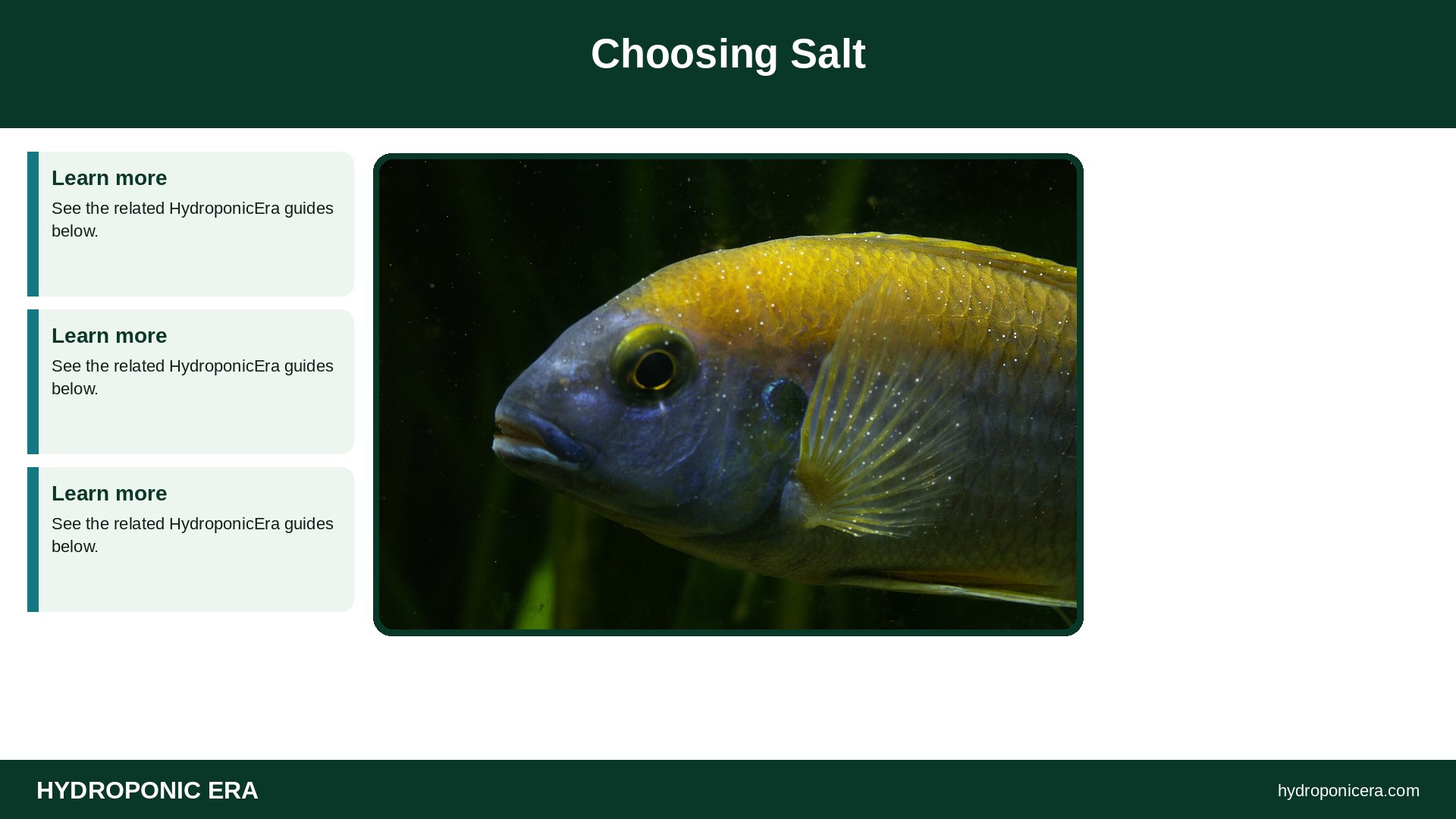
- Use plain sodium chloride: canning, pickling, solar or pure aquarium salt.
- Avoid iodized salt and salt with anti-caking agents such as yellow prussiate of soda.
- Don’t use marine aquarium salt mixes for freshwater treatment; they contain other minerals.
- Don’t use water softener salt pellets with additives.
Salt Treatment in a Hospital Tank
- Set up a separate tank with aeration, a heater if needed and dechlorinated water matched to the system temperature.
- Move sick fish into it.
- Dissolve salt in a bucket of tank water first, then add it in stages over several hours to reach the target, such as 2–3 ppt.
- Keep fish in the bath for the planned period, often 1–3 weeks for Ich at warm temperatures.
- Do partial water changes as needed, replacing the salt removed.
- Lower salt gradually before returning fish to the main system.
UF/IFAS explains that only the free-swimming stage of Ich can be treated, so treatments must last through the full life cycle. See aquaponics fish diseases and quarantine new fish.
Calculating Salt Doses
One part per thousand equals 1 gram per liter, or about 3.8 grams per gallon. For a 50-gallon hospital tank at 2 ppt, you need about 50 × 3.8 × 2 = 380 grams, or about 13 ounces of salt. For chloride-based nitrite protection, the doses are much smaller: about 0.6 grams of salt raises chloride by 1 ppm in 100 gallons.
Dips and Short Baths
Dips use high salt for a very short time, usually 30 seconds to a few minutes at about 30 ppt. Remove the fish immediately if it rolls over or loses balance, and return it to clean, aerated water. Short baths at about 10 ppt last 30 minutes to a few hours. Species tolerance varies, so test a few fish first. Texas A&M AgriLife describes short-term and prolonged bath methods for sick fish and stresses watching fish closely during treatment.
Salt Treatment Limits for the Main System
- Keep therapeutic salt doses out of the aquaponics loop.
- Use chloride for nitrite protection at the lowest effective level.
- Track every salt addition in a log.
- Watch EC; a rise without more feeding often means salt buildup.
- Use water changes to bring sodium down if plants show tip burn.
See EC and TDS.
Salt and Nitrifying Bacteria
Freshwater nitrifying bacteria tolerate low salt but can be set back by sudden large doses. Raising salt slowly gives them time to adjust. Another reason to keep treatment salt in a separate tank is to avoid stalling the biofilter. See nitrifying bacteria.
Returning Fish After Treatment
Lower the salt in the hospital tank over two or three days with partial water changes, then acclimate fish to the main system water as you would new arrivals. Moving fish straight from a 3 ppt bath into fresh system water is another shock.
Species Tolerance
Tilapia tolerate salt well. Catfish, goldfish and koi tolerate moderate salt. Some scaleless or sensitive fish handle it poorly. Always check species guidance before treating. See best fish for aquaponics.
When Salt Treatment Makes Sense
- New fish in quarantine: a low prolonged salt treatment reduces shipping stress and can control some external parasites before fish join the system.
- Ich outbreaks: salt treatment in a hospital tank, continued through the parasite’s life cycle, is a common first choice in food-fish systems.
- Nitrite spikes: low chloride in the main system protects fish while the biofilter catches up.
- Injuries and handling: a short salt bath after netting or transport can help fish recover.
When Salt Treatment Is the Wrong Choice
Salt won’t cure internal bacterial infections, Streptococcus, or problems caused by poor water quality, low oxygen or high ammonia. Using salt treatment for these delays the real fix and adds salt you’ll have to remove later. Test water first, look closely at the fish, and get a diagnosis from a fish health lab when deaths continue.
Salt Treatment Record Keeping
Write down the date, tank, volume, amount of salt, target concentration, duration and fish response for every salt treatment. Over months, the log shows how much salt has entered the system and helps you plan water changes before plants suffer. It also helps if you need to show a buyer or inspector what treatments your fish received. See record keeping and logs.
FAQs
Can I add salt to my aquaponics system?
Only at low chloride levels for nitrite protection; treat fish separately.
How much salt is a salt bath?
Often 1–3 ppt for prolonged baths, 10 ppt for short baths.
Does salt kill plants?
At therapeutic levels it damages most vegetables.
What salt should I use?
Plain, non-iodized sodium chloride with no additives.
Does salt cure Ich?
It’s a common treatment in a hospital tank when continued through the life cycle.
How do I remove salt?
Only water changes remove it.
Sources
- Texas A&M AgriLife Extension — Bath Treatment for Sick Fish
- Texas A&M AgriLife Extension — Introduction to Freshwater Fish Parasites
- UF/IFAS Extension — Ichthyophthirius multifiliis (White Spot) Infections in Fish
- Purdue Animal Disease Diagnostic Laboratory — Nitrite Toxicosis in Freshwater Fish
- Photo credits (Wikimedia Commons, edited with titles): Dead Sea salt crystals by Petar Milošević (CC BY-SA 4.0); Fish farming on Øksfjorden in Loppa, Troms og Finnmark, Norway, 2022 August by Ximonic (Simo Räsänen) (CC BY-SA 4.0); Ichthyophthiriasis by No machine-readable author provided. Djpalme assumed (based on copyright claims) (Public domain); Oweston sting fish for sale at Tsukiji Fishmarket, Tokyo-30 by MichaelMaggs (CC BY-SA 3.0); Fountain with goldfish in Jardí del Bisbe 03 by Kritzolina (CC BY-SA 4.0)