
Aquaponics root rot is usually caused by Pythium, a water mold that thrives in warm, low-oxygen water full of organic solids. Healthy roots are white or cream and firm; rotting roots turn brown, slimy and slough off when touched, while plants wilt or look nutrient-starved. The fix starts with the water, not chemicals: keep water below about 78–82°F (26–28°C), raise dissolved oxygen with more aeration, remove solids faster, and pull out badly infected plants. Don’t use fungicides or harsh disinfectants in a system with fish, because they can harm the fish and the nitrifying bacteria.
Key takeaway: In aquaponics, root rot is a symptom of warm, stale water. Cool it, aerate it and clean it, and healthy microbes in the system help hold Pythium back.
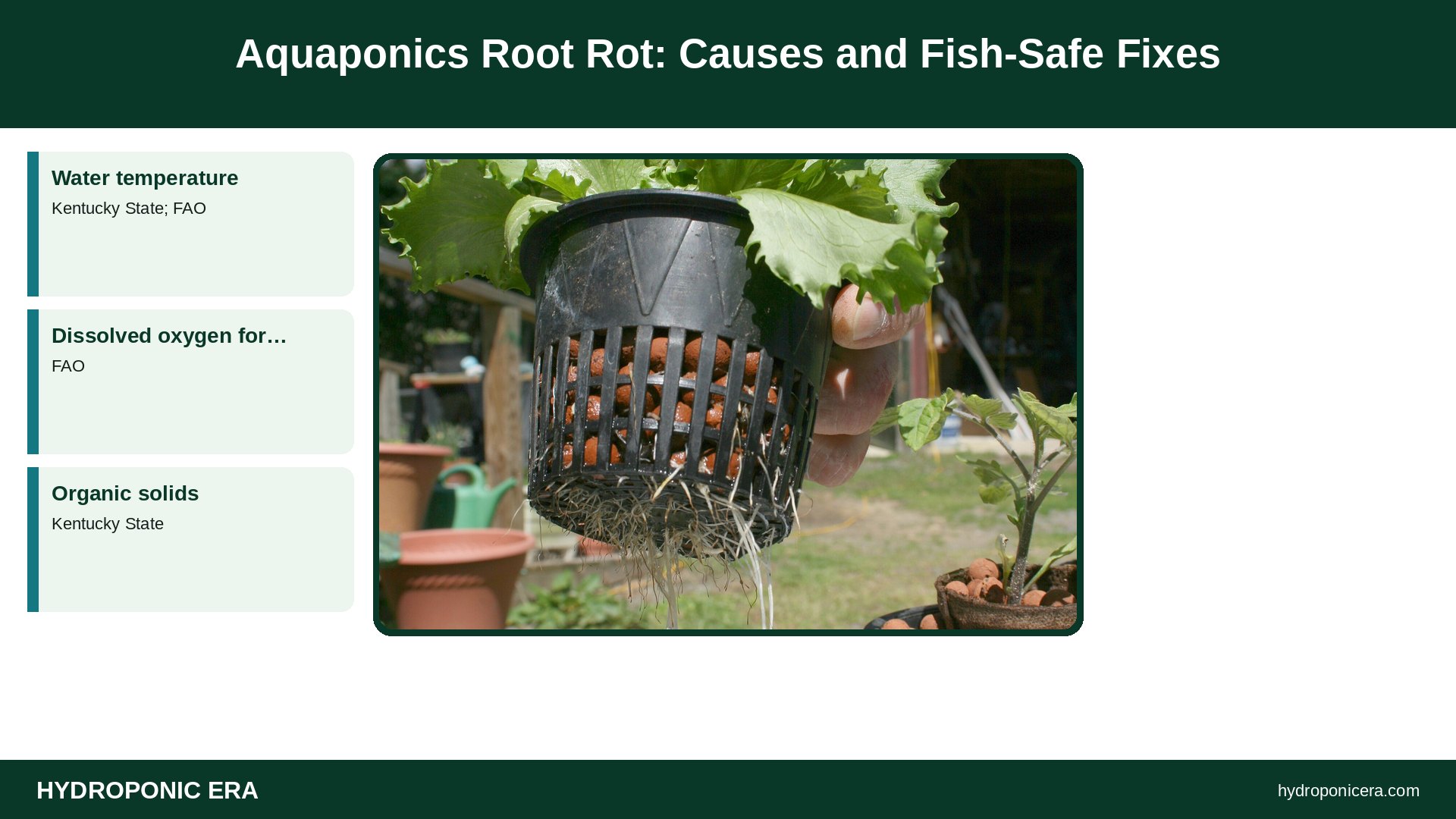
| Cause or fix | Target or action | Source |
|---|---|---|
| Water temperature | Pythium often appears above 78°F (26°C); keep below 82–86°F (28–30°C) | Kentucky State; FAO |
| Dissolved oxygen for roots | Above 3 mg/L; above 5 mg/L for fish | FAO |
| Organic solids | Remove effectively; high solids favor Pythium | Kentucky State |
| Infection sources | Soil, peat and nursery seedlings | FAO |
| Tolerant crop | Basil handles Pythium and warm water better than lettuce | FAO |
| Chemicals | Avoid fungicides in coupled systems | Stouvenakers et al. (2019) |
What Causes Aquaponics Root Rot?
The FAO calls root rot caused by Pythium spp. a very common disease in aquaponics. It’s a soil-borne pathogen that sneaks in on contaminated materials such as soil, peat or seedlings from nurseries. Kentucky State University adds that Pythium occurs naturally in growing environments, and in aquaponics it commonly appears at water temperatures above 78°F (26°C) and where organic solids build up.
Low oxygen sets the stage. The FAO notes that most plants need dissolved oxygen above 3 mg/L in the water, and without it roots die and fungus grows. Warm water holds less oxygen while roots, fish and microbes all use more, which is why root rot so often shows up in summer. At the University of the Virgin Islands, SRAC Publication 454 reports that Pythium problems appeared in summer and faded in winter as water cooled.
Signs of Aquaponics Root Rot
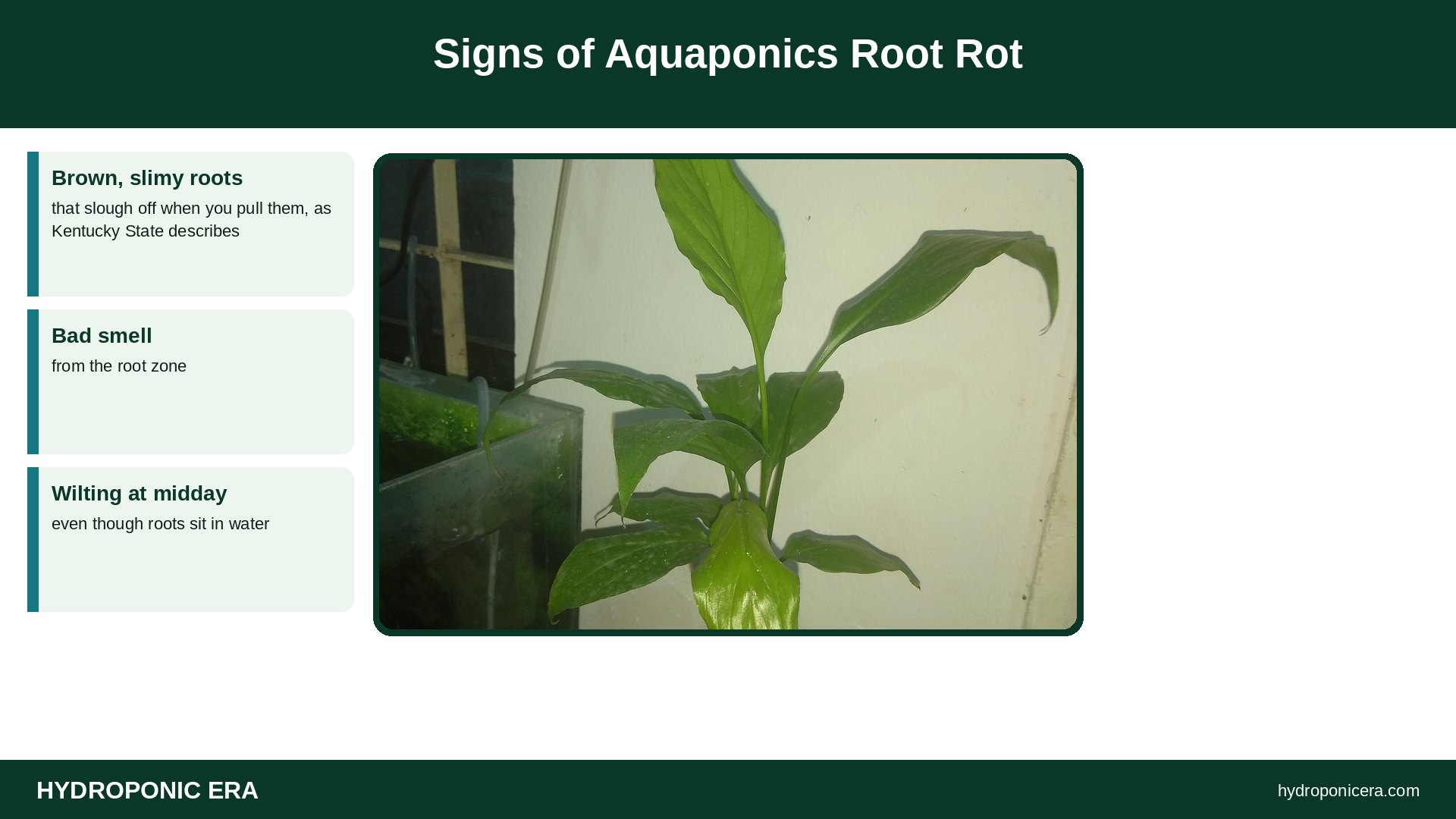
- Brown, slimy roots that slough off when you pull them, as Kentucky State describes.
- Bad smell from the root zone.
- Wilting at midday even though roots sit in water.
- Stunted growth or yellow leaves that look like a nutrient deficiency. See aquaponics plants turning yellow.
- Problems spreading from one plant to its neighbors in a raft or channel.
Don’t confuse healthy fuzzy root hairs with rot. Fine white fuzz on firm white roots is normal. See white fuzz on roots in water.
How to Fix Aquaponics Root Rot
- Check water temperature. The FAO says keeping water below 82–86°F (28–30°C) is essential to avoid Pythium outbreaks. Shade tanks, insulate them, or add a chiller in hot climates. See aquaponics water temperature.
- Add aeration. More air stones in the fish tank and under rafts raise dissolved oxygen for both roots and fish. See aquaponics dissolved oxygen and aquaponics air pumps.
- Remove solids. Kentucky State says effective solids removal limits Pythium. Clean filters and settling tanks more often. See aquaponics solids filters.
- Pull badly infected plants. The FAO advises removing diseased plants promptly so the problem doesn’t spread.
- Trim and rinse mildly affected roots, then return plants to well-aerated water.
- Reduce feeding for a few days to cut waste while the system recovers.
- Replant with tolerant crops in hot weather. The FAO suggests shifting to basil, which is more tolerant of the pathogen and of high water temperatures than lettuce.
Why Not Just Add a Fungicide?

In hydroponics, growers sometimes treat root rot with chemicals. In aquaponics, the same water flows past fish and bacteria. A review of plant pathogens in aquaponics by Stouvenakers and colleagues (2019) notes that pesticide use in coupled aquaponic systems is limited because of toxicity to fish and nitrifying bacteria. The authors also note that UV and heat treatments can reduce waterborne pathogens but don’t always prevent root infection, and they can disrupt the beneficial microbes in the system.
That beneficial microbial community matters. The FAO notes that, unlike in hydroponics, Pythium in aquaponics often doesn’t cause damage below certain temperatures because other microorganisms compete with it. A 2020 study by Stouvenakers and colleagues found that aquaponic water suppressed Pythium aphanidermatum root rot on lettuce, and traced that effect to the water’s microbes. Protecting that microbial balance is one more reason to fix temperature and oxygen instead of sterilizing.
Preventing Aquaponics Root Rot
- Start clean. The FAO advises buying seeds and seedlings from a reputable nursery, and avoiding soil or peat that can carry Pythium. Start seedlings in clean media like rockwool or coir. See aquaponics seedlings.
- Keep temperatures steady. Kentucky State recommends preventing wide daily swings with shade, insulation and covers.
- Don’t overcrowd. The FAO warns that very dense planting cuts airflow and produces soft, disease-prone tissue.
- Keep solids under control and don’t overstock fish. See aquaponics stocking density.
- Keep light off the water, since algae add organic load and swing oxygen levels.
- Inspect roots weekly, especially in summer.
Which Systems Get Aquaponics Root Rot Most?

Raft (DWC) systems have roots in open water, so oxygen and temperature control are critical. Strong aeration under the rafts is the best protection. See aquaponics raft systems. NFT channels can heat up quickly in the sun and leave roots short of water if flow stops. Media beds are usually the most forgiving, because flood-and-drain cycles pull fresh air into the root zone. Still, a bed that stays flooded because a siphon fails can rot roots in days. See aquaponics bell siphons.
Protecting Your Fish While You Fix It
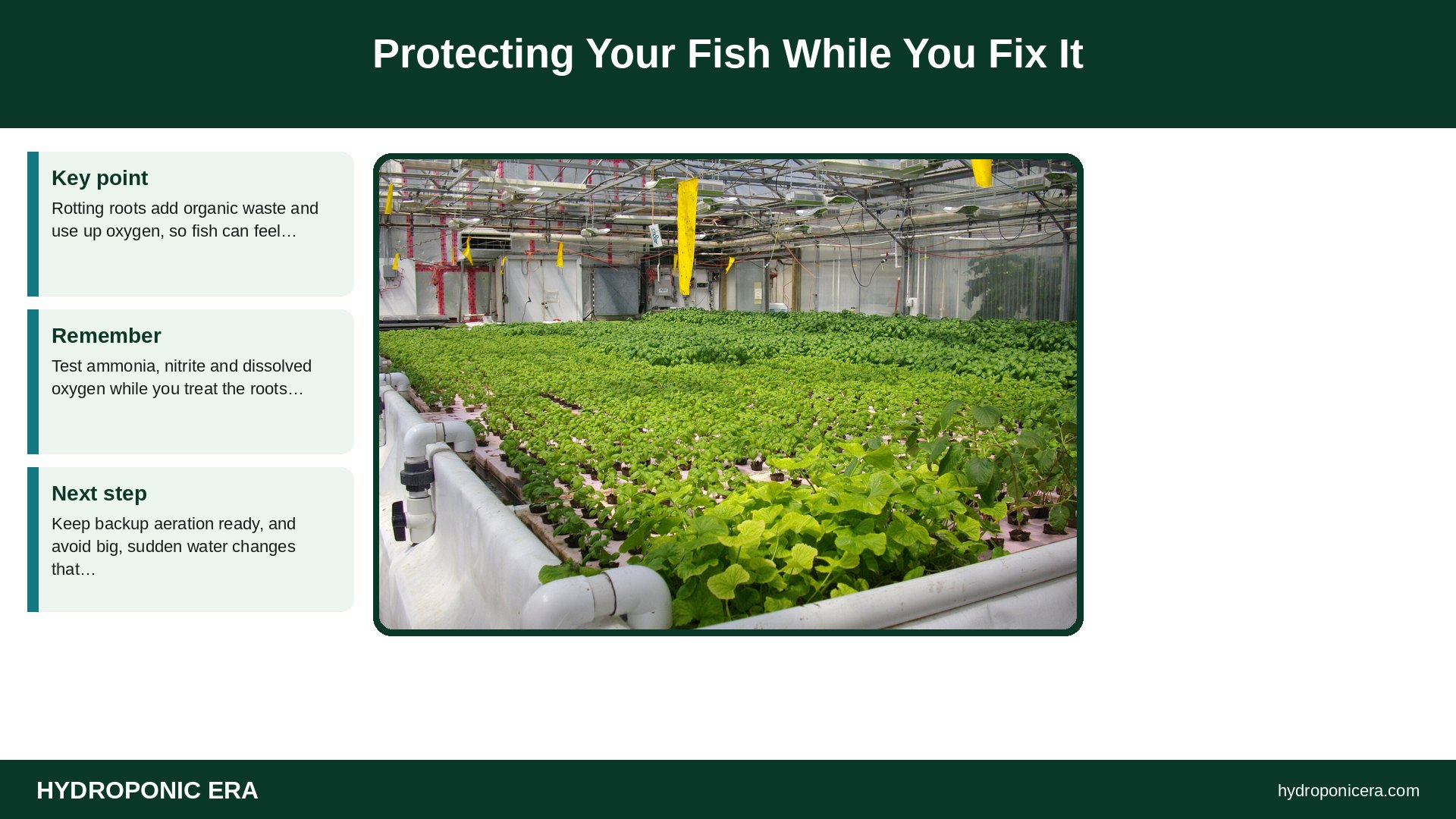
Rotting roots add organic waste and use up oxygen, so fish can feel the problem too. Test ammonia, nitrite and dissolved oxygen while you treat the roots, and watch for fish gasping at the surface. Keep backup aeration ready, and avoid big, sudden water changes that swing temperature or pH. If fish show disease signs, see aquaponics fish diseases. For more on the pathogen itself, read Pythium root rot in hydroponics.
FAQs
What does root rot look like in aquaponics?
Brown, slimy roots that fall apart, often with wilting or yellow leaves.
What temperature causes root rot in aquaponics?
Problems become common above about 78°F (26°C).
Can I use hydrogen peroxide in aquaponics?
We don’t recommend it in a fish system; fix temperature, oxygen and solids first.
Can plants recover from root rot?
Mild cases often recover once new white roots grow in cool, oxygen-rich water.
Which plants resist root rot?
Basil handles warm water and Pythium better than lettuce.
Is root rot contagious between plants?
Yes. It spreads through shared water, so remove badly infected plants quickly.
Sources
- FAO Fisheries and Aquaculture Technical Paper 589 — Small-scale aquaponic food production: Integrated fish and plant farming
- Kentucky State University — Aquaponics Handbook
- Rakocy, Masser and Losordo, Southern Regional Aquaculture Center Publication 454 — Recirculating Aquaculture Tank Production Systems: Aquaponics
- Stouvenakers et al. (2019), in Aquaponics Food Production Systems (Springer) — Plant Pathogens and Control Strategies in Aquaponics
- Stouvenakers et al. (2020), Microorganisms — Microbial Origin of Aquaponic Water Suppressiveness against Pythium aphanidermatum Lettuce Root Rot Disease
- Photo credits (Wikimedia Commons, edited with titles): 2009-03-30 Lettuce roots by Ildar Sagdejev (Specious) (CC BY-SA 4.0); Spathiphyllum wallisii hydroponically grown by Kephalian (CC BY-SA 4.0); Deep water culture by ArcadiYay (CC BY-SA 4.0); Aquarium-air-pump by User:Corydoras-adolfoi (CC BY-SA 4.0); CDC South Aquaponics Raft Tank 1 2010-07-17 by Bryghtknyght (CC BY 3.0)