
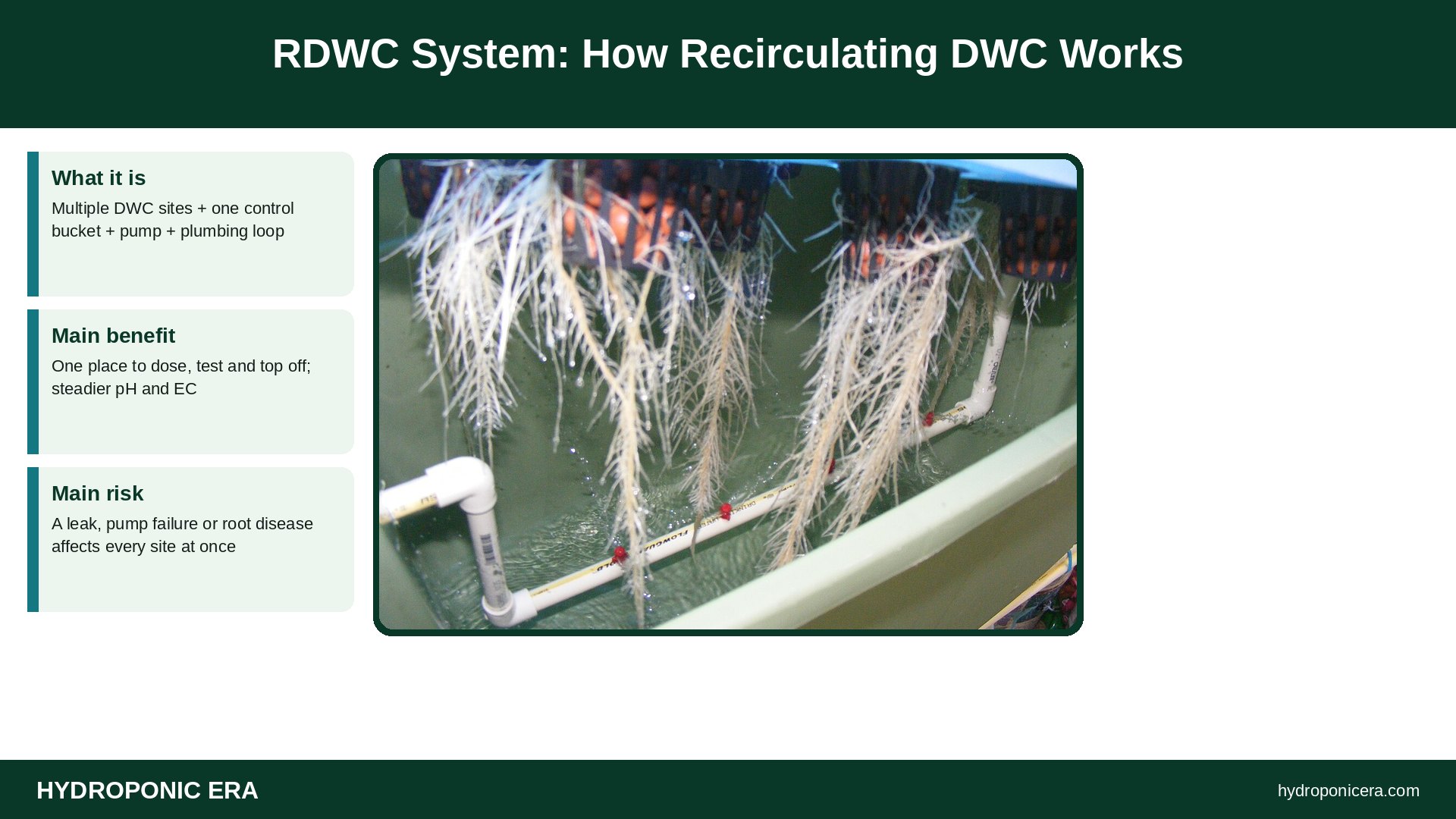
An RDWC system (recirculating deep water culture) links several aerated DWC buckets to one control bucket with pipes, so a single pump keeps the same nutrient solution moving through every plant site. You check pH, EC and temperature in one place instead of in each bucket, and the larger shared volume stays more stable.
| Question | Short answer |
|---|---|
| What it is | Multiple DWC sites + one control bucket + pump + plumbing loop |
| Main benefit | One place to dose, test and top off; steadier pH and EC |
| Main risk | A leak, pump failure or root disease affects every site at once |
| Best crops | Large plants (tomatoes, peppers, cucumbers) and big leafy crops |
| Typical home size | 4–8 sites of 5–10 gallons each |
What Is an RDWC System and How Is It Different From DWC?

In regular deep water culture, each bucket is its own little world. You mix, test and adjust every bucket separately. An RDWC system connects those buckets so they share one solution.
Water level evens out across connected sites by gravity, like water in a U-tube. A pump in the control bucket pushes solution to the far end of the loop, and it flows back through each site to the control bucket. Every site still gets its own air stone, because moving water alone does not supply enough dissolved oxygen for big root masses.
| Feature | Single-bucket DWC | RDWC system |
|---|---|---|
| Testing and dosing | Each bucket | Control bucket only |
| Solution volume | Small per plant | Large and shared |
| Stability | Swings faster | More stable |
| Failure impact | One plant | Whole system |
| Build complexity | Very simple | Plumbing, pump and leak testing |
What Parts Does an RDWC System Need?
- Site buckets. Opaque, food-grade 5-gallon buckets or larger tubs with lids and net pots. See our guide to net pots and grow cups.
- Control bucket. Usually the same size or larger, with no plant. This is where the pump, heater or chiller line, and probes live.
- Plumbing. Rigid PVC or flexible tubing connected with uniseals or bulkheads. Our bulkheads and uniseals guide covers fittings.
- Water pump. Submersible or inline, sized for your total gallons and head height. Use our pump sizing guide.
- Air pump and stones. One stone per site, plus one in the control bucket. See air pumps and air stones.
- Temperature control. A chiller in warm rooms; an aquarium heater in cold basements or garages.
- Shutoff valves. Ball valves between sites let you isolate a sick plant or drain one bucket.
How Do You Build an RDWC System Step by Step?
- Plan the layout. Put all buckets on one level surface with room for plants to spread. Keep the control bucket at the end that is easiest to reach.
- Drill and fit. Drill holes near the bottom of each bucket at the same height and fit uniseals or bulkheads. Matching heights keep water levels equal.
- Connect the loop. Run a supply line from the pump to the far site and a return line back to the control bucket. Keep runs short and avoid sags where debris settles.
- Add valves. Place a ball valve on each site connection so you can isolate or drain it.
- Leak test with plain water for 24–48 hours. Run the pump and air pump, then check every fitting with a dry paper towel. Read our leak fixing guide.
- Mix nutrients in the control bucket. Add base nutrients in label order, then adjust pH. Let the loop circulate before you take a reading.
- Set the water level. Fill until the solution sits about an inch below the net pot bottoms for seedlings. Lower it gradually as roots grow.
- Plant and log. Record pH, EC, water temperature and gallons added each day for the first two weeks.
How Do You Keep RDWC Solution Healthy?

The shared solution is the strength of an RDWC system and its weak point. Three variables matter most.
- Temperature. Aim for roughly 65–72°F (18–22°C). Warm water holds less oxygen and favors Pythium root rot. University of Kentucky’s root-disease guide for hydroponics stresses sanitation and temperature control because waterborne pathogens spread through recirculating water. See reservoir temperature and chillers.
- Dissolved oxygen. Keep every stone bubbling hard and clean them between crops. See dissolved oxygen.
- pH and EC. Test daily in the control bucket. Top off with plain water when EC rises, and add nutrients when it falls. See topping off vs reservoir changes.
Most growers change the full solution every one to three weeks depending on plant size. Large fruiting plants drink gallons a day, so check levels at least once daily in summer.
Which Crops Suit an RDWC System?
RDWC shines with big, long-season plants whose roots fill 5–10 gallon sites: indeterminate tomatoes, peppers, cucumbers and eggplant. It also works for large leafy crops, though for lettuce alone a single DWC tote or NFT channel is simpler and cheaper. Our DWC vs NFT vs Dutch bucket comparison helps you decide.
What Are Common RDWC System Mistakes?

- Skipping the leak test. A small drip becomes a flooded floor by morning.
- No backup plan for power outages. Without air and circulation, roots suffocate quickly. See backup power for pumps.
- Ignoring heat from the pump. Submersible pumps add heat; inline pumps outside the water add less.
- Letting roots clog lines. Big root masses can block fittings. Use screen guards and trim if needed; see when to prune DWC roots.
- Treating one sick plant late. Isolate it with valves as soon as you see brown, slimy roots. See Pythium root rot.
How Do You Clean an RDWC System Between Crops?
Because every site shares one loop, cleaning has to cover the plumbing as well as the buckets. Drain the system completely, pull the net pots and remove root debris from fittings and valves. Scrub buckets and the control bucket, then circulate a hydroponics-safe cleaner through the empty loop, rinse with plain water and circulate plain water again before refilling. Replace air stones that stay clogged. Our cleaning and sterilizing guide covers products and contact times, and biofilm in reservoirs explains why slime in tubing is worth the effort.
FAQs About the RDWC System
Is RDWC better than DWC?
It is better for several large plants because you manage one solution and get more stability. Single-bucket DWC is better for beginners, small spaces and anyone who wants isolation between plants.
Do you need air stones in every RDWC bucket?
Yes. Circulation alone rarely provides enough oxygen for large root masses. Put a stone in each site and in the control bucket.
How many buckets can one RDWC system have?
Home systems commonly run 4 to 8 sites. More sites mean more volume and stability, but also more plumbing and a bigger pump. Match the size to the space and light you have.
Can I grow different plants in one RDWC system?
Only if they tolerate the same pH, EC and temperature. Read multi-crop reservoir compatibility first.
How much does an RDWC system cost?
A DIY build with buckets, fittings and pumps usually costs less than a commercial kit, but prices vary widely by size and brand. Our home hydroponics cost guide helps you budget.
Related HydroponicEra Guides
- Recirculating vs drain-to-waste hydroponics
- How to grow hydroponic tomatoes
- Cleaning and sterilizing a hydroponic system
Sources
- University of Kentucky — Root disease management in hydroponic systems (PDF)
- Penn State Extension — Hydroponics Systems: Nutrient Solution Programs and Recipes
- University of Florida IFAS — Leafy Greens in Hydroponics and Protected Culture for Florida (HS1279)