
Quick Answer
Hydroponic timers and automation start with reliable light schedules and irrigation timing that match your system physics—then add only sensors and fail-safes you will maintain. A plug-in timer for lights prevents forgotten switches and protects Daily Light Integral. Pump automation must match design: many NFT loops need continuous flow, while drip/Dutch bucket systems use timed pulses. Oklahoma State and UF hydroponic primers assume controlled delivery of light and solution; timers are how home growers make that consistent.
See grow lights, PPFD/DLI, pump sizing, and kits.
Key Takeaways
- Automate lights first for photoperiod consistency.
- Match pump timers to system type; do not casually timer-off NFT.
- Mechanical timers work; digital timers reduce drift; smart plugs add complexity.
- Fail-safes beat fancy dashboards: trays, float valves, spare pumps, leak alarms.
- DLI = PPFD × photoperiod—timers are part of light math.
- Use GFCI outlets; keep water away from electronics.
- Test schedules with water only before planting.
Related HydroponicEra guides
What to Automate First
| Priority | Device | Why |
|---|---|---|
| 1 | Lights | Photoperiod / DLI |
| 2 | Intermittent irrigation | Drip/flood cycles |
| 3 | Fans / exhaust | Heat and humidity |
| 4 | pH/EC dosing | Only after manual mastery |
| 5 | Full smart stacks | Optional |
Timer Types
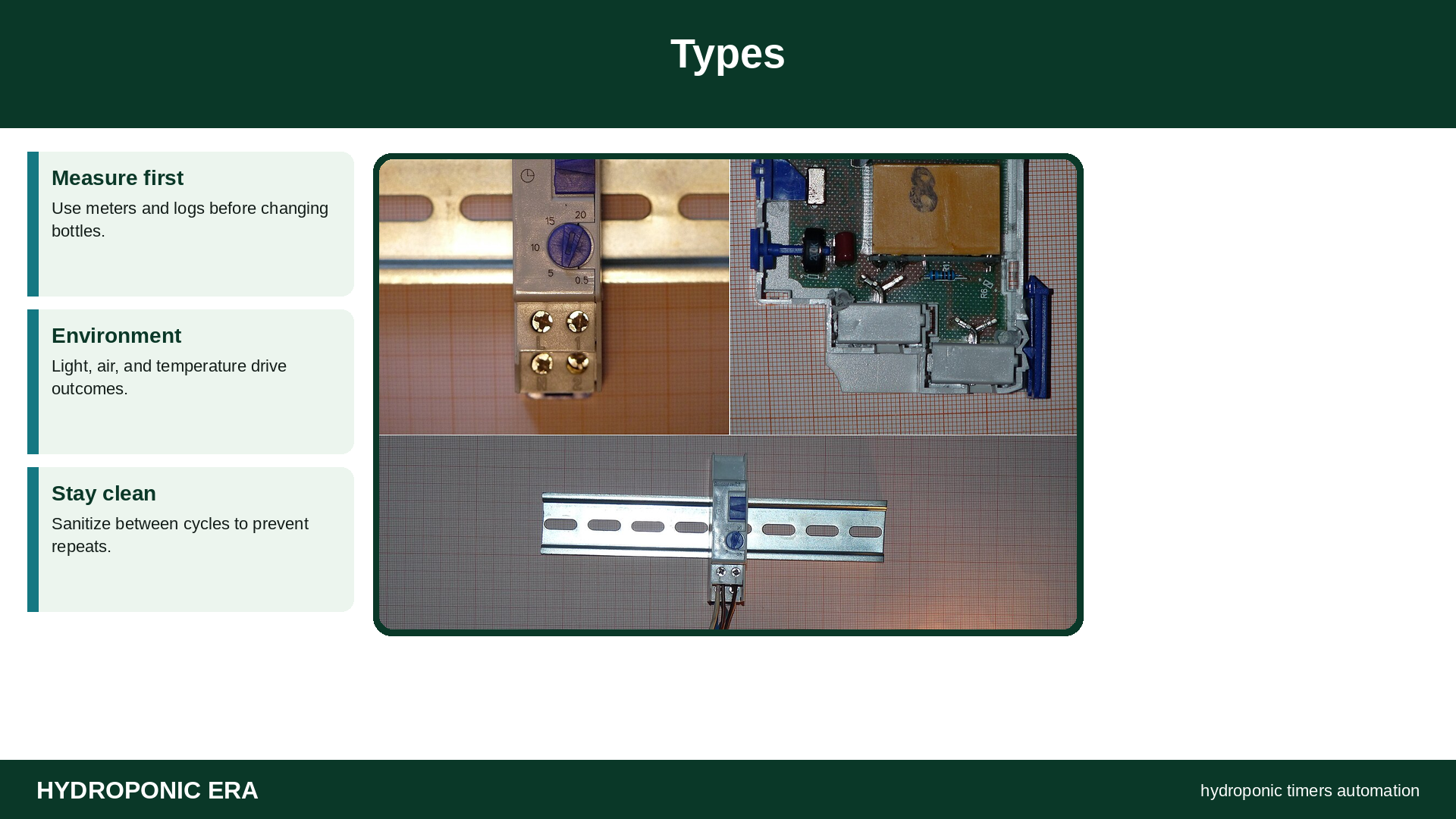
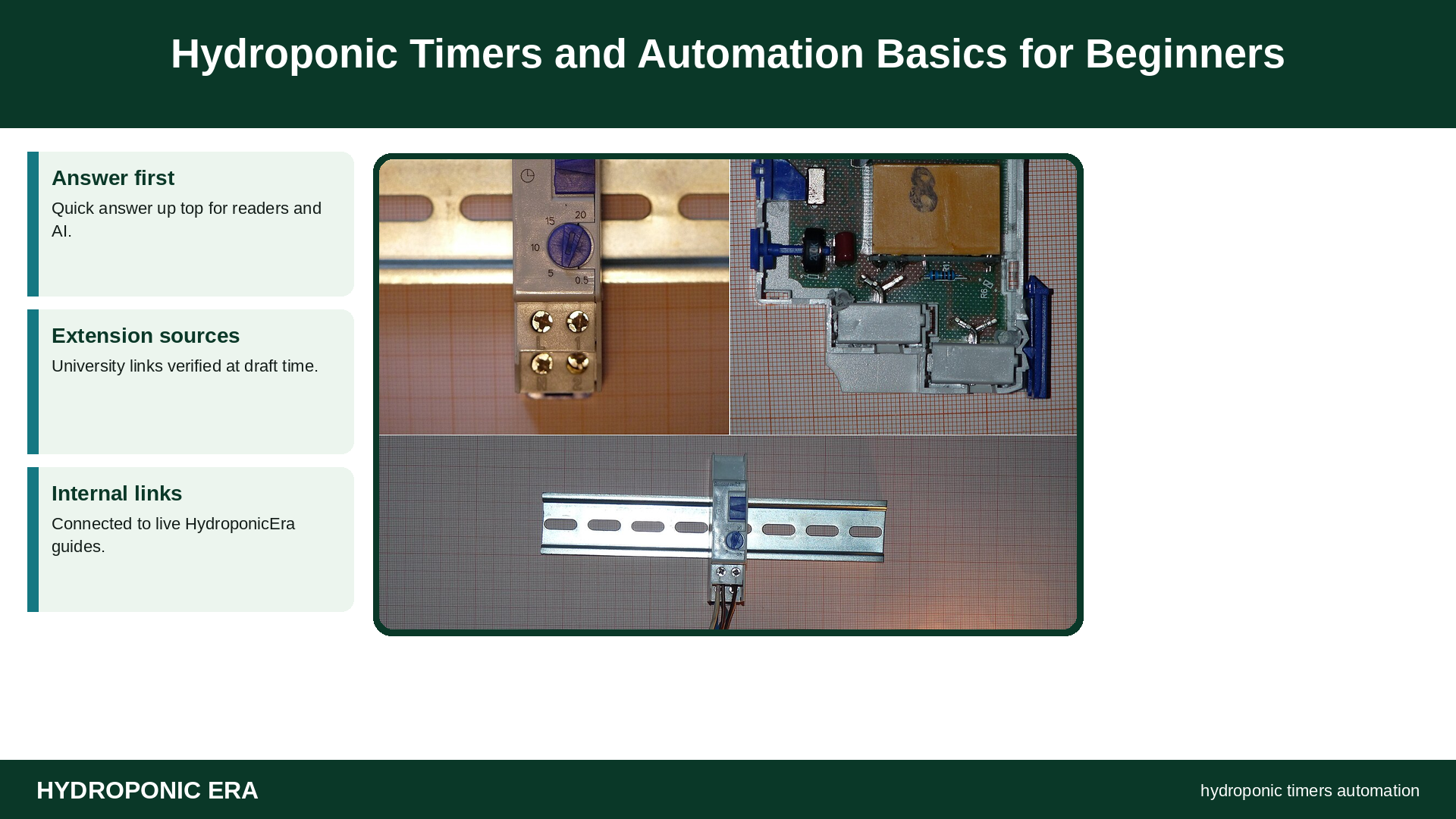
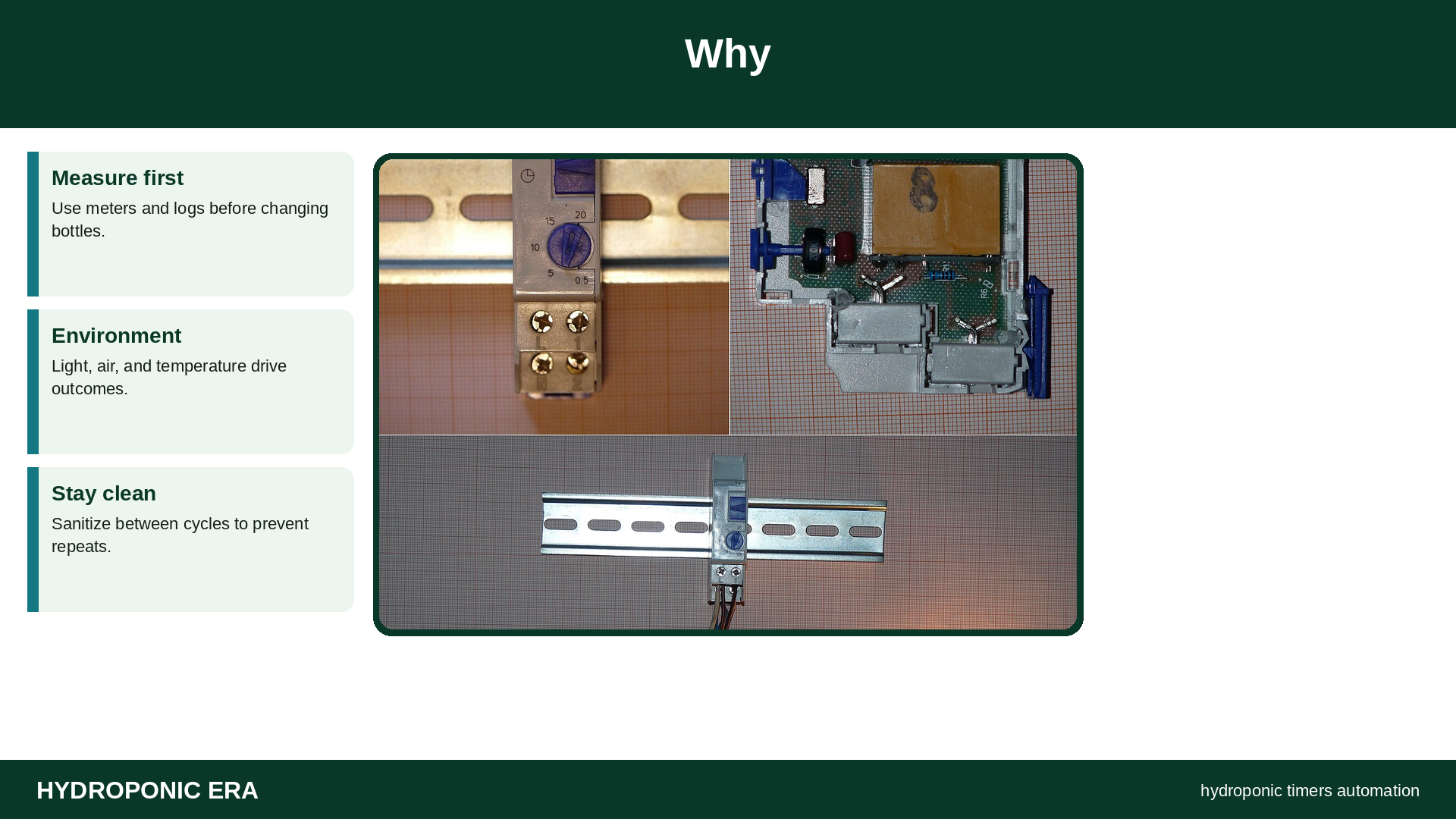
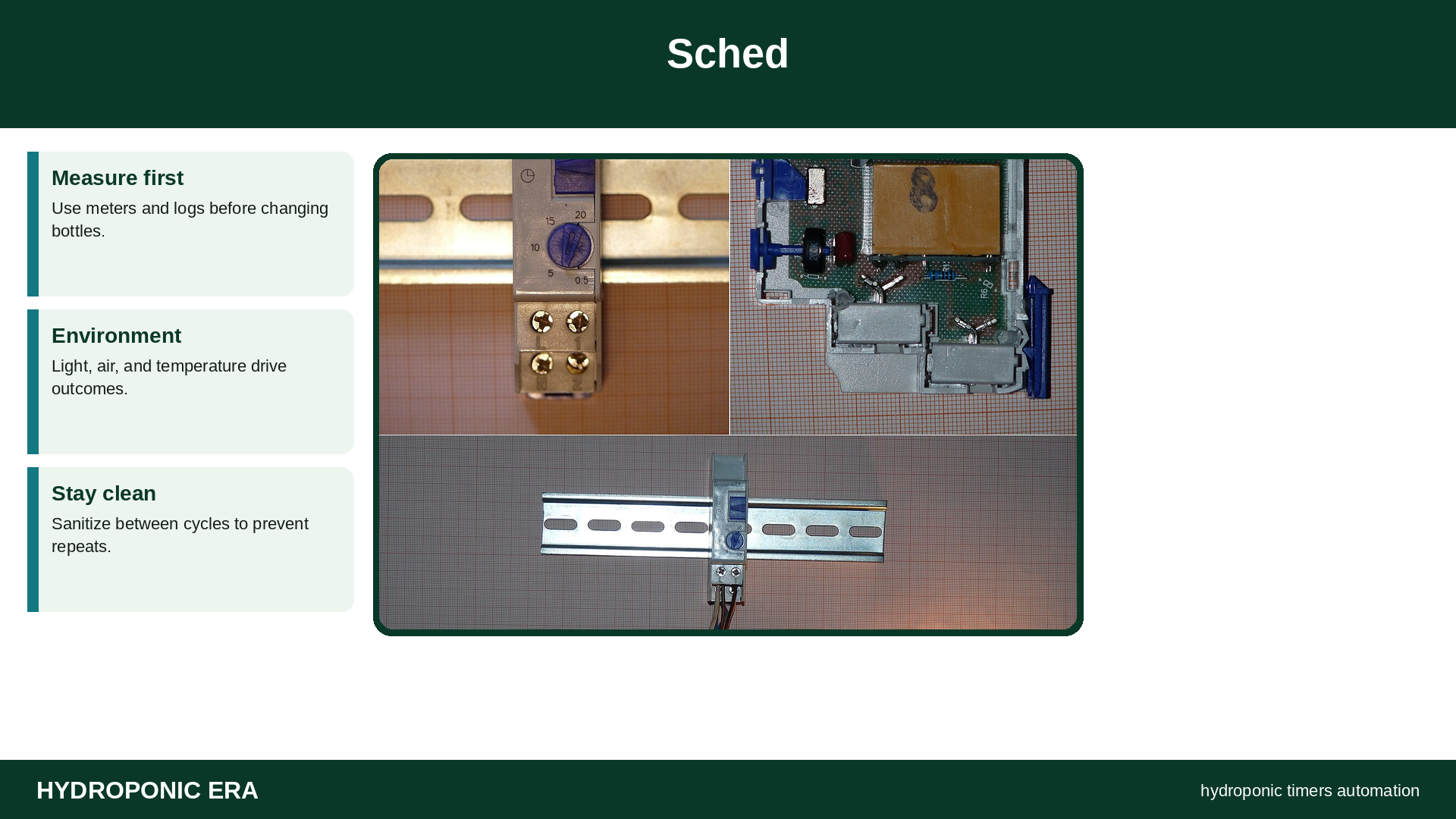
- Mechanical dial timers: simple, less precise.
- Digital outlet timers: multiple events; good for drip.
- Smart plugs: remote control; need reliable power/Wi-Fi discipline.
- Irrigation controllers: multi-zone for larger drip arrays.
Schedules by System
| System | Pump note | Light note |
|---|---|---|
| NFT | Often continuous; timer-off is risky | Stable photoperiod |
| DWC | Air pump usually continuous | Stable photoperiod |
| Dutch / drip | Short pulses several times/day | Stable photoperiod |
| Flood and drain | Timed flood frequency | Stable photoperiod |
Validate media moisture rather than copying minutes from strangers—media and climate differ.
Step-by-Step Starter Automation
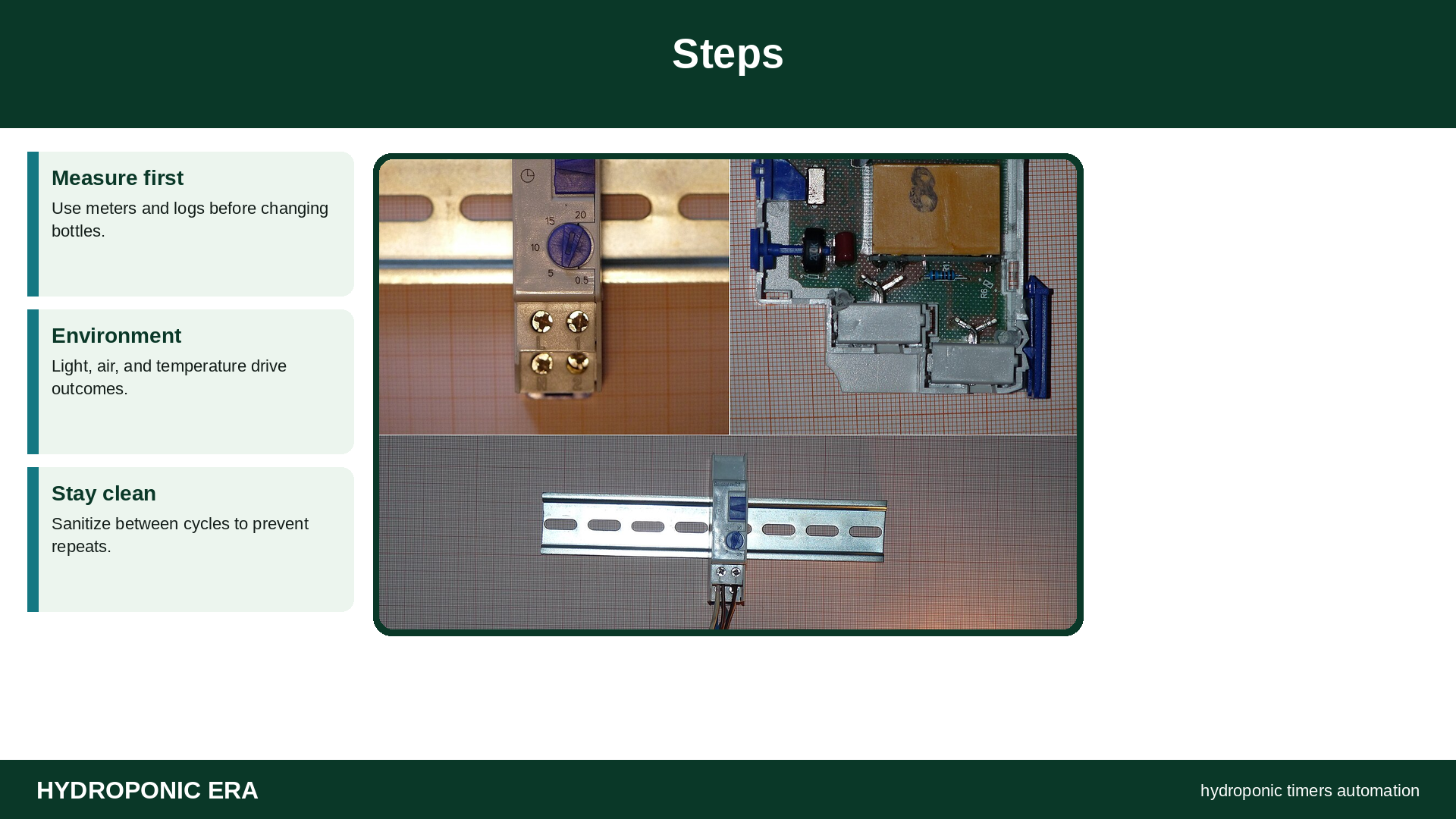
- Put lights on a timer matched to your DLI plan.
- Decide continuous vs pulsed pumps.
- Install GFCI protection; keep cords neat.
- Add catch trays and a leak plan (leaks guide).
- Test 48 hours with water only.
- Document the schedule on a card.
- Add temp/RH sensors if useful.
- Delay automated dosing until manual pH/EC is solid.
Fail-Safes
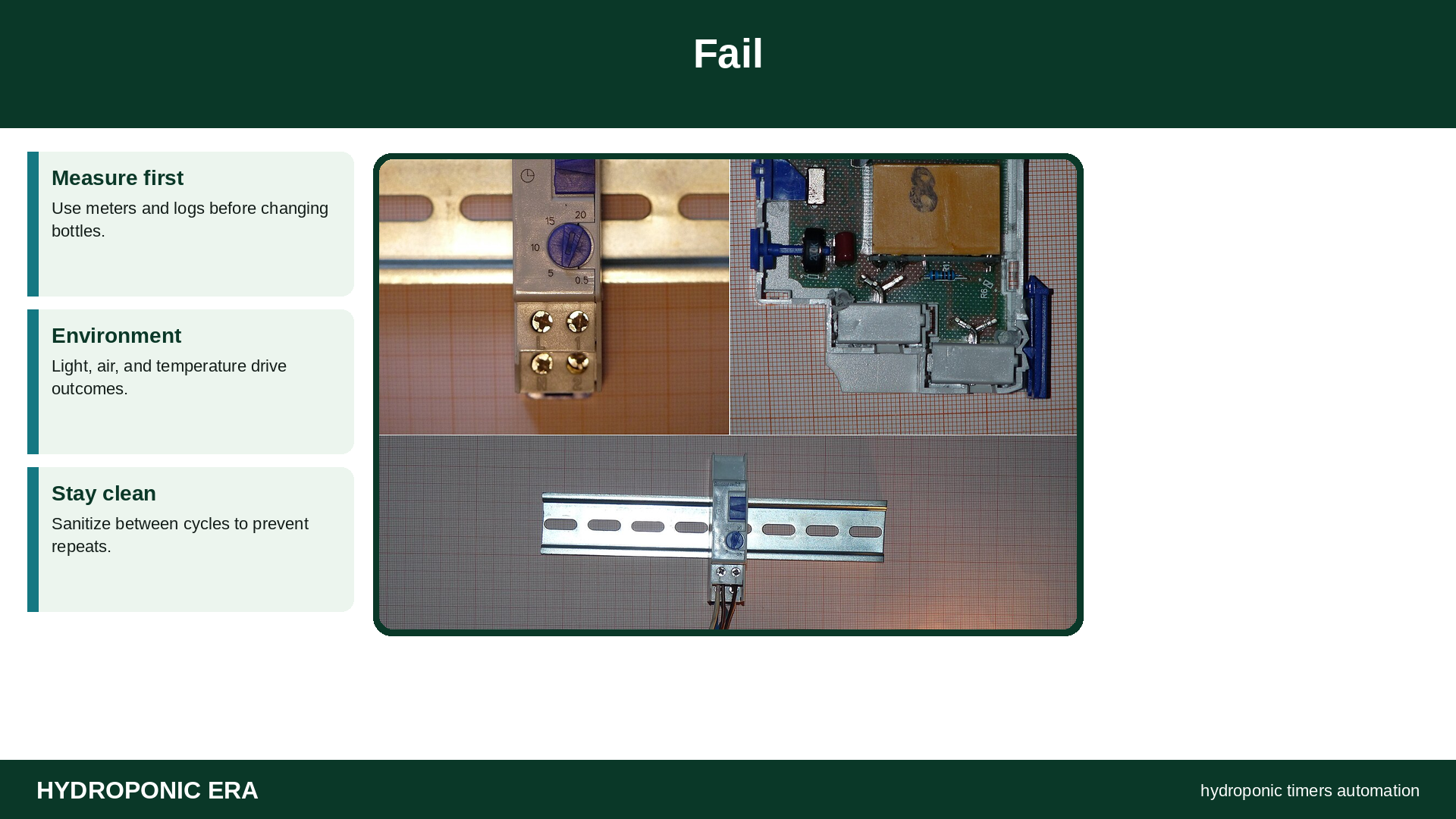
- Overflow path to a safe tub/drain
- Marked max fill line or float valve
- Spare pump for continuous systems
- Water leak alarm near fittings
- Honest outage plan (not fantasy uptime)
Common Mistakes
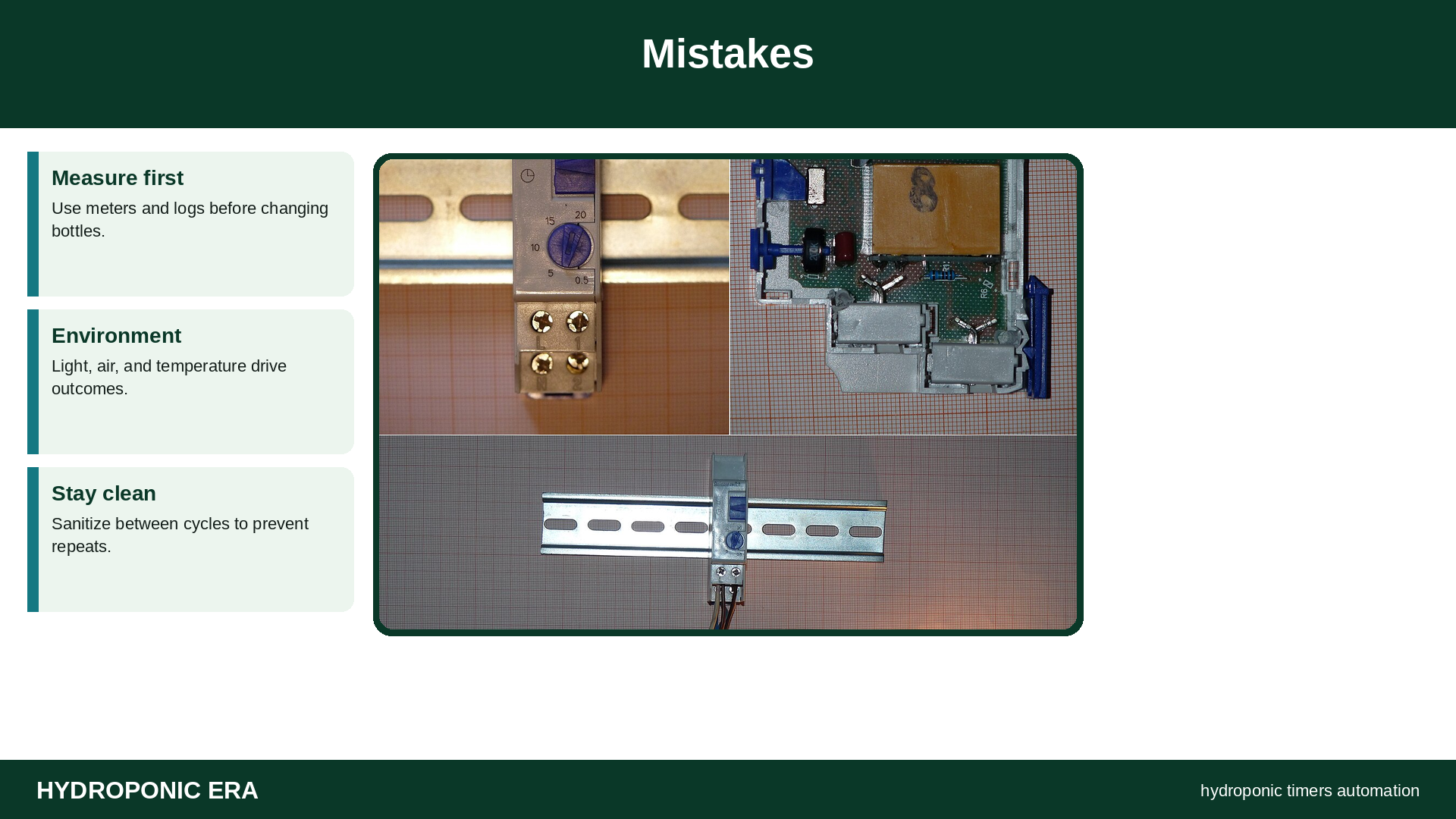
- Timer-off NFT dry-outs
- Smart gadgets before learning irrigation feel
- Unlabeled cords
- Photoperiod drift
- Automating pH before calibrating meters
- Ignoring leaks
What to Check Weekly
- Timer accuracy after power blips
- Pump priming and strainer
- Light schedule vs stretch
- Leak alarms and fittings
- Whether schedules still match plant size
DLI Connection
Daily Light Integral depends on intensity and hours. Virginia Tech’s DLI guide shows why photoperiod is not arbitrary. A timer that silently shortens lights cuts DLI even if midday PPFD looks fine. Log schedules as carefully as nutrient EC.
Final Checklist
- Lights timed
- Pump mode matches system
- GFCI + cord safety
- Leak fail-safes
- Water-only test done
- Written schedule
Outage and Clock-Drift Planning
After power blips, confirm digital timers did not reset to an all-day on or all-day off state. A weekly “timer audit” takes one minute and saves crops. For continuous NFT, prioritize pump power reliability over fancy light animations.
If you use smart plugs, document the SSID/device names and keep a manual timer backup. Automation that only you understand becomes a liability when you travel.
Coordinate irrigation pulses with lights for drip systems—plants often drink more during the photoperiod—but avoid soaking foliage at night in mildew-prone rooms.
Building a Simple Control Panel Mindset
Group cords by function: lights, always-on air, timed irrigation, fans. Label both ends. Photograph the setup for your future self. When something fails at 11 p.m., labels beat memory.
For drip systems, write the pulse schedule on the reservoir: e.g., three pulses during lights-on, none at night (example framework—tune to media). Reassess after plants double in size; seedlings and mature vines do not drink alike.
Avoid stacking multiple smart apps that can fight each other (one turns a pump on while another turns it off). Prefer one source of truth for schedules.
If you travel, give a trusted person a one-page “break glass” sheet: where the shutoff is, how to water manually, and what “normal” looks like. Automation without a human backup is fragile.
Finally, treat automation as a consistency tool, not a substitute for walking the crop. Eyes still catch leaks, pests, and pale new leaves before sensors do.
Photoperiod Examples as Frameworks
Many leafy indoor grows use roughly mid-teens hours of light, adjusted to hit a target DLI with measured PPFD. Fruiting crops may use different schedules. These are frameworks—measure PPFD, compute DLI with Virginia Tech’s method, then set the timer. Do not copy hours blindly from a forum without intensity context.
When changing photoperiod, change it once and observe stretch and leaf thickness for a week before another tweak.
Irrigation Pulse Tuning Method
Start conservative. After a pulse, check media moisture at root depth 15–30 minutes later. If bone dry, lengthen or add a pulse. If soggy hours later, shorten. Record the final schedule. Re-tune when seasons change or plants canopy over. Automation without feedback becomes overwatering on a timer.
Keep a manual watering can available for emergencies when timers fail.
Safety and Water Separation
Mount outlets above splash risk. Use drip loops. Prefer GFCI. Keep timers in a dry box if the room mists. A flooded smart plug is both a crop and electrical failure. Design dryness into the control area from day one.
Review cords whenever you move reservoirs—vibration walks plugs out of sockets quietly.
Why Consistency Beats Complexity
A reliable $15 timer that always runs the correct photoperiod outperforms an unused smart dashboard. Master lights and irrigation timing before dosing automation. Consistency is the product; gadgets are optional tools.
Manual Overrides Always
Every automated system needs a one-step manual override: unplug the pump, flip a labeled switch, or run a known-good timer profile. Teach household members the override. When traveling, leave written instructions. Automation without an off switch is a liability.
Review schedules after heat waves or cold snaps—plant water use changes with climate even indoors.
FAQs
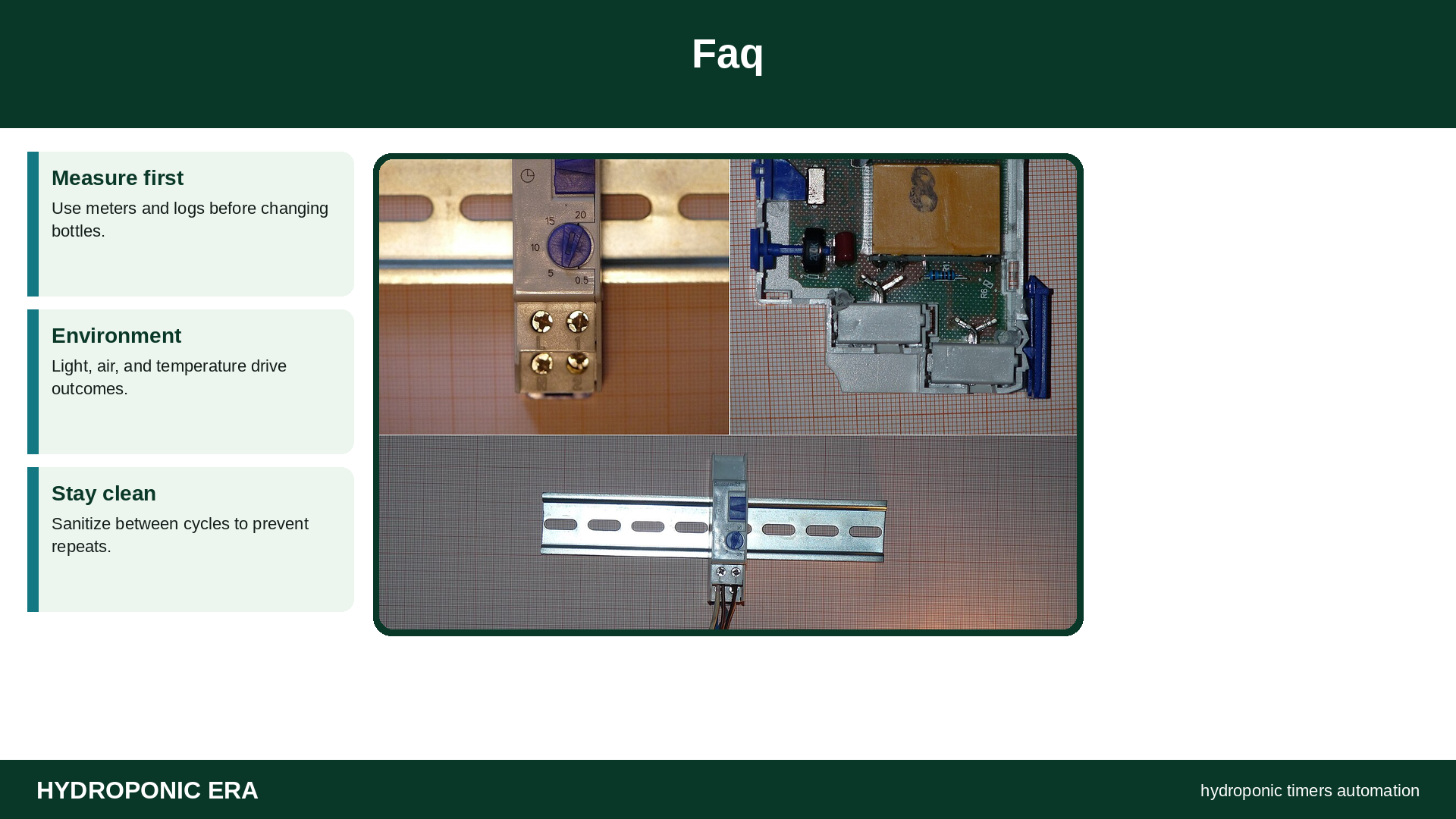
Should NFT pumps be on timers?
Many designs run continuously. Intermittent NFT needs a design that keeps roots wet plus a backup plan.
How long should drip pulses run?
Long enough to wet the root zone without constant flooding. Tune to media and climate.
Are smart plugs safe near reservoirs?
Keep electronics dry, elevated, and on GFCI.
When to automate pH?
After you can manage manually and understand your water’s alkalinity behavior.
Do I need a full controller?
Not for most homes. Reliable timers + meters + habits beat unused dashboards.
Sources
- Virginia Cooperative Extension — SPES-720 DLI
- Oklahoma State University Extension — Hydroponics
- University of Florida IFAS — HS1279
- Penn State Extension — Hydroponic nutrition principles
- University of Florida IFAS — HS184
5 thoughts on “Hydroponic Timers and Automation Basics for Beginners”