
Quick Answer
A soft vs hard water ops decision tree helps home hydro growers choose between untreated hard water, RO/remineralized water, and avoiding sodium-softened water—based on tests (GH/KH, EC, sodium risk), crop sensitivity, and maintenance willingness. Water guides explain pieces; this page sequences the decisions.
Unite hard water/RO, GH/KH tests, sodium buildup, and RO sizing.
Key takeaways for soft vs hard water ops decision tree
- Soft vs hard water ops decision tree starts with a test—not a forum anecdote.
- Hard water: alkalinity can fight pH control; minerals vary by utility.
- Ion-exchange softeners add sodium—often poor for recirculating hydro.
- RO strips ions—plan fertilizer remineralization and wastewater.
- Penn State / OSU irrigation water interpretation sheets support reading reports.
- Original tree: test → softener? → RO? → monitor Na/EC drift.
- Soft vs hard water ops decision tree fails when softener salt is ignored.
- Re-test after seasonal utility changes.
Related HydroponicEra guides
Why a Tree Beats One Tip
A soft vs hard water ops decision tree acknowledges that “just use RO” or “tap is fine” are incomplete. Penn State water-quality toolkit and irrigation test interpretation pages, plus OSU irrigation water reports, teach growers to read hardness, alkalinity, and salts. HydroponicEra already covers hard water, GH/KH, sodium, and RO gear—this article orders the ops choices.
Decision Tree Table
| If you see… | Then… | Read next |
|---|---|---|
| Softener in line (salt-based) | Bypass for hydro; do not feed Na-softened water | sodium |
| High KH / fighting pH daily | Consider RO or acid strategy with skill | GH/KH, pH |
| High EC blank water | RO or different source | hard/RO, RO |
| Chlorine/chloramine noted | Treat appropriately | chlorine |
| Stable tests + healthy crops | Keep logging; do not “fix” vanity | logs |
Step-by-Step Ops Path
- Get a utility report and/or test GH, KH, EC of source water.
- Confirm whether a salt softener feeds the grow room—bypass if yes.
- Interpret hardness/alkalinity with GH/KH and hard water guides.
- If RO is chosen, size for duty cycle and plan remineralization (RO sizing).
- Mix nutrients into the chosen base water; measure final EC/pH.
- Watch recirculating Na/EC drift over weeks ({a(‘sodium’,’sodium’)}).
- Re-test seasonally—utilities change sources.
- Do not stack softener myths with random additives.
- Keep a jug of known-good water for emergencies.
- Document the path on the reservoir lid.
Variables
| Variable | Ops impact | Link |
|---|---|---|
| Alkalinity (KH) | pH buffer strength | pH, fix pH |
| Sodium | Plant stress / EC noise | sodium |
| Crop class | Sensitivity differs | lettuce, tomato |
Mistakes
- Running hydro on softener loop because “it’s soft”
- Buying RO then skipping calcium/magnesium planning
- Never measuring blank water EC
- Blaming nutrients for utility swings
Troubleshooting
| Symptom | Water angle | Action |
|---|---|---|
| pH rebound daily | High alkalinity | Tree → KH path |
| EC climbs with poor growth | Na / salts | sodium, flush |
| RO water plants limp | Missing minerals | Remineralize via feed |
Comparison: Source Strategies
| Source | Pros | Cons |
|---|---|---|
| Untreated hard tap | Simple | KH/EC management |
| RO + feed | Control | Wastewater, filters, cost |
| Salt-softened | — | Usually avoid for hydro |
Closing: follow the soft vs hard water ops decision tree, then live in the linked deep guides.
What to Check Before You Change Water Strategy
- Softener bypassed?
- GH/KH/EC tested?
- RO plan includes remineralization?
- Seasonal retest scheduled?
- Blank water logged?
- Crop sensitivity considered?
Running the Soft vs Hard Water Ops Decision Tree Each Season
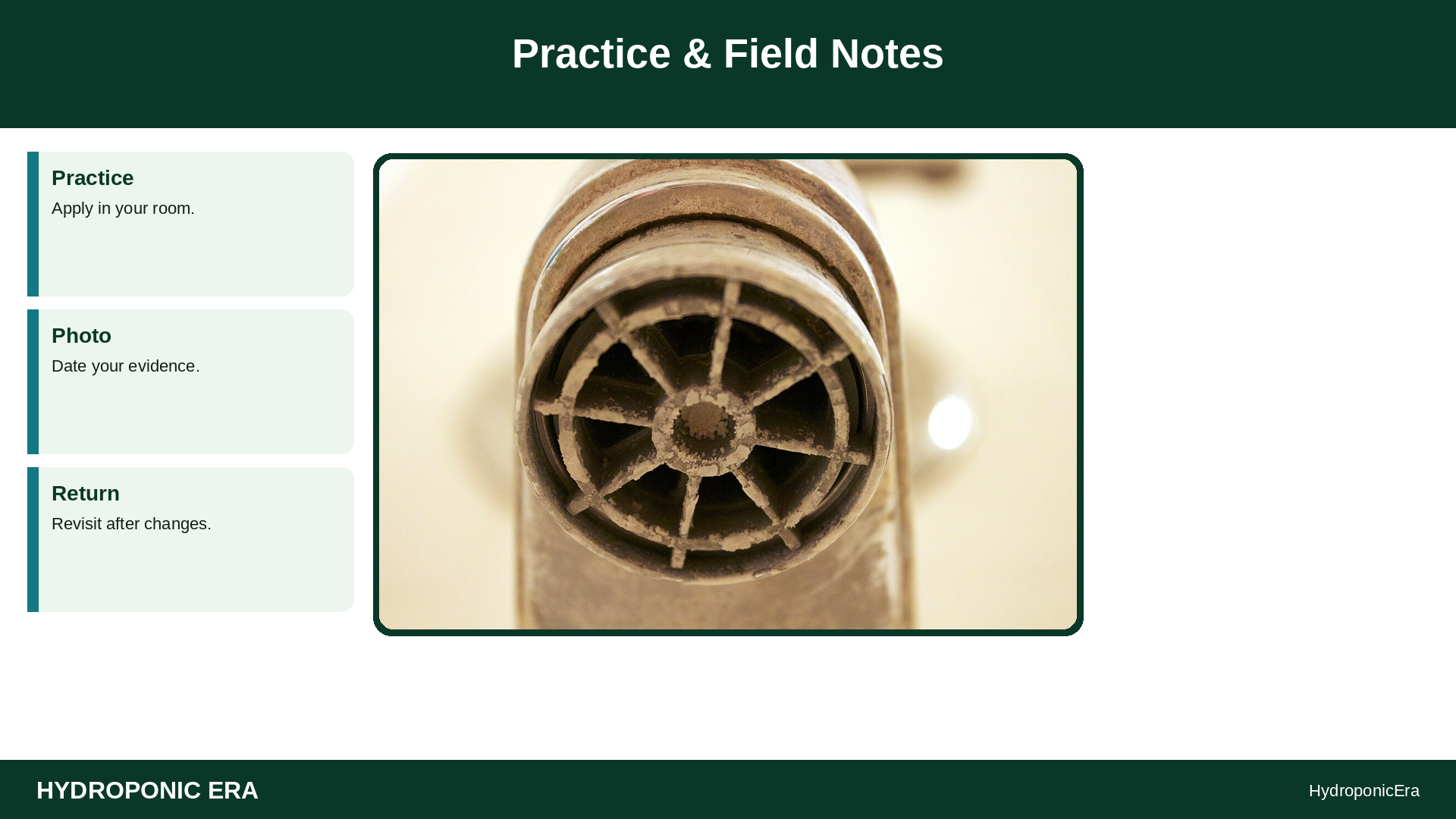
Reprint the tree on the utility closet door. A soft vs hard water ops decision tree only helps if softener bypass status is known at a glance (sodium, hard/RO).
Seasonal retest: GH/KH/EC of blank water (GH/KH). Soft vs hard water ops decision tree outcomes change when utilities switch sources. Log blank EC beside nutrient EC (logs).
Original tree stamp: date tested | softener bypassed y/n | RO in use y/n | remineralization note | next test date. If RO, confirm filter changes (RO).
Practice: measure pH fight days per week; if daily battles persist, revisit alkalinity path (pH, fix pH). Cluster: chlorine, EC, mixing.
Soft vs hard water ops decision tree discipline prevents buying gadgets before reading a report.
FAQs
Is soft water always bad?
Salt-softened yes for many hydro loops; naturally soft water is a different case—test.
Must everyone RO?
No—only when tests and ops pain justify it.
Rainwater?
Test and treat risks; not automatically perfect.
Where Na detail?
Sodium buildup article.
Meters needed?
Yes—decision trees without numbers are opinions.
Chlorine step?
Separate disinfectant guide.
Put a red tag on softener bypass valves: “HYDRO BYPASS—DO NOT ENGAGE SALT LOOP.” Soft vs hard water ops decision tree failures are often someone “fixing” laundry water paths (sodium).
When traveling, brief sitters: soft vs hard water ops decision tree says top off with the labeled source only (water changes, top-off). Re-verify after plumbing work in the building.
Measurement Habits That Keep Advice Honest
HydroponicEra favors meters and notes over slogans. Calibrate pH and EC instruments on a schedule you can keep (meters, pH, EC). Write the calibration date on painter’s tape stuck to the meter case. When numbers disagree with plant looks, trust a re-calibration before a random bottle dump.
Change one major variable at a time for a week: light, recipe strength, or water source—not all three. That discipline is how home growers build first-hand process knowledge without inventing farm credentials. Photograph the canopy at the start and end of each single-variable week (logs).
Keep a short “stop doing” list on the reservoir: no unmeasured add-ups, no mixing concentrates together, no ignoring smells. Link out to the matching troubleshooting guide when a symptom repeats (deficiency chart, yellow leaves, wilting). Useful content is a loop: observe → measure → act small → re-observe.
Sanitation and electrical safety sit beside nutrition. Wet hands and open outlets do not mix (electrical safety). Dirty tools move pathogens faster than most nutrient mistakes (cleaning). If you sell or share food, revisit food-safe harvest handling even for tiny gifts to neighbors (food safety).
Sources
- Penn State Extension — A Water Quality Toolkit for Greenhouse and Nursery Production
- Penn State Extension — Interpreting Irrigation Water Tests
- Oklahoma State University Extension — Understanding Your Irrigation Water Test Report
- Oklahoma State University Extension — Electrical Conductivity and pH Guide for Hydroponics
- Michigan State University Extension — Water quality considerations for greenhouse and nursery crops
- University of Florida IFAS — AE094: Water Quality for Crop Production Systems
- Oklahoma State University Extension — Hydroponics
- Michigan State University Extension — Hydroponics as an agricultural production system