
A hydroponic water level indicator shows how much nutrient solution is left in your reservoir without lifting the lid. The common types are a float gauge (a stick on a float that rises and falls), a clear sight tube on the side of the tank, electronic float switches or sensors that trigger alarms, and smart sensors that send alerts to your phone. A cheap DIY water level indicator can be built from a fishing bobber, a wooden dowel, and a straw, or from clear vinyl tubing on a bulkhead fitting.
Key takeaway: A visual gauge saves time; an alarm saves crops. For pumps, NFT, and aeroponics, pair a water level indicator with a low-level alert.
| Type | Cost | Power | Best for |
|---|---|---|---|
| Float gauge | Very low | None | Kratky, DWC, small tubs |
| Sight tube | Low | None | Larger reservoirs with a bulkhead |
| Float switch + alarm | Low to moderate | Battery or mains | Pump-driven systems |
| Ultrasonic / smart sensor | Moderate | Mains or USB | Remote monitoring, automation |
Why Water Level Monitoring Matters
Plants can drink a surprising amount, especially fruiting crops under strong lights in warm rooms. As the reservoir drops, EC rises, pumps can run dry, and roots in NFT or aeroponic systems can dry out quickly. Opening the lid to check also lets light in and disturbs roots in DWC. A water level indicator lets you check at a glance and plan top-offs. Our guide to daily water use by plant count helps you estimate how quickly levels fall.
Float Gauge (DIY)
This is the simplest water level indicator and the one many commercial DWC buckets use.
- Drill a small hole in the reservoir lid.
- Glue a fishing bobber or a small piece of closed-cell foam to the end of a thin wooden or plastic rod.
- Slide the rod through a short section of drinking straw or tubing glued into the lid hole as a guide.
- Mark the rod at “full,” “half,” and “refill” levels while you fill the tank with measured gallons.
Use a plastic rod if possible; wood can absorb water and grow mold. Keep the hole small to avoid light leaks. See our tips on light-proofing reservoir lids.
Sight Tube
A sight tube is a clear vertical tube connected near the bottom of the reservoir. Water in the tube matches the level in the tank. Install a small bulkhead fitting or uniseal near the base, attach clear vinyl tubing, and fix it upright to the tank wall. Our guide to bulkheads and uniseals covers installation.
Clear tubing grows algae if exposed to light, so wrap it with a removable sleeve or flip a cover over it, and clean it between crops. Add a valve at the bottom if you want to use it as a drain too.
Electronic Float Switches and Alarms
A float switch closes or opens a circuit when the water reaches a set height. You can wire it to a battery buzzer, a plug-in alarm, or a controller. A low-level switch can also shut off the pump to prevent it running dry. Commercial water leak alarms with a probe can be repurposed by placing the probe at the “too low” height in reverse logic, depending on the device. See our guide to water leak alarms.
Use low-voltage parts near water, mount them securely so the float moves freely, and test the alarm regularly.
Smart and Ultrasonic Sensors
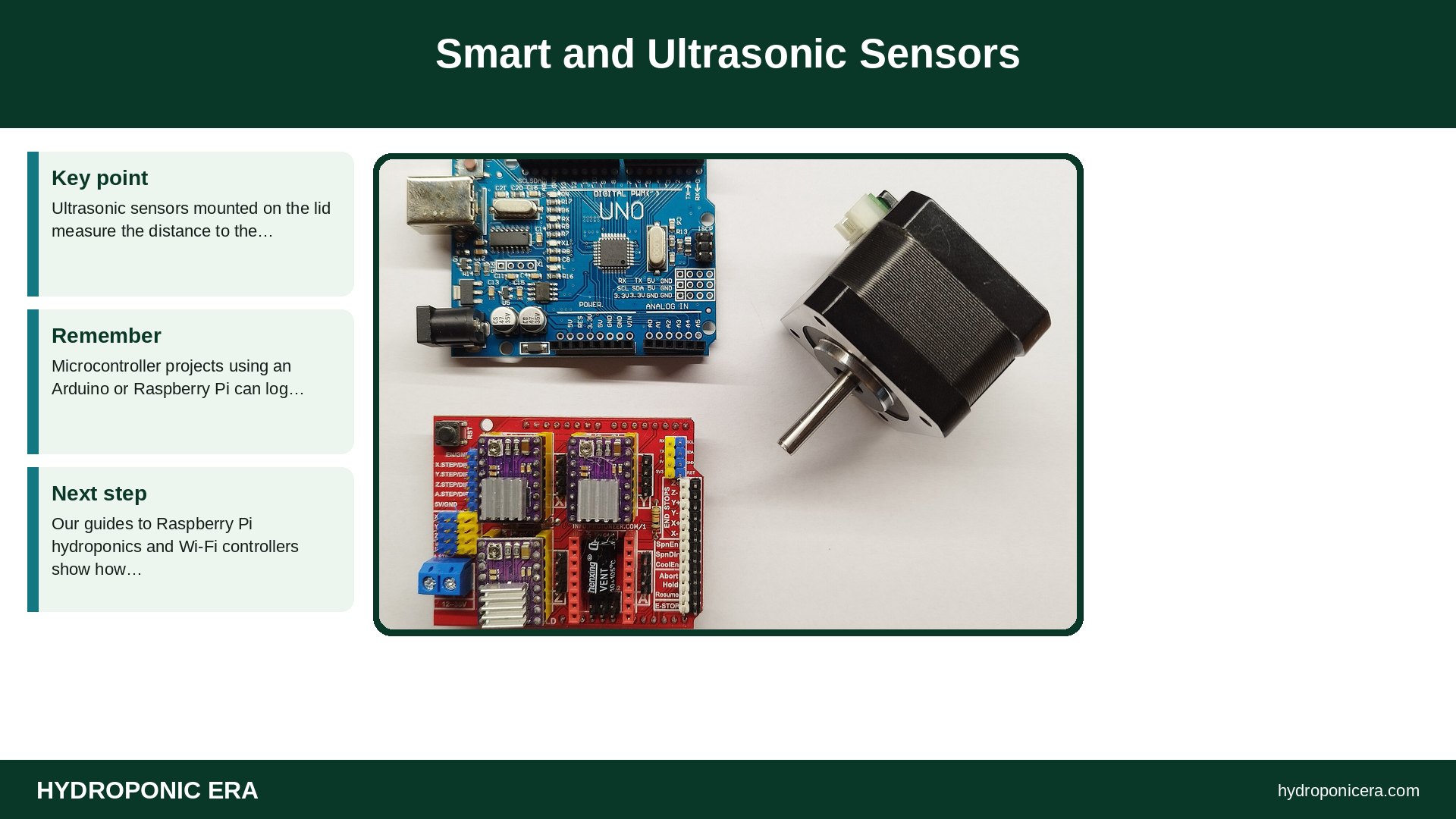
Ultrasonic sensors mounted on the lid measure the distance to the water surface and can report levels to an app. Microcontroller projects using an Arduino or Raspberry Pi can log levels over time and send alerts. Our guides to Raspberry Pi hydroponics and Wi-Fi controllers show how others build these. Condensation on the sensor can cause false readings, so angle or shield it.
Auto Top-Off: The Next Step
Once you can measure level, you can automate refilling. A float valve connected to a separate tank of plain water or weak solution keeps the reservoir at a set height. This holds EC more stable and helps during trips. See auto top-off float valves and our vacation checklist.
Calibrating in Gallons

A level indicator becomes much more useful when it shows gallons. Fill the empty reservoir one gallon at a time using a measured jug and mark each gallon on the float rod or sight tube. Now you can calculate exactly how much nutrient to add when topping off. Pair this with a simple log; our guide to record keeping shows how tracking water use reveals problems early.
Which Water Level Indicator Fits Which System?
- Kratky: a float gauge or simply a mark on an opaque tub with a removable peek window.
- DWC: float gauge in the lid; add a low-level alarm in hot weather.
- NFT and drip: sight tube plus low-level pump shutoff.
- Aeroponics: electronic alarm is strongly recommended because roots dry fast.
- Multi-reservoir setups: smart sensors with logging.
Maintenance Tips
Clean floats and tubes during reservoir changes, since biofilm can stick floats in place. Check that water level marks remain accurate if you change the lid or reservoir. Replace batteries in alarms on a schedule. A stuck indicator is worse than none because it gives false confidence.
Using Level Data to Spot Problems
A level indicator does more than tell you when to refill. Sudden changes in water level or water use point to problems worth checking. A jump in daily use may mean a leak, a heat wave, or plants entering a fast growth phase. A sharp drop in use can signal root problems, because sick roots drink less. Writing down the level each day for a couple of weeks gives you a baseline to compare against. Pair this with EC readings: if level falls and EC climbs, plants are drinking more water than nutrients. See EC climbing too fast.
FAQs: Hydroponic Water Level Indicators
How do I make a water level indicator for a DWC bucket?
Attach a fishing bobber to a thin plastic rod and slide it through a straw guide in the lid. Mark full and refill levels.
Do I need an electronic alarm?
For pump-based systems such as NFT and aeroponics, an alarm is a smart investment. For Kratky, a visual check is usually enough.
Why is my sight tube green?
Algae grows when light reaches the clear tube. Cover it and clean it between crops.
Can a float switch turn off my pump?
Yes. A low-level switch wired to the pump circuit, or through a controller, can stop the pump before it runs dry.
How often should I check the water level?
Daily for small or busy systems. Larger reservoirs with slow use can be checked every few days.
Sources
- University of Florida IFAS Extension — Leafy Greens in Hydroponics and Protected Culture for Florida
- Penn State Extension — Hydroponics Systems: Nutrient Solution Programs and Recipes
- USDA National Agricultural Library — Hydroponics resources
- Photo credits (Wikimedia Commons, edited with titles): White plastic bucket by Santeri Viinamäki (CC BY-SA 4.0); Spathiphyllum wallisii hydroponically grown by Kephalian (CC BY-SA 4.0); Raspberry Pi 4 Model B – Side by Laserlicht (CC BY-SA 4.0); Arduino UNO compatible board, CNC shield stepper motor controller, and a NEMA 17 stepper motor by DotEagle (CC BY-SA 4.0); 2009-03-30 Lettuce roots by Ildar Sagdejev (Specious) (CC BY-SA 4.0)