
If you are new to soilless growing, hydroponic nutrients can feel more complicated than they are. In soil, microbes and organic matter release food slowly. In a reservoir, the solution you mix is the entire diet.
This guide shows how to use hydroponic nutrients for beginners: what is in the bottle, how to mix A and B without making sludge, which EC and PPM ranges to start with, and why pH decides whether plants can actually use the feed.
You do not need a custom salt recipe. You need complete hydroponic nutrients, clean water, a meter, and a repeatable order of operations.
Table of contents
- What Are Hydroponic Nutrients?
- NPK and Micronutrients Plants Need
- How to Mix Hydroponic Nutrients
- Beginner EC and PPM Ranges
- How Often to Refresh Nutrient Solution
- How pH Affects Nutrient Uptake
- Common Mistakes and Yellow Leaves
- Frequently Asked Questions
- Final Thoughts
What Are Hydroponic Nutrients?
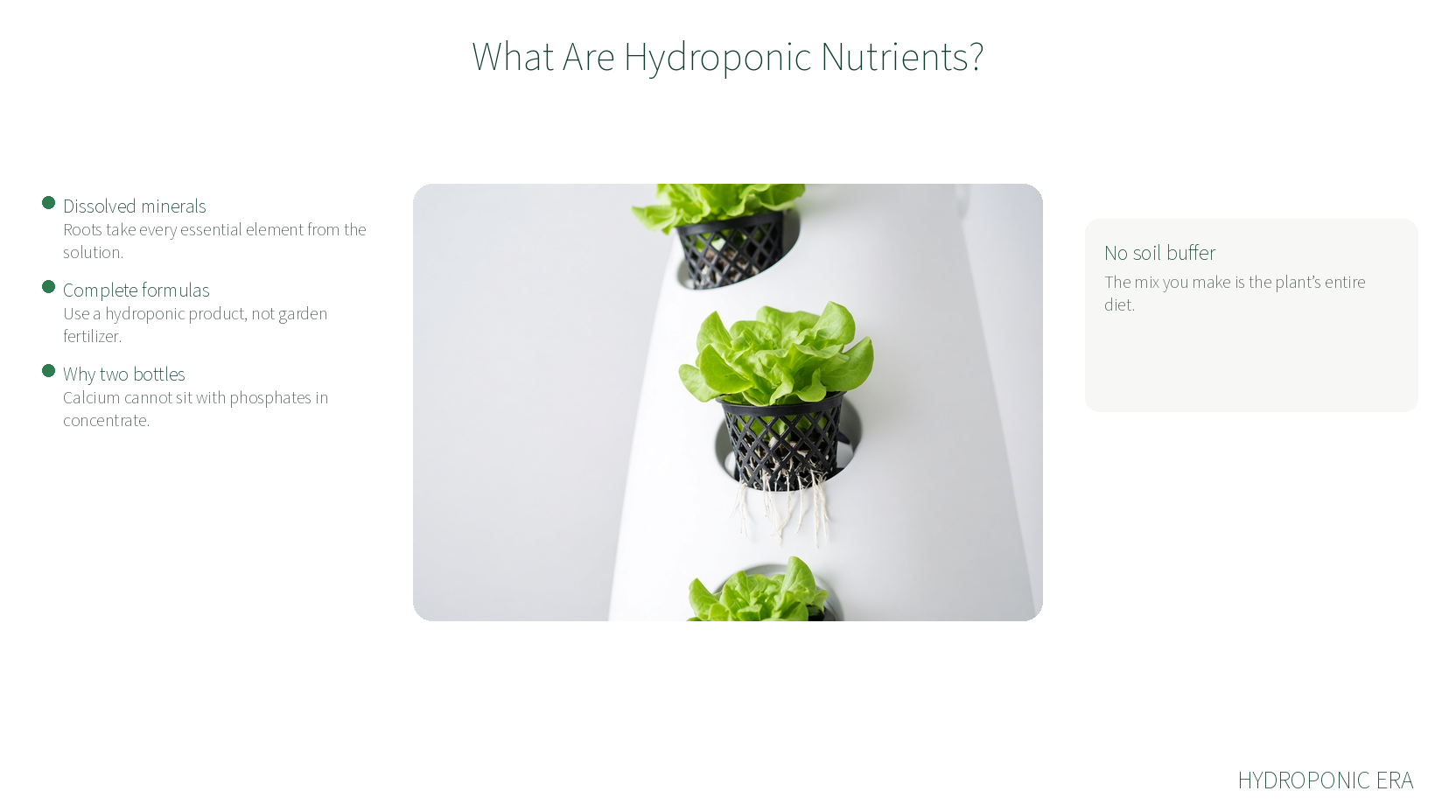
Hydroponic nutrients are water-soluble fertilizers mixed so every essential mineral is already dissolved for the roots. There is no soil to hold or slowly release those minerals. The reservoir is the growing medium and the pantry at the same time.
Penn State Extension explains that plants need 17 essential nutrients. Carbon, hydrogen, and oxygen come from air and water. The rest have to be supplied. In a hydroponic garden, that supply is the nutrient solution, not compost.
A complete product labeled as hydroponic nutrients is the right starting point. Ordinary garden fertilizer is often incomplete. It may lack micronutrients, or it may not stay fully dissolved. That is a common reason beginners see pale new leaves even though they already “fed” the tank.
Many home formulas come as two bottles, usually called A and B. That is not a marketing trick. Calcium nitrate cannot sit in a concentrate with phosphates and sulfates. University of Missouri Extension notes that calcium from one formulation will immediately react with phosphorus and sulfate from the other if you mix the stocks together. The result is sludge in the cup and missing calcium at the roots.
NPK and Micronutrients Plants Need
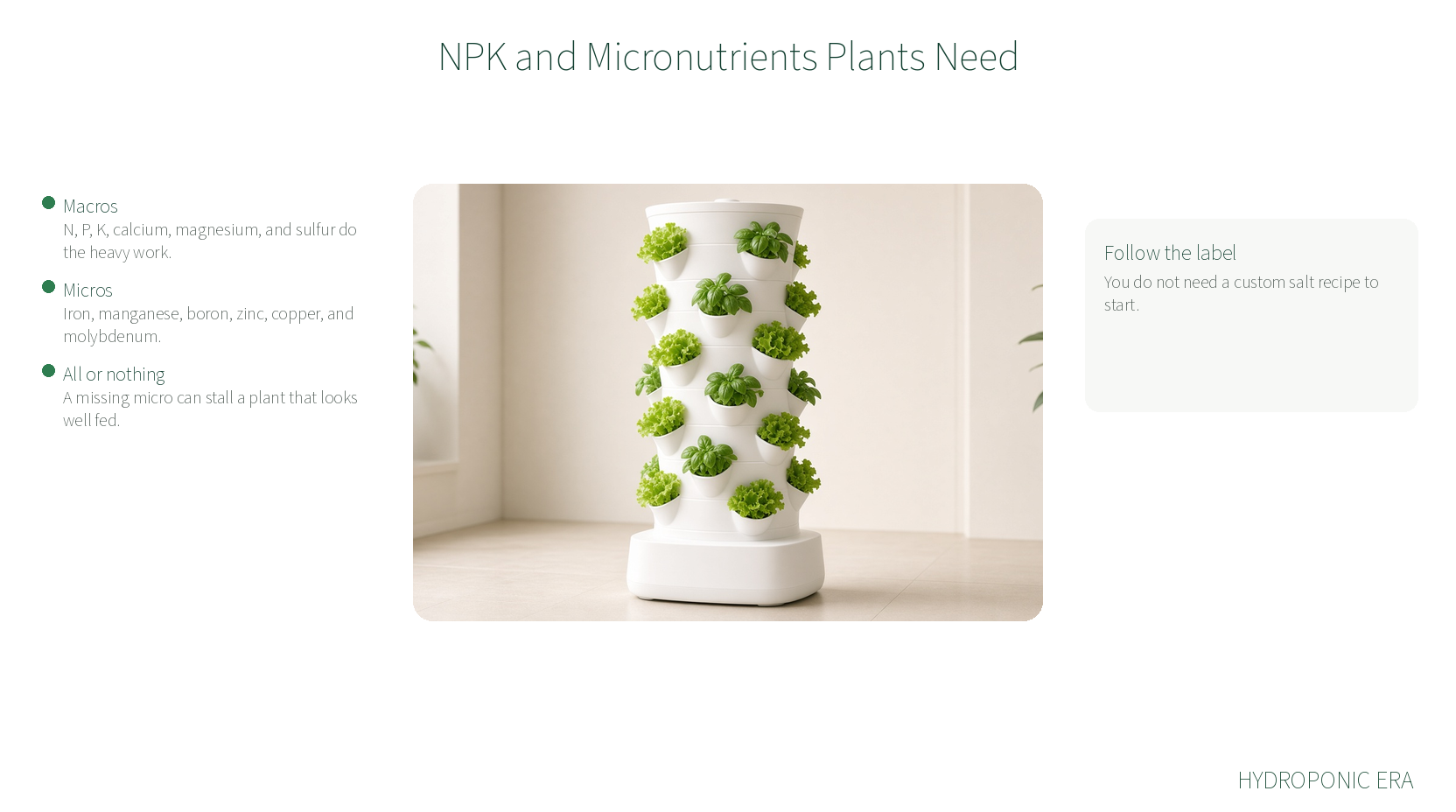
The three numbers on a fertilizer label are nitrogen (N), phosphorus (P), and potassium (K). They matter, but they are not the whole diet.
Nitrogen builds leaves and chlorophyll. Too little, and older leaves fade. Too much, and plants stay leafy and soft.
Phosphorus supports energy transfer, roots, and flowers.
Potassium helps water movement, fruit quality, and stress tolerance.
The other macros are just as important in water culture:
- Calcium builds cell walls. Deficiency shows up as tip burn or weak new growth.
- Magnesium sits at the center of the chlorophyll molecule, as Penn State notes.
- Sulfur is part of proteins and enzymes.
Micronutrients are required in much smaller amounts, but they are still essential: iron, manganese, boron, zinc, copper, molybdenum, chlorine, and nickel. Iron is the one beginners meet first. When it is missing or locked out, new leaves turn pale between the veins while older leaves still look green.
Oklahoma State University lists typical bands found in many nutrient solutions: nitrogen about 100 to 200 ppm, potassium about 100 to 200 ppm, calcium about 200 to 300 ppm, and iron about 2 to 12 ppm. You do not have to memorize those numbers on day one. You do need a complete formula that already includes them.
Fruiting crops such as tomatoes and peppers often use a slightly different N-to-K balance than lettuce. For a first system, pick one complete line of hydroponic nutrients and follow its vegetative or fruiting directions.
How to Mix Hydroponic Nutrients

The order matters more than the brand. This is the practical way to mix hydroponic nutrients in a home reservoir.
- Measure the water first. Know the true volume of the tank. Fill with water before you open any concentrate.
- Add part A. Pour it into the water and stir until it disappears. If you use a dry two-part, dissolve A in a separate jug, then add that jug to the reservoir.
- Add part B. Stir again. Give the solution a few minutes to mix.
- Never mix the concentrates together. Keep A and B in their own bottles and measuring cups. Virginia Tech’s hydroponic guides say fertilizers such as a complete 8-15-36, calcium nitrate, and magnesium sulfate should be mixed separately, then added to the reservoir.
- Set EC. Check electrical conductivity after the solution has circulated. If it is high, add water. If it is low, add a little more of both parts in the same ratio the label uses.
- Set pH last. Nutrients change pH. Adjusting before the fertilizer is mixed wastes time.
Wear gloves if you handle strong concentrates. Cover the reservoir when you are done so light does not feed algae.
One-part liquids are fine for a first Kratky jar or a small indoor hydroponic garden. The same rule still holds for hydroponic nutrients: water first, fertilizer second, measurements third.
Beginner EC and PPM Ranges
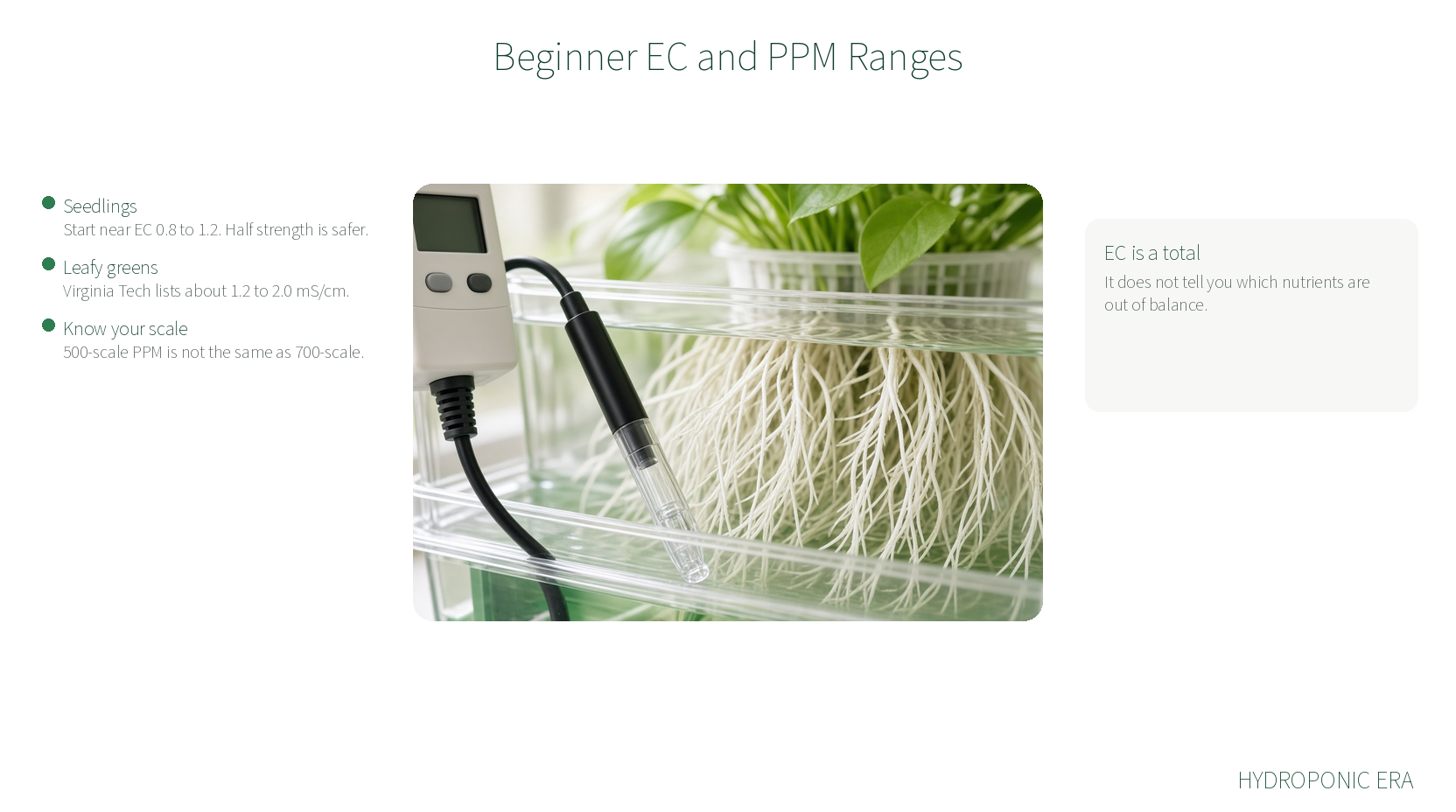
EC, or electrical conductivity, estimates how many dissolved salts are in the hydroponic nutrients solution. A higher EC means a stronger mix. It does not tell you which nutrient is high or low. Two tanks can share the same EC and still have very different recipes.
PPM, or parts per million, is another way to report the same idea. The confusion is the conversion scale. Some meters use 500 (EC 1.0 = 500 ppm). Others use 700 (EC 1.0 = 700 ppm). Always write down which scale your meter uses.
Treat these as starting bands, not laws:
| Stage or crop | EC (mS/cm) | PPM (500 scale) |
|---|---|---|
| Seedlings / half strength | 0.8–1.2 | 400–600 |
| Leafy greens and herbs | 1.2–1.8 | 600–900 |
| Many fruiting crops | 1.8–2.5 | 900–1250 |
Virginia Tech notes that many leafy greens perform well at EC 1.2 to 2.0 mS/cm. Oklahoma State’s crop table is wider for fruiting plants. Tomatoes may run higher than lettuce. If several crops share one tank, stay near the middle and watch the most sensitive plant.
Start hydroponic nutrients weaker than the label’s maximum. A new root system in a small reservoir can burn faster than a mature plant in a large one. If leaf tips scorch, lower EC with water before you add anything else.
Check EC at the same time each day in active systems. Oklahoma State recommends daily EC and pH checks.
How Often to Refresh Nutrient Solution
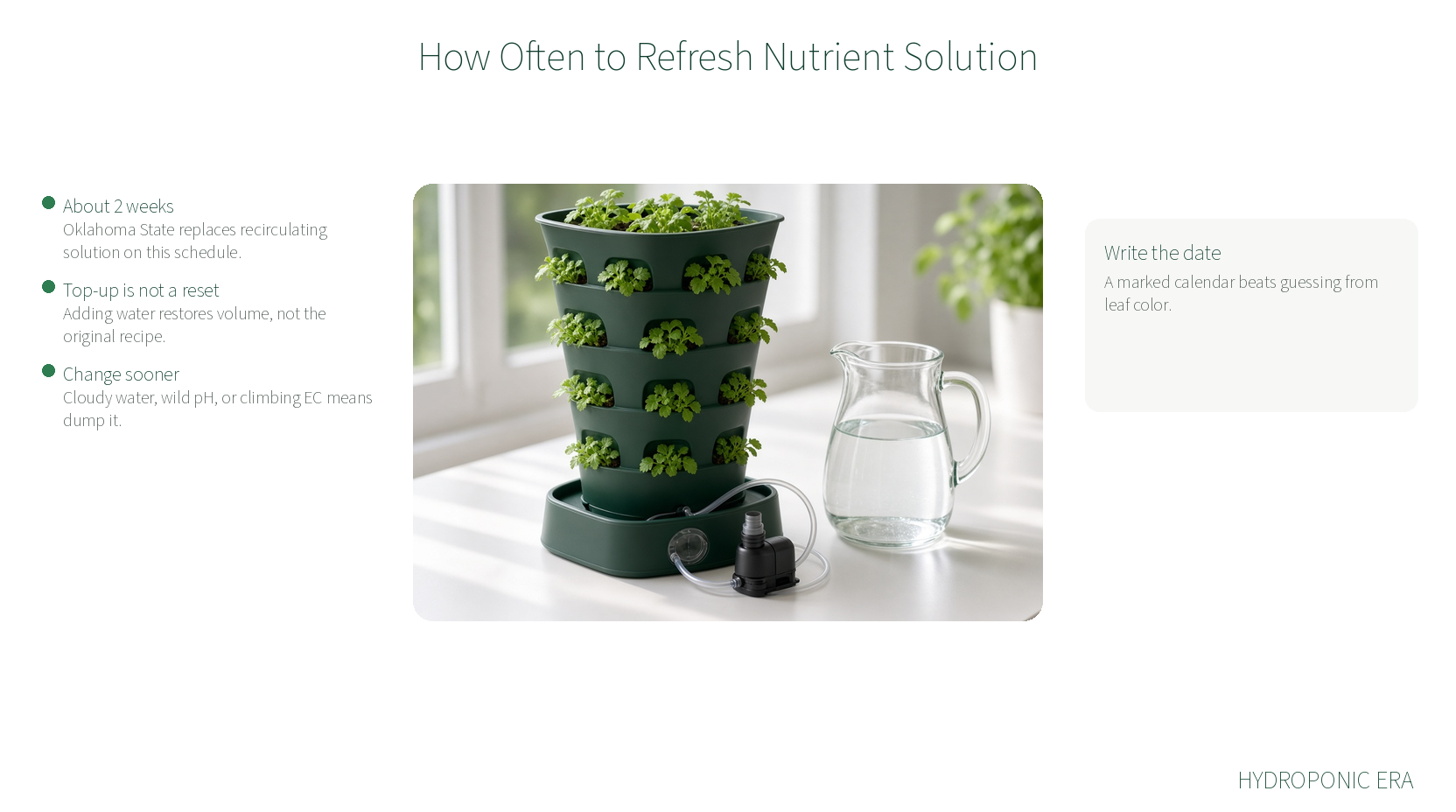
Topping up is not the same as refreshing hydroponic nutrients.
Plants drink water and minerals at different rates. Water also evaporates. After a few days the tank can look full because you added water, while the original recipe is no longer there. EC can rise if water leaves and salts stay. EC can fall if plants take minerals faster than water.
Oklahoma State University recommends completely replacing recirculating nutrient solution about every two weeks because those ratios drift over time. That is the best beginner default for DWC, NFT, drip, and tower reservoirs.
Change sooner if pH becomes hard to hold, EC stays high after a water top-up, the solution turns cloudy, or roots look slimy.
Between changes, top up with water when the level drops, then recheck EC. If EC has fallen well below your target, add a light dose of A and B. If it has risen, add water only.
A complete change is also a chance to rinse the tank and check the pump. For the full schedule by system, see how often to change hydroponic water.
How pH Affects Nutrient Uptake
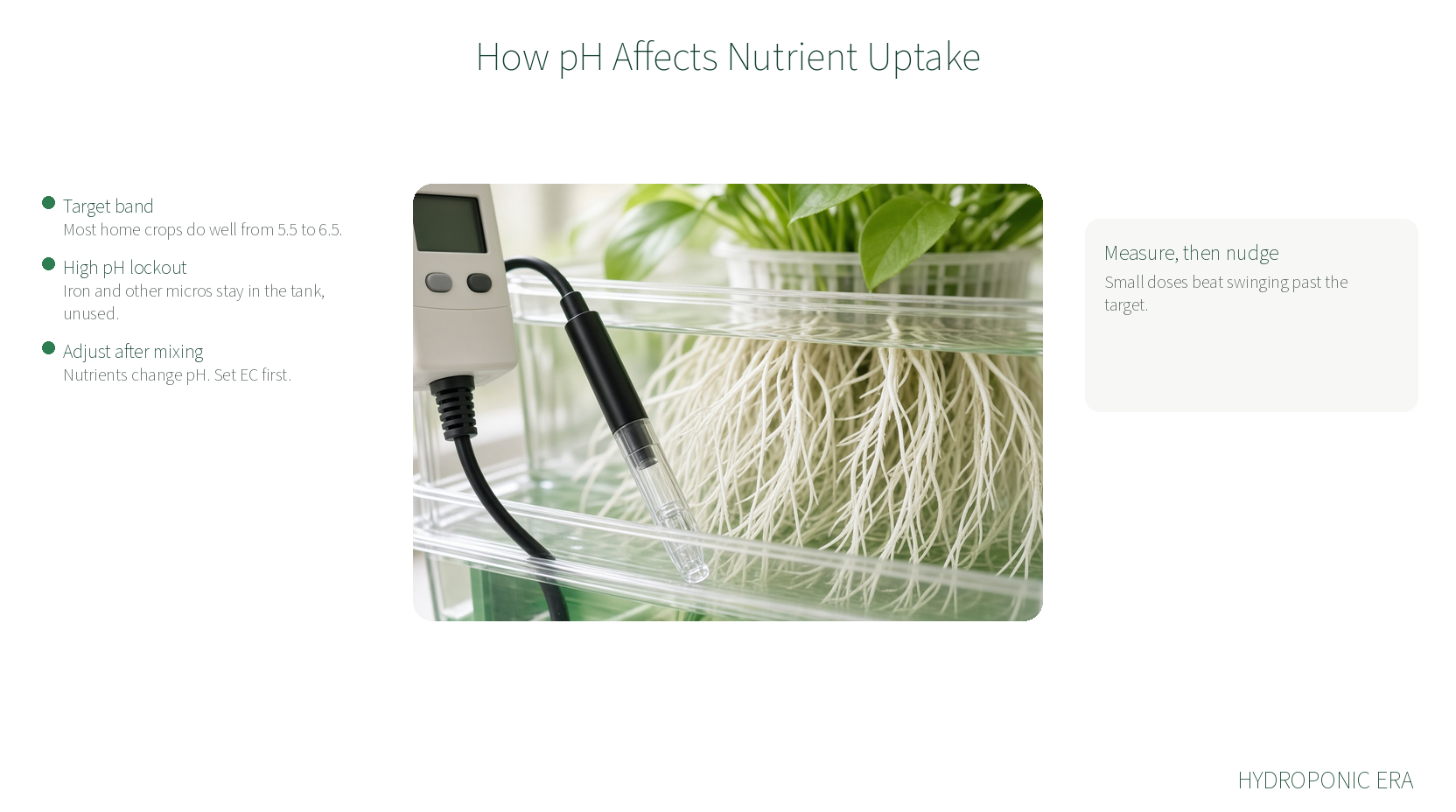
pH decides whether hydroponic nutrients stay available. The fertilizer can be in the tank and still unused if the reading is too far off. That is nutrient lockout.
For most home crops, a practical band is 5.5 to 6.5. Oklahoma State is a little tighter on the solution itself: about 5.0 to 6.0, usually around 5.5, so the root zone settles near 6.0 to 6.5. Virginia Tech’s hydroponic production guides use 5.5 to 6.2 for most plants.
High pH is the usual beginner problem. Iron, manganese, zinc, copper, and boron become harder to take up. New leaves turn pale between the veins. Adding more fertilizer does not fix it.
Low pH can make micronutrients too available and raise toxicity risk. Calcium and magnesium problems show up more often when the root zone is too acidic.
The order is the same every time you mix hydroponic nutrients: water, A and B, EC, then pH. Add pH down or pH up in small doses, wait, and measure again. Do not chase 5.80 on the nose. Stay inside the band.
For the full step-by-step, see how to control pH in hydroponics.
Common Mistakes and Yellow Leaves
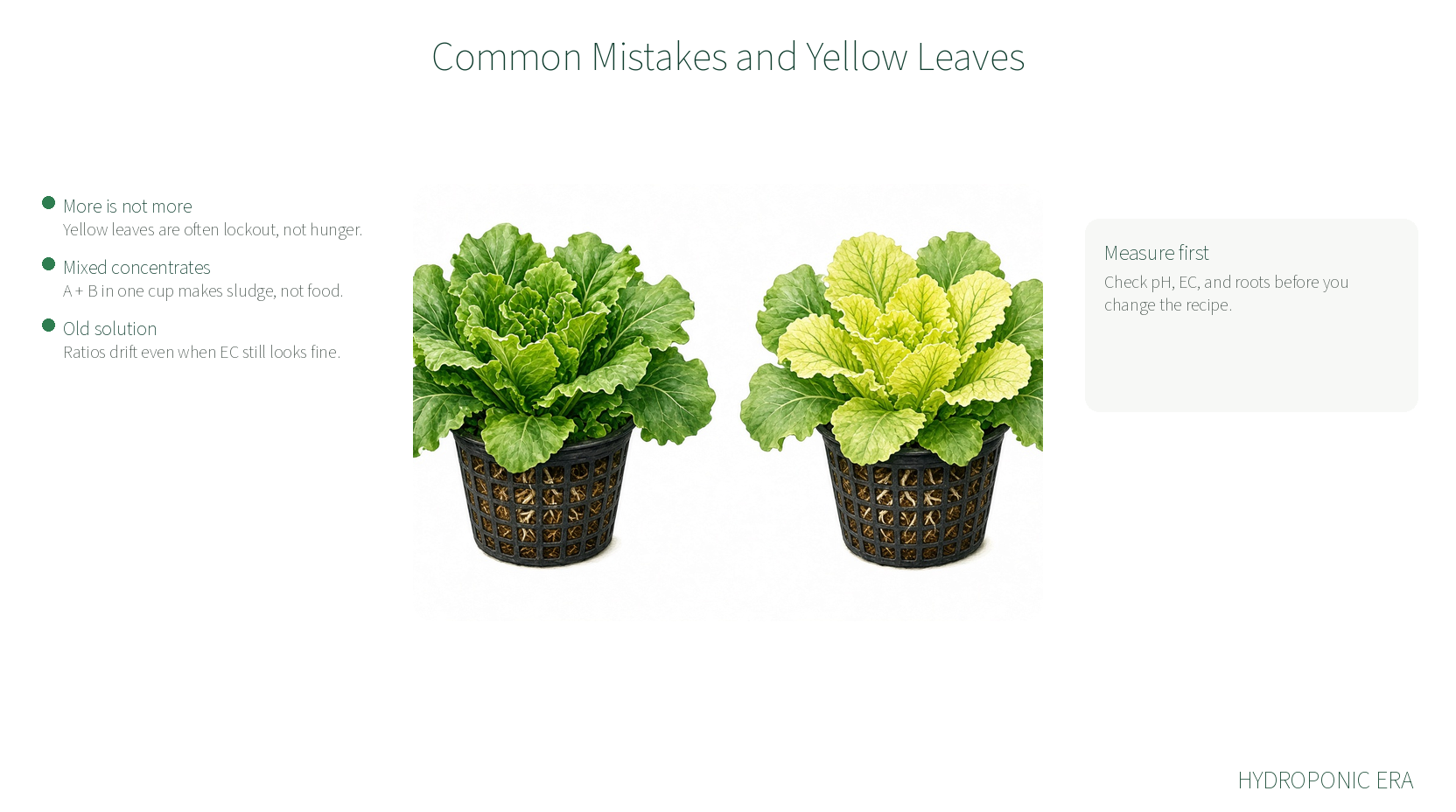
Yellow leaves are a symptom, not a diagnosis. Measure before you change the recipe.
Common mistakes with hydroponic nutrients:
- Mixing A and B concentrates in the same cup
- Adjusting pH before the fertilizer is fully mixed
- Using garden fertilizer that lacks micros
- Treating lockout with a stronger dose
- Ignoring the 500 vs 700 PPM scale
- Topping up forever and never replacing the tank
- Changing nutrients, light, and pH on the same afternoon
If new leaves are yellow between the veins, check pH first. That pattern is often iron lockout, not an empty bottle. If older leaves yellow first, nitrogen or a general dilution problem is more likely. Brown tips with a high EC suggest the mix is too strong.
Roots matter as much as the recipe. Brown, slimy roots cannot take up a perfect solution. Check aeration and cleanliness before you buy another fertilizer.
Our guide to hydroponic leaves turning yellow walks through the other usual causes, including light, so you do not keep stacking nutrients on a problem that is not hunger.
Frequently Asked Questions
Can I use regular garden fertilizer as hydroponic nutrients?
Usually no. Many garden products are not fully soluble and do not include a complete micronutrient package. Use a fertilizer made for hydroponics or soilless culture.
Should I mix part A and part B together first?
No. Add water first, then A, then B. Mixing concentrates can precipitate calcium and phosphorus. The sludge is a loss of nutrients and a clogged pump waiting to happen.
What EC should I use for lettuce?
A practical beginner band is about 1.2 to 1.8 mS/cm. Virginia Tech’s leafy-green range of 1.2 to 2.0 mS/cm is a useful ceiling. Start toward the low end in a small tank.
How often should I replace hydroponic nutrients?
For many recirculating home systems, about every two weeks. Top up with water between changes. Replace sooner if pH or EC becomes unstable.
Do I adjust pH before or after adding nutrients?
After. Nutrients change pH. Mix, set EC, circulate, then adjust pH.
Why are my leaves yellow if I already added fertilizer?
The nutrients may be present but unavailable. Check pH, EC, roots, and how old the solution is before you add more.
Related reading
- Aeroponics for Beginners
- Hydroponic Tower Garden
- Best Grow Lights for Hydroponics
- How to Grow Lettuce Hydroponically
- Why Hydroponic Roots Turn Brown
Final Thoughts
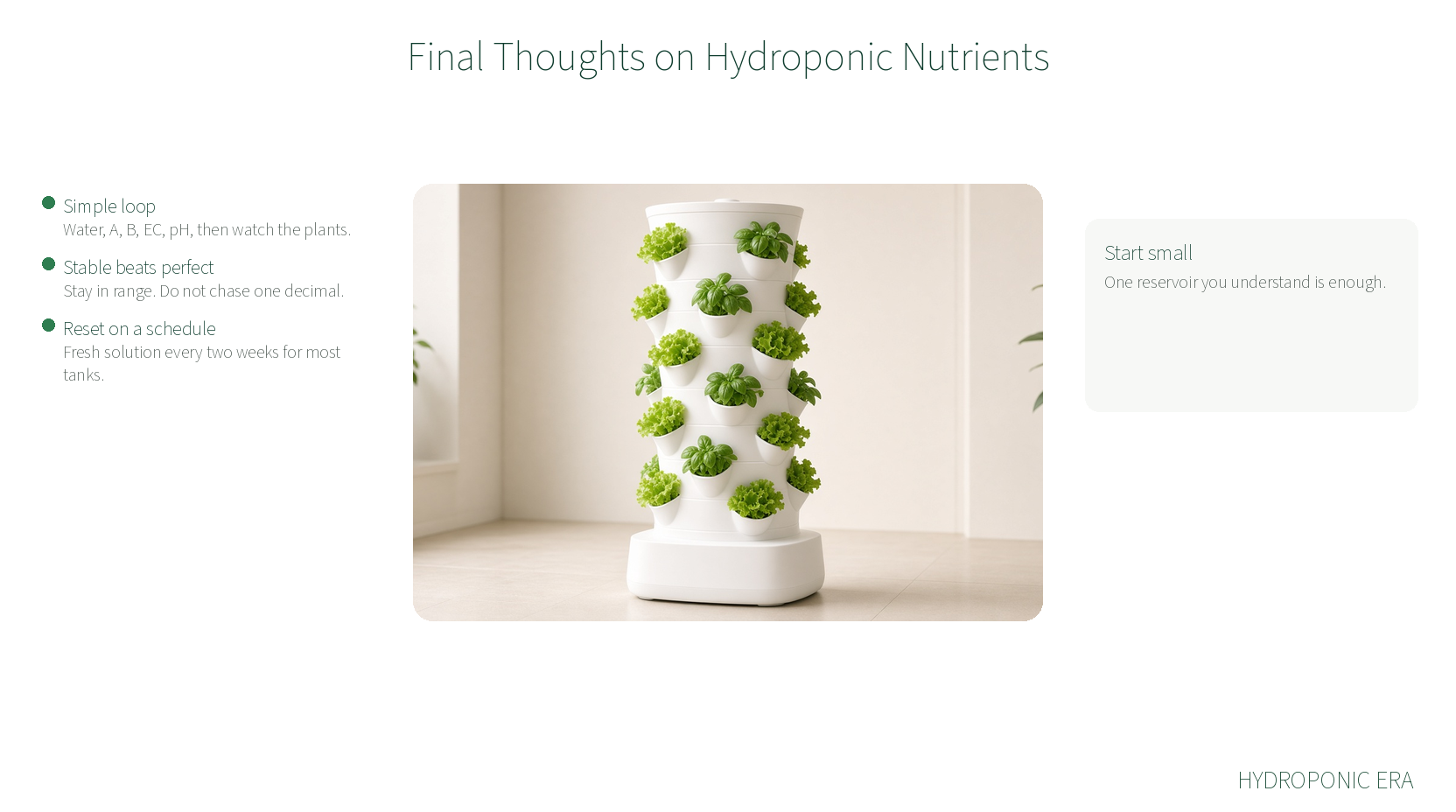
You do not need a perfect formula to use hydroponic nutrients well. You need a complete product, a clean reservoir, and a habit you can repeat.
Water first. Add A, then B. Never mix the concentrates. Set EC for the crop and the growth stage. Bring pH into a mildly acidic band. Top up as plants drink. Replace the solution about every two weeks so the recipe does not drift.
Measure first. Change one thing at a time. Watch the new leaves. That is enough to keep a first system fed without turning the reservoir into a chemistry project.
Sources and Further Reading
- Oklahoma State University — Electrical Conductivity and pH Guide for Hydroponics
- Penn State Extension — Hydroponics Systems and Principles of Plant Nutrition
- Virginia Tech Extension — Hydroponic Production of Edible Crops: Management Basics
- University of Missouri Extension — Hydroponic Nutrient Solutions
Internal Related Articles For Hydroponicera
- How to Control pH in Hydroponics for Beginners
- How Often to Change Hydroponic Water? Proven Complete Guide
- Why Are Hydroponic Leaves Turning Yellow? 7 Common Problems and Easy Solutions
- Hydroponic Garden: Complete Beginner’s Guide to Growing Plants Without Soil
- Indoor Hydroponic Garden: Complete Beginner’s Guide to Growing Plants Indoors
12 thoughts on “How to Use Hydroponic Nutrients for Beginners”