
An aquaponics ammonia spike means total ammonia nitrogen (TAN) has climbed above about 1 mg/L (ppm) and keeps rising, which can burn fish gills within hours, especially at high pH and warm temperatures. Emergency steps: stop feeding, add aeration, test pH and temperature, remove any dead fish or rotting feed, and do a 25–50% water change with dechlorinated water at the same temperature. Then find the cause, which is usually overfeeding, too many fish for the biofilter, a dead fish, low oxygen, low pH or alkalinity, or something that killed the nitrifying bacteria.
Key takeaway: Ammonia is far more toxic at high pH and temperature. A reading of 2 ppm at pH 6.8 is serious; the same reading at pH 8 can be deadly.
| Total ammonia (TAN, mg/L) | Status | Action |
|---|---|---|
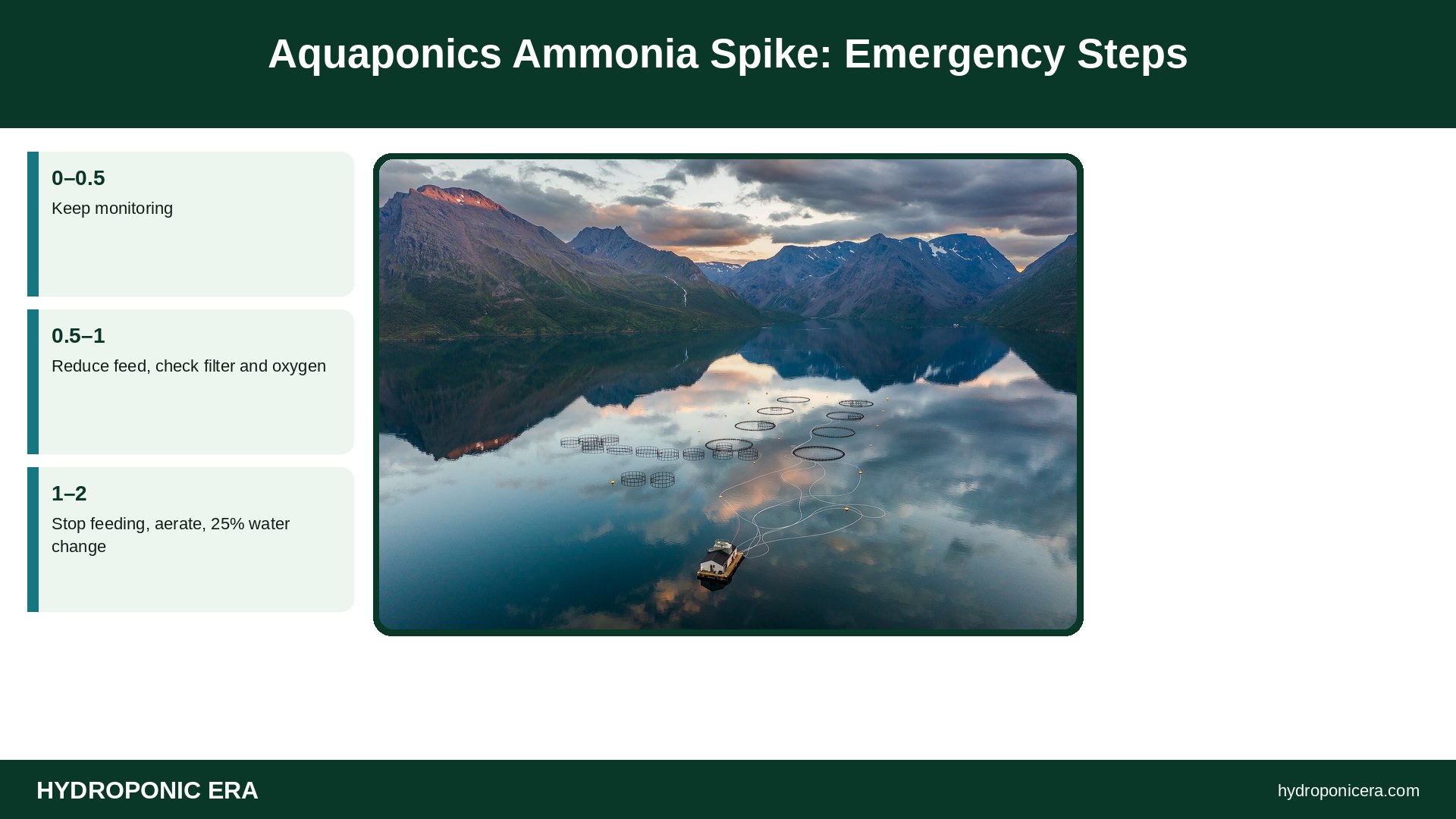
| 0–0.5 | Normal in a cycled system | Keep monitoring |
| 0.5–1 | Elevated; watch closely | Reduce feed, check filter and oxygen |
| 1–2 | Spike; stress likely | Stop feeding, aerate, 25% water change |
| 2–4 | Dangerous | Stop feeding, 30–50% water change, find cause |
| Over 4 | Emergency | Repeated water changes, move fish if needed |
What Causes an Aquaponics Ammonia Spike

Fish excrete ammonia through their gills, and decaying feed and waste release more. In a healthy system, ammonia-oxidizing bacteria convert it to nitrite, and other bacteria convert nitrite to nitrate, which plants use. UF/IFAS explains that these bacteria need oxygen and alkalinity, and stop working well when total alkalinity drops below about 20 mg/L. A spike happens when ammonia production outpaces the bacteria. See ammonia, nitrite and nitrate.
- Overfeeding or a sudden increase in feed.
- New system not fully cycled. See aquaponics cycling.
- Too many fish for the biofilter. See stocking density.
- A dead fish hidden in the tank or sump.
- Low oxygen after a pump or air failure.
- Low pH or alkalinity slowing bacteria.
- Cold water, which slows nitrification.
- Medications or cleaning chemicals that killed bacteria.
- Over-cleaning the biofilter or replacing all media at once.
Why pH and Temperature Matter
Ammonia exists in two forms: ionized ammonium (NH4+), which is relatively harmless, and un-ionized ammonia (NH3), which is toxic. As pH and temperature rise, more of the total is in the toxic NH3 form. At pH 7 and 77°F, less than 1% is toxic; at pH 8 the share is roughly ten times higher. That’s why aquaponics systems kept near pH 6.8–7.0 handle ammonia better than systems running at pH 8. See aquaponics pH.
Emergency Steps for an Aquaponics Ammonia Spike

- Stop feeding for 24–48 hours. Fish can go several days without food safely.
- Increase aeration in the fish tank and sump.
- Test ammonia, nitrite, pH and temperature to see the full picture.
- Remove dead fish, uneaten feed and sludge from tanks and filters.
- Do a 25–50% water change with dechlorinated water at the same temperature (within about 2–3°F). See chlorine and chloramine.
- Don’t raise pH during a spike unless it has crashed very low; higher pH makes ammonia more toxic.
- Retest after 6–12 hours and repeat partial changes if needed.
Signs of Ammonia Stress in Fish
- Gasping at the surface or hanging near the water inlet.
- Red or inflamed gills.
- Lethargy and loss of appetite.
- Clamped fins, darker color.
- Sudden deaths with no other cause.
Supporting the Biofilter

Once the immediate danger is over, help the bacteria catch up. Keep oxygen high, hold pH around 6.8–7.2 and alkalinity above about 50–100 mg/L as CaCO3, and keep water in the comfortable range for both fish and bacteria. Never wash biofilter media in chlorinated tap water; rinse it in tank water if it must be cleaned. Adding bottled nitrifying bacteria can help in some cases. See aquaponics biofilter and nitrifying bacteria.
Using Plants to Absorb Ammonia
Plants take up some ammonium directly, and fast-growing greens in raft or media beds help keep nutrients in balance. But plants cannot replace a working biofilter during a spike. Adding more plant area is a long-term fix, not an emergency one. See fish to plant ratio.
Testing Ammonia Correctly
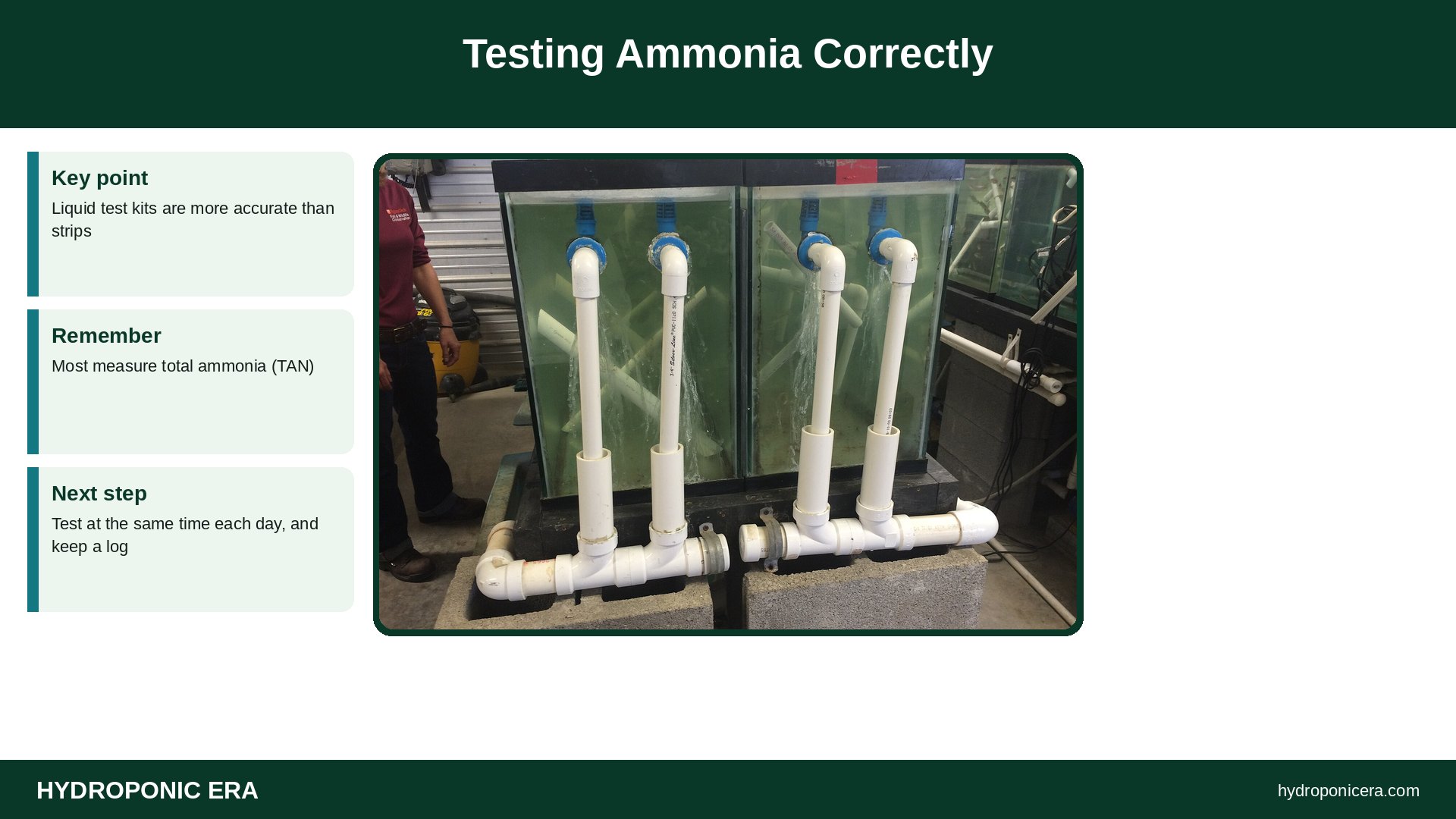
Liquid test kits are more accurate than strips. Most measure total ammonia (TAN). Test at the same time each day, and keep a log. Ammonia readings can be falsely high if the kit is old or if you test seawater with a freshwater kit. Some water conditioners bind ammonia and can confuse salicylate test kits, so read the product label. See record keeping.
Preventing an Aquaponics Ammonia Spike
- Feed only what fish eat in about 5 minutes, once or twice a day.
- Increase feed and fish numbers slowly.
- Keep solids filtered and removed. See solids filter.
- Maintain oxygen above 5 mg/L. See aquaponics dissolved oxygen.
- Have backup aeration for power cuts. See aquaponics power outage plan.
- Check tanks daily for dead or sick fish.
- Keep alkalinity in range with buffers such as calcium carbonate or potassium bicarbonate.
When to Move Fish
If ammonia stays above about 4 mg/L despite water changes, or fish are dying, move them to a separate tank of clean, dechlorinated, aerated water at the same temperature. A spare stock tank or large tote is useful to keep on hand.
Aquaponics Ammonia Spike in a New System
An aquaponics ammonia spike is normal during the first few weeks of cycling, before nitrifying bacteria are established. If you cycle with fish, keep the stocking light, feed sparingly, and test daily. Many growers prefer fishless cycling with an ammonia source, which lets bacteria grow without risking fish. Expect ammonia to peak first, then nitrite, before both fall toward zero in about four to eight weeks, depending on temperature.
Aquaponics Ammonia Spike After Adding Fish
Adding a large batch of fish to an established system can trigger an aquaponics ammonia spike, because the bacteria were sized for the old fish load. Add new fish in stages, a quarter or a third of the planned increase at a time, and raise feed slowly over two to three weeks. Quarantine new fish first so you don’t add disease on top of water stress. See fish to plant ratio.
Aquaponics Ammonia Spike in Cold Weather
Nitrification slows sharply as water cools, so a system that handled the same feeding in summer can see an aquaponics ammonia spike in late fall. Cut feeding as water temperature drops, and match rations to how actively fish eat. Insulating or heating the water also helps. See aquaponics in winter.
FAQs
What ammonia level is dangerous in aquaponics?
Total ammonia above about 1 mg/L needs action; above 2 mg/L is dangerous.
How much water should I change?
25–50%, with dechlorinated water at the same temperature.
Should I stop feeding during a spike?
Yes, for 24–48 hours.
Does high pH make ammonia worse?
Yes; more ammonia is in the toxic form at high pH.
Will plants fix an ammonia spike?
Not quickly; the biofilter and water changes do.
How long does a spike last?
Often several days until bacteria catch up.
Sources
- UF/IFAS Extension — Ammonia in Aquatic Systems
- New Mexico State University — Important Water Quality Parameters in Aquaponics Systems
- Oklahoma State University Extension — Nitrification and Maintenance in Media Bed Aquaponics
- FAO — Small-scale aquaponic food production
- Photo credits (Wikimedia Commons, edited with titles): Fish farming on Øksfjorden in Loppa, Troms og Finnmark, Norway, 2022 August by Ximonic (Simo Räsänen) (CC BY-SA 4.0); Solanum lycopersicum in aquaponics at the NC Greenhouse Nursery by Gogerr (CC BY-SA 4.0); Water droplets on a late cotoneaster (Cotoneaster coriaceus) leaf, Jardim da Fundação Calouste Gulbenkian, Lisbon, Portugal julesvernex2 by Jules Verne Times Two (CC BY-SA 4.0); Feeding fish (51250565367) by USFWS Mountain Prairie (Public domain); Recirculating Aquaculture System 1 by Narek75 (CC BY-SA 4.0)