
Aquaponics tomatoes grow well in media beds and deep water (raft) systems once your fish load is large and steady, because tomatoes are hungry for nutrients, especially potassium. Plan on 16–24 inches between plants, day temperatures of about 72–79°F with nights near 55–61°F, and supplements of potassium, calcium and chelated iron. Expect first harvest about 50–70 days after transplanting, with indeterminate vines fruiting for months. New systems should grow leafy greens first and add aquaponics tomatoes after a few months.
Key takeaway: Give aquaponics tomatoes a mature system, a media bed or raft with strong support, steady potassium and calcium additions, good pollination and regular pruning, and they can out-yield almost any other home crop.
| Factor | Aquaponics tomatoes target (FAO) |
|---|---|
| pH | 5.5–6.5 ideal; system compromise about 6.8–7.0 |
| Spacing | 16–24 inches (3–5 plants per square meter) |
| Germination | 4–6 days at 68–86°F |
| Day / night temperature | 72–79°F / 55–61°F |
| First harvest | 50–70 days after transplant |
| Best systems | Media beds and DWC |
| Feed rate | 50–80 g fish feed per square meter per day |

Can You Grow Aquaponics Tomatoes Successfully?

Yes. The FAO’s small-scale aquaponics manual calls tomatoes an excellent summer fruiting crop for all aquaponics methods, provided plants get physical support. It also warns that, because of their high nutrient demand, especially potassium, the number of plants should match the fish biomass. SRAC’s aquaponics fact sheet adds that fruiting crops need longer culture periods (90 days or more) and have more pest and disease problems than leafy greens. So aquaponics tomatoes are very doable, but they’re an intermediate crop, not the first thing to plant in a new system.
Best System for Aquaponics Tomatoes
- Media beds: the top choice for home systems. Deep beds (at least 12 inches) anchor big roots and hold solids that mineralize into nutrients. See aquaponics media bed.
- Raft (DWC): works with strong overhead support; roots hang in aerated water. See aquaponics raft system.
- NFT: not recommended; the FAO warns tomato roots can clog even large pipes.
- Dutch buckets: a popular hybrid on media-filled buckets fed by system water. See Dutch buckets.
Fish Load and Feeding for Aquaponics Tomatoes
The FAO’s feed rate ratio for fruiting vegetables is 50–80 grams of fish feed per square meter of growing area per day, compared with 40–50 grams for leafy greens. A 4×8 foot bed of tomatoes (about 3 square meters) needs roughly 150–240 grams of feed a day, which means a well-stocked tank. The FAO notes tomatoes benefit from more nitrogen early and more potassium from flowering onward. See aquaponics fish to plant ratio.
Supplements Aquaponics Tomatoes Need
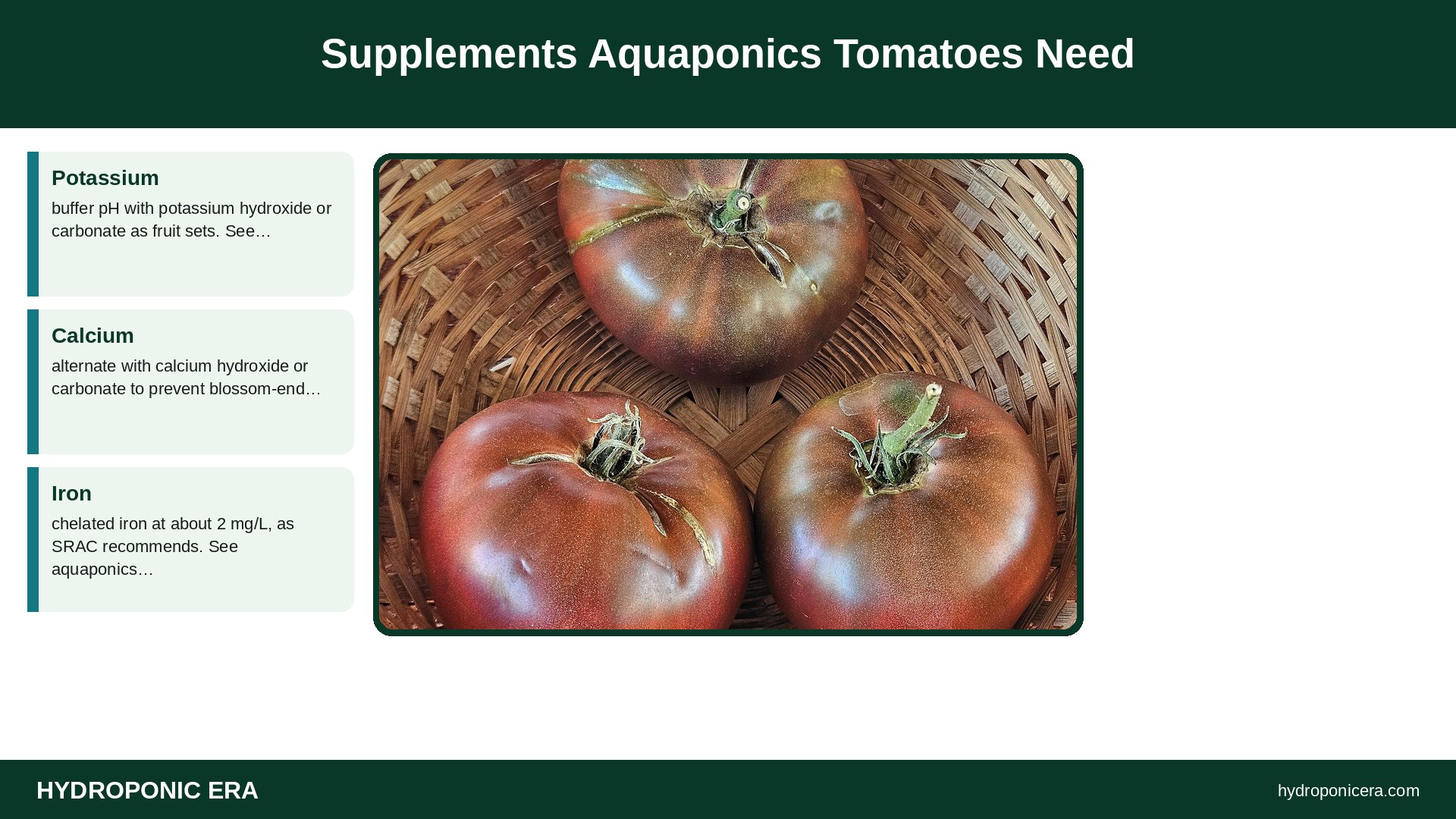
- Potassium: buffer pH with potassium hydroxide or carbonate as fruit sets. See aquaponics potassium deficiency.
- Calcium: alternate with calcium hydroxide or carbonate to prevent blossom-end rot. See aquaponics calcium deficiency.
- Iron: chelated iron at about 2 mg/L, as SRAC recommends. See aquaponics iron deficiency.
Check the full symptom guide in the aquaponics nutrient deficiencies chart.
How to Grow Aquaponics Tomatoes Step by Step
- Choose varieties. Indeterminate cherry and slicing types give long harvests. See best tomato varieties.
- Start seeds in plugs at 68–86°F. See aquaponics seedlings.
- Set supports first. The FAO advises installing stakes or strings before transplanting to avoid root damage.
- Transplant at 3–6 weeks when seedlings are 4–6 inches tall and nights stay above about 50°F.
- Prune to one or two stems. Remove side shoots (suckers) and the lowest 12 inches of leaves for airflow, as the FAO recommends. See tomato pruning.
- Pollinate. Indoors, shake flower clusters or use a vibrating tool. See indoor pollination.
- Harvest when fruit is firm and fully colored; the FAO notes fruit picked half-ripe will finish indoors.
Temperature and Light

The FAO notes tomatoes stop growing below about 46–50°F, that nights around 55–57°F encourage fruit set, and that temperatures above 104°F cause flower drop and poor fruit set. Full sun is best. In a greenhouse, ventilate and shade during heat waves; indoors, use strong LEDs for 14–16 hours. Water temperature affects roots: aim for the system range your fish need, usually 70–80°F for tilapia. See blossom drop.
Intercropping With Greens
SRAC describes intercropping lettuce with tomatoes and cucumbers: one lettuce crop can be harvested before the tomato canopy starts to limit light. It’s an easy way to use bed space while young tomato plants fill in, and it smooths nutrient uptake in a new bed. See aquaponics lettuce.
Common Aquaponics Tomatoes Problems
| Problem | Likely cause | Fix |
|---|---|---|
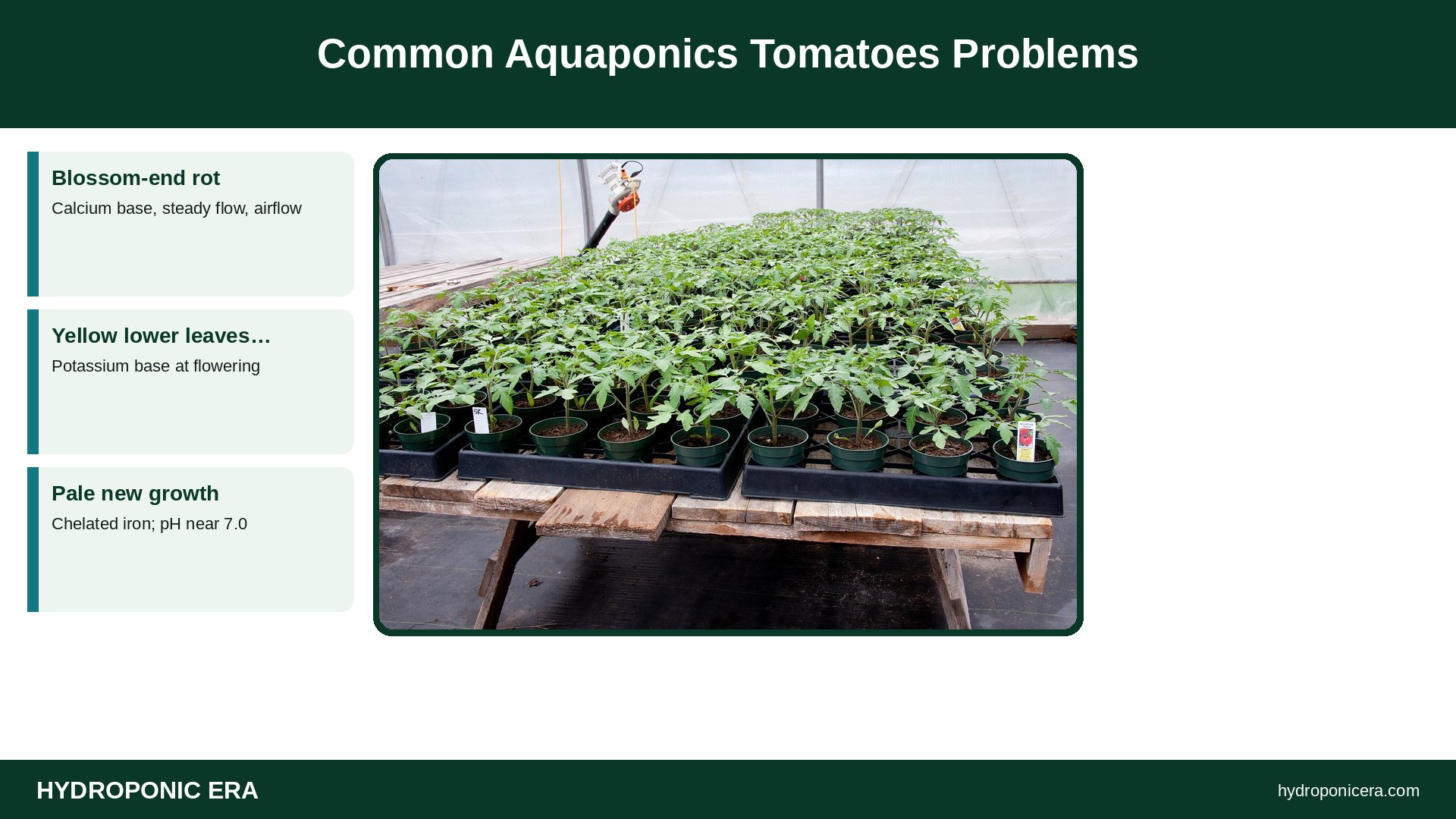
| Blossom-end rot | Calcium delivery | Calcium base, steady flow, airflow |
| Yellow lower leaves, weak fruit | Potassium shortage | Potassium base at flowering |
| Pale new growth | Iron or high pH | Chelated iron; pH near 7.0 |
| Flowers drop | Heat or poor pollination | Ventilate, shake flowers |
| Lots of leaves, few fruit | Too much nitrogen | More plants or less feed per bed |
| Leaf spots and mold | Humidity | Prune lower leaves, fans |
For pests such as whiteflies and aphids, use fish-safe methods only. See aquaponics pest control and tomato leaf mold.
What Yields to Expect
SRAC reports preliminary data from a UVI-style aquaponics system in Alberta, Canada, where tomatoes produced about 6 pounds per square foot per year when yields from one cycle were extrapolated. That’s a research greenhouse number, not a promise; home systems vary widely with light, season and care. The same data showed herbs and cucumbers earning more per square foot, which is why commercial growers often favor them. Track your own pounds per plant to judge improvements.
Aquaponics Tomatoes Weekly Checklist
- Prune and train: remove suckers on indeterminate vines and tie the main stem to its support.
- Check lower leaves: yellowing between veins on old leaves can point to potassium or magnesium shortage. See aquaponics potassium deficiency.
- Look at fruit ends: dark sunken spots mean blossom-end rot. See aquaponics calcium deficiency.
- Test pH: keep it near 6.8–7.0 for fish, plants and bacteria. See aquaponics pH.
- Clear roots from drains and pipes, since tomato roots grow large.
FAQs
Can you grow aquaponics tomatoes in a new system?
It’s better to wait a few months until the fish load and nutrients stabilize.
What pH do aquaponics tomatoes need?
Tomatoes prefer 5.5–6.5, but grow well at the system compromise of about 6.8–7.0.
Why do my tomatoes have black bottoms?
Blossom-end rot from poor calcium delivery.
Do aquaponics tomatoes need extra potassium?
Usually yes, especially from flowering onward.
Which system is best?
Media beds, or rafts with strong support.
How long until harvest?
About 50–70 days after transplanting.
Sources
- FAO — Small-scale aquaponic food production
- Southern Regional Aquaculture Center — SRAC 454: Aquaponics—Integrating Fish and Plant Culture
- UF/IFAS Extension — Production of Greenhouse Tomatoes
- Photo credits (Wikimedia Commons, edited with titles): Solanum lycopersicum in aquaponics at the NC Greenhouse Nursery by Gogerr (CC BY-SA 4.0); Tomato je by Softeis (CC BY-SA 3.0); Heirloom tomatoes at county fair by Eric Polk (CC BY-SA 4.0); Blossom end rot tomato 2017 A by Fructibus (CC0); Early tomatoes (5673784575) by Dwight Sipler from Stow, MA, USA (CC BY 2.0)