
The aquaponics best plants for most growers are leafy greens and herbs: lettuce, basil, mint, chard, kale, pak choi, watercress, parsley and chives. They have low nutrient needs that fish waste supplies well, grow fast and tolerate the system pH of about 6.8–7.0. Once the system is mature and well stocked, fruiting crops such as tomatoes, cucumbers, peppers and strawberries can do very well with potassium, calcium and iron support. Root crops need deep media beds, and big trees or field crops are poor fits.
Key takeaway: Start with low-nutrient greens and herbs, add medium-demand brassicas next, and save nutrient-hungry fruiting plants for when your fish load is steady. Match the plant group to your system type and season.
Aquaponics Best Plants by Nutrient Demand
| Group (FAO) | Examples | Best for |
|---|---|---|
| Low demand | Lettuce, chard, arugula, basil, mint, parsley, cilantro, chives, pak choi, watercress, peas, beans | New systems, rafts, NFT |
| Medium demand | Kale, cabbage, cauliflower, broccoli, kohlrabi | Established systems, media beds |
| Medium to high | Beets, onions, carrots, taro | Deep media beds only |
| High demand | Tomatoes, cucumbers, peppers, eggplant, zucchini, strawberries | Mature, well-stocked systems |

Why Greens and Herbs Top the List
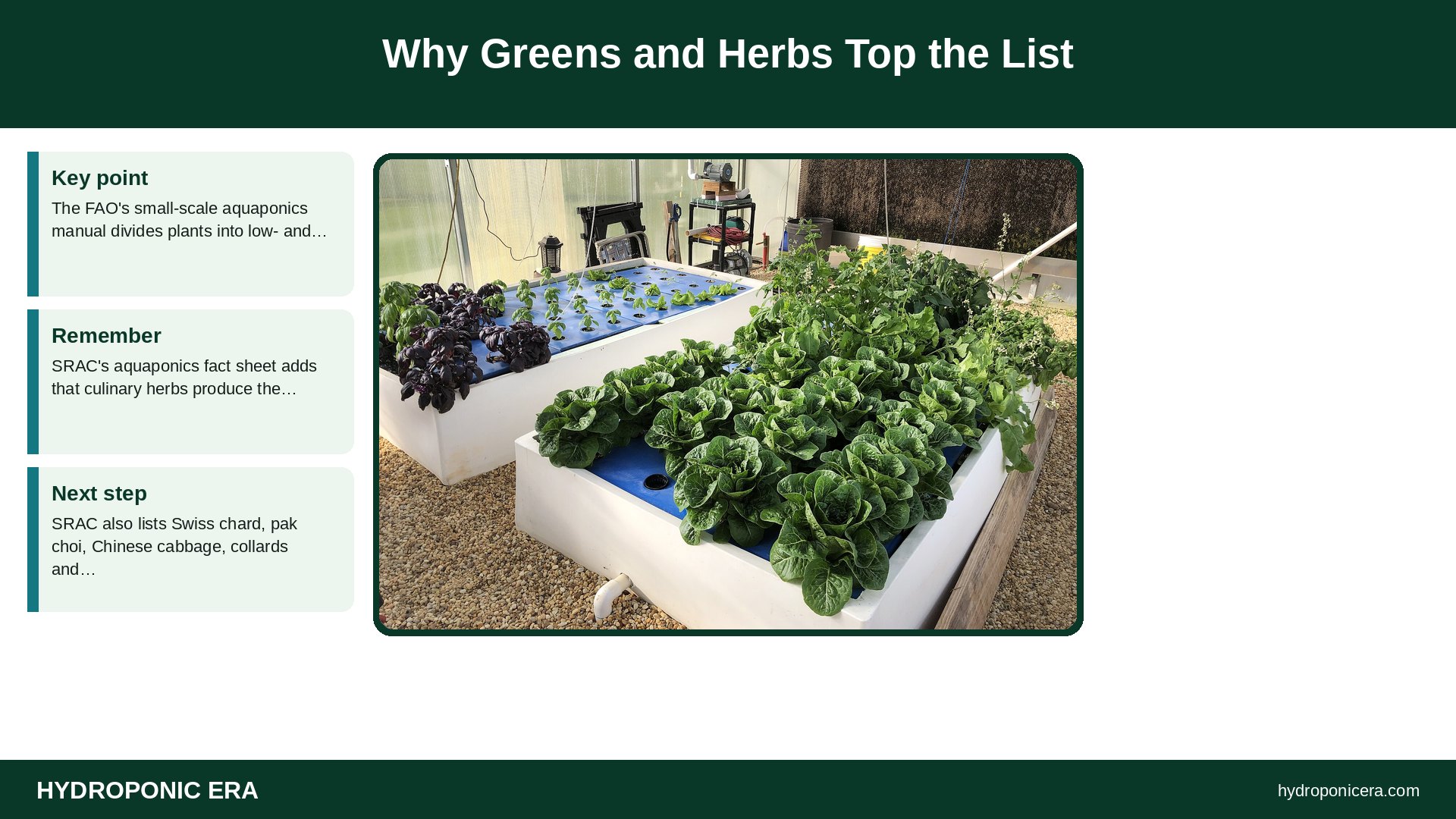
The FAO’s small-scale aquaponics manual divides plants into low- and high-nutrient-demand groups, listing leafy greens and herbs such as lettuce, chard, salad rocket, basil, mint, parsley, coriander, chives, pak choi and watercress as low demand. SRAC’s aquaponics fact sheet adds that culinary herbs produce the highest income per area and time, and that lettuce is a good crop because it grows in 3–4 weeks with few pest problems. SRAC also lists Swiss chard, pak choi, Chinese cabbage, collards and watercress as suitable crops. Start here. See aquaponics lettuce and aquaponics herbs.
Top 12 Aquaponics Best Plants
- Lettuce: the classic raft crop; ready 3–4 weeks after transplant.
- Basil: high value, loves warm water.
- Swiss chard: tolerant, cut-and-come-again.
- Kale: cold hardy; a medium-demand brassica.
- Pak choi (bok choy): fast and compact. See bok choy.
- Watercress: thrives in moving water. See watercress.
- Mint: vigorous; keep it in media beds.
- Parsley and chives: low-maintenance herbs.
- Tomatoes: high yield in mature systems. See aquaponics tomatoes.
- Cucumbers: fast producers. See aquaponics cucumbers.
- Peppers: slower but long-producing. See aquaponics peppers.
- Strawberries: rewarding but trickier. See aquaponics strawberries.
Matching Plants to Your System

| System | Aquaponics best plants | Avoid |
|---|---|---|
| Media bed (12 in deep) | Almost anything: greens, herbs, fruiting crops, some roots | Very large trees |
| Raft (DWC) | Lettuce, basil, chard, kale, pak choi | Root crops, heavy vines without support |
| NFT | Lettuce, herbs, strawberries | Tomatoes, mint, cucumbers (roots clog pipes) |
| Vertical tower | Lettuce, herbs, strawberries | Large fruiting plants |
The FAO notes that media beds of the right depth (at least about 12 inches) can grow all of these categories, and that polycultures of greens, herbs and fruiting plants are common in media beds. It also warns that tomatoes and mint have root systems that can clog even large NFT pipes. For a full comparison, see aquaponics media bed, aquaponics raft system and aquaponics NFT vs DWC.
Root Crops and Other Special Cases
The FAO says root crops need special attention and can only be grown successfully in deep media beds or wicking beds. Carrots, beets and onions can work in deep gravel, but they’re slower and use bed space for a long time. Radishes need fewer nutrients and are an easy quick crop in media. Beans and peas are recommended by the FAO for newly established units because of their low nitrate needs. Flowers such as marigolds and zinnias also grew well in UVI’s aquaponic system, according to SRAC. See marigolds.
Seasonal Aquaponics Best Plants

- Cool season (water about 55–70°F): lettuce, kale, chard, spinach, pak choi, parsley, cilantro, watercress, peas.
- Warm season (water about 70–85°F): basil, tomatoes, peppers, cucumbers, eggplant, okra, beans.
- Year-round indoors: lettuce, herbs, microgreens. See aquaponics microgreens.
Match crops to your fish too. Warm-water tilapia systems favor basil and fruiting crops; cooler goldfish, koi or trout systems favor lettuce and brassicas. See aquaponics water temperature and best fish for aquaponics.
Balancing Plants With Fish
The FAO’s feed rate ratio is 40–50 grams of fish feed per square meter per day for leafy greens and 50–80 grams for fruiting vegetables. Too many fruiting plants for your fish leads to deficiencies; too few plants lets nitrate build up. See fish to plant ratio and aquaponics nutrient deficiencies.
Plants to Skip or Treat as Experiments

- Large fruit trees: too big for most systems; dwarf citrus or figs are experiments at best.
- Field crops: corn, wheat and potatoes take a lot of space for little value.
- Acid-loving plants: blueberries want pH far below what fish tolerate.
- Long-season roots: sweet potatoes and big carrots tie up beds.
A Simple Planting Plan for a New System
- Months 1–2: lettuce, pak choi, basil and herbs while the system matures.
- Months 3–4: add kale, chard and a few bean plants.
- Month 4 onward: add one or two tomato, cucumber or pepper plants per bed, with potassium and iron support.
- Ongoing: replant greens weekly for continuous harvest.
Aquaponics Best Plants by Experience Level
| Level | Crops | Why |
|---|---|---|
| First 3 months | Lettuce, pak choi, basil, mint, watercress | Low nutrient needs, fast harvests |
| 3–6 months | Kale, chard, parsley, chives, cilantro | Handle a stable but still young system |
| 6+ months | Tomatoes, cucumbers, peppers | Need a mature system and heavier fish load |
| Experiments | Strawberries, root crops | Need extra care or special media |
Choosing aquaponics best plants by experience level keeps early wins coming while your biofilter matures. The FAO’s feed-rate guideline is 40–50 grams of fish feed per square meter of growing area per day for leafy greens versus 50–80 grams for fruiting vegetables, because fruiting plants need more nutrients. The FAO also calls nutrient-demanding crops such as cabbage unsuitable for units less than four months old. See aquaponics cycling and aquaponics biofilter.
How to Tell If Your Aquaponics Best Plants Are Thriving
- Deep green, steady new growth.
- White, healthy roots with no slime or bad smell.
- Nitrate stable or slowly rising, not crashing.
- No yellowing on new or old leaves. See aquaponics plants turning yellow.
If several of these signs fail at once, check pH and fish feeding before adding supplements. Healthy fish and a balanced feed rate are the foundation of the aquaponics best plants list. See fish-to-plant ratio.
FAQs
What are the aquaponics best plants for beginners?
Lettuce, basil, chard, kale, pak choi and herbs.
Can I grow tomatoes in aquaponics?
Yes, in a mature system with potassium, calcium and iron support.
What plants don’t grow well?
Acid-loving plants, large trees and long-season field crops.
Can root vegetables grow in aquaponics?
Only in deep media beds or wicking beds.
Which plants earn the most?
Culinary herbs, according to SRAC.
How many plants can my fish support?
Use 40–50 g feed per square meter per day for greens, 50–80 g for fruiting crops.
Sources
- FAO — Small-scale aquaponic food production
- Southern Regional Aquaculture Center — SRAC 454: Aquaponics—Integrating Fish and Plant Culture
- UC Davis — Aquaponics fact sheet
- Photo credits (Wikimedia Commons, edited with titles): AQUAPONIE by Hopeballa (CC BY-SA 4.0); Deepwater Aquaponics Floating Rafts Growing Lettuce, Basil and Arugula by Alabama Extension (CC0); Ocimum Basilicum leaf lighted by the left by BernaBotto (CC BY-SA 4.0); Tomato je by Softeis (CC BY-SA 3.0); Fragaria vesca fruit – Keila by Ivar Leidus (CC BY-SA 4.0)