
Aquaponics cucumbers are one of the most productive fruiting crops for a fish system. They grow fast in media beds or deep water rafts, like warm days of about 75–81°F with nights near 64–68°F, and start producing just 2–3 weeks after transplanting. Cucumbers need a lot of nitrogen and potassium, so give them a well-stocked system, a trellis, good airflow and regular potassium additions. Avoid NFT pipes, where their big roots can clog the channels.
Key takeaway: For heavy aquaponics cucumbers, use a media bed or raft, choose seedless greenhouse types indoors, trellis to a single stem, keep potassium up, and pick fruit every few days.
| Factor | Aquaponics cucumbers target (FAO) |
|---|---|
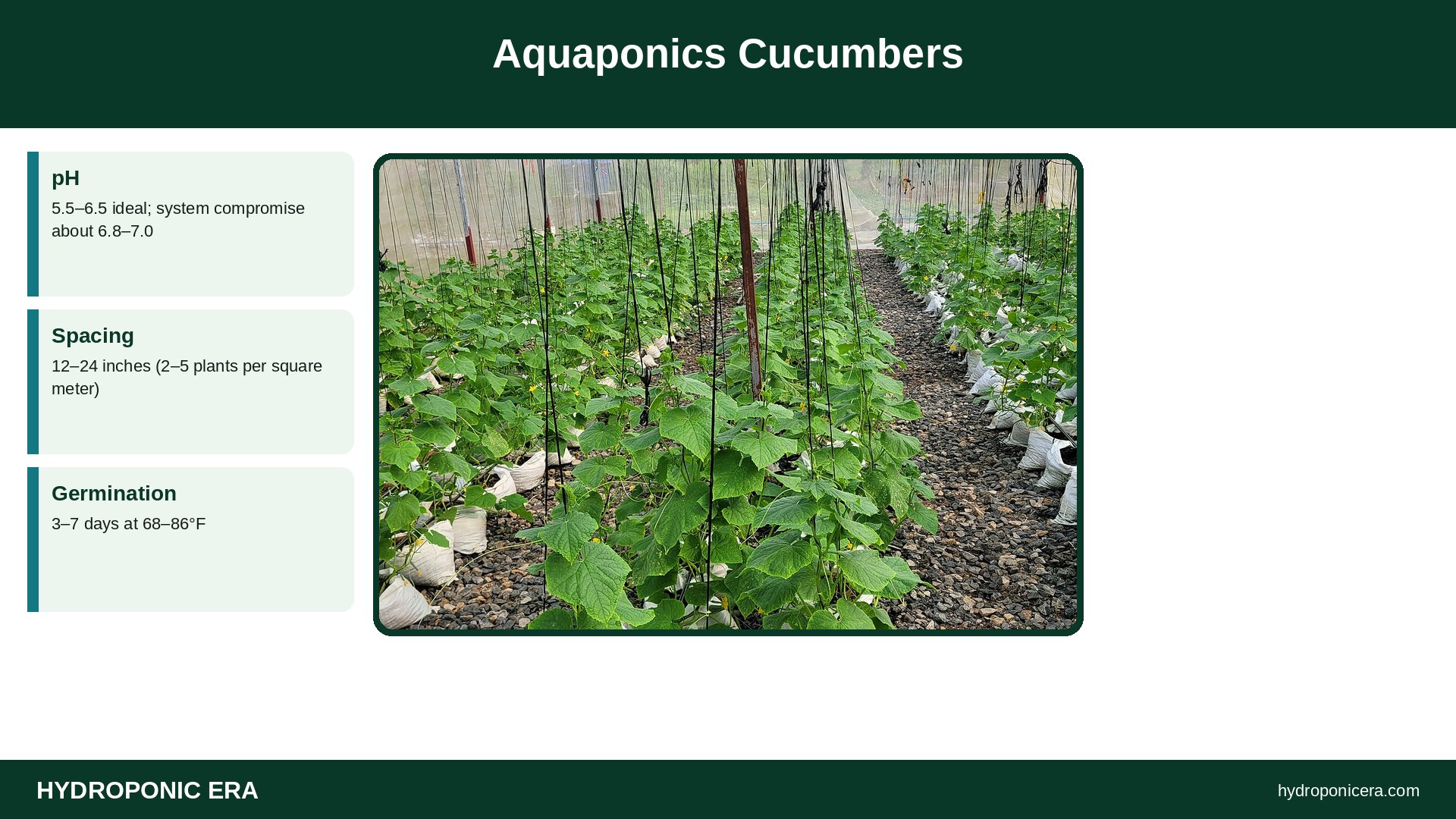
| pH | 5.5–6.5 ideal; system compromise about 6.8–7.0 |
| Spacing | 12–24 inches (2–5 plants per square meter) |
| Germination | 3–7 days at 68–86°F |
| Day / night temperature | 75–81°F optimal / 64–68°F |
| Humidity | 70–90% relative humidity |
| Time to harvest | Production starts 2–3 weeks after transplant |
| Best systems | Media beds; DWC |
Why Aquaponics Cucumbers Are Worth Growing
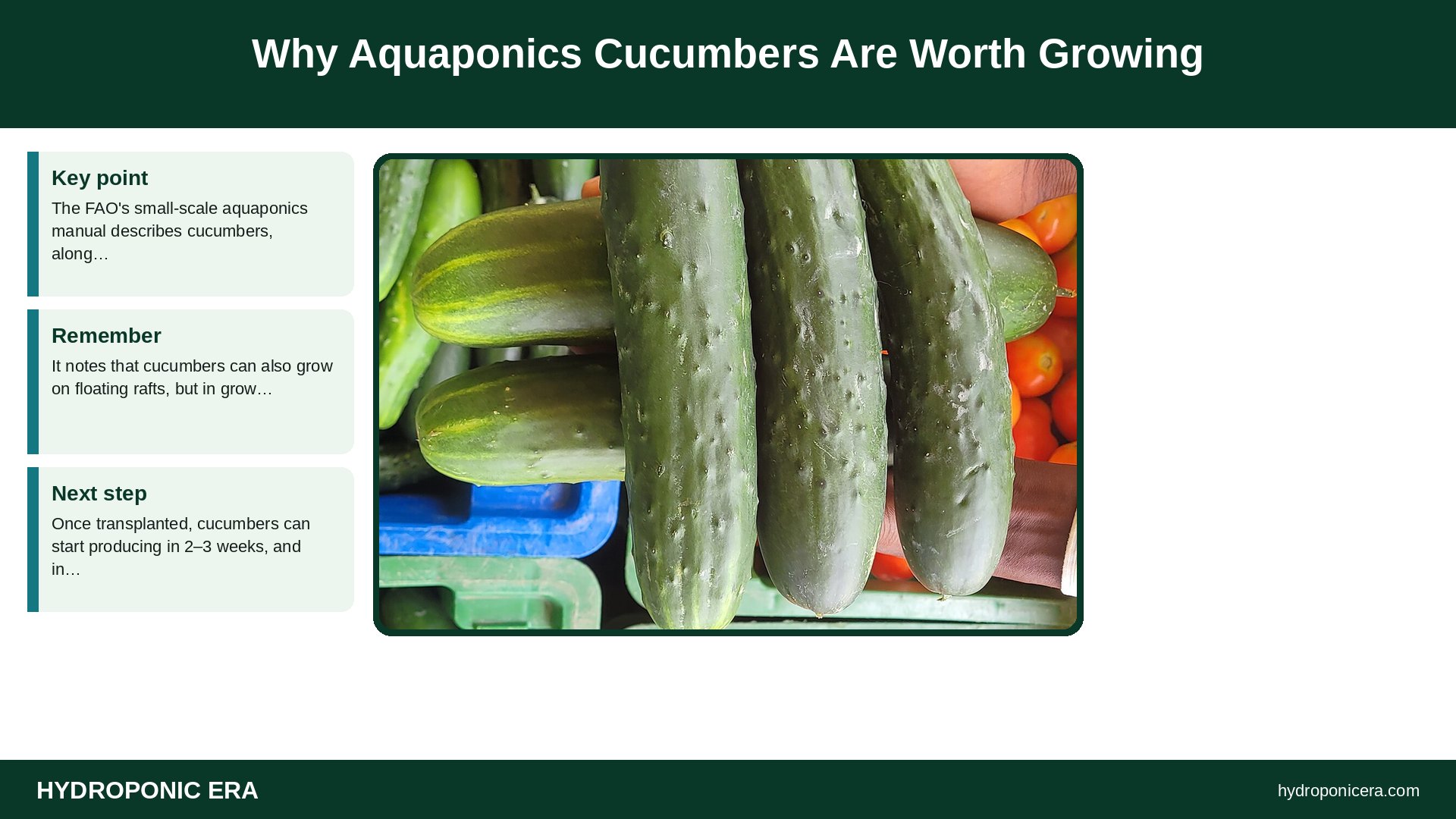
The FAO’s small-scale aquaponics manual describes cucumbers, along with squash, zucchini and melons, as excellent high-value summer vegetables and ideal plants for media bed units because of their large root systems. It notes that cucumbers can also grow on floating rafts, but in grow pipes there’s a risk of clogging. Once transplanted, cucumbers can start producing in 2–3 weeks, and in optimal conditions plants can be harvested 10–15 times. In preliminary data from a UVI-style aquaponics system in Alberta reported by SRAC, cucumbers produced about 12.4 pounds per square foot per year, the highest weight of any crop listed.
Nutrients and Fish Load for Aquaponics Cucumbers
The FAO says cucumbers require large quantities of nitrogen and potassium, so the number of plants should match the nutrients available and the fish biomass. It also recommends higher potassium to support fruit set and yields. Use the fruiting-crop feed rate ratio of 50–80 grams of fish feed per square meter per day. Supplement:
- Potassium through pH buffering. See aquaponics potassium deficiency.
- Iron as chelated iron at about 2 mg/L. See aquaponics iron deficiency.
- Calcium by alternating calcium bases. See aquaponics calcium deficiency.
See fish to plant ratio.
Best Cucumber Types for Aquaponics
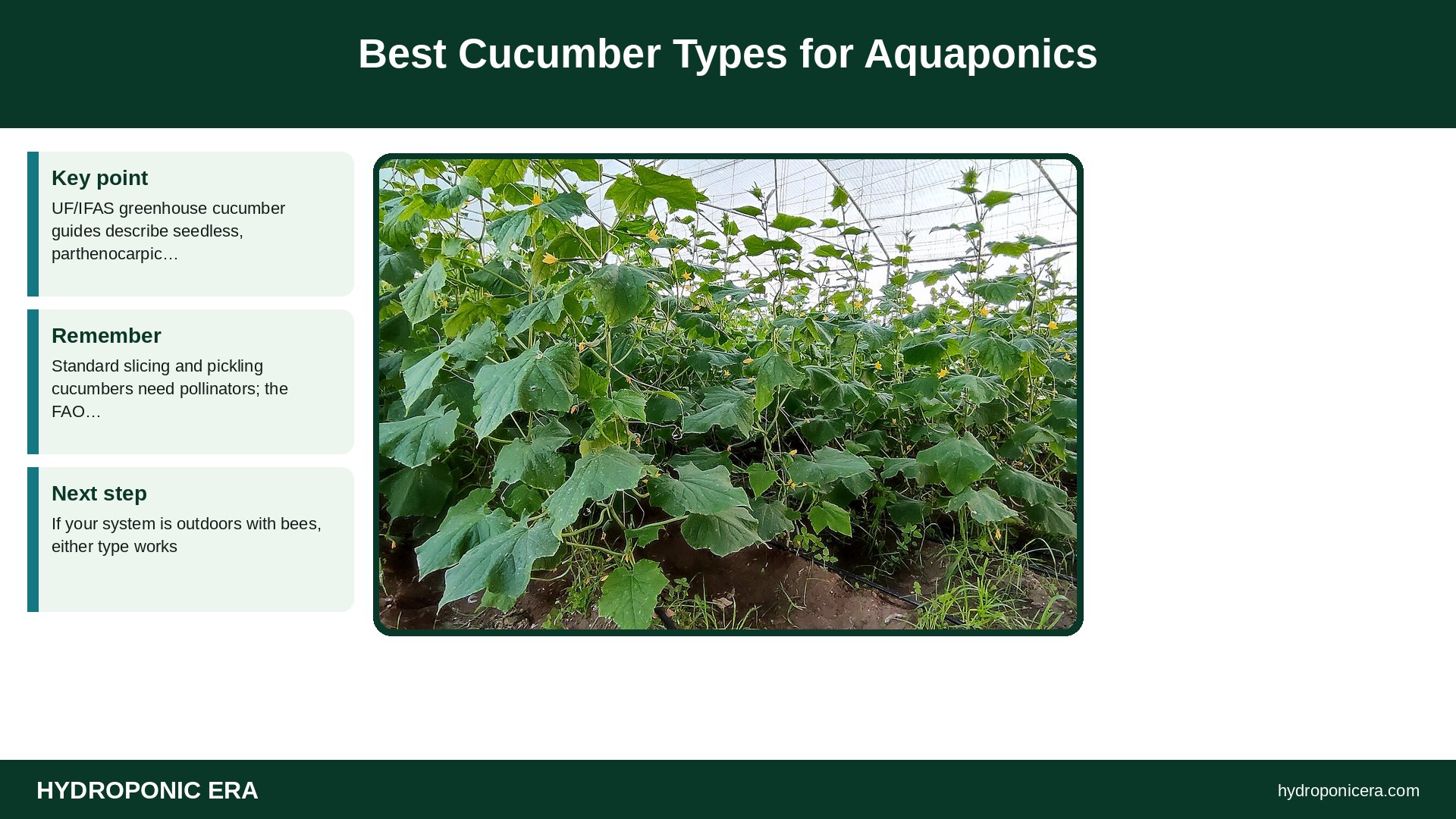
UF/IFAS greenhouse cucumber guides describe seedless, parthenocarpic types (European long and Beit Alpha or mini types) that set fruit without pollination, which makes them ideal indoors or in screened greenhouses. Standard slicing and pickling cucumbers need pollinators; the FAO notes pollinating insects are necessary for these. If your system is outdoors with bees, either type works. See best cucumber varieties.
How to Grow Aquaponics Cucumbers Step by Step
- Start seeds at 68–86°F; they sprout in 3–7 days. See aquaponics seedlings.
- Transplant at 2–3 weeks, at the 4–5 leaf stage, as the FAO advises.
- Trellis immediately. Vertical strings or netting save space and improve airflow. See cucumber trellis.
- Train a single stem. Remove side shoots on the lower stem; the FAO suggests removing lateral branches for ventilation.
- Top the plant when the main stem reaches about 6.5 feet, then let only the two farthest buds continue, per the FAO.
- Pollinate non-parthenocarpic types by hand indoors.
- Harvest often. The FAO recommends picking slicers over about 6 ounces, every few days, so new fruit keeps coming.
Temperature, Light and Humidity
The FAO lists optimal day temperatures of 75–81°F with 70–90% relative humidity and a root-zone temperature near 70°F. Growth and production stop at about 50–55°F, and cucumbers are highly susceptible to frost. Full sun or strong LED light is needed. High humidity helps growth, but stagnant humid air invites powdery mildew, so keep fans running. See powdery mildew and aquaponics greenhouse.
Managing Roots in the System
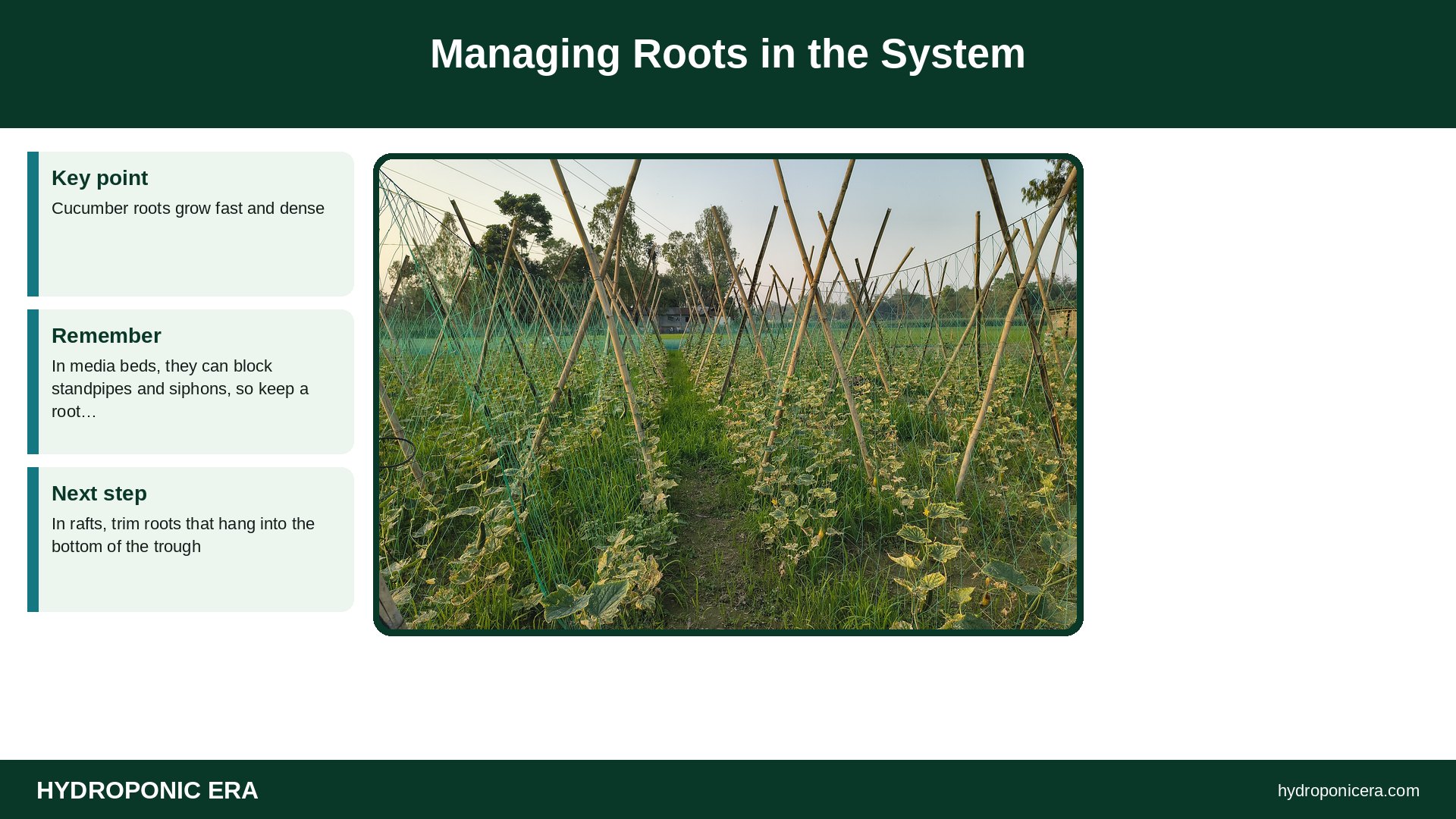
Cucumber roots grow fast and dense. In media beds, they can block standpipes and siphons, so keep a root guard around the drain and check flow weekly. In rafts, trim roots that hang into the bottom of the trough. The FAO specifically warns that in NFT grow pipes cucumber roots risk clogging. See aquaponics bell siphon and aquaponics media bed.
Common Aquaponics Cucumbers Problems
| Problem | Likely cause | Fix |
|---|---|---|
| Yellow leaves | Nitrogen, potassium or iron shortage | Check feed rate, add K and Fe |
| Misshapen fruit | Poor pollination or low potassium | Hand pollinate; boost potassium |
| Bitter fruit | Heat or water stress | Shade, steady flow |
| White powder on leaves | Powdery mildew | Airflow, remove infected leaves |
| Flowers, no fruit | Male flowers only or no pollinators | Wait for female flowers; pollinate |
| Siphon stops cycling | Roots in drain | Root guard, trim roots |
See cucumber leaves yellow and bitter cucumbers.
Pests on Aquaponics Cucumbers
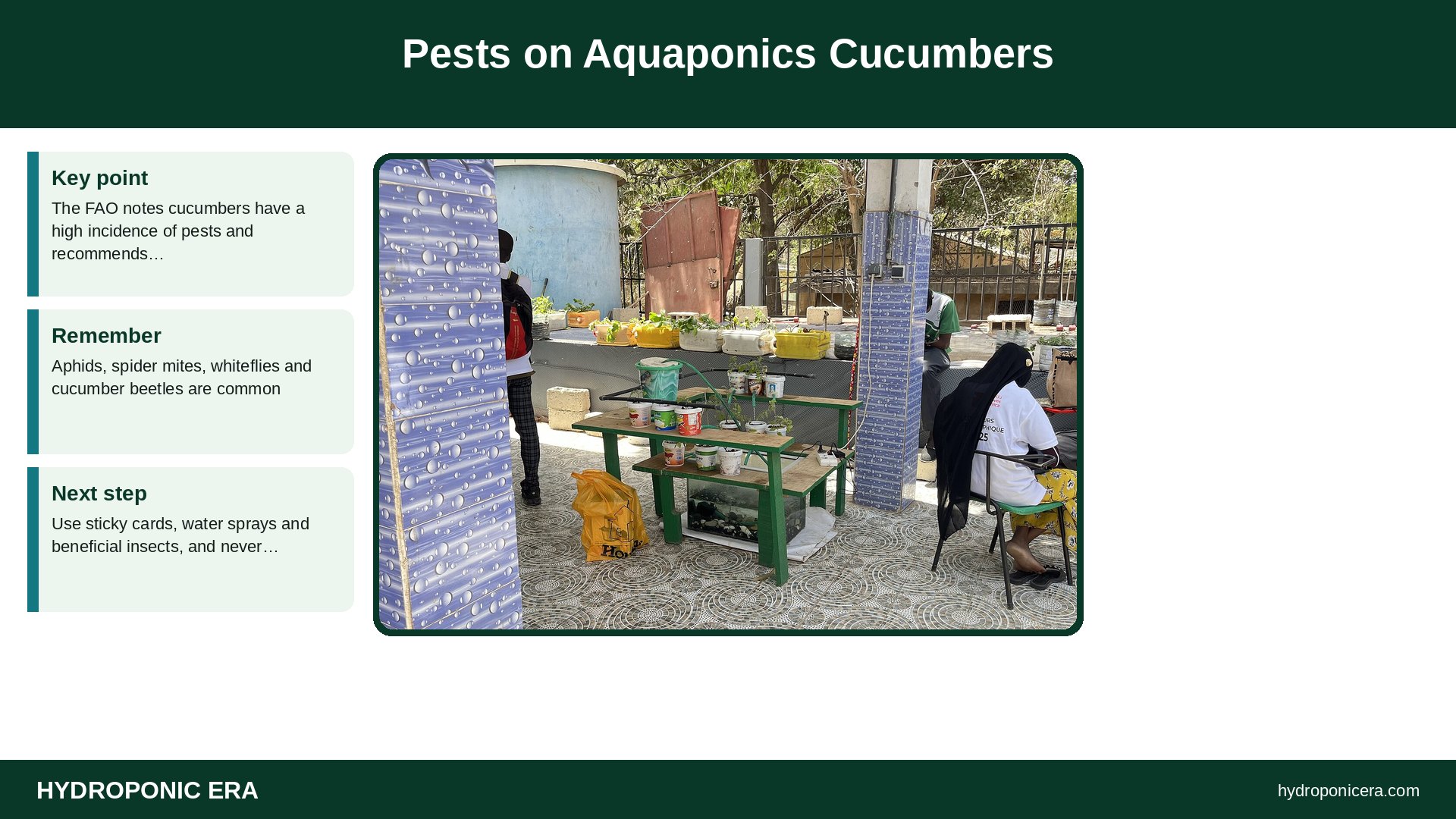
The FAO notes cucumbers have a high incidence of pests and recommends planning integrated pest management early. Aphids, spider mites, whiteflies and cucumber beetles are common. Use sticky cards, water sprays and beneficial insects, and never spray pesticides near the water. The FAO also suggests intercropping cucumbers with plants that are less affected by the treatments you use. See aquaponics pest control.
Aquaponics Cucumbers With Other Crops
SRAC describes intercropping lettuce with tomatoes and cucumbers, harvesting a lettuce crop before the vines shade the bed. Cucumbers also share beds well with herbs at the edges. Because they’re nutrient-hungry, avoid putting more than a few cucumber plants on a small system with few fish. See aquaponics lettuce and aquaponics tomatoes.
How Many Aquaponics Cucumbers Per Bed?
With FAO spacing of 2–5 plants per square meter, a 4×8 foot media bed (about 3 square meters) fits roughly 6–15 cucumber plants. Trellised single-stem plants sit at the higher end; sprawling or bushy types at the lower end. At the fruiting feed rate, that bed needs about 150–240 grams of fish feed per day. Start at the low end and add plants once your fish load can support them.
Aquaponics Cucumbers Harvest Tips
Pick fruit young and often; leaving large cucumbers on the vine slows new fruit. Cut with clean scissors rather than pulling, and keep harvested fruit cool. Wash before eating, as with all aquaponics produce. See home food safety.
FAQs
Do cucumbers grow well in aquaponics?
Yes; they’re among the most productive aquaponic fruiting crops.
Which system is best for aquaponics cucumbers?
Media beds or rafts; avoid NFT pipes.
How fast do they produce?
About 2–3 weeks after transplanting.
Do I need bees?
Only for non-parthenocarpic types; seedless greenhouse types set fruit alone.
Why are my cucumbers bitter?
Usually heat or water stress.
What nutrients do they need most?
Nitrogen and potassium, plus iron.
Sources
- FAO — Small-scale aquaponic food production
- Southern Regional Aquaculture Center — SRAC 454: Aquaponics—Integrating Fish and Plant Culture
- UF/IFAS Extension — Greenhouse Cucumber Production
- Photo credits (Wikimedia Commons, edited with titles): Cucumber in the greenhouse 3 by Pascal Kings (CC BY 4.0); Harvested vegetables(Cucumbers) by Pascal Kings (CC BY 4.0); Cucumber greenhouse plants of Dr. Mahmoud Salem’s farm by Amnsalem (CC BY-SA 4.0); Cucumber cultivation on a trellis, Kurigram, Bangladesh by Tanvir Rahat (CC BY-SA 4.0); AQUAPONIE by Hopeballa (CC BY-SA 4.0)