
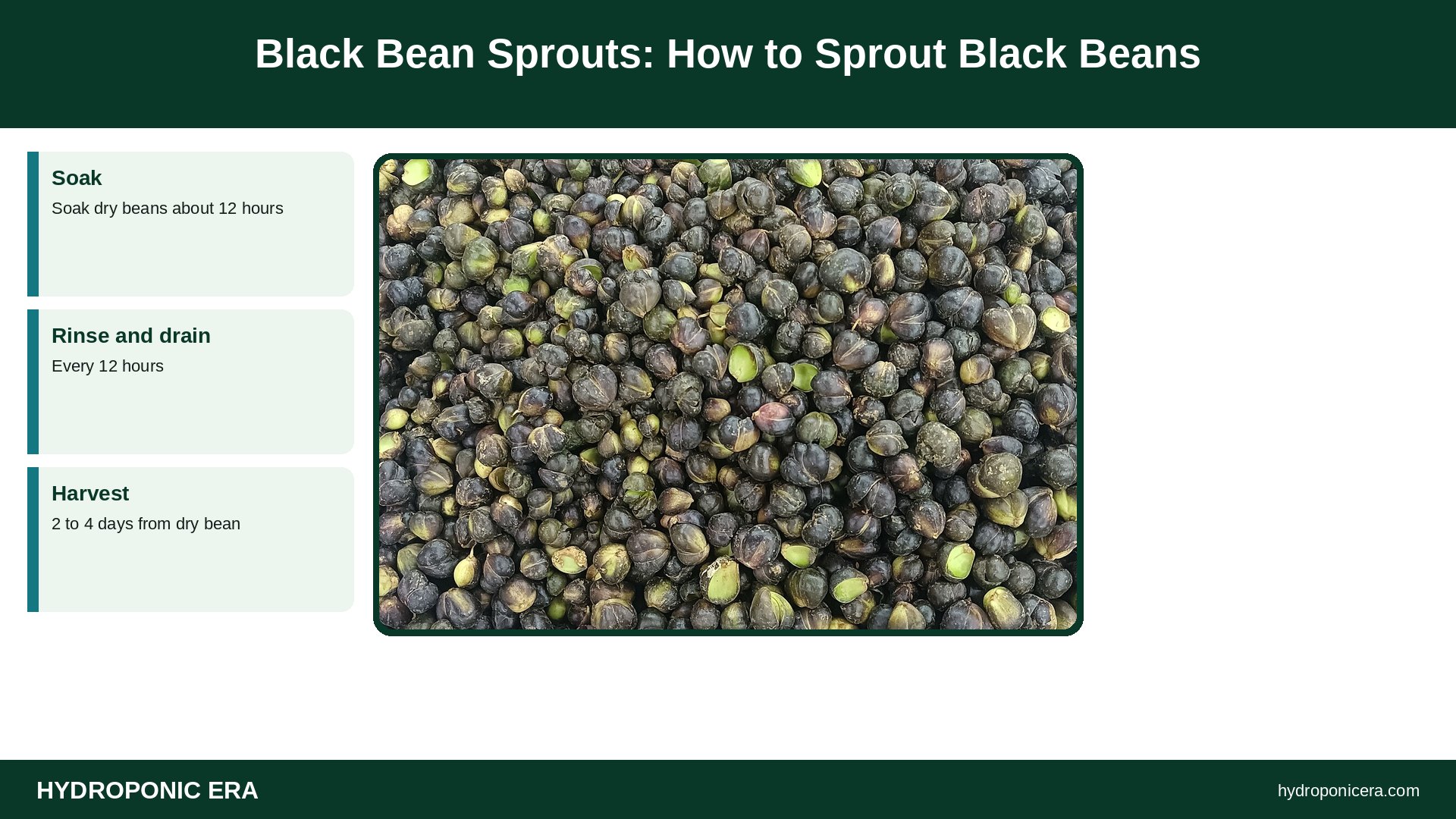
Can you eat black bean sprouts? Yes, but cook them. Sproutpeople, a sprout seed seller, says black bean sprouts should be cooked even when sprouted. Health Canada advises against eating any raw or undercooked sprouts because they can carry E. coli and Salmonella. Black bean sprouts are ready in 2 to 4 days and suit soups, stews and chili.
Key takeaway: Black bean sprouts are easy to grow in a jar, but they are a cooking sprout, not a salad sprout. Sproutpeople, a sprout seed seller, lists a 2 to 4 day harvest and a 2:1 yield, and says the beans should be cooked even after sprouting. This guide covers soaking, rinsing, timing and safe cooking.
| Step | What to Do | Source |
|---|---|---|
| Soak | Soak dry beans about 12 hours | Sproutpeople |
| Rinse and drain | Every 12 hours | Sproutpeople |
| Harvest | 2 to 4 days from dry bean | Sproutpeople |
| Yield | 1 lb (454 g) dry beans gives about 2 lb (907 g) sprouts | Sproutpeople |
| Store | Refrigerate; eat within a few days | Health Canada |
| Cook | Cook thoroughly; FDA advice cited at 135°F (57°C) minimum | Health Canada; Ask Extension |
| Raw use | Not advised | Sproutpeople; Health Canada |
Can You Sprout Black Beans?
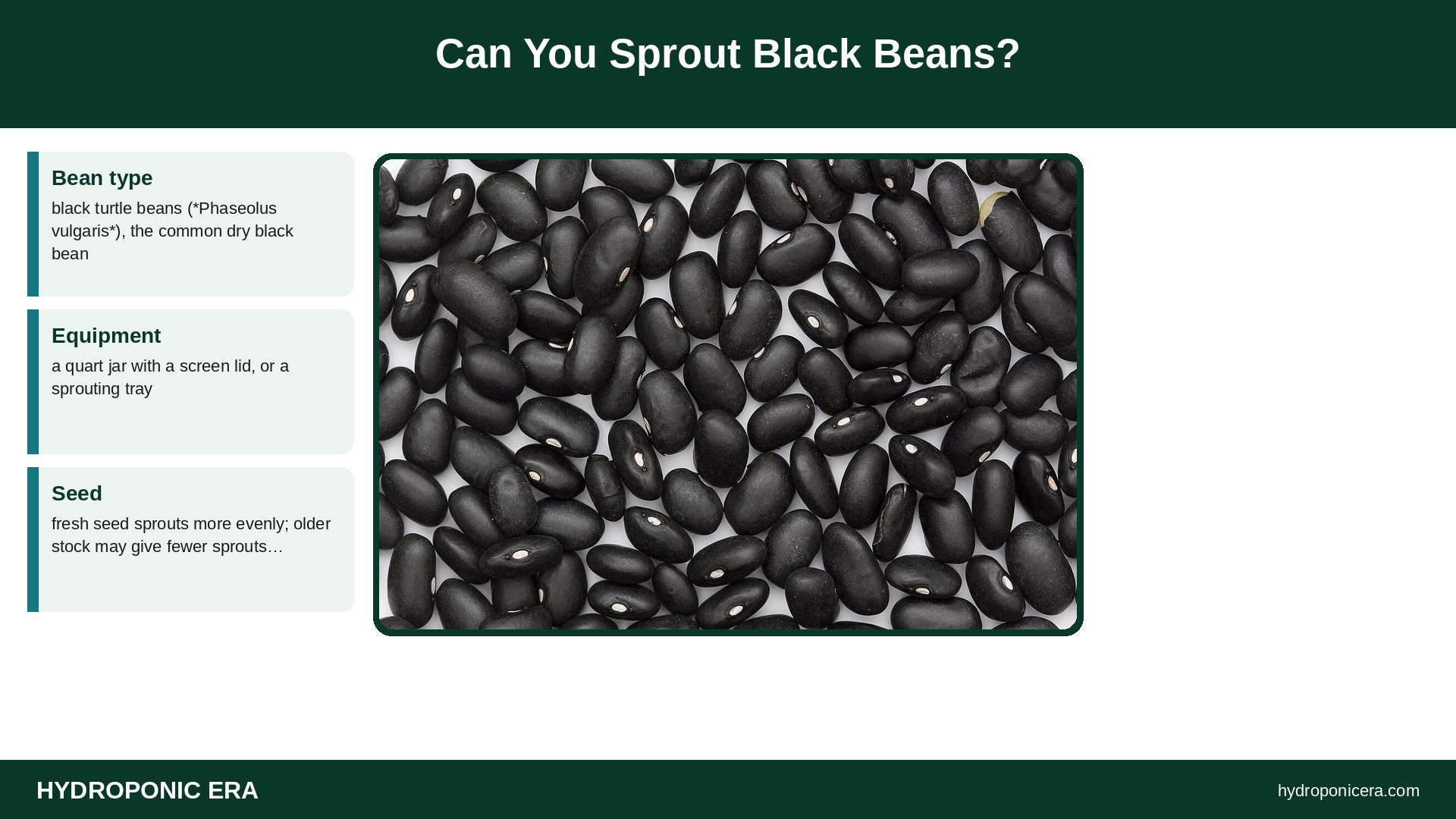
Yes. Black turtle beans sprout readily with the same soak-and-rinse method used for mung bean sprouts and chickpea sprouts. Sproutpeople’s day-by-day photos show dry beans soaked, then rinsed and drained every 12 hours, with the sprouts ready after one to three rinse cycles. Buy seed sold for sprouting, not old pantry beans (our guidance).
- Bean type: black turtle beans (*Phaseolus vulgaris*), the common dry black bean.
- Equipment: a quart jar with a screen lid, or a sprouting tray.
- Seed: fresh seed sprouts more evenly; older stock may give fewer sprouts (our guidance).
If you are new to jar sprouting, start with our how to grow sprouts in a jar guide.
How Long Do Black Bean Sprouts Take?
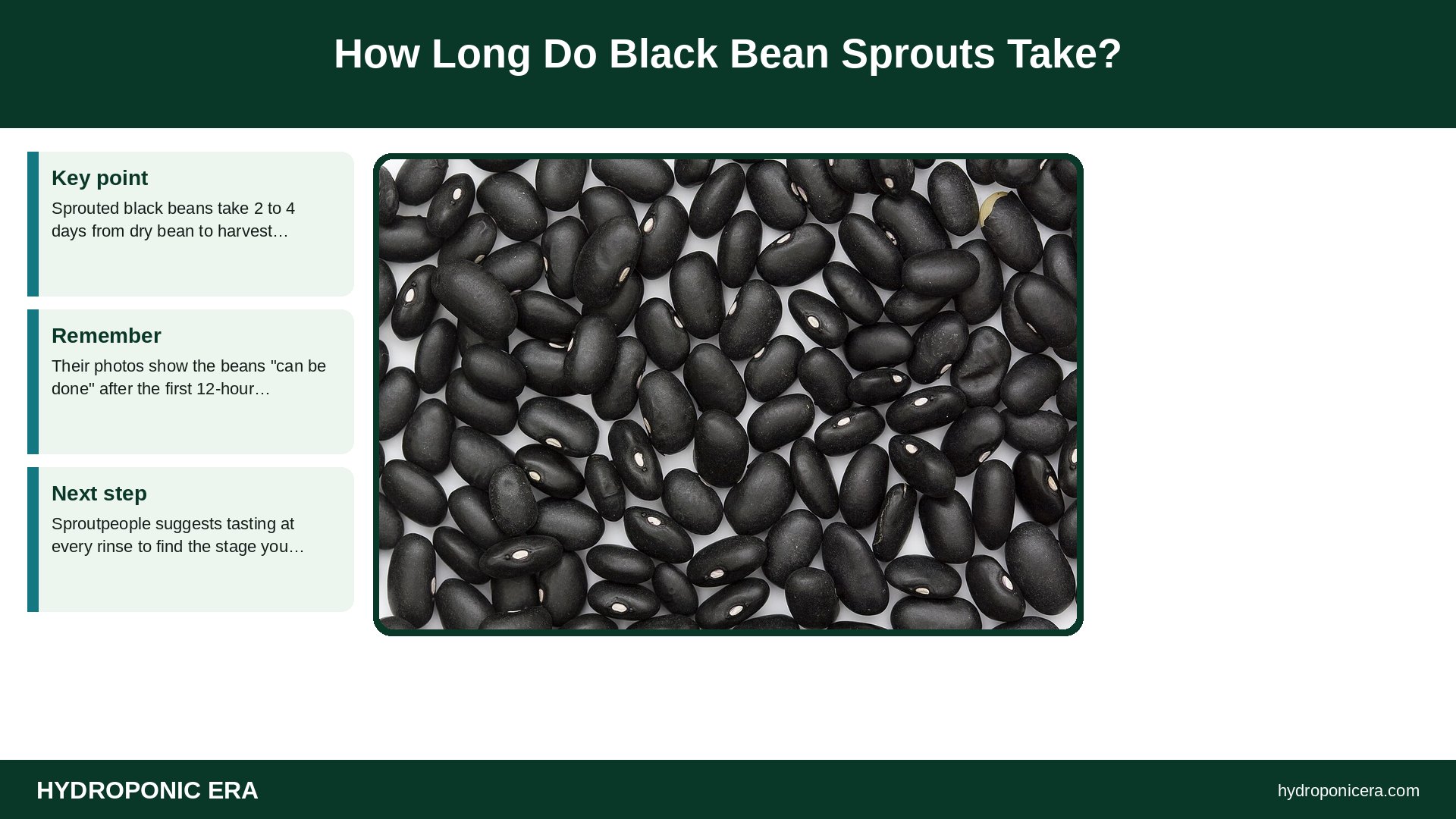
Sprouted black beans take 2 to 4 days from dry bean to harvest, according to Sproutpeople. Their photos show the beans “can be done” after the first 12-hour rinse cycle, with one or two more cycles if you want a longer tail. Sproutpeople suggests tasting at every rinse to find the stage you like best.
- Rinse 1/2 cup (about 100 g) of dry beans and remove broken ones.
- Soak in cool water for about 12 hours.
- Drain well, then rinse and drain again.
- Keep the jar tilted, out of direct sun, at room temperature.
- Rinse and drain every 12 hours (twice a day).
- Harvest when the root tail is 1/4 to 1/2 inch (6 to 12 mm) long (our guidance).
A short tail is best because long tails turn fibrous and the beans can start to sour (our guidance). With a 2:1 yield, 1/2 cup of dry beans gives about 1 cup of sprouts.
Are Black Bean Sprouts Safe to Eat Raw?
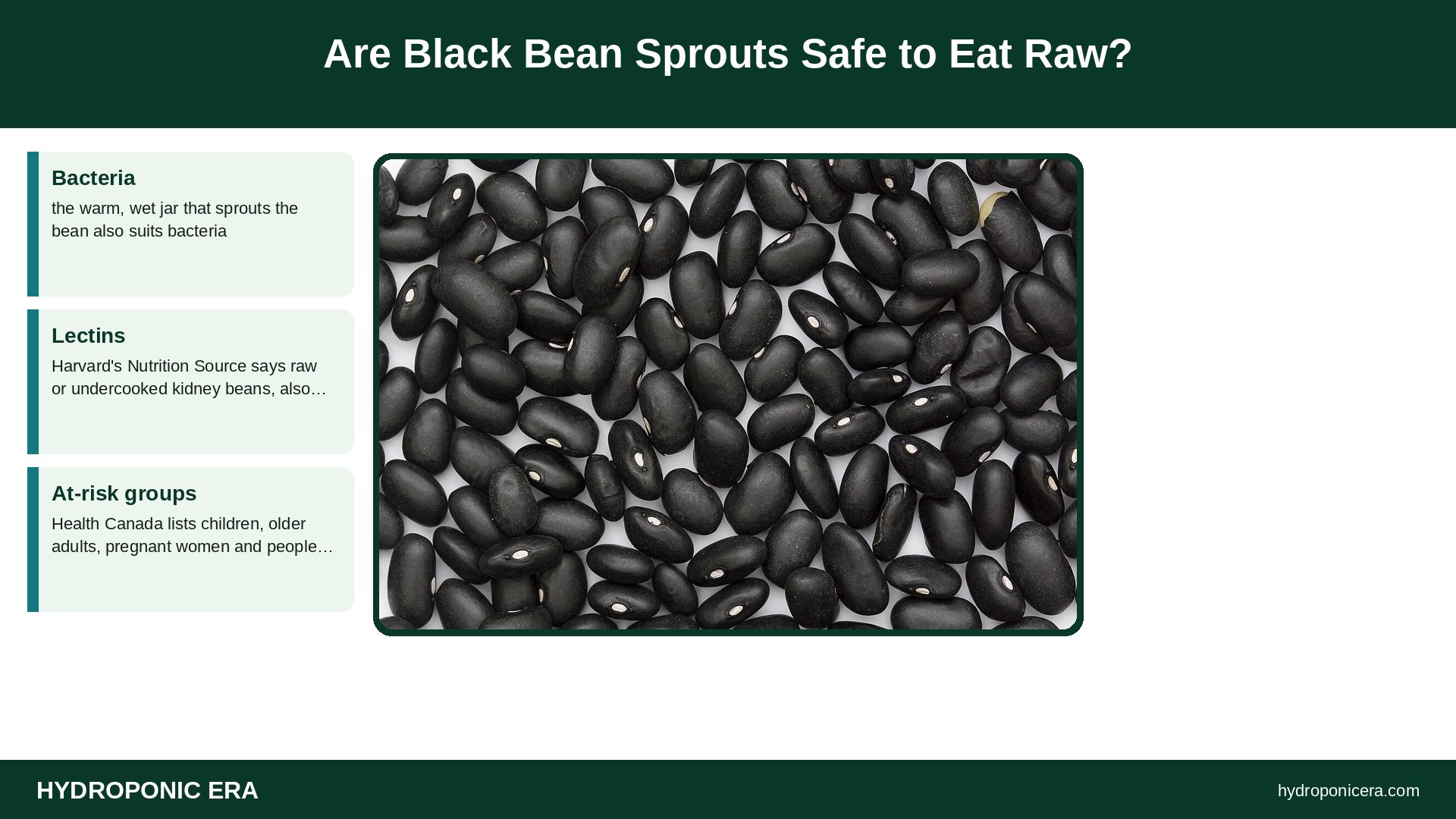
No, black bean sprouts should not be eaten raw. Sproutpeople says black beans should be cooked even when sprouted. Health Canada says sprouts can carry E. coli and Salmonella and advises against eating any raw or undercooked sprouts. An Ask Extension expert adds that warm, humid sprouting conditions raise the risk of these bacteria.
- Bacteria: the warm, wet jar that sprouts the bean also suits bacteria.
- Lectins: Harvard’s Nutrition Source says raw or undercooked kidney beans, also *Phaseolus vulgaris*, contain phytohaemagglutinin, a lectin that can cause nausea, vomiting and diarrhea.
- At-risk groups: Health Canada lists children, older adults, pregnant women and people with weakened immune systems.
Harvard notes that sprouting beans lowers lectin activity, but it does not say sprouting makes raw beans safe. Treat them as an ingredient to cook.
How Should You Cook Black Bean Sprouts?
Cook black bean sprouts with wet, high heat. Harvard’s Nutrition Source says boiling or stewing inactivates most lectins, while low-heat slow-cooker simmering of raw beans or undercooking will not remove them all. The Ask Extension expert cites FDA advice to cook sprouts to at least 135°F (57°C); for beans, a full boil is the safer choice (our guidance).
- Soups and stews: add the sprouts and boil until tender, usually 20 to 30 minutes (our guidance).
- Chili: bring to a full boil before any slow simmer.
- Avoid: adding raw sprouts to a slow cooker on low.
- Avoid: quick sautés that leave the bean hard in the middle.
Sproutpeople describes the flavor as a “creamy bean for soups,” and sprouted beans cook faster than dry ones (our guidance). Rinse the sprouts in cool running water before cooking, as Health Canada advises.
How Do You Store Black Bean Sprouts?
Store the sprouts in the refrigerator as soon as they are harvested. Health Canada says sprouts should be refrigerated, eaten within a few days, and thrown away if they lose crispness, look dark or smell musty. Drain them well first, because excess water speeds spoilage (our guidance).
- Dry first: spread on a towel for 30 minutes before chilling.
- Container: a lidded container or bag lined with paper towel.
- Shelf life: use within 2 to 3 days (our guidance).
- Hygiene: wash hands, jars and boards with warm soapy water, as Health Canada advises.
Why Are My Black Bean Sprouts Not Sprouting or Smelling Sour?
Most sprouting problems come from old seed, poor drainage or warm rooms. Beans that sit in water after rinsing can ferment and smell sour. Health Canada says to discard sprouts that smell musty or look dark. Beans that never crack open after 24 hours are usually old or dead seed (our guidance).
- No sprouts: test seed first; see our seed viability test.
- Sour smell: drain better and rinse more often; discard if it persists.
- Slimy beans: throw the batch out; do not try to wash and cook it.
- Uneven sprouting: remove hard, unswollen beans after the soak.
For more legume options, compare soybean sprouts and lentil sprouts, or browse our sprouting seeds guide.
What Nutrients Do Black Bean Sprouts Have?
Sproutpeople lists the sprouted beans as a source of vitamins A, B, C and E, plus calcium, iron, magnesium, niacin, phosphorus and potassium, with 20 to 25% protein. These are seller figures, not lab tests of your batch. Harvard notes that legumes are linked in population studies with lower rates of heart disease and type 2 diabetes.
- Protein: 20 to 25%, per Sproutpeople.
- Fiber and minerals: typical of cooked dry beans (our guidance).
- Cooking losses: Ask Extension notes water-soluble vitamins can leach into cooking water, so use the broth.
FAQ About Black Bean Sprouts
Can I sprout grocery store black beans?
Often yes, but seed sold for sprouting is cleaner and more reliable.
How long should I soak black beans?
About 12 hours, then rinse and drain twice a day.
Can you eat black bean sprouts raw?
No. Cook them thoroughly first.
Do black bean sprouts need light?
No. Room light is fine; keep them out of direct sun.
Why do my sprouts smell sour?
Poor drainage or warm temperatures; discard musty batches.
How long do black bean sprouts last?
A few days in the refrigerator.
Sources
- Sproutpeople — Black Turtle Bean Sprouts
- Health Canada — Food Safety Tips for Sprouts
- Harvard T.H. Chan School of Public Health, The Nutrition Source — Lectins
- Ask Extension — Impact of Cooking on Different Sprouts
- Photo credits (Wikimedia Commons, edited with titles): Black bean sprouts by Fumikas Sagisavas (CC0); Black Turtle Bean by Sanjay Acharya (CC BY-SA 3.0)