
Quick Answer: hydroponic farm crop selection
hydroponic farm crop selection should start with system fit, cycle time, labor intensity, market demand you can actually sell into, and risk tolerance—not a viral “most profitable crop” list. Leafy greens and many herbs usually match NFT, DWC, and small protected systems better than heavy fruiting vines. Fruiting crops can work in Dutch bucket or drip systems if you accept pollination, trellising, longer cycles, and stricter environment control. This guide is a decision framework only. It does not invent ROI, prices, or cost tables.
Business cluster context: how to start a small hydroponic farm, how to start a farm, and hobby vs small commercial hydroponics (draft sibling).
Key Takeaways
- Oklahoma State’s hydroponics fact sheet lists tomatoes, lettuce, cucumbers, peppers, and herbs among crops commonly associated with soilless production—use that as a crop menu, not a profitability ranking.
- UF/IFAS HS405 (hydroponic vegetable production in Florida) frames commercial hydroponics as market- and environment-sensitive; crop mix shifts with demand and innovation—not a static recipe.
- UF/IFAS HS1422 and HS1279 show why leafy greens dominate many small hydroponic systems: shorter cycles and system compatibility.
- UMass Extension’s hydroponic systems overview notes greenhouse environment control remains central whether you grow conventionally or hydroponically—crop choice cannot outrun a bad climate system.
- Virginia Tech SPES-467 reminds edible producers that food-safety procedures (cleaning between rotations, water quality) are part of operating reality when you sell food.
- Pick crops you can harvest, pack, and sell consistently before you pick crops that merely “look premium” online.
Related HydroponicEra guides
- Best plants for hydroponics
- Hydroponic greenhouse for beginners
- DWC vs NFT vs Dutch bucket (draft sibling)
- Vertical farming for beginners
- Grow lettuce hydroponically

Start hydroponic farm crop selection with constraints
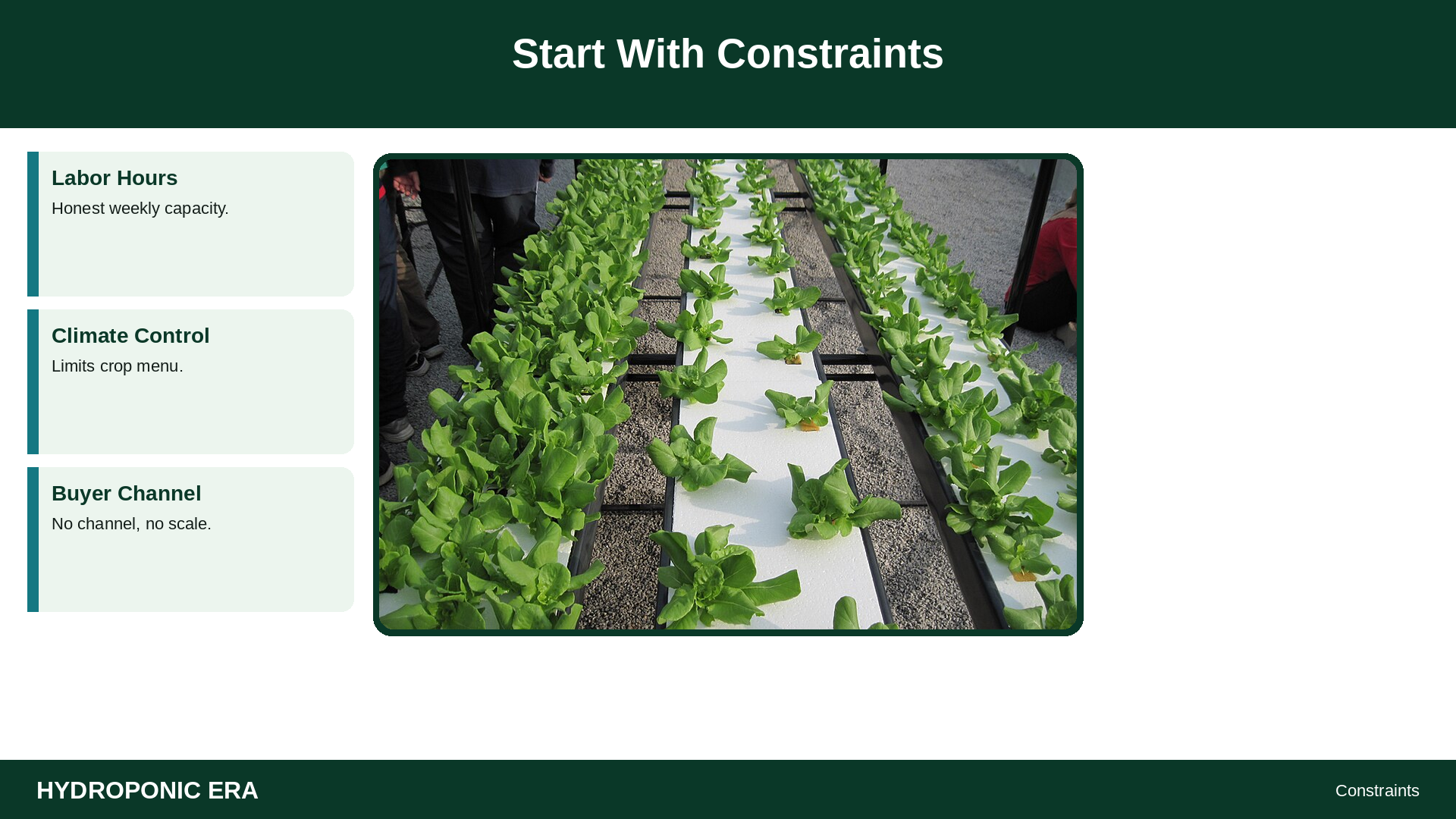
Crop selection fails when growers begin with “I want strawberries and beefsteak tomatoes in a closet NFT.” Begin with constraints:
- What system do you already have (or can build safely)?
- How many labor hours exist per week—honestly?
- What is your climate control capability (heat, cooling, humidity, light)?
- Who will buy the harvest, at what quality standard?
- What food-safety and labeling rules apply if you sell?
OSU’s advantages list for hydroponics (control of nutrients, water efficiency, density potential) only helps if your operations can use that control consistently.
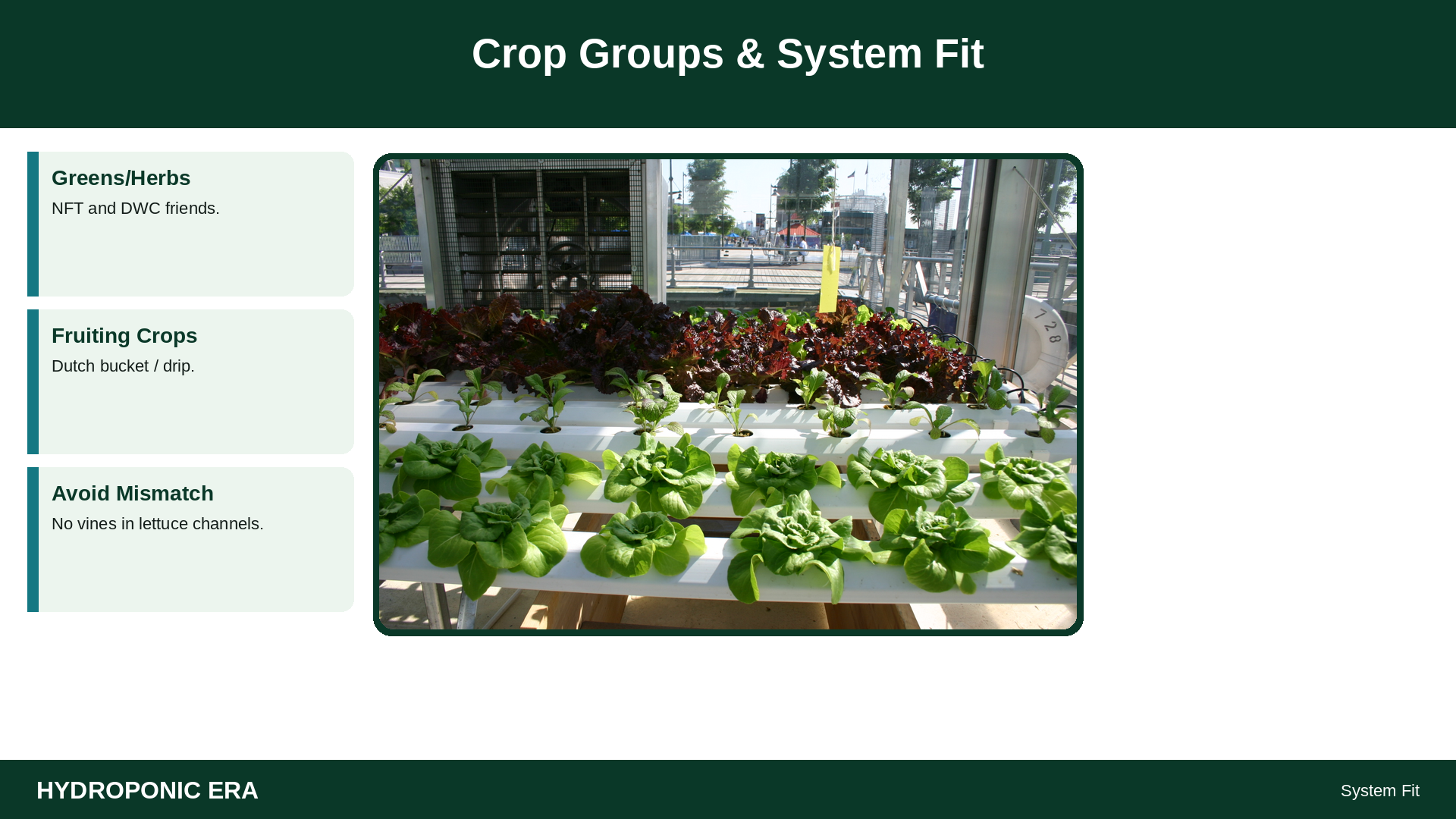
Crop Groups and Typical System Fit
| Crop group | Often fits | Harder fit | Labor notes |
|---|---|---|---|
| Lettuce / leafy greens | NFT, DWC/raft, small channels | Deep Dutch buckets (oversized) | Frequent harvest/packing cadence |
| Culinary herbs (basil, mint, cilantro) | NFT, DWC, towers | Systems without airflow | Succession planting; pest scouting on soft tips |
| Microgreens | Shallow trays (sometimes soilless) | Deep water channels meant for mature heads | Very fast cycles; sanitation discipline |
| Tomatoes / peppers | Dutch bucket, drip/media | Tiny NFT lettuce channels | Trellis, pruning, pollination |
| Cucumbers | Dutch bucket / drip | Crowded towers | Vigor, training, pollination type |
| Strawberries | Gutters, towers designed for berries | Deep raft lettuce systems | Pollination, runner management |
Use crop pages for culture details: basil, cilantro, spinach, cucumbers, tomatoes, peppers, strawberries, microgreens.
Decision Matrix You Can Score Yourself
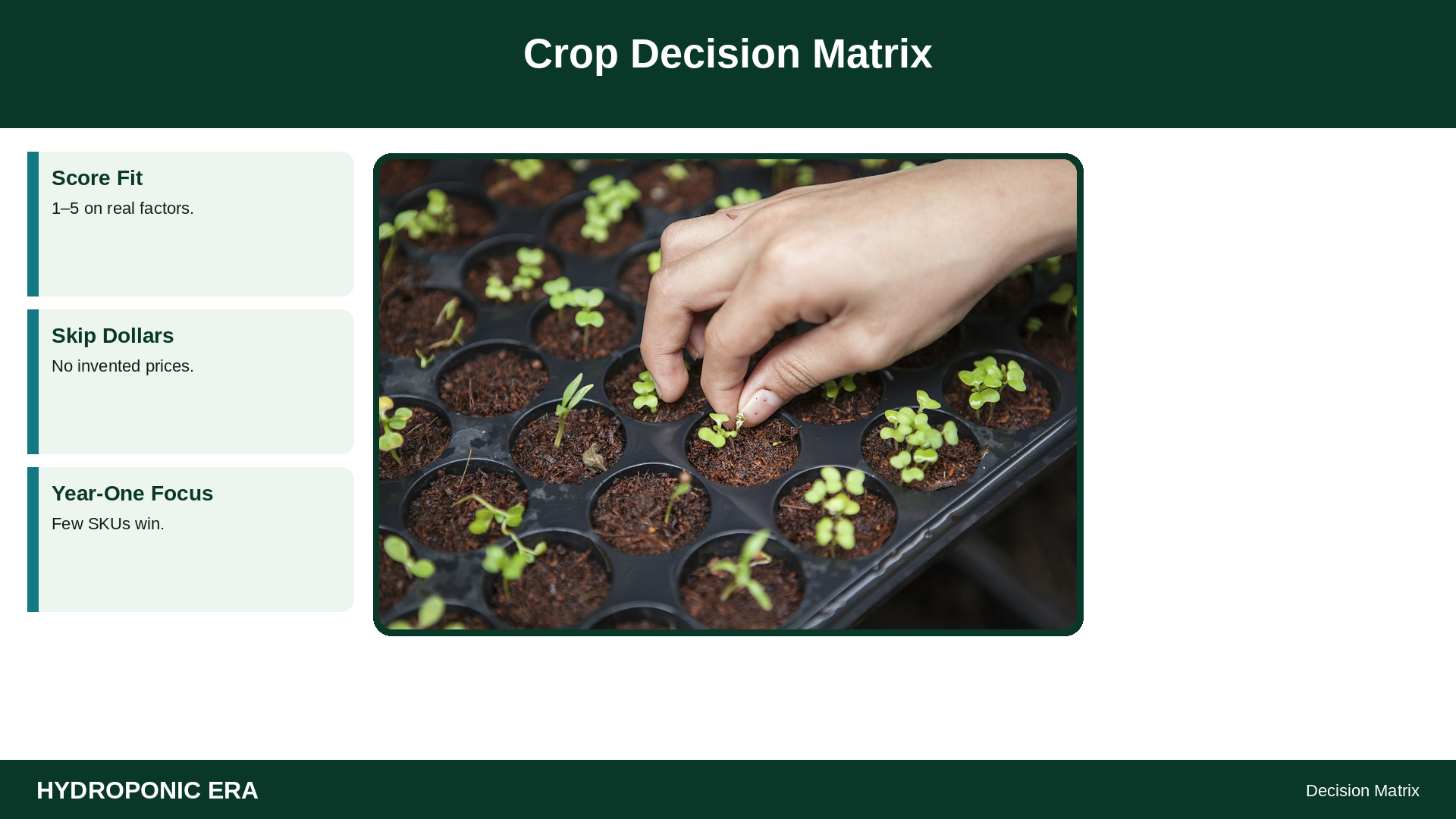
Score each candidate crop 1–5 on factors below. Do not invent dollar returns—score operational fit.
| Factor | Ask | Low score means |
|---|---|---|
| System match | Does hardware already suit this crop? | Expensive rebuilds |
| Cycle speed | How quickly can you learn and cash-flow harvests? | Long waits before feedback |
| Environment demand | Can you hold temperature/humidity/light? | Chronic stress and pests |
| Labor skill | Trellis, prune, pollinate, pack? | Quality failures |
| Market access | Do buyers already want this weekly? | Unsold perishable inventory |
| Sanitation load | Can you clean between rotations? | Food-safety and disease risk |
| Risk diversity | Are you betting the farm on one crop? | Single-point failure |
A crop with glamorous photos but a total score of “low” on system match + market access is a hobby experiment, not a farm plan.
Leafy Greens First: Why Many Small Farms Start Here
UF’s small hydroponic lettuce work (HS1422) and leafy greens protected-culture materials (HS1279) illustrate why greens dominate teaching and small systems: manageable plant size, compatibility with NFT/DWC, and relatively short production windows. That does not mean greens are “easy money.” It means feedback cycles are shorter, so you learn fertigation and sanitation faster.
Herbs can ride similar systems but bring aroma, pest, and bolting nuances (cilantro heat sensitivity; basil warmth preference). Microgreens compress cycles further but demand tray sanitation and dense labor at harvest.
Fruiting Crops: Only After the Room Is Stable
Tomatoes, peppers, and cucumbers need fruiting hardware, higher daily light, pollination plans, and patient training. KY’s small-scale soilless tomato/pepper/cucumber guide and UF greenhouse tomato/cucumber handbooks show commercial-style cultural intensity even at smaller scales. If your leafy system is still fighting algae, pH swings, and fungus gnats, adding cucumbers multiplies chaos.
Pollination article: indoor pollination for hydroponic fruiting plants.
Market Filters (No Price Fabrication)
Before scaling a crop, answer with evidence from your area—not national averages invented online:
- Who buys weekly (restaurants, markets, CSA, retail)?
- What quality specs do they reject?
- What pack sizes do they actually order?
- What happens to unsold product on a hot Friday?
- Are you competing with field-season gluts?
HS405 notes industry shifts with market demand. Your crop mix should be allowed to change as buyers change—without treating last year’s mix as sacred.
Labor and Workflow Mapping
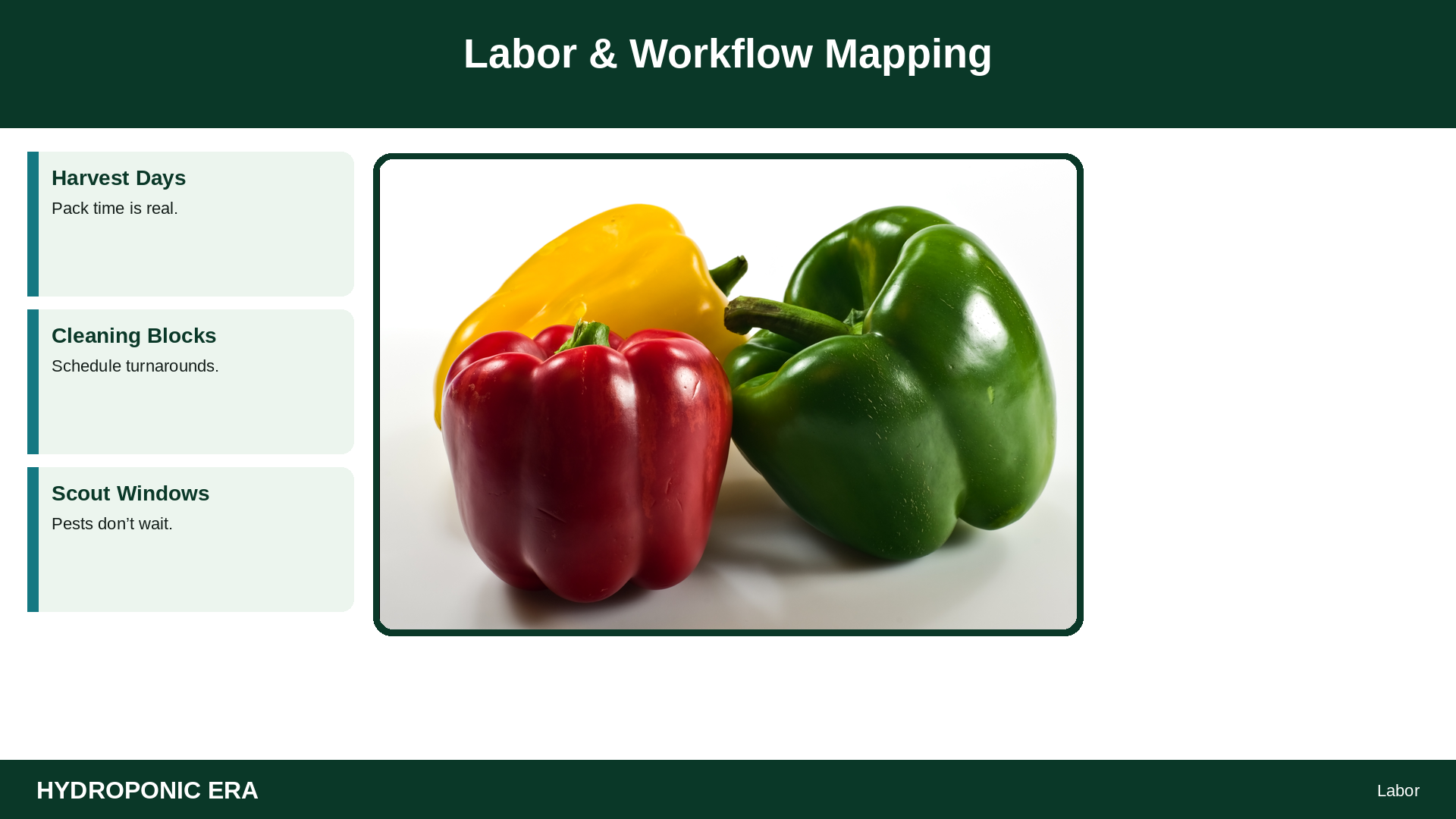
Sketch a weekly calendar:
- Seeding / transplant days
- Scouting days
- Reservoir measurement days
- Harvest / pack days
- Between-crop cleaning blocks
If harvest and cleaning collide on the only free afternoon you have, the crop mix is wrong for your life—even if the plants would grow.
Risk Stacking: What Not to Do First
- Do not launch five fruiting crops in an untested greenhouse
- Do not promise year-round supply before you complete several successful cycles
- Do not ignore food-safety SOPs if you sell ready-to-eat leaves
- Do not choose crops solely because a social post claimed a payback period
Sample Starter Mixes (Framework Examples)
| Scenario | Crop emphasis | Why |
|---|---|---|
| First commercial-leaning NFT | Lettuce + 1–2 herbs | System match, faster learning |
| Restaurant herb focus | Basil + cilantro successions + mint | Culinary demand; manage bolting/heat |
| Dutch bucket bay ready | Cherry tomatoes or peppers first | One fruiting crop before cucumbers |
| Mixed teaching farm | Greens primary + small fruiting demo | Education without betting all sites |
These are starting patterns, not prescriptions or income claims.
Common Mistakes
- Choosing crops from profit memes
- Growing what you love but cannot sell
- Forcing fruiting vines into lettuce channels
- Underestimating packing labor for greens
- Skipping buyer conversations until week 12
- No sanitation plan between rotations
Troubleshooting Crop-Mix Problems

| Symptom | Likely crop-selection issue | Adjustment |
|---|---|---|
| Constant plant stress | Environment demand too high | Simplify to greens/herbs |
| Unsold harvests | Market mismatch | Shrink planting; talk to buyers |
| Labor burnout | Too many high-touch crops | Cut SKUs; standardize |
| Disease carryover | Cleaning gaps + dense mix | Fewer crops; stricter turnarounds |
| Empty channels for weeks | Long-cycle crop dominance | Add short-cycle successions |
What to Check Before You Commit Seed Budget
- Written list of system sites and crop assignments
- Buyer interest evidence (messages, LOIs, market rules)—not vibes
- Labor calendar that fits real life
- Cleaning SOP between rotations
- One primary crop + limited secondary crops for year one
- Learning goals for cycle 1–3 (not just revenue goals)
Seasonality and Protected Culture
Even indoors, electricity costs, cooling loads, and pest pressure change through the year. A crop that fits your winter greenhouse may fight you in late summer humidity. UF HS405’s industry narrative shows commercial mixes evolving with weather and markets—build flexibility into planning.
If you lack cooling, favor crops that tolerate your warm season or reduce density to improve airflow. Do not add cucumbers to a heat-stressed lettuce house just to “diversify.”
Packout and Shelf-Life Filters
Crop selection includes what happens after harvest. Soft herbs bruise. Lettuce wilts without cold handling. Cherry tomatoes travel differently than beefsteaks. If you lack cold storage, choose crops and pack methods that match reality—or stay hobby scale.
Ask buyers how they store product and what defects cause rejection. That conversation prevents growing beautiful plants nobody accepts.
Learning Roadmap Tied to Crops
- Cycle 1–2: one leafy crop, perfect sanitation and EC/pH habits.
- Cycle 3–4: add one herb with succession planting.
- Later: consider one fruiting crop on appropriate hardware with a pollination plan.
Skipping ahead usually rewrites the same failure in a more expensive system.
Worked Example Scoring (Illustrative)
Imagine you own a working NFT system, 10 honest labor hours weekly, one farmers-market channel interested in salad mix, and no Dutch buckets yet. Score lettuce high on system match, cycle speed, and market access; score slicing cucumbers low on system match and labor. The framework points to greens first—even if cucumbers are personally exciting. Excitement belongs in a later hardware phase.
Rewrite the scores with your real constraints. The value is the method, not this imaginary grower’s answers.
SKUs vs Varieties
Restaurants may want “basil,” not five basil cultivars that pack differently. Markets may want mixed lettuce colors. Decide whether diversity helps marketing or destroys packing efficiency. Standardization often wins in year one.
Scorecard: hydroponic farm crop selection without hype
Score each candidate crop 1–5 on this card to keep hydroponic farm crop selection honest.
| Factor | Ask | Low score means |
|---|---|---|
| System fit | Does my system actually grow this well? | Fighting hardware weekly |
| Cycle time | How fast can I learn and harvest? | Cash/time locked in long cycles |
| Labor | Prune, trellis, pollinate, pack? | Hidden labor sinks |
| Market | Who already wants this at a real price? | Growing into a void |
| Risk | Disease/pest/climate sensitivity? | Fragile promises to buyers |
- Leafy crops often score higher for small NFT/DWC starters than heavy fruiting vines.
- Hydroponic farm crop selection is a filter, not a viral “most profitable” list.
- Pilot one crop through a full clean cycle before promising volume.
hydroponic farm crop selection: practical review sheet
Use this review sheet to keep hydroponic farm crop selection actionable after you finish the main guide.
- What did you measure today related to hydroponic farm crop selection?
- What did you change with your hands (not just what you bought)?
- What will you re-check in 24–48 hours about hydroponic farm crop selection?
- Which linked HydroponicEra guide should you reread next?
- What cleaning or logging step did you skip last cycle?
| Item | Today | Next check |
|---|---|---|
| Environment | ||
| Solution (pH/EC) | ||
| Roots / pests / biofilm | ||
| Plant response |
Print or duplicate this table in your notes app. The goal is not paperwork—it is fewer repeated mistakes around hydroponic farm crop selection.
When results are unclear, slow down and restate the problem in one sentence that includes hydroponic farm crop selection, then list the last three changes you made. Most home-system failures come from stacked changes without logs. Keep hydroponic farm crop selection paired with basic hygiene: clean reservoirs, honest meter calibration, and root inspection. If you cannot explain your last adjustment, do not add another product. Re-read the troubleshooting section and apply one change at a time while you watch how hydroponic farm crop selection interacts with pH, temperature, and oxygen.
When results are unclear, slow down and restate the problem in one sentence that includes hydroponic farm crop selection, then list the last three changes you made. Most home-system failures come from stacked changes without logs. Keep hydroponic farm crop selection paired with basic hygiene: clean reservoirs, honest meter calibration, and root inspection. If you cannot explain your last adjustment, do not add another product. Re-read the troubleshooting section and apply one change at a time while you watch how hydroponic farm crop selection interacts with pH, temperature, and oxygen.
When results are unclear, slow down and restate the problem in one sentence that includes hydroponic farm crop selection, then list the last three changes you made. Most home-system failures come from stacked changes without logs. Keep hydroponic farm crop selection paired with basic hygiene: clean reservoirs, honest meter calibration, and root inspection. If you cannot explain your last adjustment, do not add another product. Re-read the troubleshooting section and apply one change at a time while you watch how hydroponic farm crop selection interacts with pH, temperature, and oxygen.
hydroponic farm crop selection: habits that compound
These habits keep hydroponic farm crop selection practical between deep cleans and big changes.
- Keep notes when you work on hydroponic farm crop selection so small changes stay visible across weeks.
- Revisit hydroponic farm crop selection after any reservoir reset, media change, or heat wave.
hydroponic farm crop selection FAQs
What is the best crop for a small hydroponic farm?
There is no universal best. Many small systems start with leafy greens/herbs because of system fit and shorter cycles (UF leafy hydroponic materials). Your market and labor may point elsewhere.
Are tomatoes more profitable than lettuce?
This guide does not claim profitability numbers. Tomatoes demand different systems, light, and labor. Compare operational fit first.
Can I grow strawberries and lettuce in one beginner system?
Usually poorly. Different architectures and cultural needs fight each other. Separate systems or choose one focus.
How many crops should a first-year small farm grow?
Fewer than you think—often one primary and one secondary. Complexity compounds failures.
Do I need a greenhouse?
Not always, but environment control limits crop options. UMass notes greenhouse climate systems remain central for many hydroponic operations.
Where do food-safety rules fit into crop choice?
Ready-to-eat leaves bring packing and sanitation expectations. VT SPES-467 is a starting point for thinking, not a substitute for local compliance advice.
Sources
- Oklahoma State University Extension — Hydroponics (HLA-6442)
- UF/IFAS EDIS — Hydroponic Vegetable Production in Florida (HS405)
- UF/IFAS EDIS — Growing Lettuce in Small Hydroponic Systems (HS1422)
- UF/IFAS EDIS — Leafy Greens in Hydroponics and Protected Culture (HS1279)
- UMass Extension — Hydroponic Systems
- Virginia Cooperative Extension — Hydroponic Production of Edible Crops: Food Safety Considerations (SPES-467)
- University of Kentucky — Tomatoes, Peppers and Cucumbers in Small-Scale Soilless Systems (W844-C)
1 thought on “Small Hydroponic Farm Crop Selection Guide: Match Crops to Your System”