
Wick system hydroponics is the simplest passive way to grow without soil: a cotton or nylon wick pulls nutrient solution from a reservoir up into a soilless medium by capillary action, with no pump, timer or electricity. It works well for lettuce, herbs and other small, light feeders, but it can’t keep up with thirsty fruiting plants such as tomatoes.
| Question | Short answer |
|---|---|
| Best crops | Leaf lettuce, basil, mint, parsley, chives, baby bok choy |
| Poor crops | Tomatoes, peppers, cucumbers, squash (they drink faster than a wick can supply) |
| Power needed | None for the system itself; only your grow light if you grow indoors |
| Typical size | 1–5 gallon reservoir for 1–6 small plants |
| Biggest risk | Salt buildup in the medium and wilting on hot days |
What Is Wick System Hydroponics and How Does It Work?
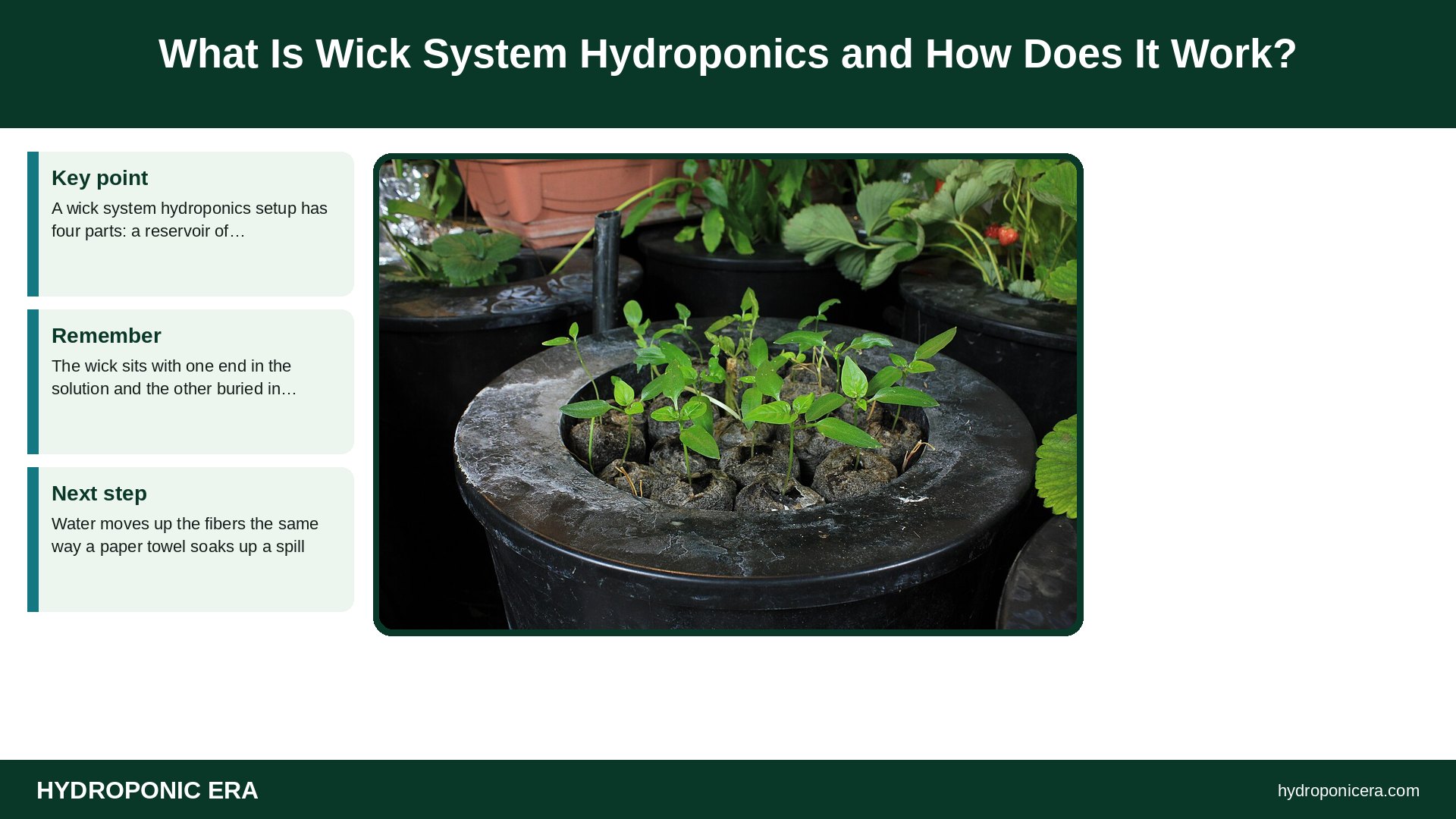
A wick system hydroponics setup has four parts: a reservoir of nutrient solution, one or more wicks, a container of soilless medium, and the plant. The wick sits with one end in the solution and the other buried in the medium near the roots. Water moves up the fibers the same way a paper towel soaks up a spill.
University of Illinois Extension describes passive hydroponics exactly this way: nutrients in solution are drawn up by the growing medium or a wick and passed to the roots without pumps. The University of Nebraska–Lincoln’s “lunchbox hydroponics” project uses the same idea, with a piece of clothesline rope pulling solution into rockwool.
The roots stay in moist medium rather than hanging in water, so they get air from the pore spaces. That is the key difference from the Kratky method, where roots hang in the solution and breathe through an air gap above it.
Which Plants Grow Well in Wick System Hydroponics?
In wick system hydroponics, water moves only as fast as capillary action allows. Small, leafy plants with modest water demand do well. Large plants that transpire heavily under strong light will wilt by afternoon.
| Good fit | Marginal | Poor fit |
|---|---|---|
| Leaf lettuce, basil, mint, parsley, chives, cilantro, oregano, baby bok choy | Strawberries, compact kale, dwarf herbs in larger pots | Tomatoes, peppers, cucumbers, zucchini, melons |
If you want fruiting crops, move to an active system. Our guides to the best plants for hydroponics and plants that struggle in home hydroponics explain why.
How Do You Build a DIY Wick System Hydroponics Setup?

You can build a small wick system hydroponics unit for well under $20 with a storage tote or a 2-liter bottle. Here is a simple build for two to four lettuce plants.
- Pick an opaque reservoir. A 1–2 gallon tote with a lid works well. Light inside the reservoir grows algae, so avoid clear plastic or wrap it.
- Choose wick material. Nylon or acrylic rope, felt strips or polyester yarn resist rot better than 100% cotton. Use strands about 3/8 inch thick.
- Cut wicks long enough. Each wick should reach the bottom of the reservoir and run several inches up into the medium. Use two wicks per plant for anything bigger than a seedling.
- Pre-soak the wicks in plain water so capillary flow starts right away.
- Fill the pot with a wicking medium. A 50/50 mix of perlite and vermiculite or coco coir and perlite wicks well. Clay pebbles wick poorly and are a bad choice here. See our growing media guide.
- Keep the lift short. Set the pot just above the solution so the wick only has to lift water a few inches. The higher the lift, the slower the flow.
- Mix a mild nutrient solution. Start at half the label rate for leafy greens, as the UNL project recommends, and check pH.
- Plant and light. Transplant seedlings with a few true leaves. Indoors, give leafy greens 14–16 hours under an LED grow light.
How Do You Manage Nutrients, pH and Water?

Wick system hydroponics is low-maintenance, not no-maintenance. Three habits keep it healthy.
- Watch pH. Most leafy greens and herbs do best around pH 5.5–6.5. Check it when you mix and once a week after. Our pH control guide covers adjustments.
- Prevent salt buildup. Water evaporates from the top of the medium and leaves minerals behind. A white crust is the warning sign. Every two to three weeks, pour plain pH-adjusted water through the pot to flush it. Learn more about salt crust on media.
- Refill before the wick runs dry. Top off with plain water between changes and replace the whole solution every two to three weeks, as explained in our guide on how often to change hydroponic water.
Keep the solution roughly 65–72°F (18–22°C). Warm solution holds less oxygen and encourages root disease; see reservoir temperature for details. An EC meter helps you see whether the plants are using nutrients or water faster. Our EC and TDS guide explains the readings.
Wick System Hydroponics vs Kratky vs DWC: Which Should You Choose?
| Feature | Wick system | Kratky | Deep water culture (DWC) |
|---|---|---|---|
| Pump or power | No | No | Air pump required |
| Where roots live | Moist medium | Solution + air gap | Aerated solution |
| Water delivery speed | Slow | Fast | Fast |
| Best for | Herbs, lettuce, classrooms | Lettuce, short crops | Leafy greens to large plants |
| Main weakness | Can’t feed big plants | One-shot water supply | Needs power and monitoring |
If you outgrow wick system hydroponics, the next step is usually deep water culture. For a broader comparison, see our hydroponic system guide for beginners.
What Are the Most Common Wick System Hydroponics Mistakes?

- Cotton wicks that rot. They work at first, then turn slimy and stop moving water. Synthetic fibers last longer.
- Too few wicks. One thin wick can’t supply a full-size basil plant in summer. Add a second or third.
- The wrong medium. Clay pebbles and coarse bark don’t wick. Fine, airy mixes do.
- Full-strength nutrients. Salts concentrate in the medium, so start mild.
- Clear containers. Light reaches the solution and algae competes with your plants. See algae in reservoirs.
- Choosing heavy feeders. A tomato in a wick pot is a frustrating experiment, not a harvest.
How Do You Troubleshoot Wick System Hydroponics?
| Symptom | Likely cause | Fix |
|---|---|---|
| Wilting by afternoon, recovers at night | Wick can’t supply enough water | Add wicks, shorten the lift, use a smaller plant |
| Soggy, sour-smelling medium | Medium too fine or too much vermiculite | Add perlite; keep the pot slightly higher |
| White crust on top | Salt buildup | Flush with plain water; lower nutrient strength |
| Pale lower leaves | Underfeeding or pH drift | Check EC and pH; refresh the solution |
| Green film in reservoir | Light leak | Use an opaque container or lid |
FAQs About Wick System Hydroponics
Does a wick system need an air pump?
No. In wick system hydroponics, roots get oxygen from the air spaces in the medium. Some growers add an air stone to the reservoir to keep the solution fresh, but it is optional.
What is the best wick material?
Nylon or acrylic rope, felt and polyester yarn are durable choices. Test a strand first: dip one end in water and see how quickly the other end gets wet.
Can you grow tomatoes in a wick system?
You can keep a seedling alive, but a full-size tomato needs far more water than wicks can deliver. Use a Dutch bucket or DWC instead.
How long does lettuce take in a wick system?
Leaf lettuce is usually ready to start harvesting in about four to six weeks from transplant under good light. Growth is a little slower than in DWC because water delivery is slower.
Is wick hydroponics good for kids and classrooms?
Yes. Wick system hydroponics is cheap, quiet and safe because there is no electricity near the water. See our ideas for hydroponics with kids.
Related HydroponicEra Guides
- Kratky method hydroponics
- How to grow lettuce hydroponically
- Best herbs for hydroponics
- How to start hydroponics at home
Sources
- University of Illinois Extension — Using Hydroponics at Home
- University of Nebraska–Lincoln Extension — Lunchbox Hydroponics (G2358)
- University of Florida IFAS — “Set It and Forget It” Hydroponic Lettuce (HS1488)
- University of Hawaii CTAHR — A Suspended Net-Pot, Non-Circulating Hydroponic Method (VC-1)