
Quick Answer: growing media for hydroponics
growing media for hydroponics are soilless materials that anchor roots and manage water–air balance while nutrients come mainly from the solution. Common choices include rockwool (stone wool), expanded clay pebbles (LECA), coco coir, perlite, and related blends. Pick media for your system: rockwool and coco for drip/slabs, clay pebbles for Dutch buckets and many DWC net pots, finer coco carefully (clog risk in recirculating lines). Prep media before planting—rinse, pH-condition when required—and match irrigation frequency to water-holding capacity.
See also hydroponic systems, Dutch bucket, DWC, and supplies.
Key Takeaways
- UF/IFAS EP623 reviews common hydroponic media, including rockwool, coco, and aggregates, with practical pros/cons.
- Oklahoma State’s soilless growing mediums fact sheet covers rockwool, coir, clay pebbles, and related materials used in soilless culture and aquaponics contexts.
- University of Minnesota Extension’s small-scale hydroponics guide compares rockwool, coco, and hydroton-style clay pebbles for home systems and recommends presoaking.
- Media do not replace a complete nutrient program—most are low-fertility anchors.
- Coco quality varies; rinse/buffer as directed to avoid salt surprises.
- Rockwool is sterile and consistent but not biodegradable; handle dry fibers carefully.
- Choose media that will not clog pumps (fine coco dust is a common recirculating headache).
Related HydroponicEra guides
- DWC vs NFT vs Dutch bucket
- Cucumbers hydroponically (draft)
- Air pumps and air stones (draft)
- Water-change guide
What growing media for hydroponics actually do

In soil, the mineral/organic matrix stores water, air, and nutrients. In hydroponics, the nutrient solution carries most fertility. Media mainly:
- Support the plant physically
- Create pore space for roots and oxygen
- Hold a film of nutrient solution between irrigation events
- Sometimes contribute minor cation exchange (notably coco) or almost none (rockwool, many pebbles)
UF EP623 and OSU’s soilless mediums sheet are the backbone references for comparing these behaviors without brand mythology.
Media Comparison Table
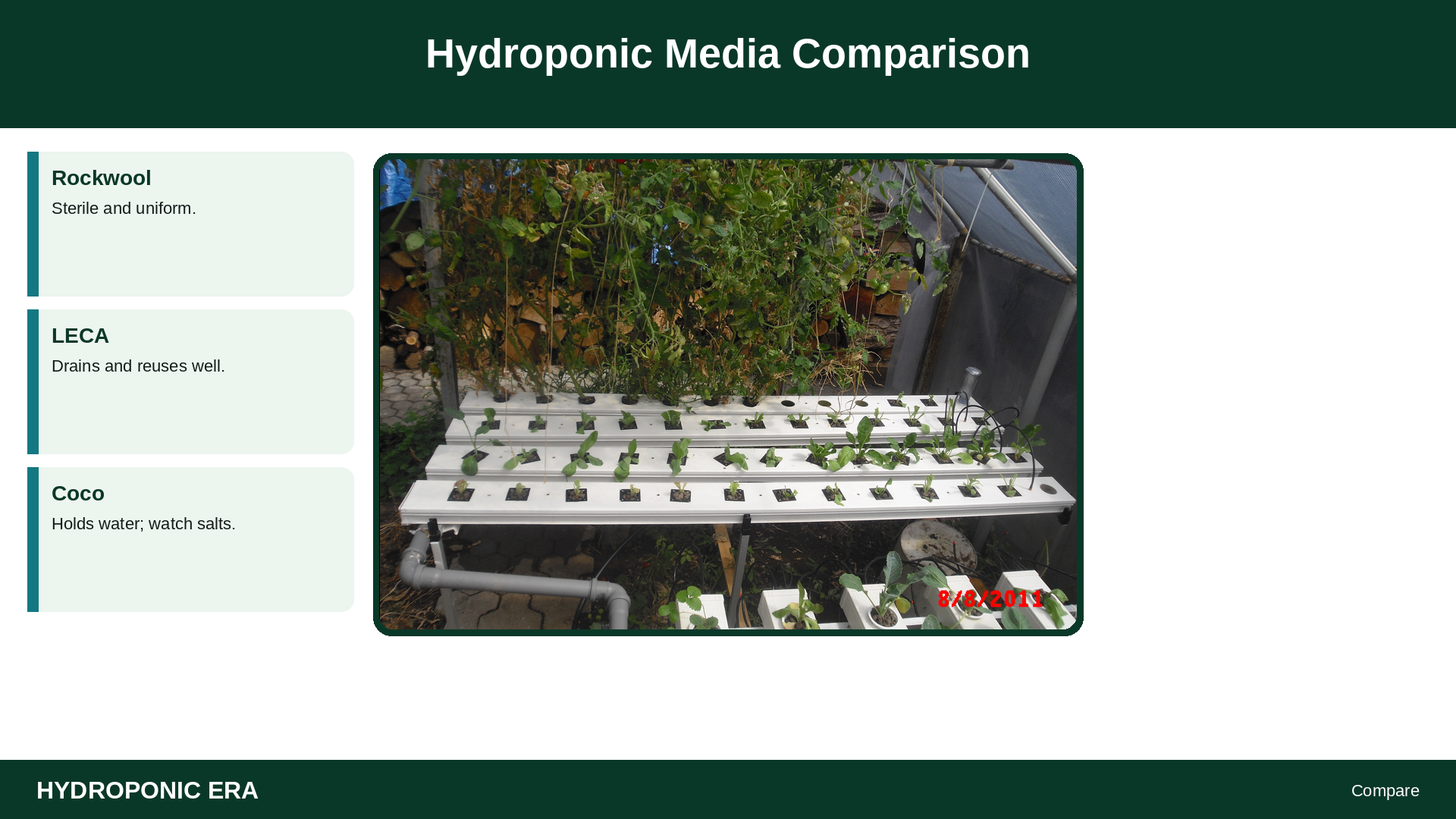
| Media | Best-fit systems | Strengths | Watch-outs |
|---|---|---|---|
| Rockwool / stone wool | Seed starts, slabs, drip | Consistent, sterile, good water/air when managed | Alkaline tendency; disposal; skin/dust care; algae on wet surfaces |
| Expanded clay pebbles | Dutch bucket, DWC net pots, media beds | Reusable, excellent aeration, easy to handle | Low water holding—irrigate reliably; rinse dust |
| Coco coir | Drip, bags, some Dutch buckets | Renewable, good water holding, workable | Variable salts; buffering; fines can clog filters |
| Perlite | Blends, some drip/bucket mixes | Light, aerating | Dust; can float; low CEC |
| Peat blends | Some transplant mixes | Familiar water holding | Not ideal as pure recirculating media; sustainability debates |
| Gravel / pebbles | Some beds / aquaponics | Durable aeration | Heavy; avoid calcareous types that shift pH (UF notes) |
UMN’s small-scale hydroponics table similarly lists rockwool, coconut coir, and hydroton/LECA with home-grower pros and cons, including presoaking guidance.
How to choose growing media for hydroponics systems

- Name the system: NFT often uses plugs only; DWC uses net pots with pebbles or plugs; Dutch bucket wants draining media; drip slabs may use rockwool or coco.
- Match water holding to irrigation reliability. Clay pebbles forgive overwatering better than underwatering; coco forgives brief pump pauses better than bare pebbles.
- Consider reuse and cleaning. Clay pebbles are commonly washed and reused; rockwool is often single-crop.
- Mind filtration. If using coco in recirculating systems, UF notes clogging concerns—prefer chunkier grades and good filtration, or avoid fines in sensitive loops.
- Plan seedling workflow. Many growers start in rockwool or foam plugs, then transplant into pebbles/coco.
- Check pH conditioning needs for rockwool and salt management for coco per product instructions and extension cautions.
Prep Steps Before Planting

- Clay pebbles: Rinse dust thoroughly; soak and drain. UMN recommends soaking substrates and changing soak water before transplanting.
- Rockwool: Follow manufacturer wetting/pH conditioning. Avoid compressing cubes into anaerobic bricks.
- Coco: Hydrate compressed bricks fully; rinse/buffer if directed; discard excess fines when possible.
- Perlite blends: Moisten to reduce dust; wear a mask when pouring dry perlite.
- All media: Start with clean tools and a clean reservoir—media cannot save a filthy system.
Important Variables
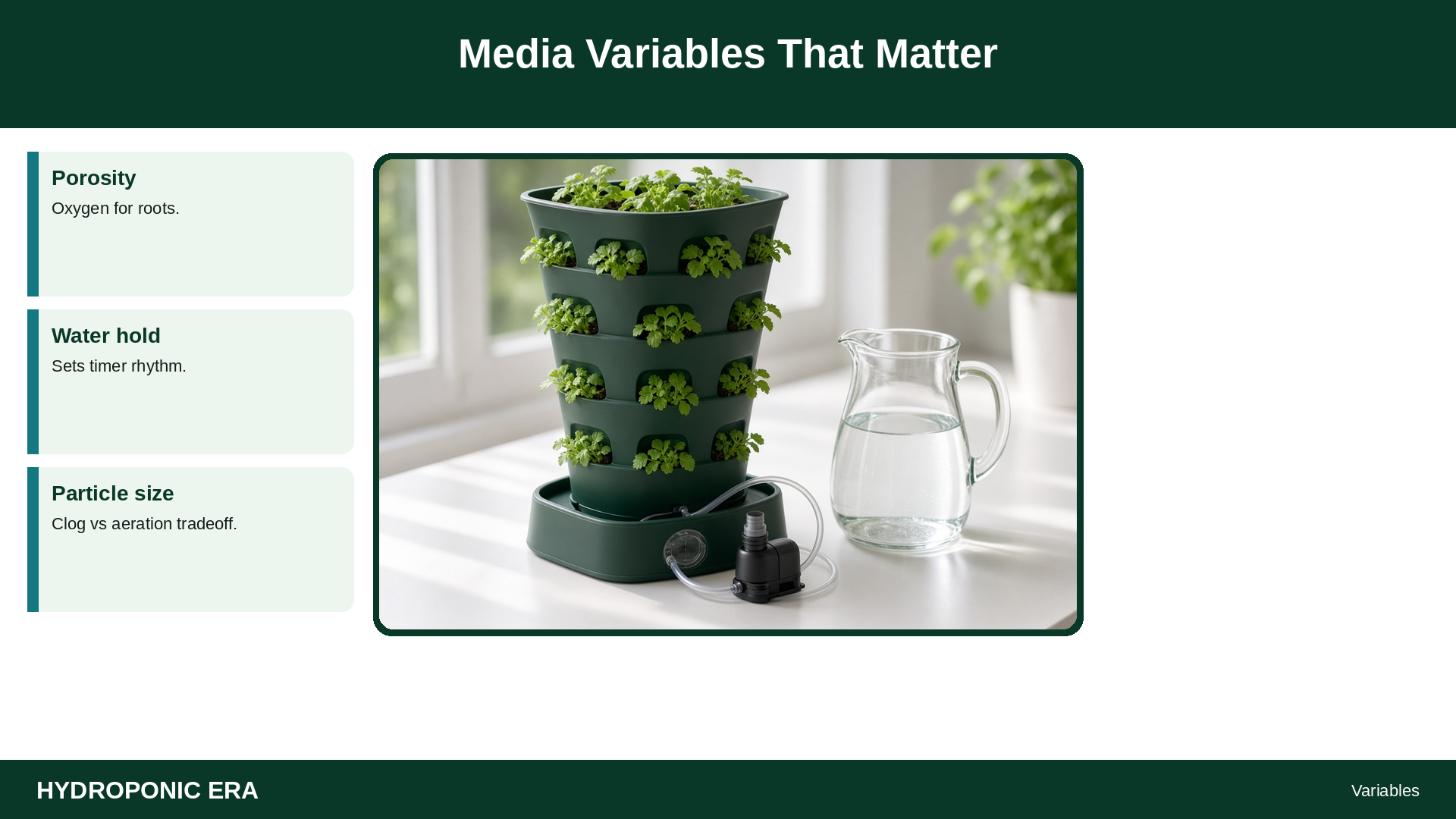
| Variable | Why it matters | Beginner tip |
|---|---|---|
| Air-filled porosity | Root oxygen | Do not keep media saturated with nowhere for air |
| Water holding | Irrigation frequency | Pebbles need more frequent pulses than coco |
| CEC | Nutrient buffering | Coco buffers more than rockwool; still feed a complete solution |
| pH drift contribution | Solution stability | Condition rockwool; avoid limestone gravel |
| Particle size | Clogs and aeration | Keep fines out of pumps |
| Reuse hygiene | Disease carryover | Wash and, when appropriate, sterilize between crops |
Common Mistakes
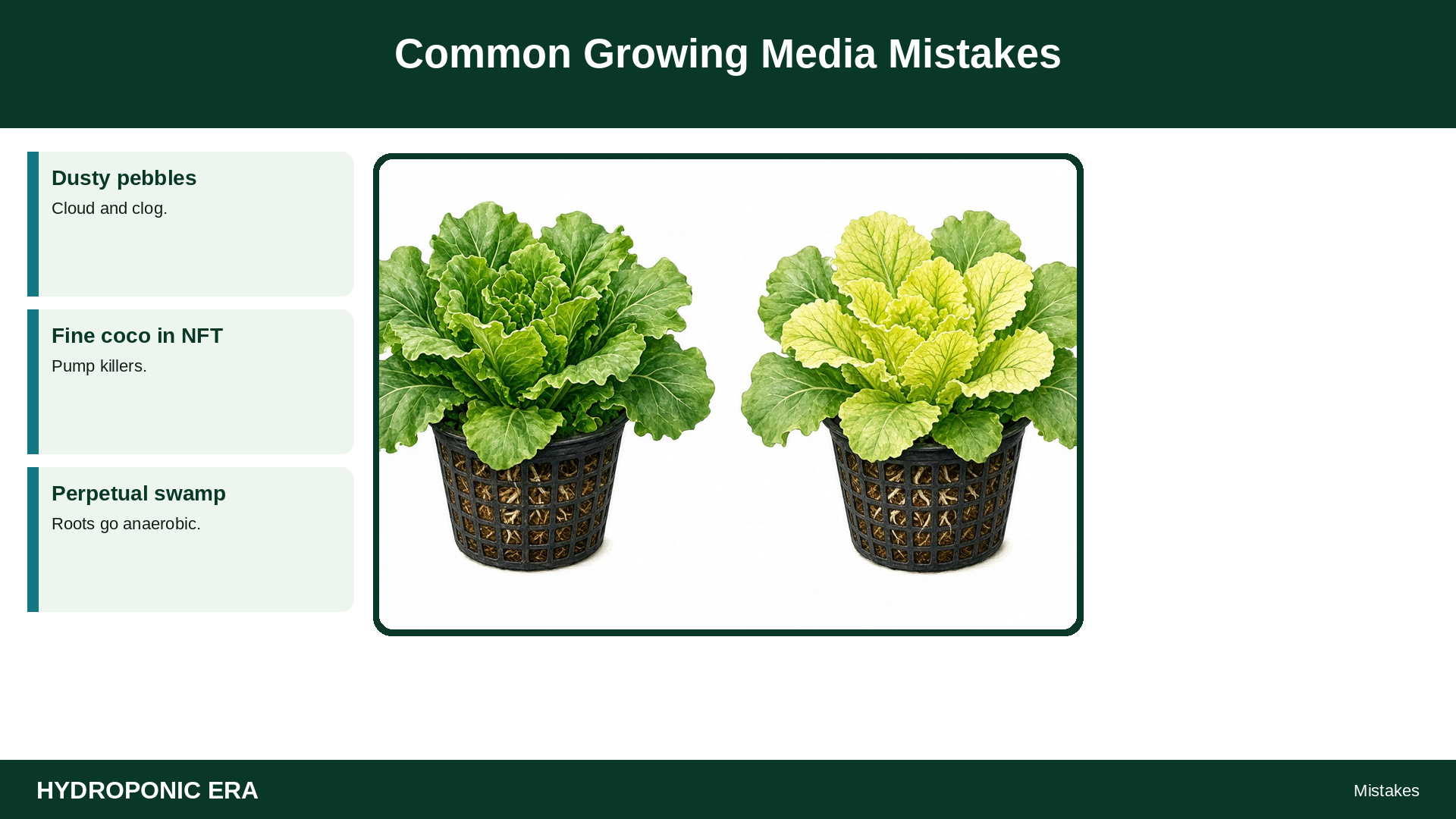
- Planting into dusty, unrinsed clay pebbles
- Running fine coco through a tiny NFT pump
- Treating media like soil fertilizer—double feeding
- Letting rockwool sit in a perpetual swamp with no drain
- Reusing media after root disease without cleaning
- Choosing calcareous gravel that fights your pH down adjustments
- Ignoring algae on persistently lit wet rockwool surfaces—pair with algae prevention
Troubleshooting Media Problems

| Symptom | Likely media-related cause | Fix |
|---|---|---|
| Wilting while media looks wet | Anaerobic saturation / low oxygen | Increase drain-off; add aeration; check roots |
| Frequent dry-back wilt in pebbles | Low water holding + missed irrigation | More frequent pulses; larger reservoir safety margin |
| pH fighting you after new rockwool | Media not conditioned | Follow wetting/pH prep |
| EC spike after new coco | Residual salts | Rinse/buffer; reset solution |
| Pump clogging | Fines migration | Filter; switch grade; rinse media |
| Algae mat on cubes | Light + nutrients on wet surface | Exclude light; improve cover |
System Pairing Cheat Sheet
- DWC net pots: clay pebbles around a starter plug
- Dutch bucket: clay pebbles, perlite, or coco (with filtration discipline)
- Drip tomato/cucumber: rockwool slabs or coco bags are common commercial patterns (UF greenhouse production context)
- NFT: small plugs; minimal loose media in channels
- Seed starting: rockwool cubes or clean foam plugs
For fruiting crops like cucumbers, media that drain reliably pair well with trellis culture—see cucumber guide. Leafy raft systems may use almost no bulk media beyond plugs—see lettuce and spinach guides.
Final Media Checklist
- System type chosen before media shopping
- Pros/cons reviewed from extension comparisons
- Rinse/condition/prep completed
- Irrigation matched to water holding
- Filtration protecting pumps
- Reuse/cleaning plan decided
- Nutrient program still complete and metered
Irrigation Matching: The Real Skill Behind Media Choice
Media arguments online often skip the operational truth: irrigation frequency must match water holding. Clay pebbles with infrequent drip pulses create drought stress and blossom-end disorders on fruit. Coco or rockwool with constant flood and no air create oxygen stress and dull roots. Extension media comparisons only help if you also rewrite your timer.
A practical commissioning test: after transplant, observe media moisture at the next irrigation. If the root zone is still shiny-wet and cool with no air pockets, lengthen the off time or improve drainage. If plants wilt before the next pulse and media feels dry deep in the pot, shorten the off time or increase pulse length. Make one change at a time.
Keep spare media for emergencies—extra rinsed pebbles to remake a net pot after a root wash, or extra cubes for a failed germination tray. Store dry media sealed against dust and pests.
When switching media mid-hobby, expect a learning week. Your old EC targets may still apply, but dry-back behavior will not. Log both chemistry and moisture feel until the new rhythm is boring.
Environmental and Safety Notes
Dry rockwool and perlite dust can irritate skin, eyes, and lungs—moisten before handling and consider gloves and a mask. UF and OSU materials note practical handling and disposal realities for stone wool: it is effective, but not a backyard compost ingredient.
Coco sustainability is often better framed than peat in modern discussions, yet quality control still matters. Cheap bricks with high salt load create week-one EC surprises. Budget for a proper rinse even when marketing says “buffered.”
In shared family spaces, keep media storage sealed. Fungus gnats love chronically wet organic media surfaces; let the top dry slightly between irrigations when the crop allows, and exclude light from wet cubes to reduce algae films that feed fungus gnat habitat.
If you run aquaponics or hybrid systems, media also become biofilm habitat for beneficial bacteria—OSU’s soilless mediums discussion touches aquaponic media roles. That biology is desirable there, but it changes cleaning rules versus sterile hydro recirculation. Do not copy aquaponic media habits blindly into a disease-sensitive DWC lettuce tub.
Beginner Starter Kits: Sensible Defaults
If you want a simple default without overthinking:
- DWC herbs/lettuce: starter plug + clay pebbles in net pots
- Dutch bucket fruiting: clay pebbles or quality coco with filtration
- Seed starting: rockwool or clean foam plugs under mild light
- NFT greens: plugs only in channels
Buy media volume for one full crop plus 20% spare. Running out mid-transplant forces rushed substitutions that create uneven moisture.
Rinse and reuse habits for growing media for hydroponics
Media choice is only half the job. Clean handling keeps growing media for hydroponics from becoming a salt-and-biofilm sponge.
| Media type | Common fit | Handling note |
|---|---|---|
| Rockwool / stone wool | Propagation + many systems | Follow product wetting/pH guidance; do not crush structure |
| Expanded clay (LECA) | DWC net pots, some drip | Rinse dust; re-wash between cycles if reusing |
| Coco coir | Drip / media beds | Quality buffered coco matters; watch salt history |
| Perlite blends | Mixes / drainage | Dust control; avoid compacting when wet |
- Match growing media for hydroponics to irrigation style—NFT often uses small plugs; Dutch buckets like stable media volume.
- Between crops, remove roots and organic debris; reuse only if you can clean honestly.
- If plants stall after a media swap, check pH/EC and whether the new media changed water retention dramatically.
growing media for hydroponics: practical review sheet
Use this review sheet to keep growing media for hydroponics actionable after you finish the main guide.
- What did you measure today related to growing media for hydroponics?
- What did you change with your hands (not just what you bought)?
- What will you re-check in 24–48 hours about growing media for hydroponics?
- Which linked HydroponicEra guide should you reread next?
- What cleaning or logging step did you skip last cycle?
| Item | Today | Next check |
|---|---|---|
| Environment | ||
| Solution (pH/EC) | ||
| Roots / pests / biofilm | ||
| Plant response |
Print or duplicate this table in your notes app. The goal is not paperwork—it is fewer repeated mistakes around growing media for hydroponics.
When results are unclear, slow down and restate the problem in one sentence that includes growing media for hydroponics, then list the last three changes you made. Most home-system failures come from stacked changes without logs. Keep growing media for hydroponics paired with basic hygiene: clean reservoirs, honest meter calibration, and root inspection. If you cannot explain your last adjustment, do not add another product. Re-read the troubleshooting section and apply one change at a time while you watch how growing media for hydroponics interacts with pH, temperature, and oxygen.
When results are unclear, slow down and restate the problem in one sentence that includes growing media for hydroponics, then list the last three changes you made. Most home-system failures come from stacked changes without logs. Keep growing media for hydroponics paired with basic hygiene: clean reservoirs, honest meter calibration, and root inspection. If you cannot explain your last adjustment, do not add another product. Re-read the troubleshooting section and apply one change at a time while you watch how growing media for hydroponics interacts with pH, temperature, and oxygen.
When results are unclear, slow down and restate the problem in one sentence that includes growing media for hydroponics, then list the last three changes you made. Most home-system failures come from stacked changes without logs. Keep growing media for hydroponics paired with basic hygiene: clean reservoirs, honest meter calibration, and root inspection. If you cannot explain your last adjustment, do not add another product. Re-read the troubleshooting section and apply one change at a time while you watch how growing media for hydroponics interacts with pH, temperature, and oxygen.
When results are unclear, slow down and restate the problem in one sentence that includes growing media for hydroponics, then list the last three changes you made. Most home-system failures come from stacked changes without logs. Keep growing media for hydroponics paired with basic hygiene: clean reservoirs, honest meter calibration, and root inspection. If you cannot explain your last adjustment, do not add another product. Re-read the troubleshooting section and apply one change at a time while you watch how growing media for hydroponics interacts with pH, temperature, and oxygen.
growing media for hydroponics FAQs
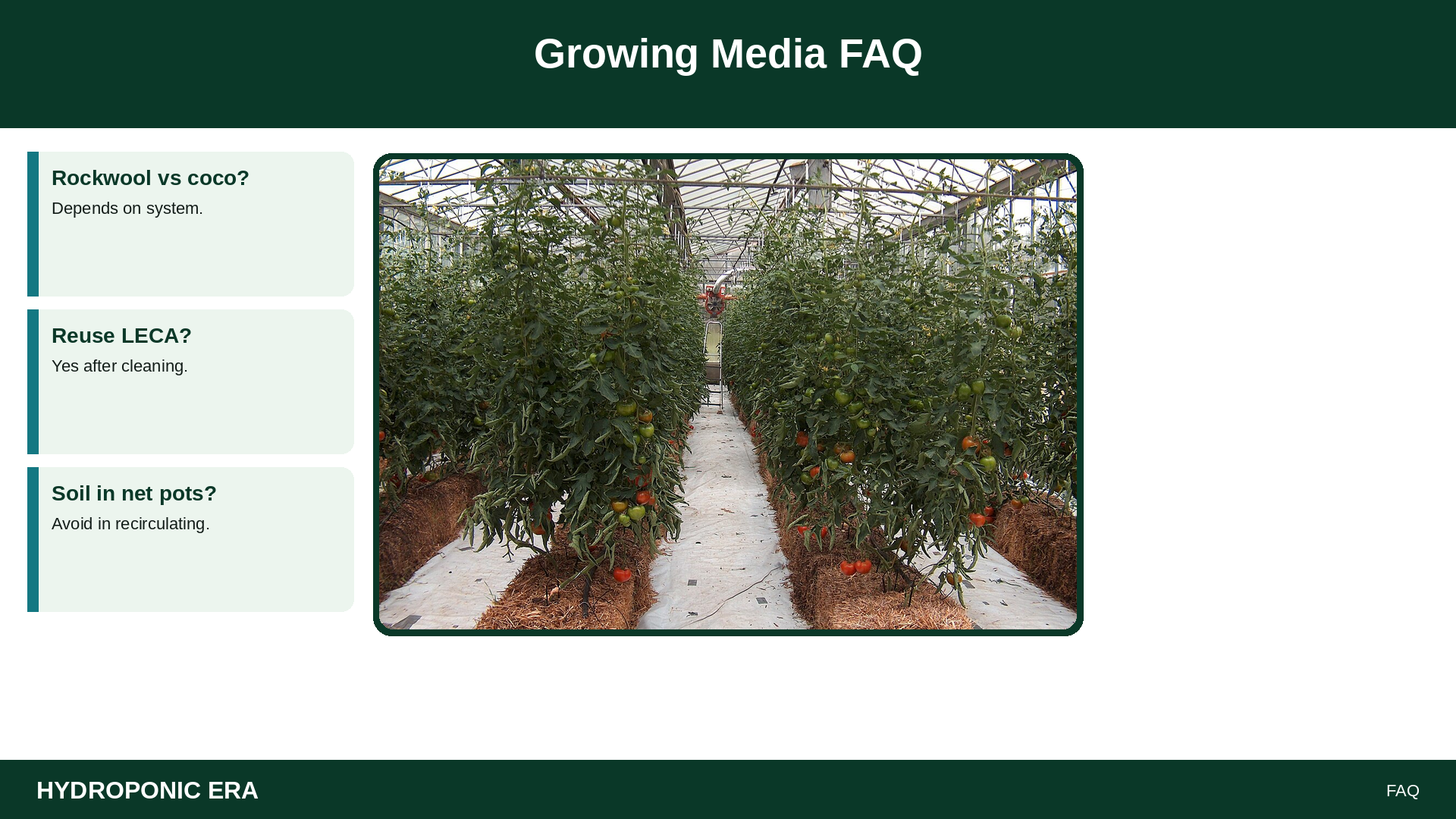
Is rockwool better than coco?
Neither is universally better. Rockwool is consistent and widely used in commercial drip; coco is renewable and water-retentive but more variable. Match to system and management style.
Can I reuse clay pebbles?
Often yes after thorough washing and sanitation between crops. Discard media from diseased root systems if you cannot clean confidently.
Do I need media in NFT?
Usually only a starter plug. Loose media in channels can disrupt flow.
Why did my pH rise after adding new media?
Some media (notably improperly conditioned rockwool or calcareous aggregates) influence solution pH. Prep media and recheck after transplant.
Is soil OK in a hydroponic net pot?
Soil in recirculating hydroponics usually clouds water, clogs gear, and introduces unwanted biology. Stick to soilless hydro media.
Sources
- University of Florida IFAS — EP623: Common Media Used in Hydroponics
- Oklahoma State University Extension — Soilless Growing Mediums
- University of Minnesota Extension — Small-scale hydroponics
- University of Florida IFAS — HS405: Hydroponic Vegetable Production in Florida
- University of Florida IFAS — CV263: Production Systems
- Oklahoma State University Extension — Hydroponics
18 thoughts on “Growing Media for Hydroponics: Rockwool, Clay Pebbles, Coco, and More”