
Quick Answer
Grow kale hydroponically as a cool-season leafy brassica: keep air and root temperatures moderate, use a complete mild nutrient solution for leafy growth, hold pH near a soilless band of about 5.5–6.5, and harvest outer leaves on a steady schedule. University of Minnesota Extension emphasizes that the best kale quality comes from fast growth without heat or moisture stress—overheated plants produce pungent or bitter flavors. Choose curly, lacinato, or Red Russian types that fit your harvest style, and treat kale more like a long-lived leafy plant than a one-cut lettuce head.
Pair this guide with lettuce hydroponics, spinach hydroponics, and solution basics in the pH and nutrients articles.
Key Takeaways
- UMN Extension frames kale as a cool-season cole crop; quality suffers when plants overheat or struggle to take up water.
- UF/IFAS HS1279 covers leafy greens in hydroponics and protected culture—cultivar, environment, and system design interact.
- Oklahoma State soilless guidance supports a hydroponic pH band roughly near 5.5–6.5 for many crops; verify with your meter.
- Virginia Tech’s DLI materials help you think in daily light integral—leafy crops need steady light, not fruiting-crop extremes.
- Outer-leaf harvest keeps plants productive longer than waiting for a single oversized cut.
- Opaque reservoirs, clean water changes, and oxygen matter—see the water-change guide.
- Yellow new leaves often point to pH/lockout before “more iron”—see yellow leaves and nutrient lockout.
Related HydroponicEra guides
- Best plants for hydroponics
- How to grow lettuce hydroponically
- How to grow spinach hydroponically
- Deep water culture for beginners
- NFT hydroponics for beginners
- PPFD and DLI light levels
- Calcium/magnesium deficiency

Grow Kale Hydroponically: Why Kale Works Well in Hydroponics

Kale (Brassica oleracea Acephala group) is grown for nutritious leaves, not a dense cabbage head. UMN Extension’s collards and kale guide treats kale as a cool-season garden crop that responds poorly to heat stress. Indoors, that same cool-season preference still applies: a warm garage DWC that thrills basil may push kale toward tough, bitter leaves.
Hydroponics helps because you can deliver steady water and nutrients without soil drought cycles. UF HS1279’s leafy greens framework is useful even for home systems: match cultivar and environment before blaming the nutrient bottle. Kale is generally more heat-tolerant than spinach, but it is not a tropical herb—aim for temperate indoor conditions.
Compared with lettuce, kale can stay productive longer with outer-leaf harvests. Compared with fruiting tomatoes, it wants milder EC and less aggressive light. Start with a leafy schedule, then adjust from plant feedback.
Grow Kale Hydroponically: Choose a System for Hydroponic Kale

| System | Beginner fit for kale | Watch-outs |
|---|---|---|
| NFT | Good for baby and mid-size leaves | Pump failure dries roots quickly; large plants may need wider channels |
| DWC / raft | Good when solution stays cool and aerated | Warm rafts + low oxygen invite root stress |
| Media bed / drip | Good for larger kale plants | Avoid soggy, anaerobic media |
| Dutch bucket | Possible for long-lived plants | Often overkill for kitchen kale |
| Kratky jar | Small trials only | Heat and oxygen swings |
Compare layouts in DWC vs NFT vs Dutch bucket. For plugs and media, see growing media and seedlings and transplanting.
Step-by-Step: Grow Kale Hydroponically
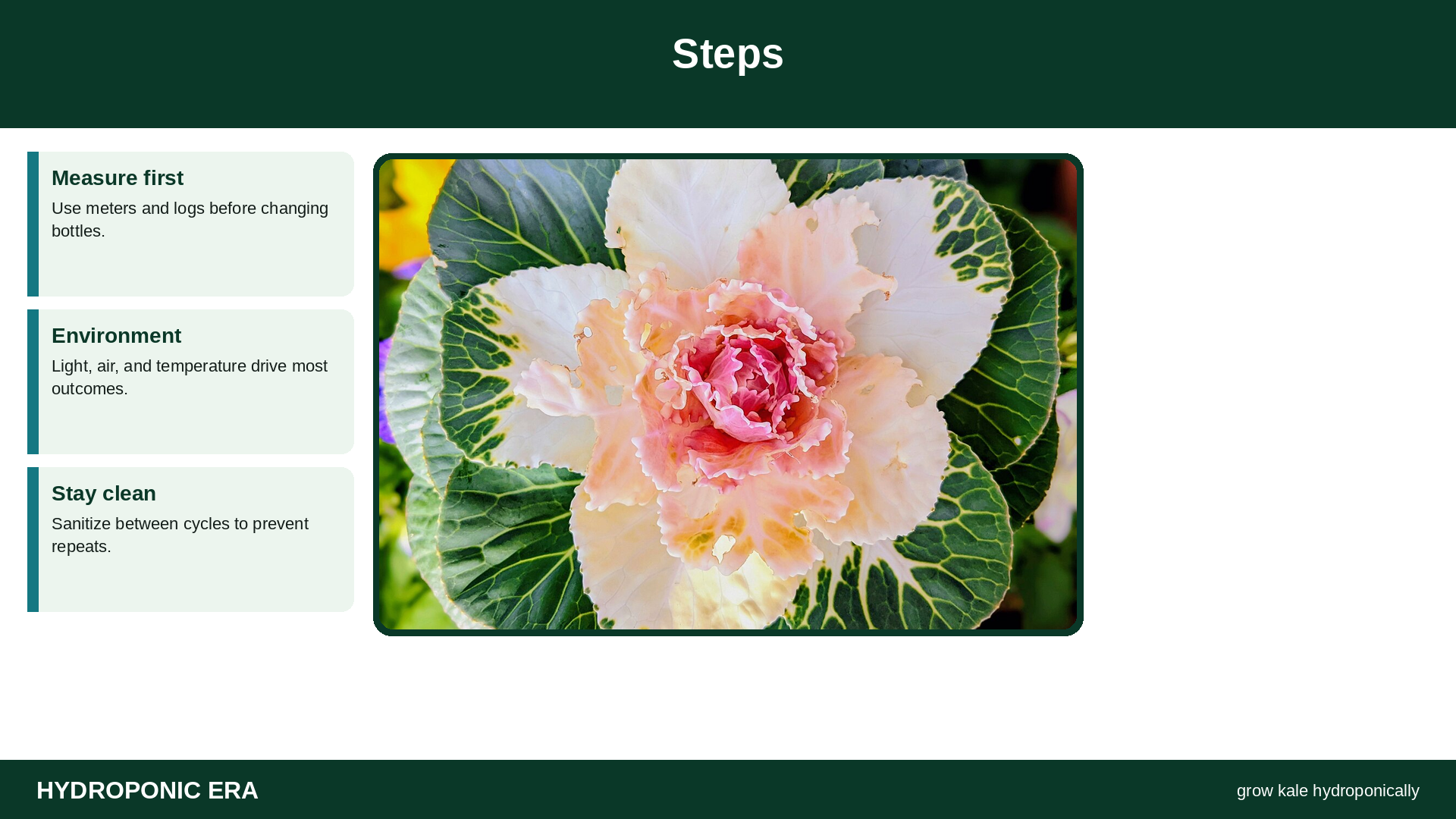
- Pick a type. Curly kale for classic texture, lacinato for flatter leaves, Red Russian for tender baby leaves.
- Start seeds in clean plugs. Keep seed zone moist—not waterlogged—and give light as soon as sprouts emerge.
- Transplant when roots hold the plug and true leaves appear. Handle gently; bruised leaves spoil quickly.
- Mix a mild complete hydroponic nutrient for leafy growth. Avoid tomato-strength recipes on young plants.
- Set pH after mixing into roughly 5.5–6.5 (Oklahoma State soilless hydroponic framing).
- Provide steady leafy light. Use the grow lights guide and PPFD/DLI article; do not stack extreme intensity with heat.
- Keep roots oxygenated. Aerated DWC or reliable NFT flow matters—see dissolved oxygen and air pumps.
- Hold reservoir temperature moderate. Warm solution accelerates stress and disease pressure—see reservoir temperature.
- Harvest outer leaves when they reach usable size; leave the growing point intact for continuous production.
- Reset hygiene between long runs with the cleaning and sterilizing guide.
Grow Kale Hydroponically: Important Growing Variables
| Variable | Practical beginner guidance | Notes |
|---|---|---|
| Temperature | Cool-to-moderate room | Heat drives bitterness (UMN framing) |
| Light / DLI | Steady leafy DLI | Measure PPFD × hours (VT method) |
| pH | ~5.5–6.5 | OSU soilless band; meter weekly |
| Nutrient strength | Mild leafy EC | High salts → tip burn risk |
| Oxygen | Steady aeration / film flow | Low DO → dull growth, brown roots |
| Harvest habit | Outer-leaf cuts | Beats waiting for tough oversized leaves |
Track EC trends with the EC and TDS guide. Rising salts between top-offs often explain tip burn better than “needs more calcium” alone—cross-check Ca/Mg deficiency.
Grow Kale Hydroponically: Common Mistakes
- Growing kale under a hot fruiting-crop schedule and blaming “bad genetics”
- Using tomato-strength nutrients on baby kale
- Waiting weeks to harvest, then complaining leaves are tough
- Ignoring tip burn while raising light and EC together
- Skipping pH checks when new leaves yellow
- Crowding plants so inner leaves never dry or get light
- Sharing a warm cucumber reservoir without watching kale stress first
Grow Kale Hydroponically: Troubleshooting Kale Problems
| Symptom | Likely causes | What to do |
|---|---|---|
| Bitter / pungent leaves | Heat or water/nutrient stress | Cool environment; harvest younger; reset solution |
| Leaf tip burn | Fast growth + high EC / Ca uptake limits | Moderate EC; review Ca/Mg and nutrient burn |
| Yellow older leaves | Mobile nutrient shortage / imbalance | Check strength and pH; review nutrients guide |
| Yellow new leaves | pH lockout / micronutrients | Lockout troubleshooting |
| Wilting in wet system | Low DO / root disease | Increase aeration; check brown roots |
| Aphids on soft growth | Indoor pest pressure | Pest IPM guide |
What to Check in Your Own Kale System
- Afternoon air and reservoir temperatures
- Whether newest leaves look pale between veins
- EC trend between top-offs
- Root color and smell
- Leaf toughness versus harvest age
- Spacing and airflow between plants
Suggested Beginner Schedule
| Stage | Focus | Actions |
|---|---|---|
| Germination | Even sprouts | Even moisture; moderate temperature |
| Seedling | Compact leaves | Steady light; mild nutrients after true leaves |
| Vegetative | Cool roots + canopy | Hold pH/EC; keep oxygen up |
| Harvest window | Quality leaves | Outer-leaf cuts; succession trays every 2–3 weeks |
| Reset | Hygiene | Clean system after long runs |
Succession note: Keep a second seedling tray going so you never depend on one aging plant. Baby-leaf kale cycles faster and often tastes better under imperfect indoor climates.
Shared reservoirs: Kale shares space with lettuce more easily than with cucumbers or tomatoes. If you mix crops, monitor which plant empties nutrients fastest.
Final Kale Success Checklist
- Cool-to-moderate temperatures for air and solution
- Steady leafy light without heat stacking
- Mild nutrient strength and stable pH
- Oxygenated roots
- Outer-leaf harvest habit
- Clean resets between long production runs
FAQs

Is kale good for beginners in hydroponics?
Yes, if you can keep conditions cooler than a hot fruiting room. In very warm spaces, lettuce or basil may be easier first crops.
Can kale grow in DWC?
Yes when the solution stays cool and well aerated. Warm, stagnant water is a poor match.
How long until harvest?
Baby leaves can be ready in a few weeks from transplant depending on light and temperature; continuous outer-leaf harvests continue for weeks after that. Exact days vary—track your own cycles rather than copying a fixed marketing number.
What pH should I use?
Many soilless hydroponic crops perform in roughly 5.5–6.5 (Oklahoma State framing). Calibrate your meter and watch plant response.
Why do my kale leaves taste bitter?
Heat and stress commonly reduce quality (UMN Extension). Harvest younger leaves and cool the room/reservoir before changing cultivars.
Grow Kale Hydroponically: Practical Checklist
Grow Kale Hydroponically matters every week in a home system. Recheck grow kale hydroponically after transplants, heat spikes, and canopy fill-in. Strong grow kale hydroponically habits beat one-time guesses. When grow kale hydroponically drifts, leaves crowd, roots stress, or harvest quality drops. Write grow kale hydroponically targets into your log so you do not rely on memory. Teach helpers your grow kale hydroponically checklist before you leave town. Improve grow kale hydroponically in small steps—measure, adjust, then wait a day. Compare grow kale hydroponically notes against light, airflow, and reservoir temperature. Keep grow kale hydroponically realistic for your shelf depth and cultivar size.
Sources
- University of Minnesota Extension — Growing collards and kale in home gardens
- University of Florida IFAS — HS1279: Leafy Greens in Hydroponics and Protected Culture for Florida
- University of Florida IFAS — HS1422: Growing Lettuce in Small Hydroponic Systems
- Virginia Cooperative Extension — SPES-720: Calculating and Using Daily Light Integral (DLI)
- Oklahoma State University Extension — Hydroponics
- Oklahoma State University Extension — Electrical Conductivity and pH Guide for Hydroponics
- University of Kentucky CCD — Hydroponic Lettuce Production in Controlled Environments (PDF)