
An aquaponics daily maintenance routine takes about 10–20 minutes for a home system. Every day, check that water and air pumps run and water flows, top off evaporation with dechlorinated water, look for leaks, check water temperature, feed the fish two or three times and remove uneaten feed, watch fish behavior, scan plants for pests, remove any dead fish or sick plant parts, and clear solids from the filter. Weekly, test pH, ammonia, nitrite and nitrate; monthly, deep-clean filters and check fish health.
Key takeaway: Most aquaponics failures start with a pump, oxygen or feeding problem. A short daily check catches them before fish die, so make it a habit at the same time each day.
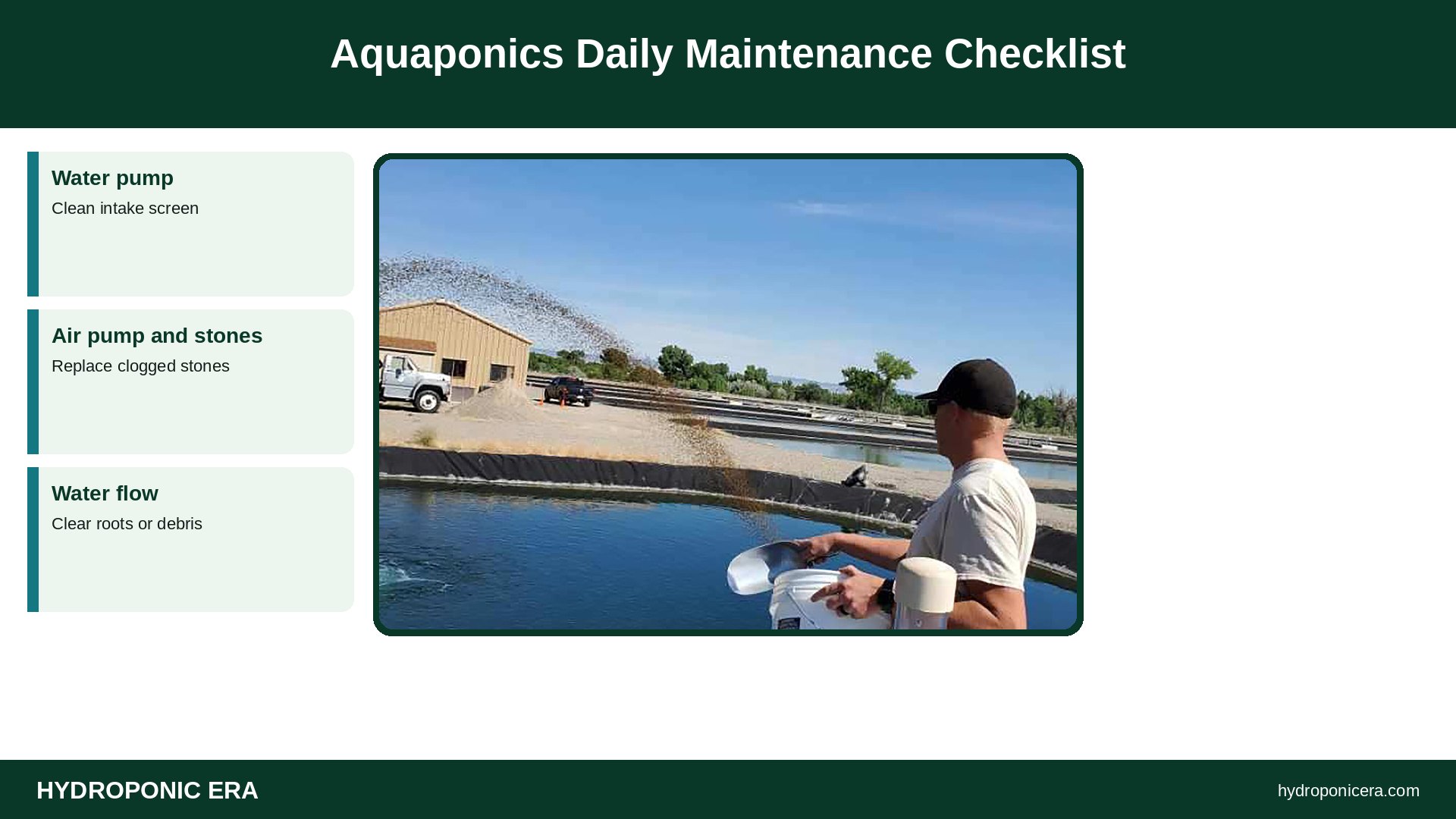
Aquaponics Daily Maintenance Checklist
| Check | What to look for | Action |
|---|---|---|
| Water pump | Running, intake clear | Clean intake screen |
| Air pump and stones | Steady bubbles | Replace clogged stones |
| Water flow | Returns to tank, beds cycling | Clear roots or debris |
| Water level | Normal level | Top off with dechlorinated water |
| Leaks | Dry floor, tight fittings | Fix immediately |
| Water temperature | Within your fish’s range | Heat, shade or chill |
| Feeding | Fish eat eagerly in a few minutes | Remove leftovers; adjust amount |
| Fish behavior | Active, no gasping or flashing | Test water if odd |
| Plants | No pests or wilting | Remove pests and sick leaves |
| Solids filter | Not overflowing | Drain or rinse |
Why Aquaponics Daily Maintenance Matters

The FAO’s small-scale aquaponics manual lists these exact daily activities: check water and air pumps and clean their inlets, check flow, top off water lost to evaporation, look for leaks, check water temperature, feed fish two or three times a day while removing uneaten feed, watch fish behavior and appearance at each feeding, check plants for pests, remove dead fish and sick plants, and remove solids from the clarifier. The FAO also warns that low dissolved oxygen, including from accidental leaks, is the number one killer in aquaponic units, and that if water flow stops, fish can suffer and die within a few hours. As long as water flows, problems can be solved calmly.
Morning Routine (5–10 Minutes)
- Listen and look. Is the pump humming and the air pump bubbling? Is water returning to the tank?
- Check the fish. Fish gasping at the surface signal low oxygen. See aquaponics dissolved oxygen.
- Read the thermometer. Note the temperature in a log. See aquaponics water temperature.
- Feed. Offer only what fish eat in about 5 minutes. See aquaponics fish food.
- Top off with dechlorinated water if levels dropped. See dechlorinate water.
Evening Routine (5–10 Minutes)
- Feed again and remove uneaten food after a few minutes.
- Walk the beds: look under leaves for aphids, mites and caterpillars. See aquaponics pest control.
- Check that bell siphons are cycling and drains aren’t blocked by roots. See aquaponics bell siphon.
- Drain or rinse the solids filter if it’s filling. See aquaponics solids filter.
- Remove dead leaves and any dead fish right away.
Weekly Tasks

The FAO’s weekly list: test pH, ammonia, nitrite and nitrate before feeding; adjust pH; check plants for deficiencies and add supplements; clear fish waste from the tank bottom and biofilter; plant and harvest; harvest fish if needed; and check that roots aren’t blocking pipes. Keep a notebook or spreadsheet with each test. See ammonia, nitrite and nitrate, aquaponics pH and aquaponics nutrient deficiencies.
Monthly Tasks
- Stock new fish if planned. See aquaponics fingerlings.
- Clean the biofilter, clarifier and all filters, as the FAO recommends; rinse biofilter media gently in system water, never tap water.
- Clean the tank bottom with a net.
- Weigh a sample of fish and inspect them closely for disease. See aquaponics fish diseases.
- Clean air stones and the pump impeller.
Warning Signs to Act on Immediately

| Sign | Likely problem | First step |
|---|---|---|
| Fish gasping at surface | Low oxygen | Check air pump, add aeration, stop feeding |
| Fish not eating | Water quality, temperature, stress | Test ammonia and nitrite. See fish not eating |
| Cloudy, smelly water | Overfeeding, dead fish, solids | Remove waste, feed less |
| Water level falling fast | Leak | Find and fix; protect pump from running dry |
| Ammonia above zero | Biofilter overloaded | Feed less, partial water change. See ammonia spike |
| Sudden fish deaths | Oxygen crash or toxin | See fish dying triage |
Safety During Maintenance
The FAO calls the closeness of electricity and water the most dangerous part of aquaponics. Use a ground-fault (GFCI) protected outlet for every pump and heater, use drip loops on cords, and never hang wires over tanks. Wear gloves when handling fish and media, and don’t put bare hands with open cuts in the water. See electrical safety.
Making Aquaponics Daily Maintenance Easier

- Automate feeding for vacations with a timer feeder, but check daily when home.
- Add alarms: a water-level float alarm and a power-outage alarm. See leak alarms.
- Keep a backup air pump on battery. See aquaponics power outage.
- Use a log sheet by the tank. See record keeping.
- Keep spare parts: a spare pump, air stones and tubing.
Sample Aquaponics Daily Maintenance Log
| Date | Water temp | Feed (g) | Fish behavior | Flow OK? | Notes |
|---|---|---|---|---|---|
| Mon | 76°F | 120 | Normal | Yes | Topped off 2 gal |
| Tue | 75°F | 120 | Normal | Yes | Aphids on kale, rinsed |
The values above are examples of what to record, not targets. Over a few weeks the log shows patterns, such as feed rising as fish grow or temperature dips on cold nights, that help you plan changes before problems start.
Seasonal Aquaponics Daily Maintenance Changes
- Summer: warm water holds less oxygen, so check air stones twice a day, shade tanks, and watch fish closely during heat waves. See aquaponics dissolved oxygen.
- Winter: fish eat less in cool water, so reduce feed and remove leftovers promptly. The FAO notes that deficiencies often appear when feeding is reduced during winter months. See aquaponics nutrient deficiencies.
- Spring and fall: big day-night temperature swings stress fish; check the thermometer morning and evening.
- Storm season: test the backup air pump and keep tanks covered against debris.
Adjusting your aquaponics daily maintenance by season keeps the routine short while protecting fish when risks are highest. Write seasonal reminders on the same log sheet you use every day.
Who Should Do Aquaponics Daily Maintenance?
Pick one main caretaker and one backup who knows the checklist. Show the backup how to spot gasping fish, restart a pump and feed the right amount. Overfeeding by well-meaning helpers is a common cause of cloudy water and ammonia problems, so pre-measure portions in labeled bags when you’re away.
FAQs
How long does aquaponics daily maintenance take?
About 10–20 minutes for a home system.
How often should I test water?
Weekly once cycled; daily during cycling or problems.
How often should I feed fish?
Two or three times a day, removing uneaten feed.
Can I leave my system for a weekend?
Yes, with an auto feeder, alarms and a neighbor’s check.
Should I clean the biofilter with tap water?
No; rinse in system water to protect bacteria.
What’s the most important daily check?
That water and air pumps are working.
Sources
- FAO — Small-scale aquaponic food production
- New Mexico State University — Important Water Quality Parameters in Aquaponics Systems
- University of Florida IFAS — Dissolved Oxygen for Fish Production
- Photo credits (Wikimedia Commons, edited with titles): Feeding fish (51250565367) by USFWS Mountain Prairie (Public domain); 2008-09-20 Thermometer reading by Ildar Sagdejev (Specious) (CC BY-SA 4.0); Electrical conductivity meter by Nuno Nogueira (Nmnogueira) (CC BY-SA 2.5); Aquarium-air-pump by User:Corydoras-adolfoi (CC BY-SA 4.0); Deepwater Aquaponics Floating Rafts Growing Lettuce, Basil and Arugula by Alabama Extension (CC0)