
Hydroponics for Beginners: How Growing Without Soil Works
Hydroponics is a way of growing plants in a water-based nutrient solution instead of garden soil. Roots take minerals from that measured solution, often with an inert support such as clay pebbles, coco coir, or rockwool. Beginners in the United States, United Kingdom, Australia, and Canada can start with one small indoor or patio system and learn pH, light, and water care before expanding.
This guide explains what hydroponics is, how the loop works, which home systems fit first, what to grow, and how pH, EC, and light stay in a safe band. It also compares indoor and outdoor setups and lists the quiet mistakes that stall a first harvest.
Published by Hydroponic Era, beginner hydroponics and farming guides for home growers. This page is the overview of the method. For a room-by-room garden walkthrough, see the live hydroponic garden beginner guide after you understand the method here.
Key takeaways
- Hydroponics means plants grow without soil and drink a measured nutrient solution.
- Home systems include deep water culture, nutrient film channels, towers, and aeroponics.
- Lettuce, herbs, and microgreens are the calmest first crops.
- pH, EC, and light matter more than fancy hardware.
- Indoor rooms need a grow lamp; outdoor tanks need shade and algae control.
- Most first failures come from skipped meters, light leaks, or stale water.
- One small loop and one harvest teach more than a warehouse of unused parts.
Table of contents
- What Hydroponics Is
- How Hydroponics Works
- What Are the Main Hydroponics Systems?
- What to Grow With Hydroponics
- How Do You Manage pH, EC, and Light?
- Indoor vs Outdoor Hydroponics
- Common Hydroponics Mistakes
-
Related system guides: Hydroponic system types for beginners · Hydroponic greenhouse for beginners · EC and TDS basics
Frequently Asked Questions - Final Thoughts
What Hydroponics Is

Hydroponics is the technique of growing plants using a water-based nutrient solution rather than soil. The USDA National Agricultural Library uses that definition and notes that an aggregate substrate—vermiculite, coconut coir, or perlite—may still hold the roots. The soil is gone; the minerals are not.
Oklahoma State University Extension describes the method as growing plants in a liquid nutrient solution with or without artificial media such as expanded clay, coir, perlite, or vermiculite. Systems can be liquid (roots in solution) or aggregate (roots in an inert medium), and they can be open (solution used once) or closed (solution returned, topped up, and reused).
For a home grower, that science becomes a simple picture. A covered reservoir holds mixed fertilizer. A pump, an air stone, or a drip line moves solution to the roots. Plants sit in net pots. You read pH and electrical conductivity (EC) so the solution stays available. You supply light with the sun or a lamp. That is the whole job of soilless growing at beginner scale.
You do not need a commercial bay on day one. A tote, a lid with holes, an air pump, and a modest light can grow salad in a spare room. The same habits later scale to a patio tower or a small greenhouse. Keep the first loop boring and visible.
How Hydroponics Works

Soil normally stores water, holds air pockets, buffers minerals, and hosts microbes. In a soilless loop you split those jobs. The reservoir stores water. Air stones, a thin film, or a mist keep oxygen at the roots. A complete hydroponic formula supplies the minerals. You become the buffer by testing and adjusting on a calm schedule.
A typical closed loop looks like this. You mix a soilless nutrient in an opaque tank. A pump lifts solution to channels, buckets, or tower sites. Unused solution returns. Plants take up water and minerals at different rates, so volume falls and EC can drift. You top with plain water first, remeter, and refresh the whole batch on a regular cadence rather than waiting for a smell.
Oxygen is not optional. Roots sitting in still, warm water suffocate and brown. Deep water culture uses bubbles. Nutrient film technique leaves most of the root in humid air above a thin stream. Towers drip through stacked sites. Aeroponics mists roots on a timer. Each design is a different path to the same pair of needs: moisture plus air.
Light does the rest. Leaves turn the solution into growth only when they receive enough photons. A bright south window in a US or Australian summer may carry lettuce. A UK or Canadian winter room almost always needs a dedicated lamp and a timer. Match the footprint of the light to the plants, not to empty floor.
What Are the Main Hydroponics Systems?
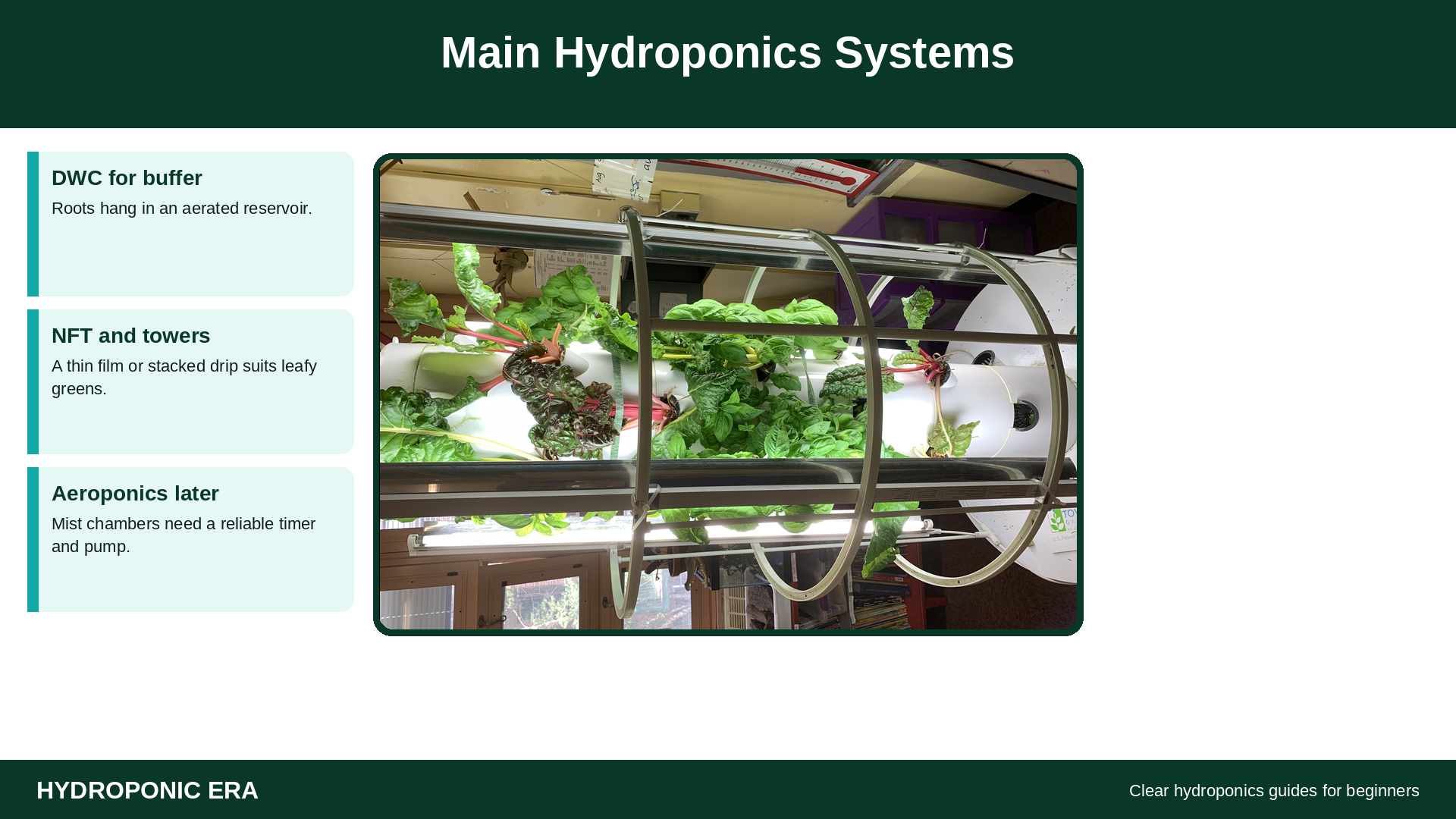
Beginners meet four common layouts. All share the same idea. They differ in how solution meets the root and how much buffer you have if a pump pauses.
| System | How roots drink | Best first crops | Beginner note |
|---|---|---|---|
| Deep water culture (DWC) | Roots hang in an aerated reservoir | Lettuce, basil, mint | More water buffer if you miss a day |
| Nutrient film technique (NFT) | A thin moving film in a sloped channel | Lettuce, soft herbs | Watch the return drip daily |
| Tower / vertical drip | Solution drips through stacked pockets | Greens and herbs | Saves floor space indoors |
| Aeroponics | Roots hang in air and take a timed mist | Lettuce, herbs | Needs a reliable pump and timer |
Oklahoma State’s fact sheet groups methods as liquid or aggregate and as open or closed. Home growers almost always choose closed loops so they can reuse solution and see what the plants drink. Closed loops need more metering; that is a feature, not a flaw.
Deep water culture is the usual first bucket: lid, net pots, air pump, stone, and a covered tank. Nutrient film technique uses a gentle slope and a continuous shallow film. A hydroponic tower garden stacks sites when floor space is tight. Aeroponics for beginners mists roots instead of bathing them. Those live pages go deeper; this page keeps you inside the shared idea of growing without soil.
Dutch-style media buckets and greenhouse rails exist too. Save fruiting vines and large houses until greens feel ordinary. One working loop teaches more than four half-built ones.
What to Grow With Hydroponics

Leafy crops forgive small mistakes and finish quickly. That makes them the best teachers for a first soilless loop. Choose them first so you can see feedback in days, not months.
Strong beginner crops include butterhead and leaf lettuce, basil, mint, cilantro, parsley, pak choi, and microgreens. They do not need pollination. They fit net pots. They taste good from a kitchen counter. A focused walkthrough of how to grow lettuce hydroponically saves early trial and error. Soft herbs follow the same water and light habits; see how to grow mint hydroponically and the microgreens hydroponic guide when you want a shorter cycle.
USDA’s hydroponics overview lists cucumbers, lettuce, peppers, tomatoes, herbs, and ornamentals among crops grown this way. Fruiting plants can succeed, but they ask for stronger light, support, and more careful EC. Wait until your first salad harvest is even. Then try a compact pepper if the lamp can cover it; the live peppers hydroponic guide covers fruiting and pollination when you are ready.
Root crops and large vines are poor first projects in a small tote. Carrots want depth. Pumpkins want space you do not have on a bookshelf. Keep the first season inside crops that finish in four to eight weeks under a modest lamp.
How Do You Manage pH, EC, and Light in Hydroponics?

Three numbers keep a soilless loop honest: pH, EC, and photoperiod. You do not need a laboratory. You need a calibrated pH meter, an EC or TDS meter, and a timer on the lamp.
Most leafy greens in soilless culture prefer a pH near 5.5 to 6.5. Outside that window, iron and other nutrients stay in the water but stop entering the plant. Leaves yellow even when the bottle says the recipe is complete. For adjustment steps, use how to control pH in hydroponics for beginners. Change in small amounts. Wait. Remeter. Do not chase every tenth of a point.
EC measures how strong the solution is. Beginner lettuce and soft herbs often sit near 1.0 to 1.8 mS/cm, depending on the formula and the room. Too low and growth stalls. Too high and tips burn. Cornell’s Controlled Environment Agriculture program treats consistent water, light, and temperature as the core of predictable harvests. Home growers use the same idea at tote scale: write the reading, do not guess from leaf color alone.
Check meters at least twice a week, and daily in the first fortnight. Top with water when volume falls, then remeter. Refresh the whole solution on a calm schedule. Timing habits across systems are covered in how often to change hydroponic water.
Indoor light is a buying decision, not a mood. Size the lamp to the canopy. Use a timer so days stay even. A practical comparison of coverage and spectrum sits in best grow lights for hydroponics. Greens need less intensity than fruiting peppers. Hang the lamp at the height the maker lists, then watch stretch and tipburn.
Indoor vs Outdoor Hydroponics

An indoor loop trades weather for electricity. You control photoperiod, keep rain off the leaves, and avoid soil splash. You also pay for lamps, a timer, and sometimes a small fan. A spare bedroom, basement corner, or insulated garage can work if you can spill a little water safely and keep pets out of the tank. The live indoor hydroponic garden beginner guide walks through room setups after you choose a method here.
An outdoor or patio loop uses the sun and saves lighting cost for much of the year. It also invites algae if tanks are clear, heat spikes if reservoirs sit in full sun, and splash from storms. Use opaque lids. Shade the tank. In a hot Texas, Queensland, or inland Australian summer, solution can warm faster than roots like. In a UK, Canadian, or northern US winter, outdoor loops stall without a greenhouse or a move indoors.
Climate notes you can actually use:
- United States: indoor lamps carry winter greens in the north; shade cloth and a cool tank matter in the south.
- United Kingdom: short winter days almost always need a lamp; watch damp rooms for still, wet leaves.
- Australia: strong sun helps outdoor towers, but reservoirs overheat; use shade and extra volume.
- Canada: treat most of the year as indoor or greenhouse growing; keep solution off freezing walls.
Units are mixed on purpose. Reservoirs are often sold in gallons in the US and litres in the UK, Australia, and Canada. Temperatures appear on meters in °F or °C. Convert once, label the tank, and stop switching mid-week. Consistency beats perfect conversion in a home loop.
Common Hydroponics Mistakes

First failures are usually mechanical, not mysterious. Fix the environment before you buy another additive.
- Using garden fertilizer. Soil feed is not a complete soilless formula and can cloud a pump.
- Skipping meters. Guessing pH from leaf color wastes a week you could have fixed in ten minutes.
- Clear tanks and light leaks. Light on solution grows algae that compete for nutrients.
- Still, warm water. Roots brown when oxygen drops. Check the air stone or the return drip.
- Overcrowding. Overlapping leaves hide dry sites and raise disease risk.
- Changing everything at once. Alter one variable, wait, then remeter.
Pale leaves with a high EC are not a request for more fertilizer. Look at light, temperature, and root color first. The live guides on why hydroponic leaves turn yellow and why hydroponic roots turn brown help you sort those symptoms without panic.
Give new transplants a quiet first week. Resist major recipe changes unless the film is dry, the stone is silent, or the tank smells. Steady notes teach the method faster than constant tweaking.
A calm weekly habit keeps the loop readable. Twice a week, lift the lid, smell the tank, check the air stone or return drip, and write volume, pH, and EC in a notebook. Once a week, wipe salt crust from lids and look at root color. Between crops, empty the tank, rinse fittings, and start with fresh solution so leftover slime does not train the next sowing.
Cost stays modest if you refuse unused gadgets. A first tote or small tower, meters you will actually calibrate, a complete soilless formula, and a lamp sized to the canopy cover most kitchens. Chillers, dosing pumps, and extra rails can wait until the first salad is even from end to end. Buy one spare air stone or pump if your room runs hot; a quiet backup beats a wilted weekend.
Choosing a first layout is easier when you name your constraint. If you want buffer against a missed day, use a deep reservoir with bubbles. If you want to see flow, use a short opaque channel. If floor space is the limit, use a tower. If you enjoy timers and fine mist, wait until the simpler loop feels ordinary. The method is the same; the plumbing changes.
Sanitation is part of the method, not an extra chapter. Wash hands before you handle roots. Keep soil and compost out of the tank. Do not dunk garden tools into the reservoir. If a plant fails, remove it and check neighbors before you change the whole recipe. One sick site is a clue; a tank-wide change is a last step.
Neighbors in the US, UK, Australia, and Canada will ask whether the food is “chemical.” Every plant eats ions. In a garden bed those ions come from compost, minerals, and microbes. In a soilless loop they come from a labeled formula you can measure. Neither approach is magic. Both can be done carefully or carelessly. Your job is the careful version: meters, shade on the tank, and a harvest you are willing to eat.
Frequently Asked Questions
What is hydroponics in simple terms?
Hydroponics is growing plants in a nutrient solution instead of soil. Roots still need water, minerals, oxygen, and light. You supply those with a reservoir, a formula, air or flow, and a lamp or the sun.
Is hydroponics good for beginners?
Yes, if you start small. One tote or tower, lettuce or herbs, and a twice-weekly meter check teach the routine. Fancy automation can wait until one harvest succeeds.
Do I need soil at all?
No garden soil. You may use inert media—clay pebbles, coco, or rockwool—to hold the stem. Soil clogs pumps and clouds recirculating water.
What can I grow first with hydroponics?
Lettuce, basil, mint, and microgreens. Add peppers later if the light is strong enough. Keep fruiting vines out of a first tote.
How is hydroponics different from a hydroponic garden page?
This page explains the method—what growing without soil is and how it works. The garden guide covers layout and room choices. Use both; do not copy one into the other.
Can I grow hydroponics outdoors year-round?
In mild seasons, yes, with shade on the tank. In cold winters or extreme heat, move the loop indoors or into a protected house. Match the climate, not the calendar photo.
Is hydroponics the same as organic farming?
No. Organic farming is a soil-and-ecosystem standard with legal labels. Most home hydroponic gardens are not certified organic. Compare the two honestly before you use either word on a label.
Final Thoughts

Hydroponics rewards quiet consistency more than dramatic hardware. Build one opaque loop, keep roots wet and oxygenated, read pH and EC on a calm schedule, and give leaves a light they can finish under.
Start with lettuce and soft herbs. Protect the reservoir from light. Treat yellow leaves or brown roots as a meter, air, or heat problem first. When that first harvest tastes clean, you will understand the method well enough to add a second site with confidence.
External reading with real links: the USDA National Agricultural Library hydroponics overview, Oklahoma State University Extension’s hydroponics fact sheet (HLA-6442), and Cornell University Controlled Environment Agriculture resources on predictable indoor and greenhouse harvests.
1 thought on “Hydroponics for Beginners: How Growing Without Soil Works”