
Hybrid striped bass aquaponics works best in larger, well-aerated systems run by growers who already have some fish experience. Hybrid striped bass (a cross of striped bass and white bass) grow fastest at about 77–81°F, prefer dissolved oxygen of 6 mg/L or more, tolerate a wide pH range with 7.0–8.5 as the optimum, and usually reach a harvest size of 1.5–2.5 pounds in 18–24 months. They are aggressive, high-protein carnivores, so they need feed-trained fingerlings, strong solids removal and careful stocking.
Key takeaway: Choose hybrid striped bass aquaponics when you want a native-hybrid food fish for warm summers and have the aeration, filtration and patience for an 18–24 month grow-out; choose tilapia or bluegill if you want an easier first fish.
| Factor | Hybrid striped bass target |
|---|---|
| Water temperature | Tolerates about 39–91°F; best growth 77–81°F; little growth below 59°F |
| Dissolved oxygen | 6–12 mg/L optimum; never let it fall near 3 mg/L |
| pH | 7.0–8.5 optimum; aquaponics compromise around 7.0 |
| Salinity | Freshwater is fine; tolerates brackish water |
| Harvest size | 1.5–2.5 lb at 18–24 months |
| Feed | High-protein floating pellets for carnivorous fish |

What Hybrid Striped Bass Are and Why They Suit Aquaponics
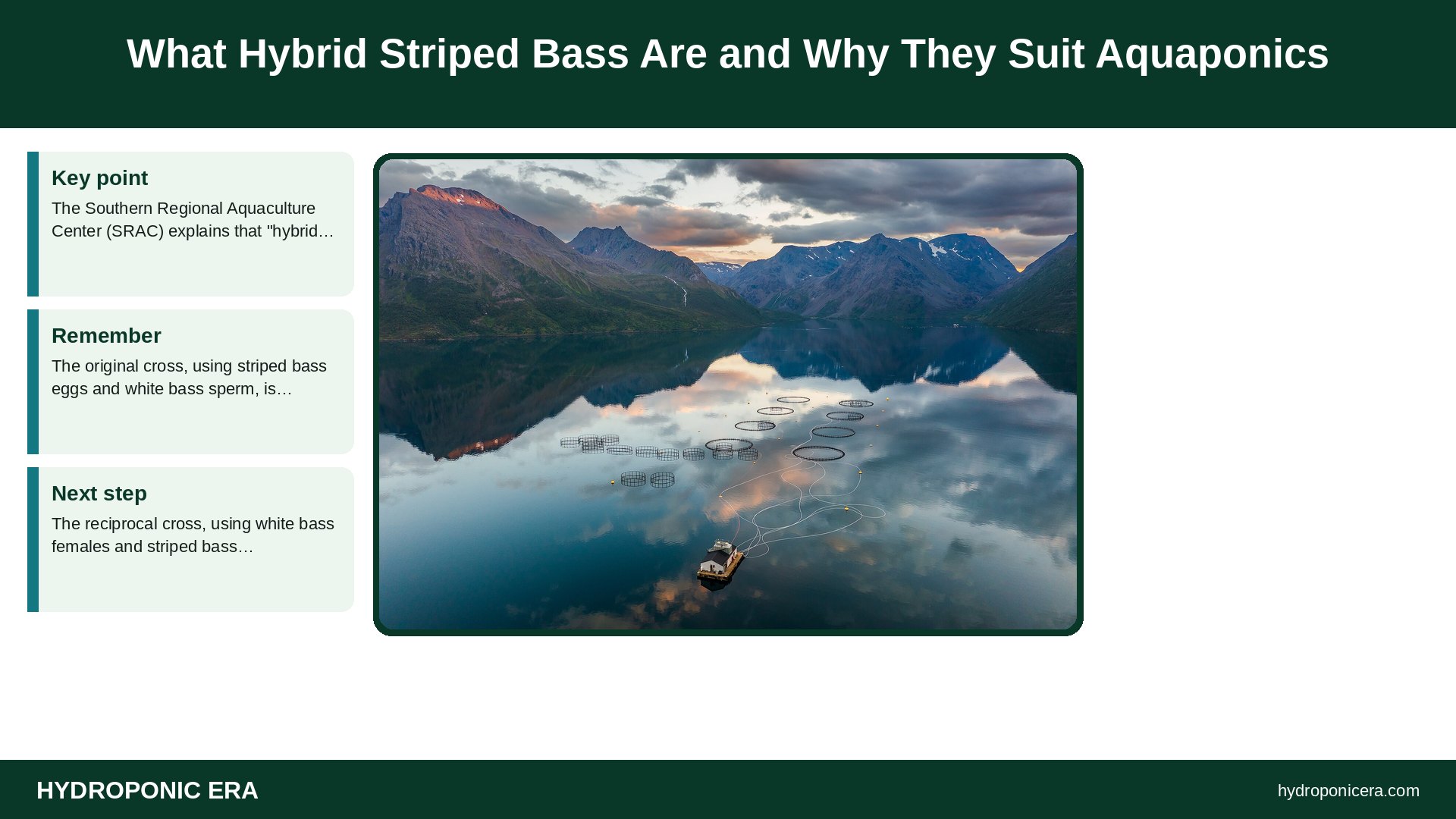
The Southern Regional Aquaculture Center (SRAC) explains that “hybrid striped bass” usually means a cross between striped bass (Morone saxatilis) and white bass (Morone chrysops). The original cross, using striped bass eggs and white bass sperm, is called the palmetto bass. The reciprocal cross, using white bass females and striped bass males, is called the sunshine bass. Both are sold as fingerlings in the US for stocking ponds, reservoirs and tanks, both are raised commercially as food fish, and either cross can be used for hybrid striped bass aquaponics.
Hybrids are hardy, grow quickly in their first two years and have firm, mild white meat. They are also predators throughout life. That’s the main difference from tilapia: you are raising a fish that wants a high-protein diet and will eat smaller tank mates. If you’re still choosing a species, compare options in best fish for aquaponics.
Water Quality for Hybrid Striped Bass Aquaponics
SRAC reports that hybrids survive roughly 4–33°C (about 39–91°F), with optimum growth at 25–27°C (about 77–81°F). They grow only when water is above about 59°F, so in a cold garage or unheated greenhouse they may sit idle for months. Optimum dissolved oxygen is 6–12 mg/L. They can survive very short dips, but stress and disease follow quickly. A pH of 7.0–8.5 is optimum, which fits well with the aquaponics compromise near 7.0.
- Oxygen: size air pumps generously and add a battery backup. See aquaponics dissolved oxygen.
- Temperature: heat in winter and shade or chill in summer. See aquaponics water temperature.
- Ammonia and nitrite: keep both near zero; test weekly.
- Alkalinity: SRAC notes hybrids are tolerant, but stable alkalinity keeps pH from crashing as nitrification consumes it.
Hybrid Striped Bass Aquaponics System Design and Tank Size

Hybrid striped bass are open-water, schooling fish that are most active at dawn and dusk. They do best in round or oval tanks with gentle circular flow, a tight lid or netting (they can jump), and dim lighting over the fish tank. A practical home minimum is a tank of several hundred gallons; an IBC tote is often too small for a full grow-out to 2 pounds. Many growers use a media bed or raft system with a separate solids filter because high-protein feed produces a lot of waste.
- Fish tank: 300–1,000 gallons for a backyard grow-out.
- Solids removal: a swirl filter or settling tank before the plant beds. See aquaponics solids filter.
- Biofilter: media beds or a dedicated biofilter. See aquaponics biofilter.
- Aeration: air stones in the fish tank plus aerated raft beds. See aquaponics air pump sizing.
Stocking Hybrid Striped Bass
Buy feed-trained fingerlings from a licensed hatchery, ideally all the same size. Mixed sizes lead to cannibalism. Stock conservatively. SRAC’s aquaponics design example caps final density at 0.5 pound of fish per gallon. For 2-pound fish, that works out to one fish per 4 gallons at harvest, so a 500-gallon tank would hold at most about 125 fish; most home growers stock far fewer and thin as fish grow. Quarantine new fish before they enter the main system, and acclimate them slowly to your water temperature and pH. See aquaponics fingerlings, quarantine new fish and aquaponics stocking density.
Feeding and Growth in Hybrid Striped Bass Aquaponics
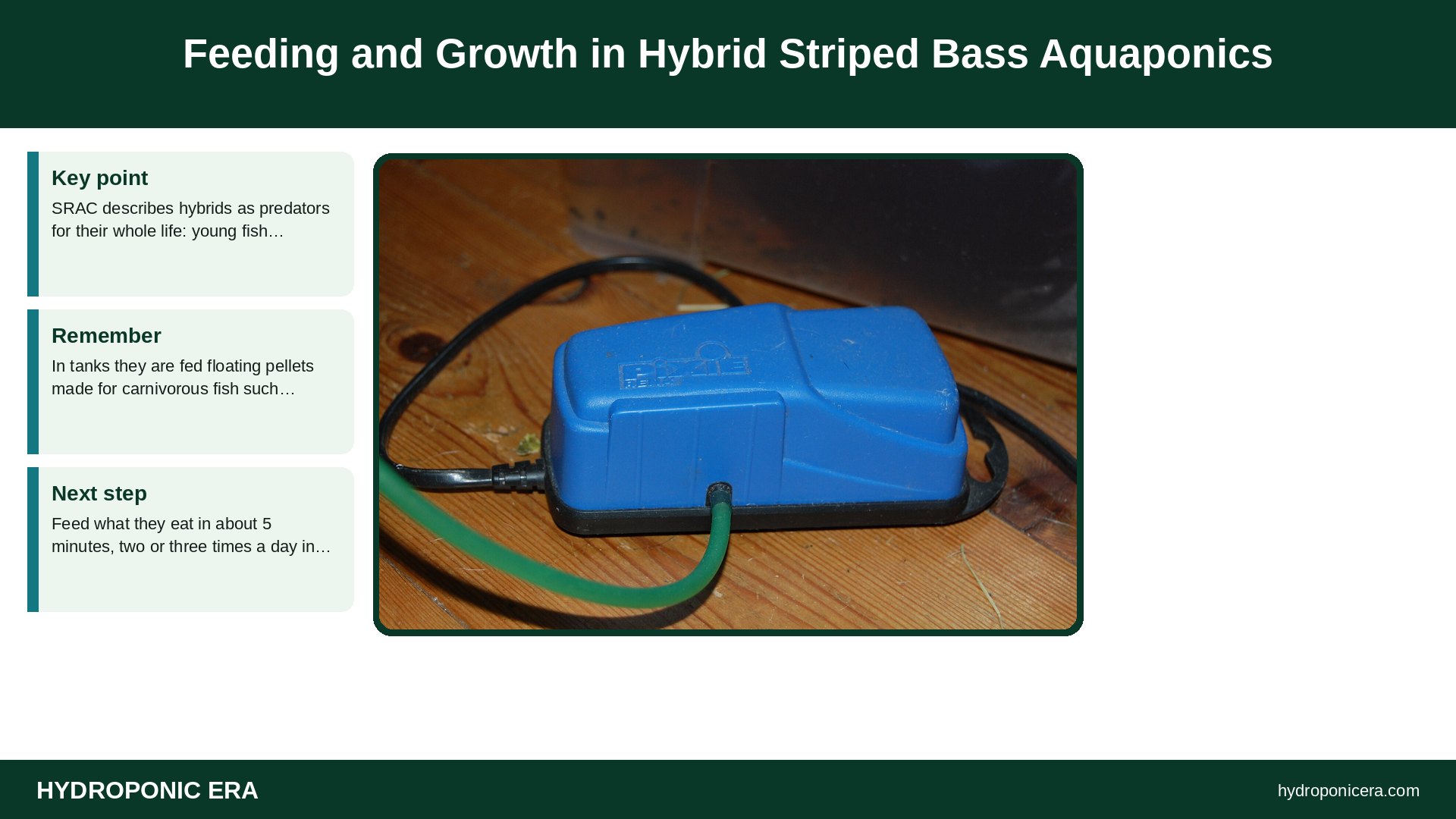
SRAC describes hybrids as predators for their whole life: young fish eat zooplankton and insects, then switch to fish. In tanks they are fed floating pellets made for carnivorous fish such as bass or trout. Feed what they eat in about 5 minutes, two or three times a day in warm water, and cut back sharply when the water cools. Floating feed lets you see appetite, which is your best early warning of a water problem. See aquaponics fish food.
SRAC notes common first-year growth of about 225–350 grams (roughly 0.5–0.75 pound) and 1–1.5 kg (about 2.2–3.3 pounds) in the second year under good conditions, with harvest typically at 1.5–2.5 pounds and 18–24 months. Home systems with cooler winters usually take longer.
Plants for Hybrid Striped Bass Aquaponics
High-protein feed means plenty of nitrogen, so a well-stocked hybrid striped bass aquaponics system can support leafy greens, herbs and, with supplements, fruiting crops. Lettuce, kale, chard, basil and watercress are easy matches. Tomatoes and peppers need extra potassium and iron. Use the feed rate ratio to match feed to plant area. See aquaponics fish to plant ratio.
Permits and Legal Checks
Hybrid striped bass are native-parent hybrids, but states still regulate live fish. Some require an aquaculture license, a fish health certificate for imported fingerlings, or approval for stocking any Morone species. Ask your state wildlife or agriculture agency before buying. Never release hybrids into ponds, lakes or streams. See aquaculture permit for aquaponics.
Common Hybrid Striped Bass Aquaponics Problems
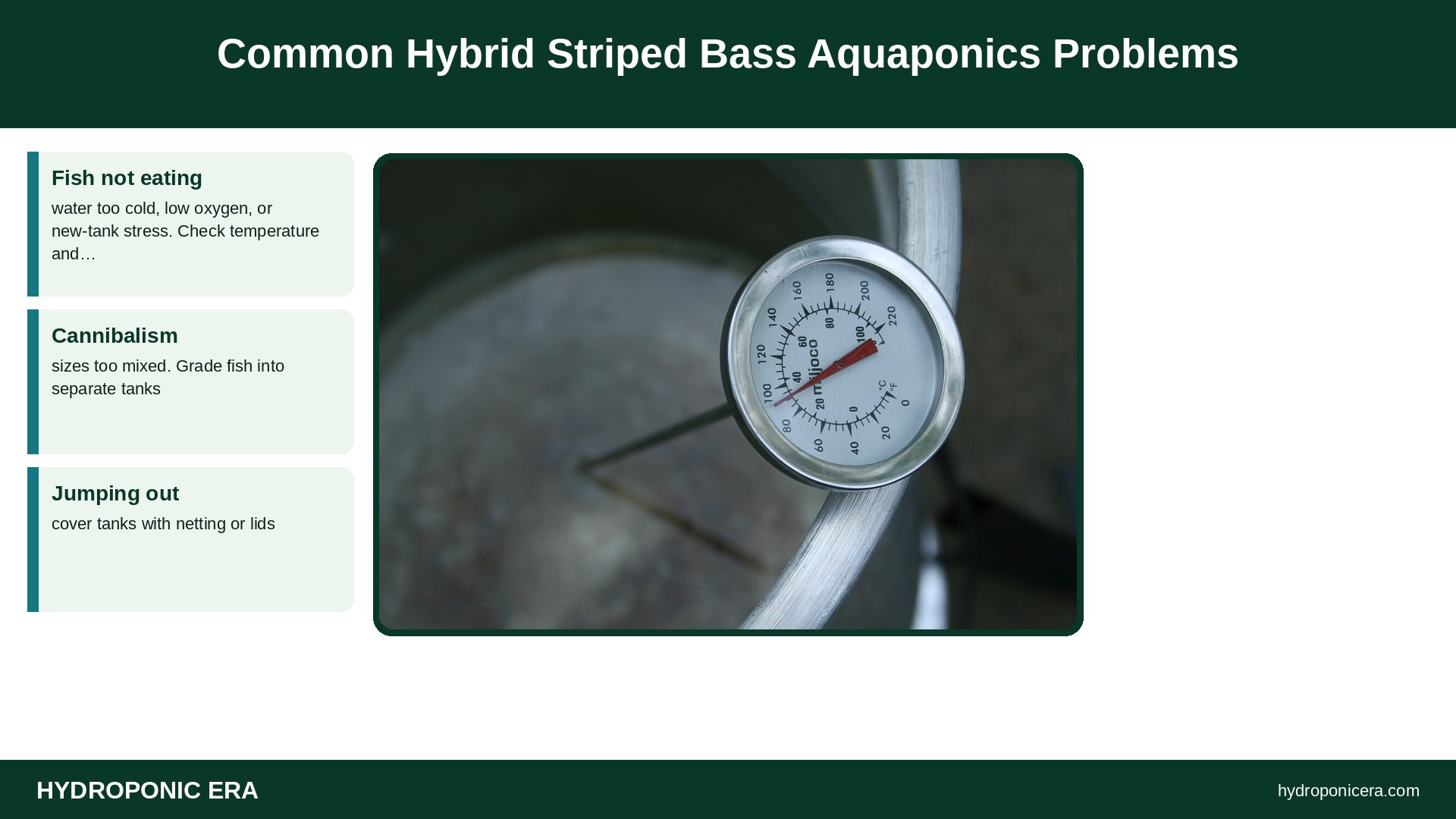
- Fish not eating: water too cold, low oxygen, or new-tank stress. Check temperature and DO first.
- Cannibalism: sizes too mixed. Grade fish into separate tanks.
- Jumping out: cover tanks with netting or lids.
- Cloudy water and ammonia rise: overfeeding and poor solids removal. See aquaponics ammonia spike.
- Disease after stress: handling, warm water and low oxygen together invite infections. See aquaponics fish diseases.
Hybrid Striped Bass vs Other Fish
| Fish | Ease | Best temperature | Notes |
|---|---|---|---|
| Hybrid striped bass | Moderate to hard | About 77–81°F | Fast growth, high protein, cannibalistic |
| Tilapia | Easy | Warm water | Restricted in some states |
| Bluegill | Easy | Warm to moderate | Native, slower growth |
| Largemouth bass | Hard | Warm to moderate | Needs feed-trained fish |
For a side-by-side with another predator, read largemouth bass aquaponics; for an easier native option see bluegill aquaponics.
Step-by-Step Hybrid Striped Bass Aquaponics Plan
- Check permits with your state agency and find a hatchery that sells feed-trained hybrids.
- Build and cycle the system until ammonia and nitrite read zero. See aquaponics cycling.
- Plan heating so water stays above about 65°F in the growing season.
- Stock one size class at a conservative density.
- Feed and test on a schedule, logging temperature, DO, ammonia and nitrite.
- Grade and thin fish as they grow, then harvest at 1.5–2.5 pounds. See aquaponics fish harvest.
FAQs
Is hybrid striped bass aquaponics good for beginners?
Not usually; tilapia, bluegill or catfish are easier first fish.
What temperature do hybrid striped bass need?
Best growth is about 77–81°F, and growth nearly stops below about 59°F.
How long until harvest?
Typically 18–24 months to reach 1.5–2.5 pounds.
Can hybrid striped bass live with other fish?
They eat smaller fish, so keep one size class of one species.
Do I need a permit?
Possibly; rules vary by state, so check before buying fingerlings.
Can they live in saltwater?
They tolerate brackish water, but aquaponics plants need freshwater.
Sources
- Southern Regional Aquaculture Center — SRAC 300: Hybrid Striped Bass Biology and Life History
- Southern Regional Aquaculture Center — SRAC 454: Aquaponics—Integrating Fish and Plant Culture
- University of Florida IFAS — Dissolved Oxygen for Fish Production
- FAO — Small-scale aquaponic food production
- Photo credits (Wikimedia Commons, edited with titles): Hybrid striped bass (51253333818) by USFWS Mountain Prairie (Public domain); Fish farming on Øksfjorden in Loppa, Troms og Finnmark, Norway, 2022 August by Ximonic (Simo Räsänen) (CC BY-SA 4.0); Feeding fish (51250565367) by USFWS Mountain Prairie (Public domain); Aquarium-air-pump by User:Corydoras-adolfoi (CC BY-SA 4.0); 2008-09-20 Thermometer reading by Ildar Sagdejev (Specious) (CC BY-SA 4.0)