
Quick Answer
A hydroponic garden grows plants without traditional soil by delivering water, nutrients, and oxygen directly to the roots. Beginners usually start with a small deep water culture (DWC) or passive Kratky setup, leafy greens or herbs, and steady basics: light, root health, and solution management.
Treat target ranges as guidance—not lab guarantees. Pair this overview with pH control, nutrient mixing, and reservoir changes, and troubleshoot early stress with our yellow leaves and brown roots guides.
Key Takeaways
- Hydroponics replaces soil with a managed root environment—water, oxygen, and nutrients still matter every day.
- Start small: one simple system and easy crops beat a large, hard-to-monitor build.
- Kratky and DWC are common beginner paths; NFT, drip, and aeroponics need more attention to pumps and clogging.
- Check pH and EC regularly; top-ups are not the same as full nutrient-solution changes.
- Indoor gardens need adequate light; outdoor/passive setups still need clean water and root oxygen.
- Yellow leaves or brown/slimy roots usually need a whole-system check, not only more fertilizer.
- Clean reservoirs and equipment between crops to reduce biofilm and pest carryover.
Related HydroponicEra guides
- Indoor hydroponic garden guide
- Deep water culture (DWC) for beginners
- How to control hydroponic pH
- Hydroponic nutrients for beginners
- How often to change hydroponic water
- Grow lights for hydroponics
- How to grow lettuce hydroponically
- How to grow strawberries hydroponically
- Vertical farming for beginners
- Why hydroponic leaves turn yellow
- Why hydroponic roots turn brown
Hydroponic Garden: Complete Beginner’s Guide to Growing Plants Without Soil

Introduction
Growing fresh vegetables, herbs, and even fruit without traditional garden soil may sound complicated, but the basic idea behind a hydroponic garden is surprisingly simple: give plant roots the water, oxygen, nutrients, light, and environmental conditions they need, while removing the need for ordinary soil.
A well-designed hydroponic garden can fit on a kitchen counter, balcony, greenhouse, garage, or dedicated indoor growing area. You can start with a simple passive system such as the Kratky method or build a more advanced setup using pumps, reservoirs, air stones, timers, and recirculating nutrient solution.
The key is not simply choosing a hydroponic system. Successful hydroponic gardening depends on managing the entire root environment.
In this guide, you will learn what a hydroponic garden is, how hydroponics works, which systems are available, what plants you can grow, how to choose nutrients and growing media, how to manage pH and EC, how to use hydroponic nutrients, and how to avoid the mistakes that commonly cause poor plant growth.
What Is a Hydroponic Garden?
A hydroponic garden is a growing system in which plants are cultivated without traditional soil. Instead, plant roots receive water and essential nutrients through a nutrient solution or a soilless growing medium.
Hydroponics can mean growing roots directly in nutrient solution, as happens in systems such as Deep Water Culture and Nutrient Film Technique, or growing plants in an inert or relatively low-nutrient medium such as clay pebbles, rockwool, perlite, or coco coir. Penn State Extension describes hydroponics broadly as growing plants in water containing nutrients or, under the broader soilless definition, growing plants without soil.
The important difference is that soil is no longer responsible for supplying and buffering the plant’s root environment. You become responsible for providing the conditions the roots need.
That includes:
- Water
- Essential nutrients
- Oxygen
- Appropriate pH
- Appropriate electrical conductivity (EC)
- Suitable temperature
- Adequate light
- Proper humidity
- A healthy root zone
When these factors are balanced, hydroponic plants can grow vigorously.
How Does a Hydroponic Garden Work?

The basic principle is straightforward.
Plants absorb water and dissolved mineral nutrients through their roots. In a hydroponic system, those nutrients are supplied through a carefully prepared nutrient solution instead of ordinary soil.
The roots also need oxygen. This is why aeration and root-zone design are so important.
A typical active system may contain:
- A reservoir
- Nutrient solution
- Plants held in net pots
- A growing medium
- A water pump and/or air pump
- Tubing
- An air stone
- A timer or controller
- pH and EC monitoring equipment
The exact components depend on the system.
For example, a Deep Water Culture system can keep roots in nutrient solution while an air pump and air stone provide oxygen. An NFT system instead sends a shallow flow of nutrient solution along the bottom of growing channels so roots receive water and nutrients while remaining exposed to air.
Hydroponic systems can be passive or active and can use either liquid culture or an aggregate growing medium.
Why Grow a Hydroponic Garden?
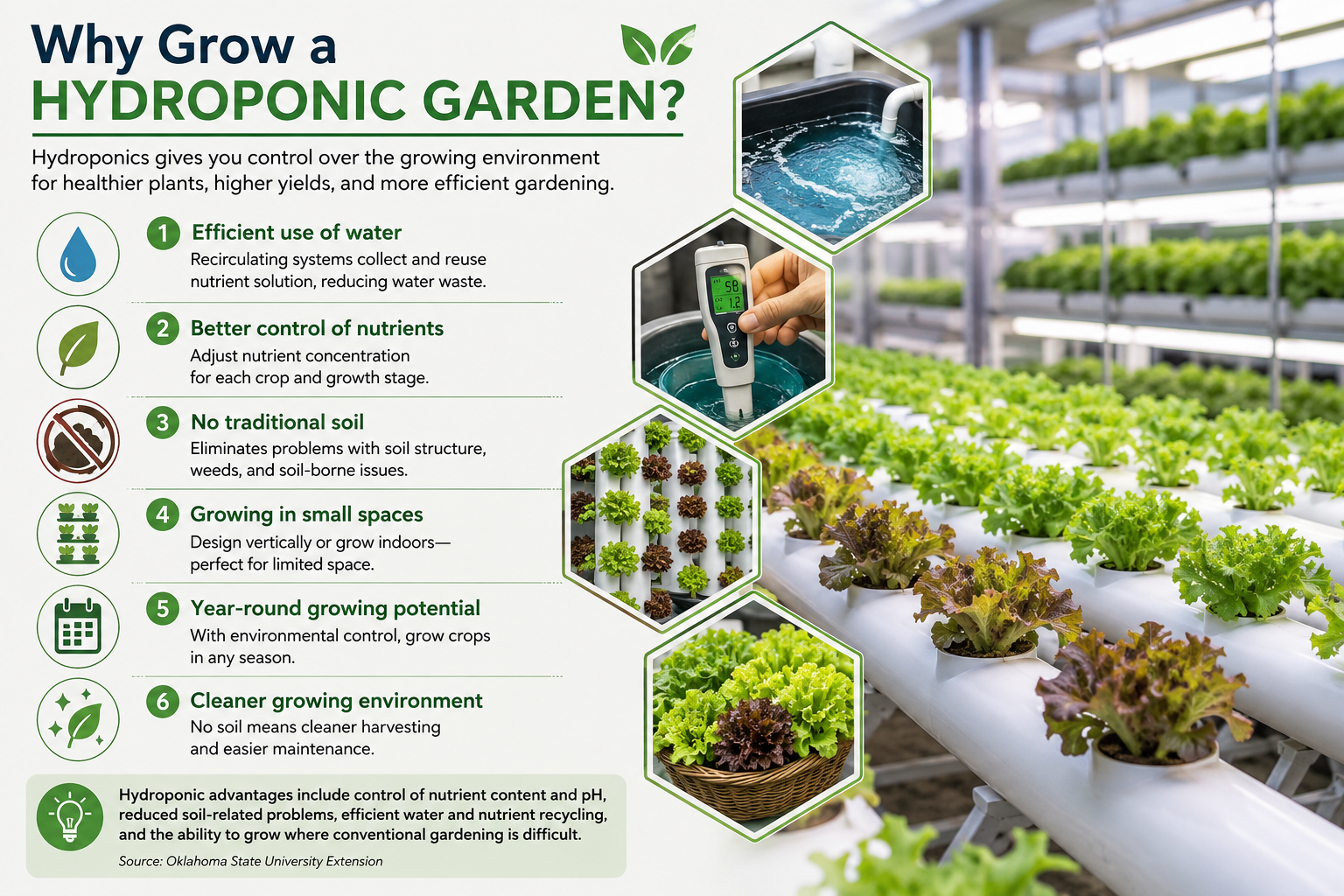
One of the biggest advantages of hydroponics is control.
Instead of relying on the physical and chemical properties of garden soil, you can directly manage the plant’s growing environment.
1. Efficient use of water
Many recirculating hydroponic systems collect and reuse nutrient solution rather than allowing water to drain away after every irrigation cycle.
2. Better control of nutrients
You can adjust the nutrient concentration according to the crop and growth stage.
3. No traditional soil
Removing soil eliminates many of the problems associated with soil structure, weeds, and soil-borne issues.
4. Growing in small spaces
A hydroponic garden can be designed vertically or placed indoors, making it useful where traditional gardening space is limited.
5. Year-round growing potential
With suitable environmental control, indoor and greenhouse systems can produce crops outside the normal outdoor growing season.
6. Cleaner growing environment
Because plants are not growing in ordinary garden soil, harvesting and maintenance can be cleaner and easier.
Oklahoma State University Extension lists control of nutrient content and pH, reduced soil-related problems, efficient water and nutrient recycling, and the ability to grow where conventional gardening is difficult among hydroponic advantages.
What Are the Disadvantages of Hydroponic Gardening?
Hydroponics is not automatically easier than soil gardening.
It replaces some soil-related problems with a greater need for monitoring and system management.
Common disadvantages include:
- Higher initial equipment costs
- Dependence on pumps in many active systems
- Need for regular pH and EC monitoring
- Nutrient-management mistakes can affect plants quickly
- Power failures can be serious in some systems
- Diseases can spread through shared nutrient solution
- Beginners need to learn basic plant nutrition
Oklahoma State University also notes that hydroponic production can require more initial and operating costs and that knowledge and skill are needed for successful operation.
The good news is that you do not need a complicated commercial installation to start.
Best Hydroponic Systems for a Home Garden
There is no single best hydroponic system for every gardener.
Your choice should depend on the plant, available space, budget, experience, and how much maintenance you are willing to perform.
1. Kratky Method
The Kratky method is one of the simplest ways to start.
It is a passive system that does not normally require a water pump or air pump. The plant sits above a nutrient reservoir, and as the plant consumes water, the water level drops and exposes more roots to air.
Best for:
- Beginners
- Lettuce
- Herbs
- Small experiments
- Low-cost projects
Its simplicity makes it an excellent introduction to hydroponics.
2. Deep Water Culture (DWC)
In Deep Water Culture, plant roots are suspended in nutrient solution.
An air pump sends air through an air stone, increasing aeration around the roots.
Main components:
- Reservoir
- Net pot
- Growing medium
- Air pump
- Air stone
- Nutrient solution
DWC is relatively simple but requires reliable aeration.
If the air pump stops for an extended period, root oxygen can become a problem.
3. Nutrient Film Technique (NFT)
NFT, or Nutrient Film Technique, continuously circulates a shallow layer of nutrient solution through channels.
Plant roots extend into the channel and receive moisture and nutrients from the flowing solution.
Advantages:
- Efficient use of nutrient solution
- Good for leafy greens
- Suitable for vertical or horizontal layouts
- Relatively clean root environment
Disadvantages:
- Pump failure can quickly interrupt nutrient delivery
- Channels need correct slope and flow
- Large plants can become difficult to support
NFT is particularly attractive for people interested in growing many small plants efficiently.
4. Ebb and Flow
Also called flood and drain, this system periodically floods a growing tray with nutrient solution and then drains it back into the reservoir.
A pump and timer control the flooding cycle.
The system can provide both moisture and air to the root zone when properly designed.
5. Drip System
A drip hydroponic system delivers nutrient solution directly to each plant through small irrigation lines.
This method works especially well for larger plants such as:
- Tomatoes
- Cucumbers
- Peppers
- Strawberries
Plants are commonly supported in a growing medium such as coco coir or another suitable substrate.
6. Wick System
A wick system uses a wick to move nutrient solution from the reservoir toward the growing medium through capillary action.
It is passive and inexpensive, but it is better suited to smaller plants that do not have extremely high water requirements.
7. Aeroponics
Aeroponics takes the idea of root oxygenation even further.
Instead of keeping roots submerged, the roots are suspended in an enclosed environment and periodically exposed to nutrient-rich mist.
Aeroponics can be highly efficient but is more technically demanding than simple beginner systems.
What Plants Can You Grow in a Hydroponic Garden?

One of the most exciting things about a hydroponic garden is the variety of crops you can grow.
Excellent choices for beginners
- Lettuce
- Basil
- Mint
- Spinach
- Kale
- Pak choi
- Microgreens
- Herbs
More demanding crops
- Tomatoes
- Cucumbers
- Peppers
- Strawberries
- Eggplant
- Melons
Larger fruiting plants usually require more space, stronger support, more light, and closer management of water and nutrients.
For example, a compact lettuce setup may be relatively simple, while a productive tomato system can require trellising, pruning, pollination, strong lighting, and a carefully managed root environment.
How to Start a Hydroponic Garden
If you are a beginner, resist the temptation to build the most complicated system you can find.
Beginner hydroponic garden checklist (typical guidance)
Use this as a practical starting checklist—not a guarantee. Adjust for your crop, water, and system.
| Area | What to set up first | Related HydroponicEra guide |
|---|---|---|
| System size | Start small (a few plants) before expanding | DWC for beginners or simple Kratky |
| pH | Meter + adjusters; check regularly | Control hydroponic pH |
| Nutrients / EC | Follow label starting rates; measure EC | Hydroponic nutrients |
| Reservoir | Top up water; plan full changes | Water-change guide |
| Light (indoors) | Full-spectrum LED sized to canopy | Grow lights guide |
| Problems | Watch leaves and roots early | Yellow leaves / brown roots |
Start with one or a few plants.
Step 1: Choose Your Crop
Select a crop that matches your experience.
For your first project, lettuce, basil, or another leafy green is often easier than a large fruiting crop.
Step 2: Choose Your Hydroponic System
Choose the system based on the plant and your available space.
For example:
| System | Beginner-friendly (guidance) | Typically good for |
|---|---|---|
| Kratky | Excellent | Lettuce, herbs |
| DWC | Excellent | Leafy greens, herbs |
| NFT | Moderate | Lettuce, herbs |
| Ebb and flow | Moderate | Multiple crops |
| Drip | Moderate | Tomatoes, peppers, cucumbers |
| Aeroponics | Advanced | Experienced growers |
Step 3: Choose the Reservoir
The reservoir stores your nutrient solution.
Use an appropriately sized, clean container that prevents excessive light from reaching the solution. Light exposure can encourage unwanted algae growth.
Step 4: Select Net Pots
Net pots hold the plant and allow roots to grow into the root zone or nutrient solution.
The correct size depends on the crop and system design.
Step 5: Choose a Growing Medium
Common hydroponic media include:
- Rockwool
- Clay pebbles
- Coco coir
- Perlite
The purpose of the growing medium is primarily to support the plant and provide an appropriate balance of moisture and air.
Different media have different water-holding and air-porosity characteristics, so they should not be treated as interchangeable.
Step 6: Prepare Your Water
Water quality matters more than many beginners realize.
Your source water already contains dissolved minerals and salts. These can influence both EC and pH.
Oklahoma State University recommends having hydroponic water analyzed and checking factors such as pH, EC, and alkalinity because poor-quality source water can contribute to nutrient problems.
Step 7: Mix Your Nutrient Solution
Use a fertilizer specifically designed for hydroponic growing and follow its mixing instructions.
Do not assume that ordinary garden fertilizer is automatically appropriate for hydroponics.
Plants require both macronutrients and micronutrients.
Important nutrients include:
Macronutrients
- Nitrogen
- Phosphorus
- Potassium
- Calcium
- Magnesium
- Sulfur
Micronutrients
- Iron
- Manganese
- Boron
- Zinc
- Copper
- Molybdenum
- Chlorine
The exact nutrient requirements depend on the crop and growth stage.
Penn State Extension emphasizes that nutrient concentration and balance are central to successful hydroponic production.
Step 8: Check EC
Electrical conductivity (EC) provides an indication of the concentration of dissolved ions in the nutrient solution.
A high EC generally indicates a higher concentration of dissolved salts, while a lower EC indicates a lower concentration.
However, EC does not tell you exactly which individual nutrients are present.
Too much nutrient concentration can cause osmotic stress and toxicity, while insufficient nutrient concentration can contribute to deficiencies and poor plant growth.
Always follow crop-specific nutrient guidance rather than assuming one EC value works for every plant.
Step 9: Check pH
pH influences nutrient availability.
Hydroponic nutrient solutions are generally maintained in a mildly acidic range, but the exact target depends on the crop and system.
Oklahoma State University’s general hydroponic guidance places nutrient solutions around pH 5–6, while crop-specific recommendations vary.
Do not chase a single number without considering the crop.
Step 10: Provide Adequate Light
Plants cannot grow well simply because they have water and nutrients.
They also need adequate light for photosynthesis.
For indoor growing, you may need artificial grow lights.
The required light intensity and duration depend on the crop, cultivar, growing environment, and light technology.
Leafy greens generally have different lighting requirements from large fruiting plants such as tomatoes and cucumbers.
Step 11: Monitor the Root Zone
Healthy plant roots are usually a sign that the system is functioning correctly.
Monitor:
- Root appearance
- Root smell
- Water temperature
- Oxygen availability
- Nutrient solution condition
- pH
- EC
A healthy root zone needs both moisture and oxygen.
Hydroponic Garden pH: Why It Matters
pH is one of the most important numbers in hydroponics.
A nutrient solution can contain plenty of nutrients but still cause deficiency symptoms if the chemical conditions make those nutrients less available.
This is why simply adding more fertilizer is not always the correct response to a nutrient problem.
Oklahoma State University explains that nutrient availability is strongly influenced by pH and recommends monitoring pH regularly.
A practical routine
- Measure the nutrient solution.
- Check EC.
- Adjust nutrient concentration if needed.
- Check pH.
- Make small adjustments.
- Allow the solution to mix.
- Measure again.
Avoid making large corrections all at once.
Hydroponic Garden EC: What Beginners Need to Know
EC stands for electrical conductivity.
It is useful because dissolved nutrients increase the solution’s ability to conduct electricity.
But EC should be treated as a management tool, not a complete nutrient diagnosis.
For example, two solutions can have a similar EC but contain different nutrient ratios.
That means a plant problem cannot always be solved simply by increasing or decreasing EC.
Crop-specific EC targets are important. Oklahoma State University provides different EC ranges for different crops, illustrating why there is no universal hydroponic EC setting.
How to Manage Hydroponic Nutrients
A good nutrient-management routine includes:
- Starting with suitable water
- Using a complete hydroponic fertilizer
- Following the manufacturer’s mixing instructions
- Measuring EC
- Monitoring pH
- Watching plant growth
- Checking for deficiency symptoms
- Replacing or refreshing solution when appropriate
Never assume that more fertilizer means faster growth.
Plants require nutrients in appropriate proportions.
Too much can be just as harmful as too little.
Penn State Extension also notes that concentrated fertilizer solutions require careful handling because some fertilizer combinations can precipitate and cause problems such as clogged irrigation lines.
Water Temperature and Root Oxygen
Water temperature affects the root environment.
Warm nutrient solution can hold less dissolved oxygen than cooler water, making oxygen management more challenging.
This is especially important in systems where roots remain continuously surrounded by nutrient solution.
Aeration can be supplied through an air pump and air stone.
In DWC, for example, continuous aeration helps provide oxygen around submerged roots.
Oklahoma State University identifies water temperature and aeration as important components of hydroponic management.
Humidity and Air Movement
A hydroponic system can have excellent roots and still struggle if the air around the leaves is poor.
Humidity affects how quickly plants lose water through transpiration.
Air movement helps reduce stagnant air around leaves and can support a healthier growing environment.
For indoor gardens, consider:
- Ventilation
- Air circulation
- Temperature
- Relative humidity
- Plant spacing
Avoid packing plants so tightly that leaves remain wet and air cannot move between them.
Common Hydroponic Garden Problems
Even a good system can experience problems.
Yellow Leaves
Possible causes include:
- Nutrient deficiency
- Incorrect pH
- Incorrect EC
- Root problems
- Environmental stress
- Natural aging of older leaves
Do not diagnose the cause based on leaf color alone.
Check the root zone, pH, EC, water level, lighting, and recent changes.
Brown or Unhealthy Roots
Possible contributors include:
- Poor oxygenation
- Excessive heat
- Unsuitable water conditions
- Root disease
- Poor sanitation
Check your system before immediately adding chemicals or changing several variables at once.
Slow Plant Growth
Check:
- Light
- Nutrient concentration
- pH
- Root oxygen
- Temperature
- Water level
- Plant spacing
Growth problems often have multiple contributing factors.
Algae
Algae need light, water, and nutrients.
If light reaches your nutrient reservoir, algae can develop.
Reduce unnecessary light exposure and keep the system clean.
Pump Failure
In active systems, a pump failure can interrupt nutrient delivery.
For this reason, consider:
- Checking pumps regularly
- Keeping spare tubing
- Having a backup air pump when appropriate
- Using alarms for larger systems
The more dependent your plants are on active equipment, the more important reliability becomes.
How Often Should You Check a Hydroponic Garden?
A simple monitoring routine can prevent many problems.
Daily
Check:
- Water level
- Plant appearance
- Root condition when visible
- Pump operation
- Temperature
- pH and EC when your crop/system management plan calls for it
Oklahoma State University’s hydroponic guidance recommends checking pH and EC daily and at the same time of day for consistency.
Weekly
Inspect:
- Tubing
- Pumps
- Air stones
- Reservoir cleanliness
- Growing media
- Plant roots
- Pests
- New growth
Periodically
Clean and sanitize the system according to the crop cycle and system requirements.
For recirculating systems, pay particular attention to anything that can accumulate or clog.
How to Keep a Hydroponic Garden Clean
Cleanliness matters because the nutrient solution moves through the growing environment and may contact roots, containers, channels, pumps, and tubing.
A basic maintenance routine includes:
- Remove dead plant material.
- Clean spilled nutrient solution.
- Inspect tubing.
- Check pumps and air stones.
- Remove algae.
- Clean the reservoir during appropriate maintenance intervals.
- Sanitize equipment between crop cycles when appropriate.
For commercial or intensive systems, sanitation becomes even more important because some pathogens can spread through shared water systems.
Common Beginner Mistakes
1. Starting Too Big
Your first project does not need 100 plants.
Start with a manageable number.
Learn how the system behaves before expanding.
2. Ignoring Water Quality
Source water can affect EC, pH, alkalinity, and nutrient management.
3. Overfeeding Plants
More nutrients do not automatically mean more growth.
4. Ignoring pH
Even a good nutrient formula can perform poorly if pH is outside a suitable range.
5. Forgetting Oxygen
Roots need oxygen.
This is particularly important in systems where roots are surrounded by water.
6. Choosing the Wrong System for the Crop
A small passive system may be excellent for lettuce but unsuitable for a large tomato crop.
7. Making Too Many Changes at Once
If a plant develops yellow leaves and you simultaneously change the nutrients, light, pH, water, and temperature, you may never discover the original problem.
Change one important variable at a time when practical.
DIY Hydroponic System: Where Should You Start?
A do it yourself hydroponics system can be inexpensive and educational.
For a beginner, a simple container-based Kratky setup or small DWC system is often easier to understand than a complicated automated installation.
A basic DIY system may require:
- Opaque container
- Net pot
- Growing medium
- Hydroponic nutrient
- Water
- Seedling
- pH meter or test method
- EC meter when appropriate
- Air pump and air stone for DWC
The goal of your first project should not be maximum yield.
The goal should be learning how the root zone, nutrient solution, pH, EC, water level, and plant growth interact.
Once you understand those fundamentals, you can move toward larger hydroponic systems.
How to Choose the Best Hydroponic Growing System
Ask yourself five questions:
1. What am I growing?
Leafy greens and herbs have different requirements from tomatoes and cucumbers.
2. How much space do I have?
A vertical NFT system may make sense in one location, while a horizontal DWC setup may work better somewhere else.
3. How much maintenance can I handle?
Passive systems generally have fewer moving parts.
4. What happens if the electricity goes out?
Active systems depend more heavily on pumps.
5. What is my budget?
You can start small and expand.
There is no requirement to build a commercial-style system on your first attempt.
Hydroponic Garden vs. Traditional Garden
| Feature | Hydroponic Garden | Traditional Soil Garden |
|---|---|---|
| Soil required | No | Yes |
| Nutrient control | High | Lower direct control |
| Water management | Highly controllable | Depends heavily on soil and irrigation |
| Growing indoors | Possible | Limited |
| Space efficiency | Can be very high | Depends on garden layout |
| Initial complexity | Moderate to high | Usually lower |
| Maintenance | Requires monitoring | Soil and plant maintenance |
| Root environment | Directly managed | Buffered by soil |
Neither approach is automatically better for every gardener.
Hydroponics is particularly attractive when you want greater control over the root environment or need to grow where conventional soil gardening is difficult.
Can You Grow a Hydroponic Garden Indoors?
Yes.
Indoor hydroponic gardening is one of the most practical applications of the technology.
A successful indoor setup needs more than a container and water.
You need to consider:
- Grow lights
- Air circulation
- Temperature
- Humidity
- Nutrients
- pH
- EC
- Water level
- Plant spacing
Leafy greens and herbs are particularly convenient for indoor systems because many varieties remain relatively compact.
Fruit-producing crops can also be grown indoors, but they generally require more space, stronger lighting, plant support, and more careful environmental management.
How Much Does a Hydroponic Garden Cost?
The answer depends heavily on the size and complexity of the system.
Low-cost beginner setup
A simple passive system can require only a container, net pot, growing medium, nutrient solution, and plant.
Intermediate setup
A DWC or small recirculating system adds equipment such as:
- Air pump
- Air stone
- Tubing
- Water pump
- Timer
- Larger reservoir
Advanced setup
A larger system may include:
- Multiple grow channels
- Automated irrigation
- Environmental sensors
- Automated nutrient dosing
- Grow lights
- Ventilation
- Controllers
- Backup equipment
Start with the smallest system that lets you learn successfully.
How to Make Your Hydroponic Garden More Reliable

Once you understand the fundamentals, automation can make monitoring easier.
You can eventually monitor:
- pH
- EC
- Water temperature
- Reservoir level
- Air temperature
- Humidity
- Light levels
More advanced growers can connect sensors and controllers to automate irrigation, nutrient dosing, alerts, and environmental equipment.
But automation should come after you understand the system.
Automating a poorly designed garden simply allows mistakes to happen faster.
Hydroponic Garden Maintenance Checklist
Use this simple checklist to keep your system under control.
Every day
- Check plant health
- Check reservoir level
- Check pump operation
- Check environmental conditions
- Check pH/EC according to your crop-management routine
Every week
- Inspect roots
- Inspect tubing
- Check air stones
- Look for algae
- Look for pests
- Remove dead leaves
- Inspect growing media
During crop changes
- Empty the system
- Clean components
- Sanitize where appropriate
- Inspect pumps and tubing
- Prepare fresh nutrient solution
- Start the next crop with clean equipment
Frequently Asked Questions About Hydroponic Gardens
What is a hydroponic garden?
A hydroponic garden grows plants without traditional soil by supplying water and essential nutrients directly to the root environment. Plants may be supported by growing media such as clay pebbles, rockwool, coco coir, or perlite.
Is hydroponic gardening good for beginners?
Yes. Beginners can start with relatively simple systems such as Kratky or DWC. Starting small is usually easier than immediately building a complicated recirculating system.
What is the easiest hydroponic system?
The Kratky method is one of the simplest because it can operate without a water pump or air pump. DWC is another beginner-friendly option, although it requires aeration.
Do hydroponic plants need soil?
No. Hydroponic plants do not require traditional soil. Some systems use growing media for physical support, but the plant’s mineral nutrients come primarily from the nutrient solution.
What nutrients do hydroponic plants need?
Plants need essential macronutrients such as nitrogen, phosphorus, potassium, calcium, magnesium, and sulfur, along with smaller quantities of micronutrients such as iron, manganese, boron, zinc, copper, and molybdenum.
What pH should a hydroponic garden have?
There is no single perfect pH for every crop. Hydroponic nutrient solutions are commonly maintained in a mildly acidic range, and crop-specific requirements should be followed. Oklahoma State University gives a general hydroponic nutrient-solution range of approximately pH 5–6.
What is EC in hydroponics?
EC means electrical conductivity. It provides an indication of the concentration of dissolved ions in a nutrient solution. It is useful for monitoring nutrient concentration but does not identify individual nutrients.
Can I grow tomatoes in a hydroponic garden?
Yes. Tomatoes can be grown hydroponically, but they generally require more space, support, light, nutrient management, and pruning than many leafy greens.
Can I grow strawberries hydroponically?
Yes. Strawberries can be grown hydroponically, including in systems that raise the plants above ground level. Crop-specific nutrient and environmental management is important.
Can hydroponic plants grow indoors?
Yes. Indoor hydroponic gardens can work very well, provided the plants receive adequate light, air movement, nutrients, water, and suitable environmental conditions.
Final Thoughts
A successful hydroponic garden is not simply a container filled with nutrient solution.
It is a controlled growing environment.
The roots need oxygen. The plants need light. The nutrient solution needs appropriate concentration and pH. The reservoir needs monitoring. The growing system needs to match the crop.
The best way to begin is simple: choose one suitable crop, build a manageable system, learn how to measure pH and EC, observe the roots and leaves, and make changes based on what the plants are telling you.
Once you understand those fundamentals, you can expand from a few plants into a larger indoor garden, greenhouse system, vertical setup, or automated hydroponic operation.
Ready to start a small hydroponic garden?
Growing fresh, healthy plants without soil is easier than you might think. Start small, choose the right hydroponic system, and follow the basics of nutrients, pH, lighting, and plant care.
Explore related HydroponicEra guides for systems, water management, and crop-specific tips.
Internal Links
How to Grow Microgreens Hydroponically: Complete Beginner’s Guide
How to Grow Peppers Hydroponically: Complete Guide to Fruiting, Pollination & High Yields
How to grow strawberries hydroponically
Once a simple garden feels steady, you can compare methods. A calm next read is aeroponics for beginners, which hangs roots in air and mist instead of a deep reservoir.
Related reading
- Hydroponic garden basics for beginners
- How to control hydroponic pH
- Hydroponic nutrients for beginners
- How often to change hydroponic water
- Grow lights for hydroponics
- Why hydroponic leaves turn yellow
- Why hydroponic roots turn brown
- Deep water culture (DWC) for beginners
- Indoor hydroponic garden guide
- Aeroponics for beginners
- Hydroponic tower garden
- Vertical farming for beginners
Sources
These university and extension resources discuss soilless/hydroponic systems, nutrient-solution management, and beginner-scale production. Ranges in this article are typical guidance and should be adjusted for your water quality, crop, and system.
- UF/IFAS Extension — Hydroponic Vegetable Production in Florida (HS405)
- UF/IFAS Extension — Building a Floating Hydroponic Garden (HS184)
- University of Minnesota Extension — Small-scale hydroponics
- Oklahoma State University Extension — Hydroponics
- University of Tennessee Extension — Leafy Crop Production in Small-Scale Soilless and Hydroponic Systems (W 844-B)
18 thoughts on “Hydroponic Garden: Complete Beginner’s Guide to Growing Plants Without Soil”