
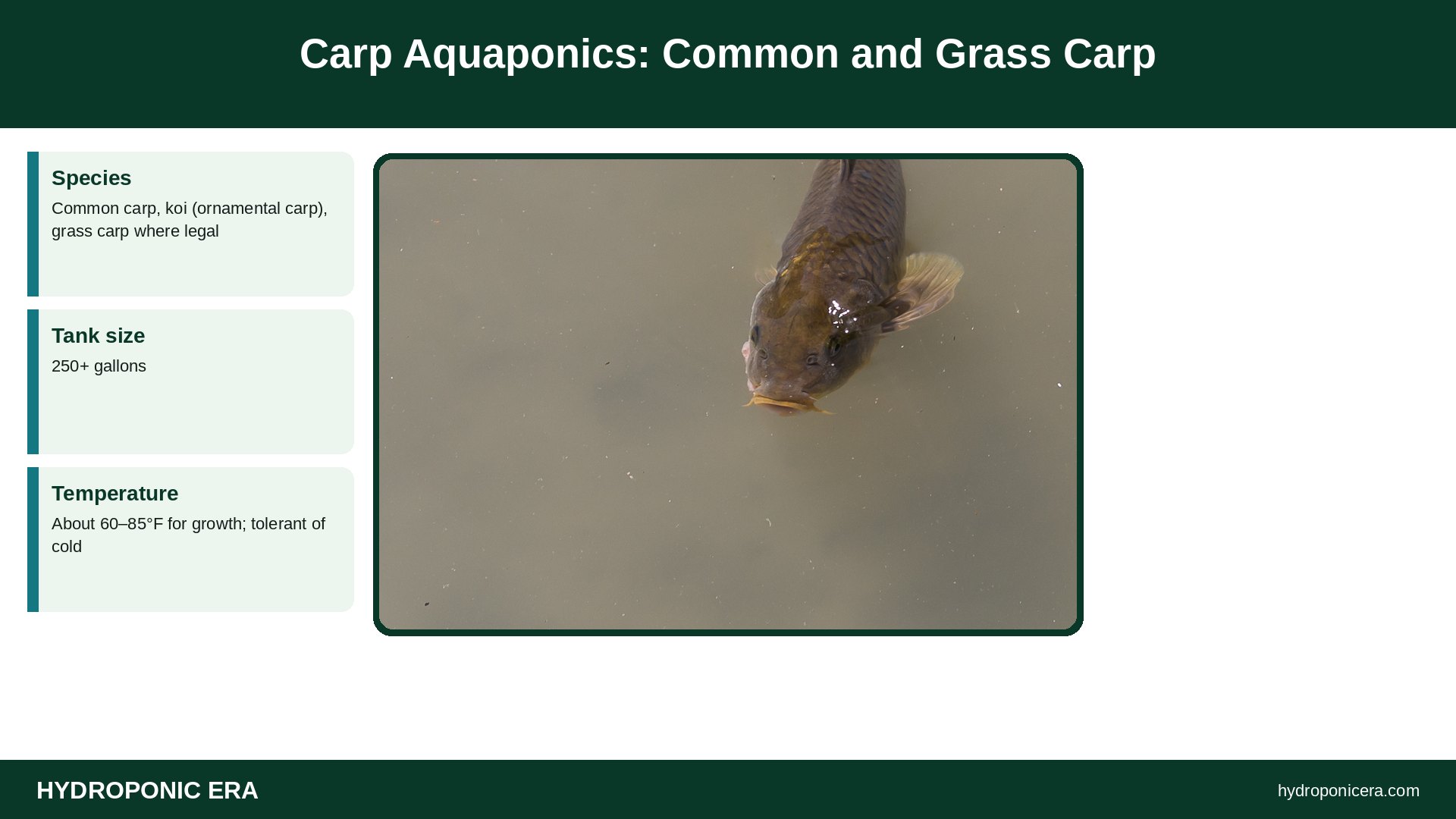
Carp aquaponics works well because common carp are hardy, eat almost anything, tolerate a wide range of temperatures and grow quickly in warm water. They suit backyard systems of about 250 gallons or more, ideally with good solids filtration because carp produce a lot of waste and stir up sediment. Keep water roughly 60–85°F for steady growth, pH near 7.0, and dissolved oxygen above 5 mg/L. Check state rules first: common carp and grass carp are restricted in many US states.
Key takeaway: Carp are tough, fast-growing and efficient, but they’re messy and often regulated; plan filtration and permits before you stock.
| Factor | Carp aquaponics guideline |
|---|---|
| Species | Common carp, koi (ornamental carp), grass carp where legal |
| Tank size | 250+ gallons |
| Temperature | About 60–85°F for growth; tolerant of cold |
| pH | About 6.8–7.5 |
| Feed | Omnivore pellets, 1–3% of body weight daily |
| Harvest size | 1–2+ lb, often in one warm season or longer in cooler climates |
Why Choose Carp Aquaponics
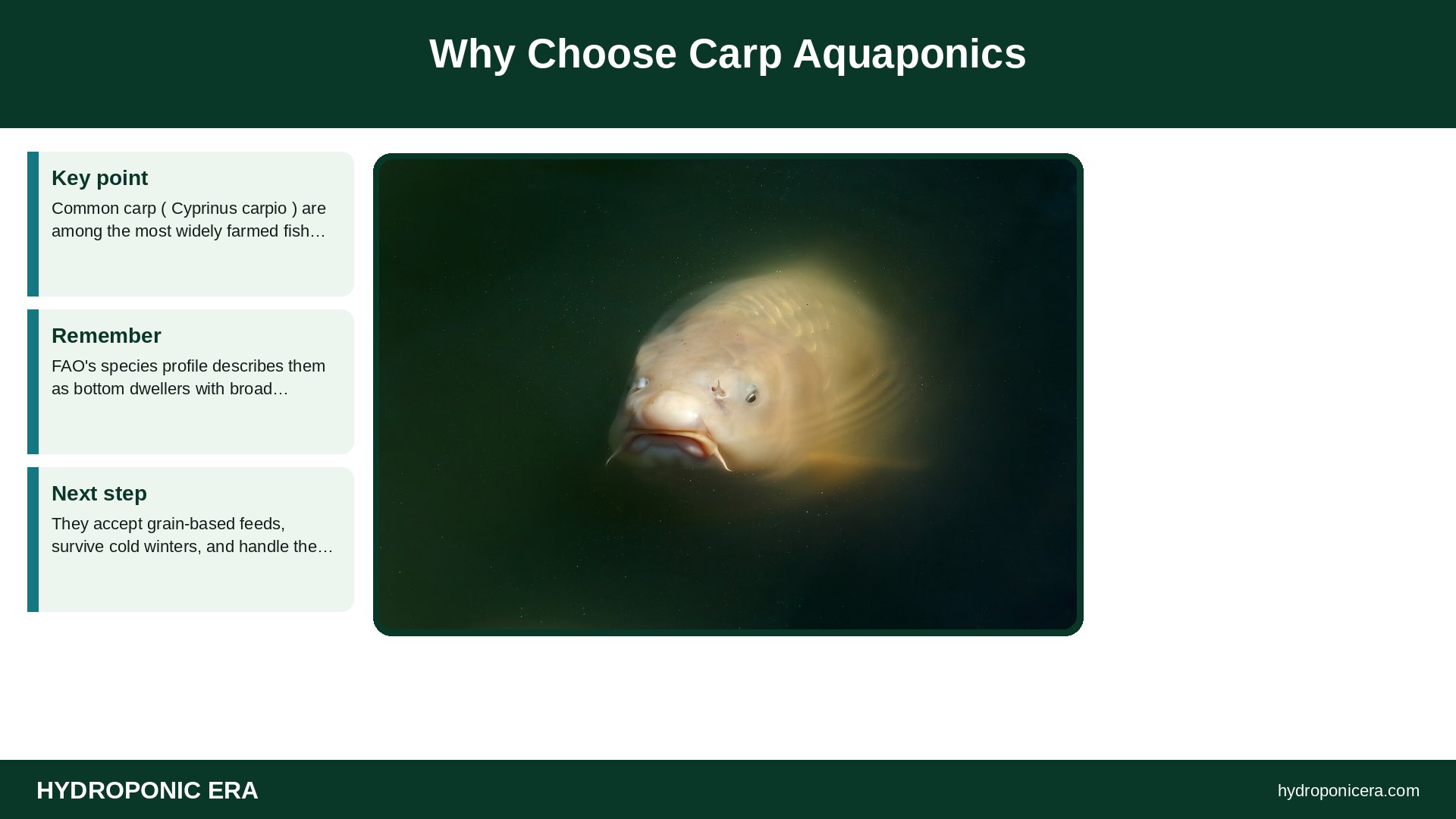
Common carp (Cyprinus carpio) are among the most widely farmed fish in the world. FAO’s species profile describes them as bottom dwellers with broad environmental tolerance and an omnivorous diet, which is why they’re a key species in integrated farming systems. They accept grain-based feeds, survive cold winters, and handle the occasional water quality slip better than many fish. For aquaponics growers in temperate climates, that toughness is attractive.
Growth Rates
FAO reports that carp can grow 2–4% of body weight per day in good conditions and reach about 1.3–2.2 pounds (0.6–1.0 kg) in a single season in warm subtropical ponds. In temperate climates, growth is much slower, with fish taking two to four seasons to reach about 2–4 pounds. In a heated or greenhouse carp aquaponics system, growth falls between these. See aquaponics greenhouse.
Temperature
Carp survive near-freezing water under ice and tolerate summer heat into the upper 80s°F. Growth is best in warm water. They slow down and eat little below about 50°F. Outdoor carp systems can often overwinter without heaters if the tank is deep enough not to freeze solid, though plants will need protection. See aquaponics winter and aquaponics water temperature.
System Design for Carp

- Tank: 250 gallons or more; carp grow large.
- Solids removal: a swirl filter or settling tank before the grow beds. See aquaponics solids filter.
- Biofilter: media beds or a dedicated biofilter. See aquaponics biofilter.
- Aeration: strong air stones; large fish use a lot of oxygen. See aquaponics dissolved oxygen.
- Cover: carp can jump.
Feeding Carp
Carp eat insects, worms, zooplankton and plant material in the wild. FAO notes that pond farming of carp relies on their ability to use cereal feeds. In aquaponics, a complete floating or sinking pellet with about 25–35% protein works well. Feed 1–3% of body weight daily in warm water, less when cool. Duckweed and worms make good supplements. See duckweed fish food and aquaponics fish food.
Koi and Grass Carp
Koi are ornamental varieties of common carp and work the same way in aquaponics, but they’re usually kept as pets rather than eaten. See koi aquaponics. Grass carp eat plants and can damage grow beds or roots that hang into the tank. Many states allow only sterile (triploid) grass carp, and only with a permit.
Legal and Environmental Concerns
FAO notes that introducing non-native carp into open waters can harm biodiversity by uprooting aquatic plants and increasing turbidity. Common carp are widespread and considered invasive in parts of the US, and several states restrict keeping, transporting or stocking them. Buy only from licensed suppliers and never release fish. See aquaculture permits for aquaponics.
Handling Carp
Large carp are strong and slippery. Use a big, soft net and wet hands or gloves, and support the fish’s body rather than holding it by the tail. Move fish in cool parts of the day, since handling stress is worse in hot water.
Disease
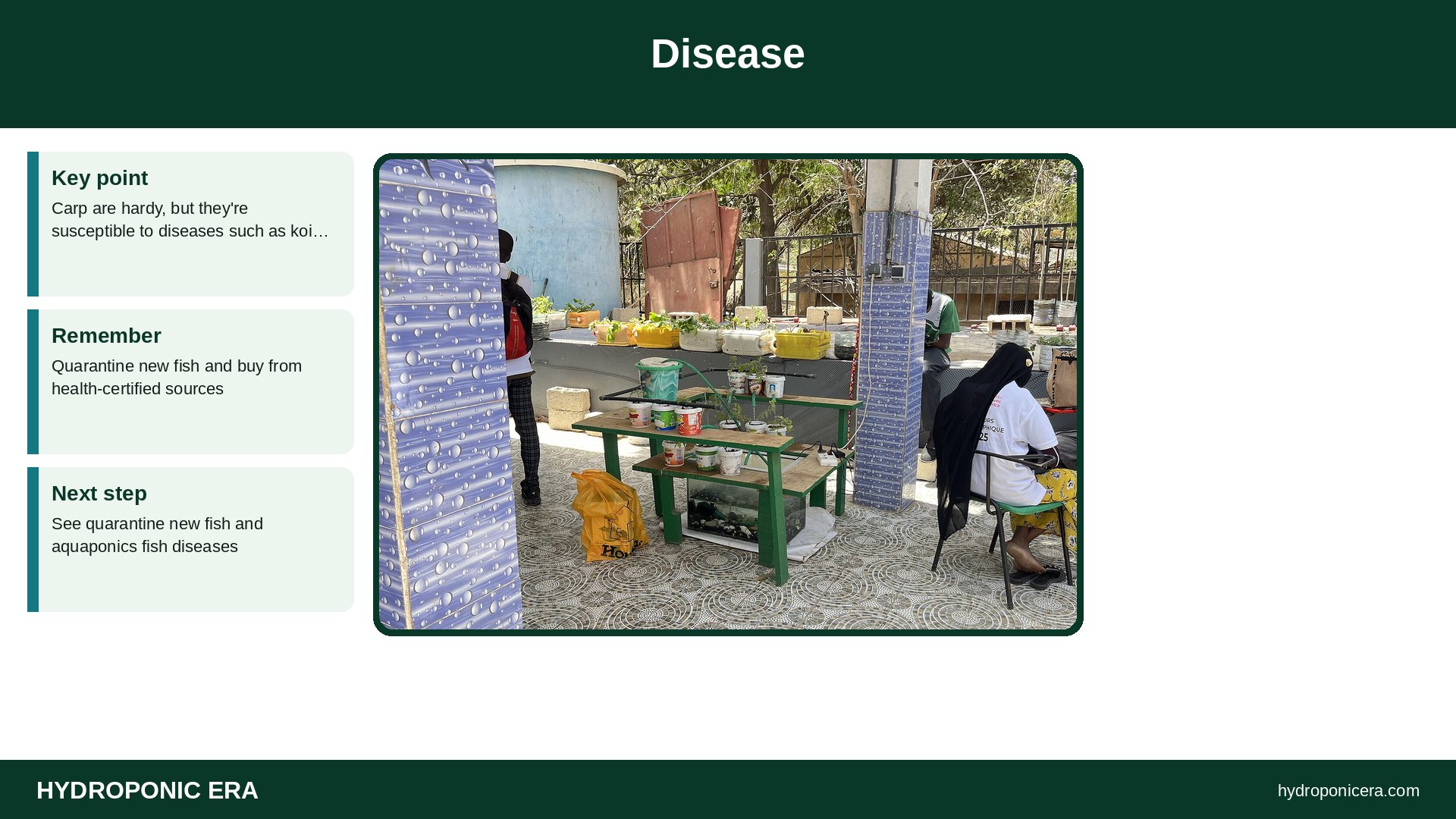
Carp are hardy, but they’re susceptible to diseases such as koi herpesvirus (KHV), spring viremia of carp, ich and parasites like anchor worms and fish lice. Quarantine new fish and buy from health-certified sources. See quarantine new fish and aquaponics fish diseases.
Eating Carp
Carp is a traditional food fish in Europe and Asia. Clean-water aquaponics carp usually taste milder than wild carp from muddy ponds. They have intermuscular bones, so scoring fillets before cooking or using them in fish cakes and soups is common. Cook to 145°F. See aquaponics fish harvest.
Stocking a Carp Aquaponics System
Start with 2–4 inch fingerlings from a licensed hatchery. Because carp grow large, stock based on the weight you’ll have at harvest, not at purchase. As a beginner, plan on about 1 pound of fish per 5–10 gallons at the end of the season. For a 300-gallon tank that means roughly 30–60 pounds total, so 20–30 fingerlings that you’ll harvest at 1.5–2 pounds each. Acclimate them slowly and test ammonia daily for the first two weeks. See aquaponics stocking density and aquaponics fingerlings.
Managing Carp Waste
Carp are bottom feeders that root through sediment, so their water often looks cloudy. In carp aquaponics, that suspended waste can clog media beds and coat plant roots in rafts. A radial or swirl filter removes most heavy solids; a mesh or sponge filter after it catches fine particles. Send the captured sludge to a mineralization tank or the garden instead of dumping it, because it’s rich in nutrients. Clean filters weekly, more often as fish grow.
Best Plants for Carp Aquaponics
A well-stocked carp tank produces plenty of nutrients, so you can grow both leafy greens and heavier feeders. Lettuce, kale, chard and herbs do well in rafts or media beds. Tomatoes, peppers, cucumbers and squash do well in media beds once the system is established and fish biomass is high. Watch for iron deficiency, which is common in aquaponics, and supplement chelated iron if new leaves turn pale. See aquaponics iron deficiency and aquaponics media bed.
Polyculture With Carp
FAO describes common carp being raised with other carps, tilapia and other species in polyculture, where fish with different feeding habits share a pond. In a home system, carp can share a tank with tilapia in warm months or with catfish and bluegill. Keep species of similar size together to avoid predation and bullying, and watch that each species gets its share of feed.
Carp Aquaponics Pros and Cons
- Pros: very hardy, cold-tolerant, fast-growing in warm water, cheap to feed, produce abundant nutrients.
- Cons: messy, stir up sediment, bony fillets, restricted in many states, large adult size.
FAQs
Is carp good for aquaponics?
Yes; it’s hardy and fast-growing, but messy.
Can carp survive winter outside?
Usually, if the tank is deep and doesn’t freeze solid.
How big does carp get?
Commonly 2–10+ pounds over several years.
Are carp legal to keep?
It depends on your state; check before buying.
Do carp eat plants?
Common carp nibble plants; grass carp eat them heavily.
Can carp live with tilapia?
Yes, in polyculture, if temperatures suit both.
Sources
- FAO Cultured Aquatic Species Information Programme — Cyprinus carpio
- FAO — Small-scale aquaponic food production
- Southern Regional Aquaculture Center — SRAC 454: Aquaponics—Integrating Fish and Plant Culture
- Photo credits (Wikimedia Commons, edited with titles): Cyprinus carpio (Carpe commune) – 426 by Another one of my pictures: This photograph was taken by Medium69 (William Croch (CC BY-SA 4.0); Koi in a garden pond in Tuntorp 3 by W.carter (CC BY-SA 4.0); Fish farming on Øksfjorden in Loppa, Troms og Finnmark, Norway, 2022 August by Ximonic (Simo Räsänen) (CC BY-SA 4.0); Intermediate Bulk Container (fcm) by Photograph: Frank C. Müller, Baden-Baden (CC BY-SA 4.0); AQUAPONIE by Hopeballa (CC BY-SA 4.0)