
The best aquaponics kit for you depends on what you want to grow. Small 3–10 gallon (11–38 L) desktop kits are great for learning and a few herbs, but they hold too few fish to feed much plant growth. For real harvests, look for a kit with a fish tank of roughly 50–264 gallons (190–1,000 L), a grow bed sized to your daily fish feed, a pump that moves the tank’s volume about once or twice an hour, an air pump, and food-safe, UV-resistant plastic.
The FAO considers a 1,000-liter (264-gallon) tank with about 32 square feet (3 m²) of growing space a good size for a family. Whatever you buy, budget extra for a water test kit and plan on 3–5 weeks to cycle the system before adding plants in earnest.
Key takeaway: Judge a kit by its tank volume, grow area, pump and filtration, not by its photos. A balanced system matters more than a brand name.
| What to check | Good target | Source |
|---|---|---|
| Fish feed vs. grow area | 40–50 g feed per m² per day for leafy greens; 50–80 g for fruiting crops | FAO |
| Water flow | Tank volume cycled 1–2 times per hour | FAO |
| Media bed depth | About 12 inches (30 cm) for fruiting crops | FAO |
| Water quality | pH 6–7; 64–86°F (18–30°C); dissolved oxygen above 5 mg/L | FAO |
| Max fish density | About 44 lb per 264 gallons (20 kg per 1,000 L) | FAO |
| Materials | Food-safe, UV-resistant plastic | FAO |
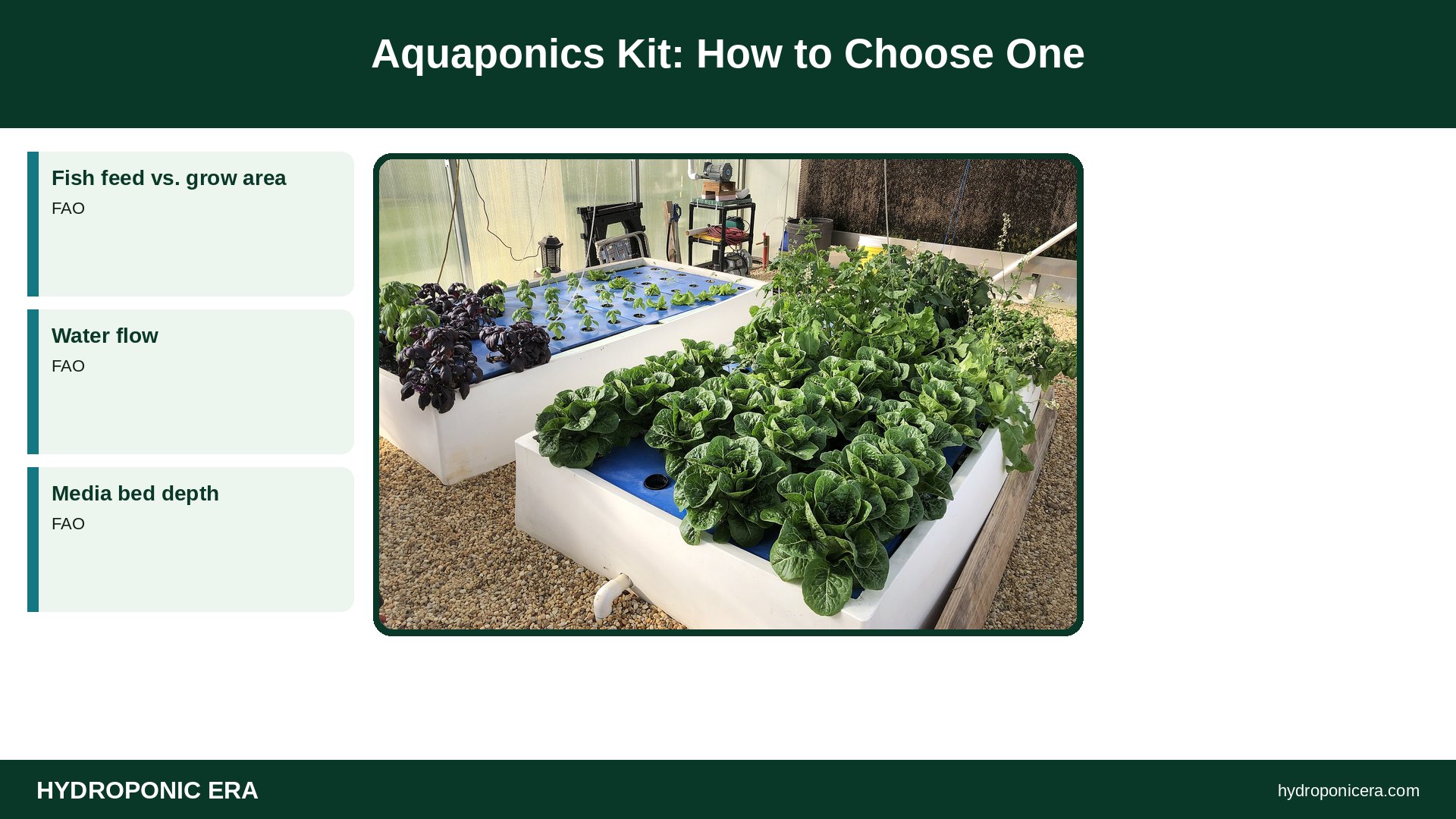
Types of Aquaponics Kits
- Desktop and aquarium-top kits (about 3–10 gallons (11–38 L)): a small tank with a grow tray on top. Good for kids, classrooms and herbs. Expect small harvests. See aquarium aquaponics.
- Media bed kits: a tank plus a gravel or expanded clay bed that also acts as the biofilter. The FAO calls media beds the most popular design for small-scale growers because they’re simple and forgiving. See aquaponics media beds.
- Raft (DWC) kits: plants float on foam rafts over a trough. Great for lettuce, but they need separate solids filtration. See aquaponics raft systems.
- Vertical tower kits: save floor space for leafy greens and herbs. See aquaponics vertical towers.
How to Size an Aquaponics Kit

The FAO’s feed rate ratio is the simplest way to check whether an aquaponics kit is balanced. It ties the fish to the plants through the amount of feed going in each day. For leafy greens, plan on about 40–50 grams of fish feed per square meter of grow bed per day (about 3.7–4.6 g per square foot). Fruiting crops like tomatoes need 50–80 grams per square meter.
Here’s a quick example. A kit with a 2 x 4 foot (61 x 122 cm) grow bed has about 8 square feet (0.74 m²). For lettuce and herbs, that bed can use roughly 30–37 grams of feed per day. If your fish eat about 1–2% of their body weight per day, that’s very roughly 3–7 lb (1.5–3.7 kg) of fish. A kit that pairs a tiny bed with a huge tank, or the reverse, will be hard to balance. For a deeper guide, see aquaponics fish-to-plant ratio.
Parts Every Good Aquaponics Kit Should Include
- Fish tank: food-safe, UV-resistant and opaque. The FAO warns that light on the water causes algae, so tanks should be shaded or covered.
- Grow bed or rafts with the right depth for your crops. The FAO recommends about 12 inches (30 cm) of media for big fruiting plants.
- Water pump: the FAO suggests cycling the full water volume about twice per hour in densely stocked systems, or once per hour at low stocking. See aquaponics pump size.
- Air pump and air stones: fish need dissolved oxygen above 5 mg/L. See aquaponics air pumps.
- Biofilter and solids filter: built into media beds; needed separately for rafts and towers.
- Plumbing and a bell siphon for flood-and-drain media beds.
What Most Kits Leave Out
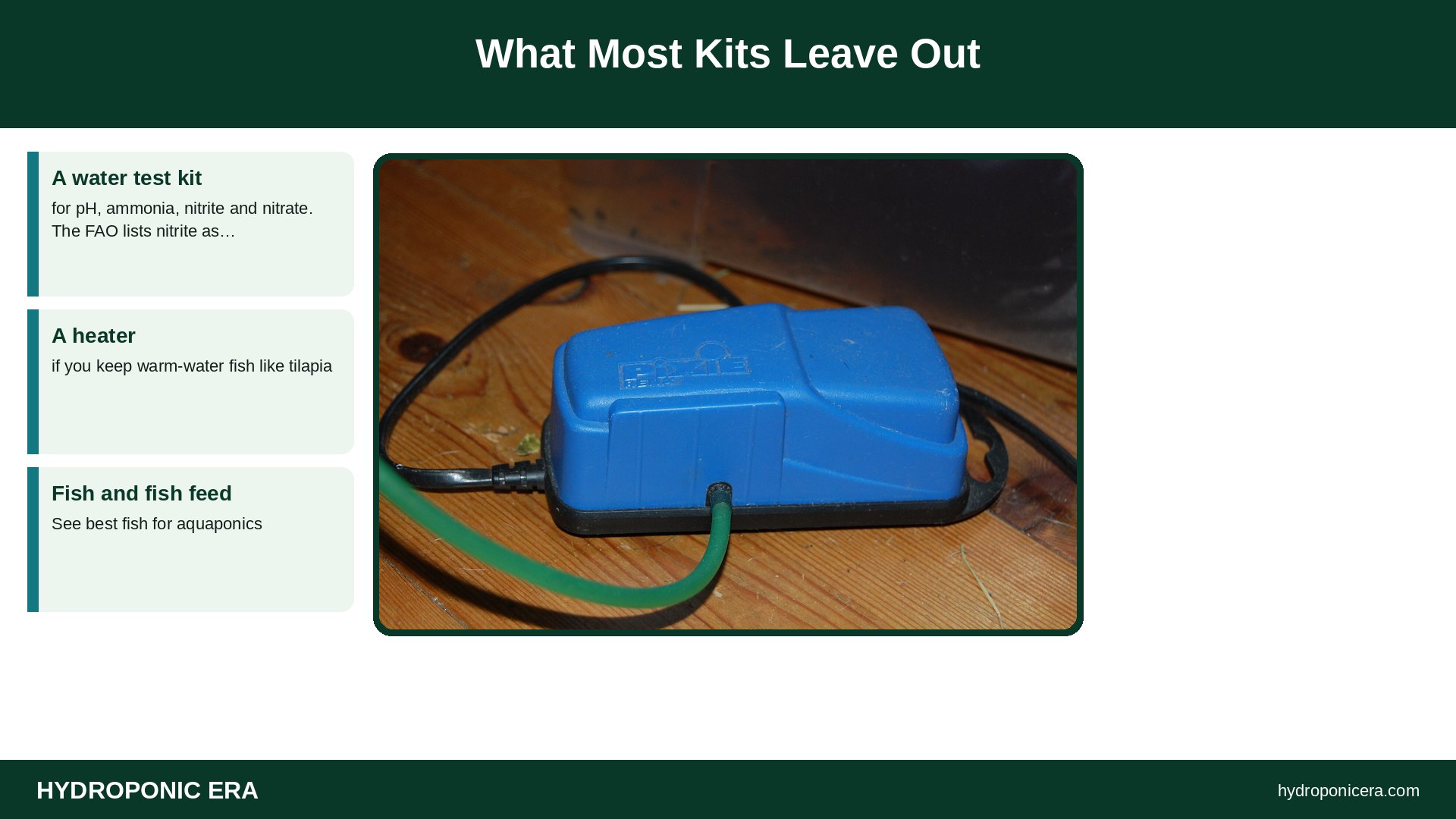
Even a complete aquaponics kit usually leaves you to buy a few extras:
- A water test kit for pH, ammonia, nitrite and nitrate. The FAO lists nitrite as harmful to fish at levels as low as 0.25 mg/L.
- A heater if you keep warm-water fish like tilapia.
- Fish and fish feed. See best fish for aquaponics.
- Grow lights for indoor setups.
- A battery air pump or backup plan for power outages.
Aquaponics Kit vs. DIY
An aquaponics kit saves time and guesswork on plumbing, and parts should fit together the first time. DIY systems built from tanks, totes or IBC containers can cost less and grow larger, but you must source safe materials and design the flow yourself. The FAO recommends UV-resistant plastic, and you should never reuse a container that held toxic chemicals. Compare options in DIY indoor aquaponics systems, IBC aquaponics and aquaponics cost.
Setting Up Your Aquaponics Kit
- Place it level on a floor or stand that can carry the weight. Water weighs about 8.3 lb (3.8 kg) per gallon.
- Fill and run the water for a day to check for leaks.
- Dechlorinate tap water before adding fish.
- Cycle the system to grow nitrifying bacteria. The FAO says this usually takes 3–5 weeks. See aquaponics cycling.
- Add fish slowly and feed lightly at first.
- Plant hardy greens first, such as lettuce, basil or mint.
- Test water weekly and keep pH around 6–7. See aquaponics pH.
Where to Put Your Aquaponics Kit
Indoors, a kit needs a level, waterproof floor, a nearby outlet with a GFCI, and enough light for the plants. Outdoors or in a greenhouse, the FAO suggests shading the fish tank and filters so sunlight doesn’t reach the water, and keeping water in the 64–86°F (18–30°C) range that suits most aquaponics. That often means a heater in winter and shade in summer. See aquaponics water temperature.
Aquaponics Kit Red Flags When Shopping
- No stated tank volume or grow bed size.
- No air pump, or a pump with no flow rating.
- Clear plastic tanks that let light reach the water.
- Claims of “no maintenance” or “no water testing.”
- Very small tanks marketed for many large fish.
New to aquaponics? Start with aquaponics for beginners.
FAQs
What size aquaponics kit should a beginner buy?
A medium kit of about 50–100 gallons (190–380 L) is more stable than a tiny desktop unit.
Are desktop aquaponics kits worth it?
Yes for learning and herbs, but harvests are small.
What fish work best in an aquaponics kit?
Goldfish and tilapia are common; match fish to your water temperature.
How long until an aquaponics kit can harvest?
Plan on 3–5 weeks of cycling, then about a month for fast greens.
Do aquaponics kits need grow lights?
Indoor kits do, unless they sit in very bright light.
Can I add plants right away?
Add a few hardy plants during cycling, but most growth starts once nitrate builds.
Sources
- FAO Fisheries and Aquaculture Technical Paper 589 — Small-scale aquaponic food production: Integrated fish and plant farming
- Southern Regional Aquaculture Center, Publication 454 — Recirculating Aquaculture Tank Production Systems: Aquaponics
- Kentucky State University — Aquaponics Handbook
- Photo credits (Wikimedia Commons, edited with titles): Deepwater Aquaponics Floating Rafts Growing Lettuce, Basil and Arugula by Alabama Extension (CC0); AQUAPONIE by Hopeballa (CC BY-SA 4.0); Aquarium-air-pump by User:Corydoras-adolfoi (CC BY-SA 4.0); Fountain with goldfish in Jardí del Bisbe 03 by Kritzolina (CC BY-SA 4.0); Fish Feed Pellets by Narek75 (CC BY-SA 4.0)